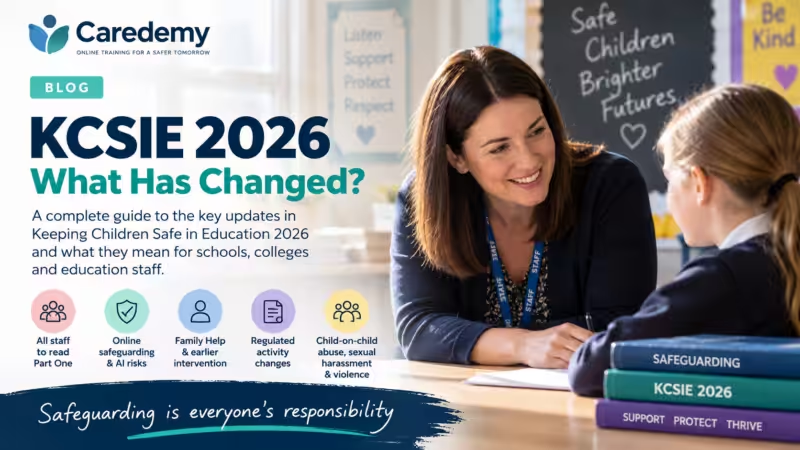
KCSIE 2026: What Has Changed in Keeping Children Safe in Education?
KCSIE 2026 Updates: What Schools and Colleges Need to Know
Keeping Children Safe in Education (KCSIE) 2026 came into force on 1 September 2026, introducing important changes to safeguarding expectations for schools and colleges in England.
The updated statutory guidance affects safeguarding responsibilities across education settings, from the information staff need to understand and the way concerns are identified and reported, through to online safeguarding, safer recruitment, child-on-child abuse and the role of the Designated Safeguarding Lead (DSL).
For schools and colleges, the new academic year therefore provides an important opportunity to review safeguarding policies, staff knowledge and training arrangements.
Caredemy has updated its Safeguarding Children in Schools and Colleges (Level 2) online course to reflect KCSIE 2026 and the safeguarding risks education staff are increasingly expected to understand.
This guide examines some of the most important KCSIE 2026 changes and what they mean in practice for schools, colleges and their staff.
What is Keeping Children Safe in Education (KCSIE)?
Keeping Children Safe in Education is statutory guidance issued by the Department for Education (DfE).
It applies to schools and colleges in England and sets out the legal duties they must follow to safeguard and promote the welfare of children and young people under the age of 18.
KCSIE is relevant across the education workforce, including teachers, teaching assistants, support and pastoral staff, school leaders, governors, proprietors and others working within schools and colleges.
A central principle remains that:
Safeguarding is everyone’s responsibility.
Staff need to be able to recognise when something may be wrong, understand their organisation’s safeguarding procedures and know how to respond appropriately.
This does not mean that individual members of staff are expected to investigate suspected abuse themselves.
Instead, effective safeguarding depends on staff recognising concerns, acting promptly, recording information appropriately and following the school’s or college’s reporting and escalation procedures.
When did KCSIE 2026 come into force?
The Department for Education published the 2026 edition ahead of the new academic year.
KCSIE 2026 came into force on 1 September 2026, replacing the previous 2025 guidance.
Schools and colleges should therefore ensure that safeguarding arrangements, policies and staff knowledge reflect the current guidance rather than relying on previous editions.
The changes are not simply an administrative update.
They reflect the changing safeguarding environment faced by children and education professionals, including developments relating to online harm, artificial intelligence, sexual imagery, exploitation, serious violence, attendance and multi-agency safeguarding.
What are the main KCSIE 2026 changes?
KCSIE 2026 contains a wide range of amendments. Some involve terminology and restructuring, while others have more direct implications for everyday safeguarding practice.
Important areas for education providers to consider include:
-
Part One now being relevant for all staff
-
greater clarity around early intervention and Family Help
-
recognising abuse, neglect, exploitation and overlapping harms
-
child-on-child abuse, harmful sexual behaviour and sexual violence
-
online safeguarding and emerging technology
-
AI-generated and digitally manipulated sexual imagery
-
filtering and monitoring
-
attendance and children absent from education
-
information sharing and safeguarding records
-
DSL arrangements and escalation
-
safer recruitment and changes concerning regulated activity
-
concerns and allegations relating to adults working with children
Schools should review the complete KCSIE 2026 guidance rather than treating any summary of the changes as a replacement for the statutory document.
1. All staff should now read Part One
One of the most immediately important changes concerns Part One of KCSIE.
Previously, KCSIE contained a shorter version of Part One in Annex A that could be used for certain staff who did not work directly with children.
That shorter route has been removed.
Under KCSIE 2026, governing bodies and proprietors should ensure that all staff, including staff who do not work directly with children, read Part One.
The Department for Education has also produced a Part One overview for staff. However, this is intended as a complementary quick-reference resource and does not replace reading Part One itself.
This is important for schools because safeguarding responsibilities do not stop with teaching and pastoral teams.
A safeguarding concern could potentially be noticed by someone working in administration, catering, premises management or another support role.
Schools should therefore consider whether their induction and annual safeguarding processes adequately demonstrate that the appropriate KCSIE information has been provided to all relevant staff.
2. A continued emphasis on safeguarding as everyone’s responsibility
Although this principle is not new, KCSIE 2026 continues to reinforce its practical importance.
Safeguarding is not solely the responsibility of the DSL, headteacher or safeguarding team.
Every member of staff has a role.
Staff should understand:
-
the safeguarding systems operating within their school or college
-
who the DSL and deputy DSL are
-
how to report a safeguarding concern
-
what to do if they receive a disclosure
-
when immediate action may be required
-
how information should be recorded
-
how concerns about adults should be raised
-
why professional curiosity matters
Safeguarding training should therefore go beyond asking staff to memorise categories of abuse.
People need to understand how safeguarding responsibilities translate into everyday situations.
3. Family Help and earlier intervention
KCSIE 2026 reflects developments in the wider safeguarding framework and provides greater clarity around support for children and families.
Staff need to understand the distinction between universal or community-based early help and the more targeted level of Family Help, alongside circumstances that may require referral to children’s social care.
This reinforces a fundamental principle of effective safeguarding:
Concerns should not have to reach crisis point before action is considered.
A child may need additional support long before a situation reaches the threshold for statutory intervention.
School and college staff are often well placed to notice changes because of their regular contact with children.
These might include:
-
deteriorating attendance
-
changes in behaviour
-
becoming withdrawn
-
sudden changes in peer relationships
-
deterioration in appearance or hygiene
-
unexplained injuries
-
changes in educational performance
-
increased anxiety
-
concerning online behaviour
-
disclosures or partial disclosures
-
signs of exploitation
-
changes in circumstances at home
No single indicator necessarily proves that abuse or neglect is taking place.
The important issue is that staff recognise potential concerns and know what to do with the information.
4. Recognising multiple and overlapping harms
Safeguarding concerns rarely fit neatly into isolated categories.
A child experiencing neglect might simultaneously be affected by domestic abuse, exploitation, mental health difficulties, school absence or online harm.
A young person being criminally exploited may also experience violence, coercion, sexual exploitation or threats towards their family.
Effective safeguarding therefore requires staff to consider the whole picture.
This is where professional curiosity becomes particularly important.
Rather than dismissing an incident as simply poor behaviour or an isolated event, staff should consider whether it could be part of a broader pattern of vulnerability or harm.
The question should not simply be:
“What has this child done?”
Staff may also need to consider:
“What could be happening to this child?”
5. Child-on-child abuse remains a major safeguarding issue
Schools and colleges should never dismiss harmful behaviour between children as simply:
“banter”
“part of growing up”
or
“boys being boys”.
Child-on-child abuse can take many forms.
It can include bullying, physical abuse, sexual harassment, sexual violence, abuse within intimate relationships, coercive behaviour and online abuse.
Staff should understand that the absence of a report does not necessarily mean that harmful behaviour is not occurring.
Children may be reluctant to disclose experiences because of embarrassment, fear of retaliation, uncertainty about whether they will be believed or concern about what will happen next.
A strong safeguarding culture therefore requires staff to recognise indicators and respond appropriately when concerns emerge.
6. Sexual violence, sexual harassment and consent
KCSIE 2026 continues to strengthen the way schools and colleges understand harmful sexual behaviour, harassment and sexual violence.
An important principle is that inappropriate sexual behaviour exists across a continuum.
What might initially appear to be sexualised language, harassment or inappropriate behaviour can form part of a wider pattern of harm.
Staff therefore need a practical understanding of:
-
sexual harassment
-
harmful sexual behaviour
-
sexual violence
-
consent
-
coercion
-
online sexual behaviour
-
image-based abuse
-
peer dynamics
-
power imbalances
The response should always be child-centred and consistent with the school’s safeguarding procedures.
7. Online safeguarding is now inseparable from safeguarding
For many children, there is little meaningful distinction between their “online life” and their “real life”.
Friendships, relationships, bullying, sexual behaviour, gaming, social interaction and communication can all move between digital and physical environments.
Online safeguarding therefore cannot be treated as a separate IT issue.
Schools should ensure staff recognise risks involving:
-
online bullying
-
grooming
-
sexual exploitation
-
criminal exploitation
-
inappropriate contact
-
harmful content
-
coercion
-
sexual imagery
-
scams and financial exploitation
-
radicalisation
-
harmful communities
-
manipulation
-
AI-generated content
The technology may change quickly, but the safeguarding principles remain consistent.
Recognise the concern.
Consider the child’s welfare.
Record relevant information.
Report it through the correct safeguarding route.
8. AI and deepfakes create new safeguarding challenges
One of the most important developments reflected in modern safeguarding practice is the growth of generative artificial intelligence.
AI tools can now create highly realistic images, audio and video.
This has created safeguarding risks that barely existed several years ago.
For example, a child may be targeted through a sexually explicit image that appears to depict them even though the original photograph was never taken.
Images may be:
-
digitally manipulated
-
generated using artificial intelligence
-
created using an existing photograph
-
altered to sexualise a child
-
shared between pupils
-
used for bullying or humiliation
-
used as part of coercion or sextortion
The fact that an image is artificially generated does not make the safeguarding concern artificial.
The emotional, reputational and psychological impact on a child can be very real.
Schools therefore need staff to understand that AI-generated sexual imagery and deepfakes can represent genuine safeguarding concerns requiring an appropriate response.
9. Sextortion and sexual imagery
Another growing online risk is sextortion.
This typically involves threatening or blackmailing someone using sexual images or supposed sexual material.
A perpetrator might threaten to send an image to friends, relatives, classmates or social media contacts unless the victim:
-
sends more images
-
pays money
-
performs sexual acts
-
continues communicating
-
meets another demand
Young people can be particularly vulnerable because fear and embarrassment can make the threat feel catastrophic.
Education staff need to recognise that a sudden change in behaviour, anxiety around a device, withdrawal or distress may sometimes be connected to online exploitation.
Again, staff are not expected to become digital investigators.
Their responsibility is to recognise concerns and follow safeguarding procedures.
10. Filtering and monitoring
Schools and colleges have long had responsibilities around appropriate filtering and monitoring of their IT systems.
The continuing development of technology makes these arrangements increasingly important.
Effective filtering and monitoring should help schools reduce children’s exposure to harmful material while identifying activity that may indicate a safeguarding concern.
However, technology should support safeguarding rather than replace professional judgement.
A filtering system cannot substitute for:
-
effective safeguarding leadership
-
staff awareness
-
appropriate supervision
-
online safety education
-
clear reporting arrangements
-
regular review of safeguarding risks
Schools should understand what their filtering and monitoring arrangements actually do rather than assuming that having a technical system automatically means online safeguarding risks have been addressed.
11. Attendance can be a safeguarding indicator
Attendance is not simply an educational performance issue.
Patterns of absence can sometimes provide important safeguarding information.
Repeated or unexplained absence may be associated with:
-
neglect
-
exploitation
-
domestic difficulties
-
mental health concerns
-
bullying
-
criminal exploitation
-
sexual exploitation
-
caring responsibilities
-
family instability
-
other vulnerabilities
Staff working with attendance information should therefore understand how attendance concerns interact with safeguarding procedures.
A child being absent from education can reduce the opportunities professionals have to observe their welfare and identify emerging concerns.
Attendance information should consequently form part of the wider safeguarding picture where appropriate.
12. Radicalisation and Prevent
Education staff continue to play an important role in identifying children who may be vulnerable to radicalisation.
Radicalisation does not always follow an obvious pathway.
Online platforms can expose young people to extremist narratives, conspiracy theories, misogynistic content and communities that gradually normalise harmful ideas.
Staff should understand their organisation’s Prevent procedures and know how concerns should be raised.
The purpose is not to label children because they hold unusual opinions.
It is to recognise vulnerability and identify situations where a young person may be at risk of manipulation, grooming or radicalisation.
13. Responding to a disclosure
Knowing how to respond when a child discloses abuse remains one of the most important practical safeguarding skills.
A poor initial response can discourage a child from continuing to seek help.
Staff should remain calm and listen carefully.
They should avoid:
-
expressing shock or disbelief
-
asking unnecessarily leading questions
-
promising confidentiality
-
confronting an alleged perpetrator
-
attempting to investigate the allegation themselves
The priority is to listen, reassure appropriately, record relevant information and follow the school’s safeguarding reporting procedures.
If a child is in immediate danger, urgent action may be required.
14. Recording safeguarding concerns properly
Good safeguarding depends on good information.
KCSIE 2026 reinforces the importance of appropriate safeguarding records.
Records should provide a clear account of the concern and the action taken.
This may include:
-
a summary of the concern
-
relevant facts
-
actions taken
-
decisions made
-
reasons for those decisions
-
referrals or escalation
-
outcomes where known
Staff should distinguish facts from assumptions or personal opinions.
Good records can become extremely important when multiple pieces of information need to be brought together to understand the full safeguarding picture.
An apparently minor concern recorded today could become highly significant when considered alongside information recorded weeks or months later.
15. Information sharing
Concerns about data protection should not prevent necessary safeguarding information from being shared.
Schools and colleges should have clear procedures explaining when and how safeguarding information is recorded and shared.
Staff should understand that protecting a child’s welfare may require relevant information to be shared with appropriate professionals.
Information sharing should be purposeful, proportionate and consistent with safeguarding procedures.
16. Changes affecting Designated Safeguarding Leads
The DSL remains central to safeguarding arrangements within schools and colleges.
KCSIE 2026 includes updates relevant to the DSL role, including expectations around availability and safeguarding information.
Schools should consider how safeguarding arrangements continue when the DSL is unavailable because of illness, leave or other circumstances.
There should be robust arrangements for safeguarding concerns to continue to be received and acted upon.
Safeguarding should never become dependent upon a single person being physically present.
17. Child protection files and transitions
The transfer of safeguarding information when children move between education settings is another important area.
Relevant safeguarding information can help the receiving school or college understand:
-
current concerns
-
relevant historical context
-
support already being provided
-
ongoing risks
-
agencies involved
-
actions that may still be required
Context is important.
Historic concerns should not automatically be treated as though they are current, but neither should relevant safeguarding history be lost.
Effective safeguarding records help provide continuity when children change settings.
18. Safer recruitment and regulated activity
KCSIE 2026 also contains important changes relating to safer recruitment and regulated activity.
A particularly significant development concerns the removal of the supervision exemption in relation to certain volunteer activity.
Schools and colleges should review volunteer roles and determine whether activities fall within the revised definition of regulated activity and whether appropriate DBS and barred-list checks are consequently required.
This is an area where schools should refer directly to current statutory guidance and applicable DBS requirements rather than relying on historic recruitment procedures.
Safer recruitment is an essential part of safeguarding because preventing unsuitable adults from gaining inappropriate access to children is just as important as responding effectively after concerns arise.
19. Concerns about adults working with children
Safeguarding systems must also allow concerns about adults to be raised appropriately.
This can include concerns involving:
-
employees
-
supply staff
-
trainee teachers
-
volunteers
-
contractors
-
other adults working within the setting
Staff need to understand the procedure for raising a concern and should not assume that apparently minor behaviour can simply be ignored.
Professional boundaries and appropriate conduct remain essential components of a strong safeguarding culture.
What does KCSIE 2026 mean for school safeguarding training?
The publication of updated statutory guidance should prompt schools and colleges to consider whether their staff training continues to reflect current safeguarding risks and expectations.
Simply having completed safeguarding training previously does not necessarily mean knowledge remains current.
Safeguarding changes because:
-
statutory guidance changes
-
legislation changes
-
technology changes
-
patterns of exploitation change
-
new online risks emerge
-
terminology evolves
-
local safeguarding arrangements change
Schools should therefore consider whether staff understand both established safeguarding principles and newer risks such as AI-generated imagery, deepfakes and sextortion.
Caredemy’s Safeguarding Children in Schools and Colleges course has been updated for KCSIE 2026
To support education professionals, Caredemy has comprehensively updated its Safeguarding Children in Schools and Colleges (Level 2) online training course.
The course is designed to provide practical safeguarding knowledge for staff who work with children and young people in education and who require safeguarding knowledge beyond basic awareness.
The updated course includes:
Safeguarding & Child Protection
Understanding safeguarding responsibilities and the wider framework protecting children.
KCSIE 2026: What Staff Need to Know
An introduction to the current statutory guidance and its implications for education professionals.
Your Safeguarding Responsibilities
Helping staff understand their individual role within the school’s wider safeguarding arrangements.
DSL, Family Help & Escalation
Understanding the DSL’s role, Family Help and appropriate safeguarding escalation.
Recognising Abuse & Neglect
Identifying indicators that may suggest a child is experiencing harm.
Multiple Harms & Professional Curiosity
Looking beyond isolated incidents and considering overlapping safeguarding risks.
Children Who May Need Additional Support
Recognising vulnerability and circumstances where children may require additional help.
Child-on-Child Abuse
Understanding that children can abuse other children and recognising different forms this can take.
Sexual Violence, Harassment & Consent
Exploring sexual harm, appropriate boundaries and safeguarding responses.
Child Sexual & Criminal Exploitation
Recognising grooming, coercion and exploitation.
Radicalisation & Prevent
Understanding vulnerability to radicalisation and safeguarding responsibilities under Prevent.
Attendance & Children Absent from Education
Recognising when absence and changes in attendance could form part of a safeguarding concern.
Online Safeguarding
Understanding how online environments interact with wider safeguarding risks.
Sexual Images, Sextortion, AI & Deepfakes
Exploring some of the rapidly evolving digital safeguarding risks affecting children and young people.
Filtering, Monitoring & Emerging Technology
Considering the role technology plays in creating and managing safeguarding risks.
Responding to a Disclosure
Practical guidance on how staff should respond when a child tells them something concerning.
Recording & Reporting Concerns
Understanding the importance of accurate and timely safeguarding records.
Information Sharing & Referrals
Understanding how appropriate information sharing supports effective safeguarding.
Concerns About Adults
Recognising and reporting concerns involving adults working with children.
Professional Boundaries
Reinforcing expectations for safe and appropriate professional relationships.
Safer Recruitment
Understanding how safer recruitment contributes to preventing harm.
KCSIE 2026: Regulated Activity Change
Introducing staff to the important 2026 changes affecting regulated activity.
Practical safeguarding scenarios
Safeguarding training should help people make better decisions rather than simply remember definitions.
For that reason, the updated Caredemy course includes practical safeguarding scenarios that encourage learners to consider how they would respond to situations they might encounter within an education environment.
The aim is to help learners move from:
“I know what safeguarding means”
to:
“I recognise when something may be wrong, and I know what I should do next.”
That distinction matters.
Who should take the course?
Caredemy’s Safeguarding Children in Schools and Colleges (Level 2) course is suitable for education professionals who work directly with children and young people and require detailed safeguarding knowledge.
This can include:
-
teachers
-
teaching assistants
-
learning support assistants
-
pastoral staff
-
heads of year
-
school nurses
-
SEND staff
-
behaviour teams
-
attendance teams
-
tutors
-
sports and enrichment staff
-
technicians
-
other staff with regular contact with pupils or students
It can also be relevant to staff whose responsibilities may involve identifying concerns, receiving disclosures, recording safeguarding information or escalating concerns to the DSL.
Is completing an online course enough to meet KCSIE requirements?
Online safeguarding training can form an important part of a school’s safeguarding training arrangements, but it should not be viewed in isolation.
Training should complement the school’s or college’s own:
-
child protection policy
-
safeguarding procedures
-
staff code of conduct
-
DSL arrangements
-
local referral pathways
-
filtering and monitoring arrangements
-
safeguarding updates and briefings
Staff must understand how safeguarding actually operates within their own setting.
A course can build knowledge, but organisations still need effective policies, leadership, reporting systems and a strong safeguarding culture.
KCSIE 2026 checklist for schools and colleges
Following the introduction of KCSIE 2026, schools and colleges may wish to check that they have:
-
reviewed the full KCSIE 2026 guidance
-
updated safeguarding and child protection policies where necessary
-
ensured staff understand the changes relevant to their role
-
made arrangements for all staff to read Part One
-
reviewed staff safeguarding training
-
updated induction materials
-
reviewed Family Help and escalation procedures
-
reviewed online safety arrangements
-
considered AI, deepfake and image-based safeguarding risks
-
reviewed filtering and monitoring arrangements
-
checked procedures concerning attendance-related safeguarding concerns
-
reviewed safeguarding recording and information-sharing arrangements
-
checked DSL and deputy DSL cover arrangements
-
reviewed safer recruitment procedures
-
considered the changes to regulated activity and volunteer roles
-
updated procedures for concerns about adults
-
retained appropriate evidence of staff safeguarding training
This should form part of an ongoing safeguarding process rather than a one-off September exercise.
Safeguarding training should evolve with the risks facing children
Perhaps the most important message from KCSIE 2026 is that effective safeguarding cannot remain static.
The fundamental principles remain familiar.
Listen to children.
Recognise signs of harm.
Act on concerns.
Share relevant information.
Follow safeguarding procedures.
Keep the child’s welfare at the centre of decision-making.
But the environment in which those principles operate continues to change.
Artificial intelligence can create an abusive image that never existed as a photograph.
Exploitation can begin through an online conversation.
Bullying can follow a child from the classroom to their bedroom through a mobile phone.
A pattern of absence may reveal vulnerabilities that would otherwise remain hidden.
A series of apparently minor concerns may collectively reveal something much more serious.
Safeguarding training therefore needs to connect established safeguarding principles with the situations staff are encountering now.
Update your safeguarding knowledge for KCSIE 2026
The Caredemy Safeguarding Children in Schools and Colleges (Level 2) course has been updated to reflect KCSIE 2026 and current safeguarding issues affecting education settings.
The course is CPD accredited, delivered online and includes an instant digital certificate on successful completion.
It covers safeguarding responsibilities, abuse and neglect, Family Help, professional curiosity, child-on-child abuse, sexual violence and harassment, exploitation, Prevent, attendance, online safeguarding, sextortion, AI and deepfakes, disclosures, recording, information sharing, safer recruitment and the KCSIE 2026 regulated-activity changes.
View the updated Caredemy Safeguarding Children in Schools and Colleges (Level 2) course
Important note
This article provides general information about safeguarding and KCSIE 2026 and should not be treated as a substitute for the Department for Education’s statutory guidance. Schools and colleges should refer to the current version of Keeping Children Safe in Education and their own safeguarding policies, local safeguarding arrangements and professional advice where appropriate.