What Recruiters Need Before Sending Healthcare Staff to Clients
Keeping Healthcare Placements Compliant
For healthcare recruitment agencies, filling a vacancy is only part of the job. Before a healthcare worker is sent to a client, recruiters need confidence that the individual has been properly identified, appropriately vetted, legally able to work and suitably trained for the role.
This is where healthcare agency compliance becomes essential.
A strong compliance process protects patients, service users, healthcare workers, clients and the recruitment agency itself. It also gives clients confidence that the people being supplied have undergone the checks and preparation expected of a professional healthcare staffing provider.
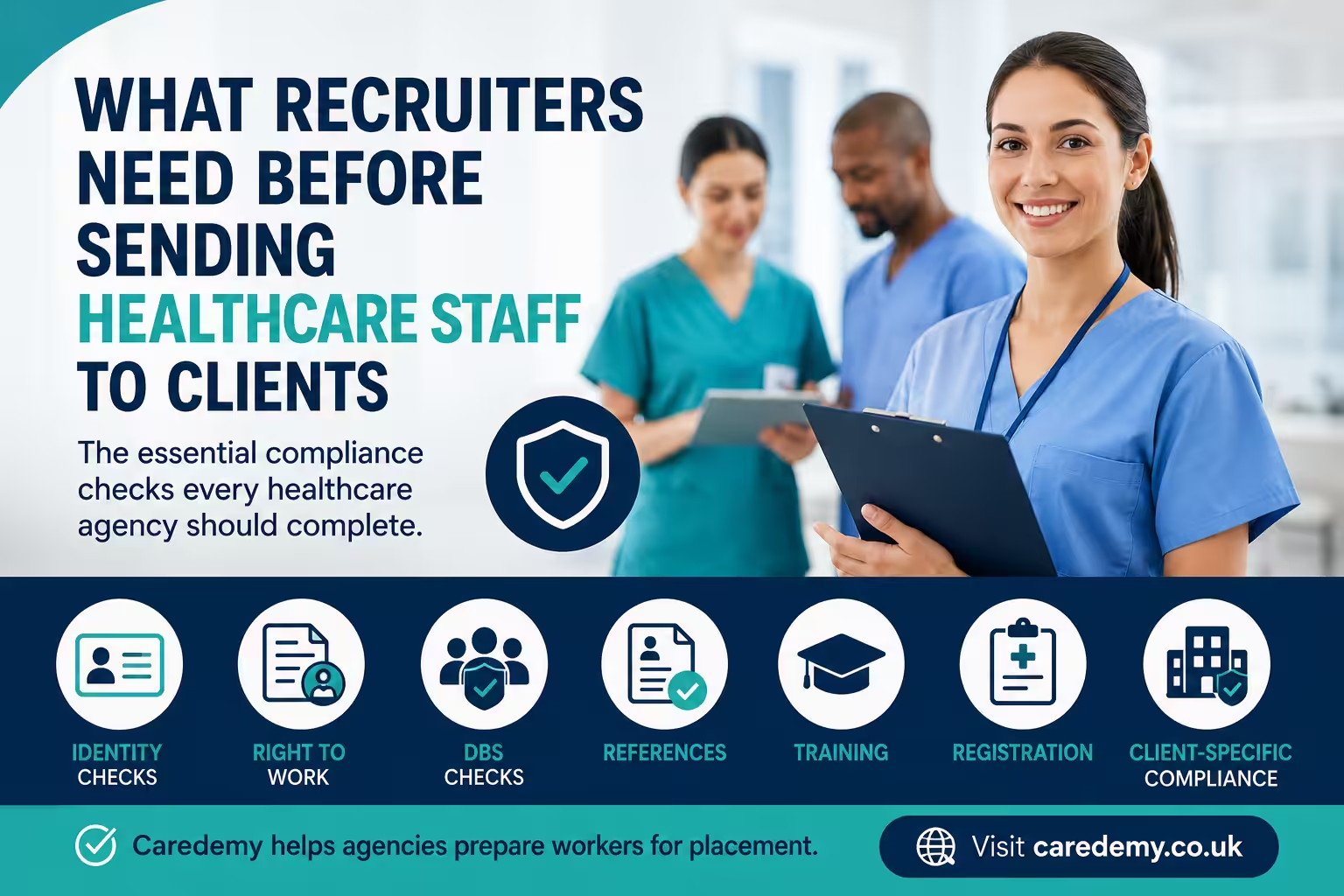
From identity checks and right to work verification to DBS checks, references, training and professional registration, there are several important areas recruiters should consider before placing a worker.
This guide explores the key checks healthcare recruiters should have in place before sending staff to clients.
Important: Compliance requirements can vary depending on the worker’s role, the type of service, the client, the regulator involved and the location of the work. Agencies should always check the specific legal and contractual requirements that apply to each placement.
Why healthcare agency compliance matters
Healthcare recruitment is different from many other forms of temporary staffing.
A worker may be entering a care home, hospital, supported living service, clinic, nursing home or a person’s own home. They may be working with older people, people with disabilities, children or individuals with complex healthcare needs.
Clients therefore need more than a CV and confirmation that someone is available for a shift.
They need assurance that the worker is:
- The person they claim to be
- Legally entitled to work in the UK
- Appropriately checked for the role
- Suitably qualified or registered where required
- Properly referenced
- Trained for the duties they will perform
- Aware of safeguarding and professional responsibilities
- Suitable for the particular client and environment
- Supported by accurate and up-to-date compliance records
A good compliance process should also make it easy for recruiters to demonstrate what checks have been completed and when.
1. Identity checks
Identity verification should be one of the foundations of the recruitment process.
Before placing a healthcare worker with a client, the agency should establish that the applicant is genuinely who they claim to be and that the identity information held on their recruitment records is accurate.
Depending on the circumstances, this can include checking appropriate identity documents and confirming information such as:
- Full name
- Date of birth
- Current address
- Previous names, where relevant
- Photograph and identifying information
- Supporting documentation required for other checks
Identity checks are particularly important because they underpin several other parts of the compliance process.
For example, a DBS application, right to work check and professional registration check all need to relate to the correct individual.
The Nursing and Midwifery Council’s employer guidance recommends checking proof of identity and address as part of background checks for nurses and midwives.
Keep records consistently
Recruiters should have a clear process for recording what was checked, when it was checked and who completed the check.
A consistent approach makes it much easier to demonstrate compliance during an internal review, client audit or regulatory inspection.
2. Right to Work checks
A healthcare worker may be highly qualified and experienced, but they still need the appropriate right to work in the UK before they are employed.
The UK Government states that employers must check that a job applicant is allowed to work in the UK before employing them.
Right to work checks can involve:
- Checking original documents where applicable
- Using the Home Office online right to work service
- Checking a worker’s share code where applicable
- Using an approved identity service provider in circumstances where this is permitted
- Carrying out follow-up checks where a worker has a time-limited right to work
The GOV.UK employer’s guide to right to work checks explains the current process and how employers can establish a statutory excuse against a civil penalty.
Don’t make assumptions
Recruiters should not assume that someone has the right to work simply because they have worked in the UK previously.
Immigration status can change, and some workers may have restrictions on the type of work they can undertake or the amount of work they can do.
Right to work checks should therefore form part of the agency’s formal onboarding and compliance process.
Recruiters should also make sure their procedures are applied consistently and without discrimination. The Home Office’s guidance makes clear that employers should not make assumptions about a person’s immigration status based on factors such as nationality, ethnicity, accent or surname.
3. DBS checks
For many healthcare and social care roles, DBS checking is a critical part of safer recruitment.
However, the level of DBS check required depends on the role and the activities the worker will carry out.
DBS checks can include:
- Basic checks
- Standard checks
- Enhanced checks
- Enhanced checks with a Children’s Barred List and/or Adults’ Barred List check where the eligibility criteria are met
The GOV.UK DBS eligibility guidance explains that the type of work a person will undertake determines the level of check they may be eligible for.
For example, current DBS guidance states that certain healthcare professionals providing healthcare to adults as part of regulated activity may be eligible for an Enhanced DBS check with an Adults’ Barred List check.
Check the role, not just the job title
One important point for recruiters is that DBS eligibility is based on the duties and activities involved, rather than simply relying on a job title.
A change in responsibilities can affect which level of check is appropriate.
For this reason, recruiters should consider:
- What the worker will actually be doing
- Who they will be working with
- Whether they will work with adults or children
- Whether the work falls within regulated activity
- Whether the client has additional DBS requirements
The DBS provides an eligibility tool and detailed guidance to help organisations determine which type of check may apply.
Record DBS information carefully
Agencies should maintain clear records of DBS checks and any relevant information required for their compliance process.
Where a client has specific requirements around the age or status of a DBS certificate, recruiters should make sure these requirements are understood before a placement is confirmed.
4. References and employment history
References provide another important layer of assurance.
A CV tells you what a candidate says they have done. A reference helps verify their employment history and suitability.
For healthcare workers, references can be particularly important because recruiters need confidence that the person has the experience and competence required for the proposed placement.
For nurses and midwives, the NMC advises employers to obtain at least two professional references from the applicant’s last place of work as a nurse or midwife and to follow up references directly.
Recruiters should consider verifying:
- Previous employers
- Dates of employment
- Job titles and responsibilities
- Relevant healthcare experience
- Competence or suitability for the proposed role
- Reasons for leaving where appropriate
- Gaps in employment history
- Any information that may affect suitability for the placement
The NMC also advises employers to investigate employment gaps and not rely solely on written statements supplied by applicants.
Don’t treat references as a box-ticking exercise
A reference should contribute to the overall recruitment decision.
If a previous employer raises concerns about a worker’s conduct, competence or suitability, the agency should have a process for assessing and documenting what happens next.
This is particularly important when supplying staff to vulnerable people.
5. Training and competency
Recruitment compliance does not end once a worker has passed their background checks.
A healthcare worker also needs the appropriate knowledge and training for their role.
Depending on the worker and placement, this may include areas such as:
- Safeguarding adults
- Safeguarding children
- Infection prevention and control
- Moving and handling
- Basic life support
- Health and safety
- Fire safety
- Medication awareness
- Mental capacity
- Equality, diversity and human rights
- Person-centred care
- Dementia awareness
- Food hygiene
- First aid
- Communication
- Confidentiality and privacy
The exact training requirements should be based on the worker’s role, responsibilities, previous experience and the requirements of the client.
This is particularly important because training completion does not automatically demonstrate practical competence. Where a role requires practical assessment, supervised practice or competency sign-off, those requirements should be addressed separately.
Keep training records up to date
Recruiters should be able to quickly answer questions such as:
- What training has the worker completed?
- When was it completed?
- When does it expire or require renewal?
- Is it relevant to the placement?
- Does the client require any additional training?
- Has the worker completed any required refresher training?
A central training record or learner management system can make this significantly easier.
Caredemy’s staff training solutions provide online CPD-accredited training and a learner management system that can be used to monitor learner progress, certification and training records.
6. Professional registration
Where a healthcare worker belongs to a regulated profession, recruiters need to verify their professional registration before placing them into a role that requires that registration.
This is particularly important for professionals such as nurses, midwives and other regulated healthcare professionals.
For example, the NMC maintains a register showing who can practise as a nurse or midwife in the UK, as well as nursing associates in England.
Recruiters supplying registered nurses and midwives should use the NMC’s official registration information rather than relying solely on a worker’s own documents or a CV.
The NMC specifically advises employers to check registration directly and regularly.
Depending on the profession, other regulatory registers may also need to be checked.
Registration is not the same as competence
Professional registration is an important requirement, but it should not be viewed as the only evidence that someone is suitable for a placement.
Recruiters should also consider:
- Experience
- Skills
- Training
- Competencies
- References
- Recent employment history
- The specific requirements of the client
A worker may be registered but still lack the specific experience needed for a particular placement.
7. Client-specific compliance
One of the areas that can easily be overlooked is client-specific compliance.
A healthcare agency may have a robust standard recruitment process, but individual clients can have additional requirements.
For example, a care home may require particular training before a worker can undertake certain duties. A hospital or clinical setting may have its own induction requirements, competency assessments or occupational health processes.
A client may request evidence relating to:
- Specific mandatory training
- Additional specialist training
- Competency assessments
- Occupational health clearance
- Immunisation requirements
- Previous experience
- Professional registration
- DBS status
- References
- Local induction
- Site-specific policies
- Specific clinical competencies
This means healthcare agencies should avoid assuming that a worker who is “fully compliant” for one client is automatically compliant for every client.
Build a placement-specific check
A useful approach is to separate your compliance process into two stages:
Agency compliance
The checks every worker must meet before they can be considered for placements.
Client compliance
The additional checks required for a particular client, role or placement.
This approach can help recruiters identify gaps before the worker arrives at the client’s premises.
8. Don’t forget ongoing compliance
Healthcare agency compliance is not a one-time process.
Some information can change after a worker has been recruited.
For example:
- Right to work permission may expire
- Professional registration may change
- Training may require renewal
- DBS information may need to be monitored according to the agency’s procedures
- Contact details may change
- New qualifications may be obtained
- A worker’s role or responsibilities may change
- Client requirements may be updated
Agencies therefore need an ongoing system for monitoring compliance rather than simply checking documents during initial recruitment.
This is especially important for workers who undertake multiple assignments.
9. Make compliance easy to evidence
Having completed checks is one thing. Being able to demonstrate them quickly is another.
Imagine a client asks:
“Can you send us evidence that this worker has completed their safeguarding and moving and handling training?”
If the information is spread across emails, spreadsheets, paper files and different systems, responding may take considerable time.
A central compliance record makes the process much easier.
Ideally, recruiters should be able to see:
| Compliance area | What to record |
|---|---|
| Identity | Documents checked and verification date |
| Right to Work | Check completed, result and follow-up date where applicable |
| DBS | Level, date and relevant status information |
| References | Referees, dates and outcome |
| Training | Courses completed and renewal dates |
| Registration | Regulatory body and registration status |
| Competency | Relevant assessments or sign-offs |
| Client requirements | Additional checks completed |
| Placement | Client, role and placement dates |
This gives recruiters a clearer picture of whether a worker is genuinely ready for placement.
10. A practical pre-placement approach
Before sending a healthcare worker to a client, recruiters should ask:
Who is this worker?
Has their identity been verified and does their documentation match their recruitment records?
Can they legally work?
Has the appropriate right to work check been completed and recorded?
Are they appropriately vetted?
Has the correct DBS check been completed for the role and activities involved?
Can their experience be verified?
Have the necessary references been obtained and checked?
Are they trained?
Have they completed the training required for their role and the placement?
Are they registered where required?
Has professional registration been verified through the appropriate regulatory body?
Are they suitable for this particular client?
Have all additional client-specific requirements been completed?
Can we prove it?
Can the agency provide clear evidence of compliance if the client asks for it?
If the answer to all of these questions is yes, the agency is in a much stronger position to demonstrate that the worker has been appropriately prepared for placement.
Healthcare agency compliance is about more than paperwork
Compliance should not be treated simply as an administrative hurdle between recruitment and placement.
It is part of delivering safe, responsible healthcare staffing.
When agencies have effective compliance processes, recruiters can identify problems earlier, reduce delays, respond to client requests more quickly and give clients greater confidence in the workers they supply.
It also creates a better experience for healthcare workers.
Instead of repeatedly being asked for the same documents or training certificates, workers can have their information managed through a clear and organised process.
For agencies supplying large numbers of workers, this becomes even more important.
A structured compliance system can help recruitment teams manage onboarding, training, certification and renewal dates more efficiently.
How Caredemy can support healthcare agencies
Training is one of the most important parts of preparing healthcare workers for placement.
Caredemy helps agencies prepare workers for placement.
Caredemy provides a range of online CPD-accredited health and social care courses covering areas such as safeguarding, first aid, infection prevention, health and safety, medication, care skills and more.
Agencies can use the training platform to enrol workers, monitor progress and access training records and certificates. Caredemy also provides a learner management system designed to help organisations track learner progress, reporting and certification.
For agencies onboarding new workers, refresher training can also be an important part of maintaining an organised compliance programme.
Explore Caredemy’s online health and social care courses
For organisations that need multiple courses across their workforce, Caredemy also offers access to a broad range of care training courses through its subscription options.
Final thoughts
Healthcare recruitment agencies have an important responsibility to ensure workers are appropriately prepared before they are sent to clients.
A strong healthcare agency compliance process should bring together identity checks, right to work verification, DBS checks, references, training, professional registration and client-specific requirements.
The key is not simply completing each check individually. Agencies should have a clear system that shows what has been checked, when it was checked, whether anything needs renewing and whether the worker meets the requirements of the specific placement.
When compliance is organised from the beginning, recruiters can place staff with greater confidence and clients can have greater assurance that the workers they receive have been properly prepared.
Caredemy helps agencies prepare workers for placement.