What Every Registered Manager Should Track Monthly
A practical monthly compliance checklist for registered managers
For a registered manager, compliance is not something that should only be reviewed when a CQC inspection is approaching. Effective registered manager compliance depends on having regular oversight of the people, processes, records and risks that affect the quality and safety of care.
A monthly compliance review gives registered managers an opportunity to identify problems early, take corrective action and demonstrate that the service is being actively managed.
The Care Quality Commission (CQC) expects providers to demonstrate safe, effective, caring, responsive and well-led services. Its assessment framework includes quality statements covering areas such as safe and effective staffing, learning culture, safeguarding, governance, management and continuous improvement.
That means compliance should be viewed as an ongoing management process rather than a box-ticking exercise.
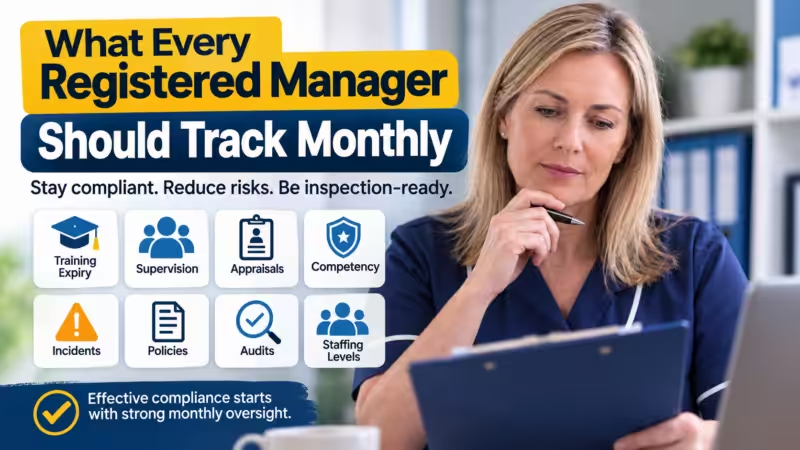
A useful monthly review should cover at least eight key areas:
- Training expiry
- Supervision
- Appraisals
- Competency
- Incidents
- Policies
- Audits
- Staffing levels
By monitoring these areas consistently, registered managers can create a clearer picture of what is working well, where risks are emerging and what needs attention.
Why Monthly Compliance Checks Matter
Care services generate a significant amount of information every month.
New staff may join the team. Existing staff may complete training. Certificates may approach their renewal dates. Incidents may occur. Policies may need reviewing. Staffing levels may change. Audits may identify areas for improvement.
If these records are reviewed individually and only when there is a problem, important connections can easily be missed.
A monthly compliance review brings these areas together.
For example, a training record might show that an employee has completed moving and handling training. However, a competency assessment may reveal that they need additional practical support.
Similarly, staffing records might show that there are enough employees scheduled for a particular shift, while a review of the skill mix may identify that the service does not have enough appropriately skilled staff available.
CQC’s guidance on safe and effective staffing specifically highlights staffing levels and skill mix, training, competency, supervision, appraisal and staff development.
This is why registered manager compliance should focus on evidence of effective management, not simply whether individual documents exist.
1. Training Expiry Dates
Training is one of the most important areas for a registered manager to monitor.
It is not enough to know that employees have completed training. Managers also need to know when training was completed, when refresher training is due and whether any employees have outstanding requirements.
A monthly training review should identify:
- Training completed during the month
- Training due to expire
- Training already expired
- Staff with overdue refresher training
- New starters requiring mandatory training
- Staff who have changed roles
- Role-specific training requirements
- Specialist training linked to the needs of people using the service
- Outstanding competency assessments
A good training matrix should make these details easy to identify.
Rather than discovering an expired certificate during an inspection, a manager should ideally know about it weeks or months beforehand.
This allows refresher training to be scheduled before the expiry date and reduces the risk of compliance gaps.
Caredemy’s guidance on training evidence highlights the importance of completion records, certificates, expiry dates, competency assessments, supervision and appraisal records as part of a wider evidence base.
You can also read our guide to CQC training requirements for care homes for more information.
What should a monthly training check ask?
A registered manager should be able to answer:
Which staff have training expiring in the next 30, 60 or 90 days?
Which employees have overdue training?
Are new starters completing the training appropriate to their roles?
Does the training completed match the needs of the service?
Is there evidence that training is being applied in practice?
This last question is particularly important. Training completion alone does not necessarily demonstrate competence.
2. Staff Supervision
Supervision should be a regular part of managing and supporting the workforce.
Skills for Care describes supervision as a process in which managers meet regularly with staff to review their work, provide support, monitor performance and identify learning and development opportunities.
Monthly compliance monitoring should therefore include a review of supervision records.
Managers should check:
- Which staff have received supervision
- Which supervisions are overdue
- Whether agreed actions have been completed
- Whether staff concerns have been followed up
- Whether learning and development needs have been identified
- Whether performance concerns are being addressed
- Whether wellbeing issues have been appropriately discussed
- Whether supervision is meaningful rather than simply recorded
A supervision record should tell a story.
For example, if a member of staff has struggled with a particular area of practice, the record should demonstrate that the issue was identified, discussed and followed up.
The next supervision can then review whether the situation has improved.
This creates a continuous management cycle:
Identify → Discuss → Support → Act → Review
That is much more valuable than simply recording that a meeting took place.
For more information, registered managers can also use the Skills for Care guidance on supervision.
3. Staff Appraisals
Supervision and appraisal are related, but they are not the same thing.
Supervision provides regular opportunities to discuss current performance, support and development.
An appraisal generally provides a broader review of an employee’s performance, achievements, objectives and future development.
A monthly registered manager compliance check should therefore include an overview of appraisal completion.
Consider tracking:
- Appraisal due dates
- Completed appraisals
- Overdue appraisals
- Objectives agreed
- Development needs
- Performance concerns
- Training requirements
- Progress against previous objectives
Appraisals can also help managers connect individual development with organisational priorities.
For example, if a service has identified medicines management as an area requiring improvement, managers may identify relevant training or competency development during staff reviews.
CQC’s safe and effective staffing quality statement specifically refers to staff receiving appropriate support, supervision and appraisal, alongside opportunities to develop.
4. Competency
One of the most important distinctions in care compliance is the difference between training and competence.
Completing an online course demonstrates that a person has undertaken learning and assessment. It does not automatically prove that they can safely apply that knowledge in the workplace.
Competency may need to be demonstrated through:
- Practical assessments
- Observations
- Competency sign-offs
- Supervision
- Spot checks
- Workplace assessments
- Role-specific assessments
- Medication competency assessments
- Moving and handling assessments
- Care documentation reviews
For example, a staff member may have completed moving and handling training but still require a practical assessment to confirm that they can apply the techniques safely.
Likewise, completing medication training does not necessarily mean that a member of staff is competent to administer medication without further assessment.
Monthly competency monitoring should therefore ask:
Which competencies are due for review?
Which staff require reassessment?
Have any incidents highlighted a potential competency issue?
Have supervision meetings identified additional training or support needs?
Are competency records complete and up to date?
This approach helps connect learning with real-world practice.
CQC’s assessment framework identifies learning, development and competency as part of safe and effective staffing.
5. Incidents and Learning
Incidents should not simply be recorded and closed.
They should be reviewed for patterns, causes and opportunities for improvement.
A monthly incident review can help a registered manager identify:
- The number and type of incidents
- Serious incidents
- Medication incidents
- Falls
- Safeguarding concerns
- Accidents
- Near misses
- Recurring incidents
- Staff-related issues
- Environmental risks
- Actions taken
- Outstanding investigations
- Lessons learned
The key question should not only be:
“What happened?”
It should also be:
“What have we learned, and what have we changed?”
CQC’s learning culture quality statement emphasises openness, reporting and investigation of safety events, together with learning and improvement following incidents and complaints.
A monthly incident review can therefore become an important part of quality improvement.
For example, if several incidents involve the same location, time of day or type of activity, the manager may need to investigate whether there is an underlying risk.
If several incidents involve the same procedure, additional training or competency assessment may be appropriate.
This is where incident monitoring connects directly with training, supervision, competency and audits.
6. Policies and Procedures
Policies should not sit in a folder and only be opened when something goes wrong.
Registered managers should know which policies are due for review and whether changes in legislation, regulation, guidance or organisational practice require updates.
A monthly policy review can include:
- Policies due for review
- Recently updated policies
- Changes in legislation
- Changes in CQC guidance
- Staff awareness of important policy changes
- Evidence that updated procedures have been communicated
- Training requirements arising from policy changes
- Outstanding policy actions
It is also useful to ask whether staff actually understand the policies that affect their roles.
For example, updating a safeguarding policy is only part of the process. Staff may also need to understand what has changed and what they are expected to do differently.
This creates a useful compliance chain:
Policy → Communication → Training → Competency → Monitoring
If one part of that chain is missing, the organisation may have a policy on paper without demonstrating effective implementation.
7. Audits and Quality Assurance
Audits provide evidence that the service is monitoring its own performance.
The exact audits required will depend on the type of service, but a monthly compliance programme may include areas such as:
- Medication
- Care plans
- Infection prevention and control
- Health and safety
- Safeguarding
- Training
- Staffing
- Documentation
- Complaints
- Incidents
- Mental Capacity Act requirements
- Deprivation of Liberty Safeguards, where applicable
- Equipment
- Environmental safety
The purpose of an audit should not simply be to produce a score.
A useful audit identifies:
- What is working well?
- What is not working?
- What action is required?
- Who is responsible?
- When will the action be completed?
- Has the action been completed?
- Did the improvement actually work?
This creates a continuous improvement cycle.
CQC’s assessment framework places significant emphasis on evidence, processes, learning and improvement. Its current framework continues to assess services through five key questions: safe, effective, caring, responsive and well-led.
A strong audit programme can therefore help registered managers demonstrate that quality is being actively monitored rather than assumed.
8. Staffing Levels and Skill Mix
Staffing levels should be reviewed regularly because having enough people on a rota does not automatically mean that a service has the right staffing arrangements.
Managers should consider:
- Planned staffing levels
- Actual staffing levels
- Vacancies
- Sickness
- Annual leave
- Agency usage
- Bank staff
- Overtime
- Staff turnover
- Skill mix
- Experience levels
- Competency
- Service user dependency
- Changes in people’s needs
- Staffing pressures and trends
For example, a service may technically have the required number of employees on duty, but if several experienced staff are absent and the shift relies heavily on new or agency workers, the manager may need to consider whether additional support or supervision is required.
CQC states that safe and effective staffing includes appropriate staffing levels and skill mix, alongside suitably qualified, skilled and experienced staff.
Staffing should therefore be viewed in terms of quality as well as quantity.
How These Eight Areas Work Together
One of the biggest mistakes managers can make is treating compliance areas as separate boxes.
In reality, they are connected.
Consider this example:
A monthly incident review identifies an increase in medication errors.
The registered manager investigates and discovers that several staff members are struggling with a particular medication procedure.
This may lead to:
Incident review → Supervision → Additional training → Competency assessment → Audit → Follow-up
The manager then monitors whether medication errors decrease.
This demonstrates a much stronger approach to registered manager compliance than simply recording the original incidents.
The same principle applies across the service.
An increase in falls may lead to a review of staffing, training and care planning.
An increase in complaints may lead to policy review, supervision and additional staff development.
Expired training may lead to refresher training and competency reassessment.
A staffing shortage may lead to changes in recruitment, induction and workforce planning.
The most effective managers look for these connections.
A Simple Monthly Registered Manager Compliance Checklist
A monthly compliance review can be structured around a simple checklist.
| Area | What to Check | Action |
|---|---|---|
| Training | Expired and upcoming training | Book refresher training |
| Supervision | Overdue or incomplete sessions | Schedule supervision |
| Appraisals | Upcoming and overdue appraisals | Complete or schedule reviews |
| Competency | Outstanding assessments | Arrange observations/sign-offs |
| Incidents | Trends, investigations and actions | Review causes and learning |
| Policies | Policies due for review | Update and communicate changes |
| Audits | Completed audits and outstanding actions | Create and track action plans |
| Staffing | Staffing levels, absence and skill mix | Address gaps and risks |
This checklist can be incorporated into a wider monthly management meeting or compliance dashboard.
The important point is consistency.
A checklist that is reviewed every month is far more useful than a detailed compliance document that is only opened before an inspection.
What Evidence Should a Registered Manager Keep?
A strong compliance system should make it easy to demonstrate what has been done.
Depending on the service, useful evidence may include:
- Staff training records
- Training certificates
- Training matrix
- Expiry and renewal records
- Supervision records
- Appraisal records
- Competency assessments
- Spot-check records
- Incident reports
- Incident investigation records
- Action plans
- Audit reports
- Policy review records
- Staff meeting records
- Staffing records
- Recruitment and induction records
- Quality improvement plans
The goal is not to create paperwork for its own sake.
The goal is to create an accurate record of how the service is managed, how risks are identified and how improvements are made.
Caredemy’s guidance on preparing for a CQC inspection also highlights the value of organised training records, competency assessments, induction documentation, refresher schedules and evidence that learning is applied in practice.
Using Technology to Improve Registered Manager Compliance
Managing all these records manually can become difficult, particularly for larger care homes, domiciliary care providers and organisations with multiple locations.
Spreadsheets can be useful, but they may require significant manual administration.
A digital learning and compliance system can make it easier to see:
- Who has completed training
- Who has outstanding training
- Which certificates are approaching expiry
- Individual learner progress
- Training compliance across teams
- Certification records
- Audit information
- Areas requiring attention
Caredemy provides visibility over staff training compliance.
Its online learning platform includes learner progress monitoring, certification tracking, reporting and compliance tools designed to help organisations manage workforce training.
You can explore Caredemy’s compliance training courses or view the range of CQC-compliant online courses.
For managers looking specifically at workforce development, Caredemy also offers care management training.
Registered Manager Compliance Should Be Continuous
Compliance should not be something that happens immediately before a CQC inspection.
The strongest approach is to build compliance into the normal management rhythm of the service.
A monthly review gives registered managers the opportunity to identify small issues before they become significant problems.
It also creates a clearer evidence trail showing that the service is:
- Monitoring risks
- Supporting staff
- Reviewing competence
- Maintaining training
- Learning from incidents
- Reviewing policies
- Completing audits
- Monitoring staffing
- Taking corrective action
- Driving continuous improvement
This is particularly important because CQC’s assessment framework considers not only whether systems exist, but how providers deliver safe, effective and well-led care.
Ultimately, good compliance management is about more than preparing for an inspection.
It is about creating a service where staff have the right knowledge and skills, risks are identified early, concerns are acted upon and improvements are sustained.
Final Monthly Checklist for Registered Managers
Before completing your monthly compliance review, ask:
Training
- Are all mandatory training records up to date?
- Are any certificates expiring soon?
- Are refresher courses booked?
- Are new starters completing required training?
Supervision
- Has every staff member received supervision as required?
- Are there any overdue sessions?
- Have concerns and development needs been followed up?
Appraisals
- Are appraisals up to date?
- Are staff objectives being reviewed?
- Have development needs been identified?
Competency
- Are staff competent to perform their roles?
- Are practical assessments and competency sign-offs complete?
- Have incidents or supervision identified competency concerns?
Incidents
- Have all incidents been reviewed?
- Are there recurring patterns?
- Have lessons been identified and acted upon?
Policies
- Are policies up to date?
- Are any reviews overdue?
- Have important policy changes been communicated to staff?
Audits
- Have scheduled audits been completed?
- Are action plans being followed?
- Have previous issues improved?
Staffing
- Are staffing levels appropriate?
- Is the skill mix suitable?
- Are absence, vacancies or agency use creating additional risks?
If these questions are reviewed consistently, registered managers can develop a much clearer understanding of the overall compliance position of their service.
Need Help Managing Staff Training Compliance?
Keeping track of training, certificates, expiry dates and staff progress does not have to be a manual process.
Caredemy offers CPD-accredited online training for health and social care organisations, alongside tools that help managers monitor learner progress, certification and training compliance.
Caredemy provides visibility over staff training compliance.
Visit caredemy.co.uk to explore online training and compliance solutions for your organisation.