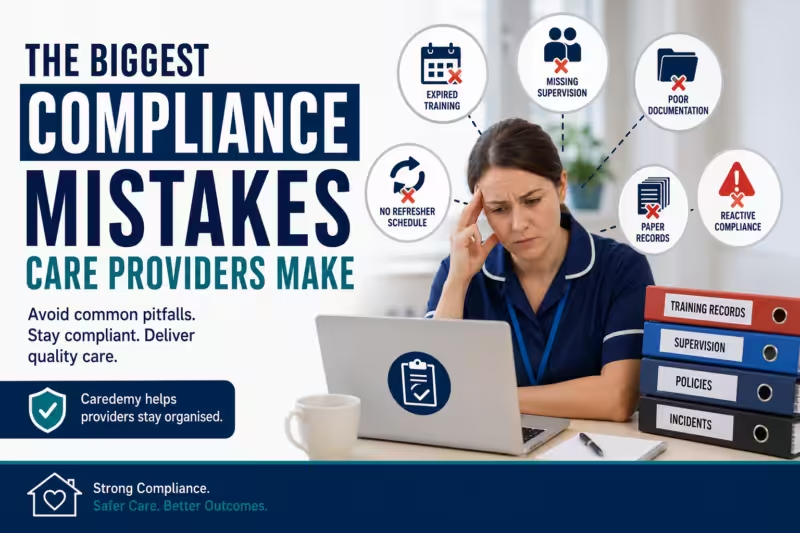
The Biggest Compliance Mistakes Care Providers Make
Stay Compliant, Stay Inspection-Ready
Care home compliance is not simply about preparing for a CQC assessment. It is about having the right systems, processes, training and evidence in place every day to help ensure people receive safe, effective and high-quality care.
For care providers, compliance can involve many different areas, from staff training and supervision to record keeping, safeguarding, policies, risk management and ongoing quality improvement.
Yet even well-managed care homes can develop compliance gaps.
Training certificates expire. Supervision sessions get postponed. Records become difficult to find. Refresher training dates are missed. Paperwork accumulates across different folders and systems. Before long, a provider can find itself trying to solve several compliance problems at once.
The good news is that many of these problems can be prevented with a structured and proactive approach.
In this guide, we look at six of the most common care home compliance mistakes and explain what providers can do to reduce the risk.
What Does Care Home Compliance Mean?
Care home compliance refers to the processes and standards that help a care provider meet its legal, regulatory and organisational responsibilities.
In England, the Care Quality Commission (CQC) regulates health and adult social care services and provides guidance on regulations, assessment and enforcement.
Under Regulation 18 of the Health and Social Care Act 2008 (Regulated Activities) Regulations 2014, providers must ensure that staff receive the support, training, professional development, supervision and appraisal necessary for their roles.
Compliance therefore goes beyond having a collection of training certificates.
A provider needs to be able to demonstrate that its staff are appropriately trained, supported and competent, and that relevant processes are being followed and recorded.
This is particularly important when preparing evidence for assessment or responding to concerns identified through internal monitoring.
1. Allowing Staff Training to Expire
One of the most common care home compliance mistakes is allowing mandatory or role-specific training to expire.
A member of staff may have completed safeguarding, moving and handling, infection prevention and control or other relevant training several months ago. However, if the provider does not have an effective system for monitoring renewal dates, refresher training can easily be overlooked.
This can create unnecessary compliance risks.
Why expired training is a problem
Training is only useful if staff continue to have the knowledge and skills required for their roles.
Some subjects may require regular updates because guidance, procedures, legislation or the risks associated with a role can change.
Skills for Care provides guidance for adult social care employers on statutory and mandatory training, with its current guidance updated in December 2025.
Providers should therefore know:
- Which training each role requires
- When each employee completed the training
- When refresher training is due
- Which staff members are approaching their renewal dates
- Which employees are already overdue
- What action is being taken when training expires
A simple training matrix can make this considerably easier.
How to prevent expired training
Instead of waiting until a certificate has expired, create a system that identifies upcoming renewals in advance.
For example, managers could review training due within:
- 90 days
- 60 days
- 30 days
- The current month
This gives managers enough time to schedule training without creating last-minute pressure.
Digital systems can also make monitoring easier. Skills for Care’s Adult Social Care Workforce Data Set (ASC-WDS), for example, allows employers to record training and qualifications, identify missing mandatory training and receive notifications when training is due to expire.
2. Missing or Inconsistent Staff Supervision
Training is only one part of supporting staff.
Another common compliance mistake is failing to maintain regular, meaningful supervision.
Supervision gives managers an opportunity to discuss performance, workload, development needs, concerns, wellbeing and the practical application of learning.
Skills for Care describes supervision as an important part of supporting staff to deliver high-quality care and notes that it can include reviewing workload, standards, performance and learning and development.
Why supervision matters
A training certificate can demonstrate that someone completed a course.
It does not necessarily demonstrate that the person understands how to apply that learning in practice.
For example, a care worker might complete safeguarding training but still need guidance about recognising subtle signs of abuse, reporting concerns or following the organisation’s safeguarding procedures.
Supervision provides an opportunity to explore these issues.
A useful supervision record might include:
- Date of supervision
- Key issues discussed
- Staff member’s development needs
- Concerns or incidents discussed
- Training completed
- Further training required
- Competency or performance issues
- Actions agreed
- Review date
- Manager and staff member confirmation
NICE guidance on safeguarding adults in care homes also recommends checking that training has been completed within an agreed timeframe, discussing learning with staff and evaluating whether learning is being applied in practice.
Avoid treating supervision as a tick-box exercise
A record stating that a supervision meeting took place is useful, but the quality of the discussion matters too.
Managers should use supervision to identify potential problems early and support staff development.
Regular supervision can help turn training from a compliance exercise into something that genuinely improves practice.
3. Poor Documentation and Record Keeping
Good care home compliance depends heavily on evidence.
A provider may have excellent policies, highly trained staff and effective procedures. But if there is no clear evidence showing what happened, when it happened and what action was taken, demonstrating compliance can become difficult.
Poor documentation can include:
- Missing training records
- Incomplete supervision records
- Outdated staff files
- Missing competency assessments
- Inconsistent dates
- Unclear action plans
- Missing signatures or confirmations
- Incomplete incident records
- Policies that have not been reviewed
- Different versions of documents being used
Why documentation matters
Documentation creates an audit trail.
It allows managers to demonstrate what the organisation has done and, importantly, what it has learned and improved.
For example, suppose an incident identifies a training need.
A strong compliance process might show:
Incident identified → concern investigated → training need identified → staff training completed → competency reviewed → practice monitored → improvement recorded.
That provides much stronger evidence than simply having a training certificate in a staff file.
Skills for Care highlights the importance of maintaining training and qualification records and notes that records can be used as evidence for inspections.
Keep records consistent
One of the easiest ways to improve documentation is to standardise your processes.
Use consistent templates for:
- Supervision
- Appraisals
- Competency assessments
- Training records
- Induction
- Audits
- Action plans
- Policy reviews
The objective is not to create more paperwork.
The objective is to make important information easier to find, understand and verify.
4. Having No Refresher Training Schedule
Another major care home compliance mistake is treating training as something that happens once.
Staff may complete their induction, receive certificates and then move on to their day-to-day responsibilities.
But learning needs to be maintained.
Some subjects require regular refresher training, while others may need to be revisited when there is a change in legislation, guidance, organisational policy, role responsibilities or identified risk.
Build a training calendar
A proactive provider should have a clear overview of upcoming learning and development requirements.
A training calendar can include:
| Training area | Staff/roles affected | Completion date | Renewal/review date | Status |
|---|---|---|---|---|
| Safeguarding | Care staff | Date | Date | Up to date |
| Infection prevention | Relevant staff | Date | Date | Due soon |
| Moving and handling | Relevant staff | Date | Date | Booked |
| Fire safety | All relevant staff | Date | Date | Up to date |
| Medication | Relevant staff | Date | Date | Review required |
The exact training requirements should be determined according to the service, roles, risks, policies and applicable guidance rather than assuming that every care worker requires exactly the same courses.
Skills for Care’s statutory and mandatory training guidance is a useful reference when developing a training programme.
Don’t forget competency
Refresher training should not automatically mean repeating an online course.
Skills for Care emphasises that training alone does not guarantee that a worker understands what was taught or will apply it correctly. Employers should assess knowledge and competence rather than simply assuming learning has transferred into practice.
Depending on the subject, refresher activity may therefore include:
- Online learning
- Classroom training
- Practical demonstrations
- Observations
- Competency assessments
- Supervision discussions
- Scenario-based learning
- Team meetings
- Policy updates
5. Relying Too Heavily on Paper Records
Paper records can have a place in care settings, but relying on them too heavily can make compliance management harder.
Imagine having dozens or hundreds of staff records spread across filing cabinets.
A manager needs to identify:
Who has safeguarding training expiring next month?
If the answer requires manually checking every file, there is a greater chance that something will be missed.
Common problems with paper-based compliance
Paper records can be:
- Difficult to search
- Easy to misfile
- Difficult to update
- Difficult to audit
- Vulnerable to damage
- Time-consuming to maintain
- Difficult to analyse across a whole workforce
Digital record keeping can provide a clearer overview.
For example, training management systems can help managers see which staff have completed training, identify outstanding courses and monitor renewal dates.
Skills for Care’s ASC-WDS is one example of a digital system that supports the management of training and qualification records.
Digital does not automatically mean compliant
Moving from paper to digital records is not enough on its own.
A digital system is only useful if information is:
- Accurate
- Up to date
- Consistently recorded
- Accessible to authorised people
- Regularly reviewed
- Supported by appropriate processes
The goal should be better compliance management, not simply replacing a filing cabinet with a computer.
6. Taking a Reactive Approach to Compliance
Perhaps the biggest mistake of all is treating compliance as something to think about only when an assessment is approaching.
This is reactive compliance.
A provider notices a problem, fixes it, files the evidence and moves on.
Then the next problem appears.
A more effective approach is proactive compliance.
Instead of asking:
“What do we need to fix before an assessment?”
ask:
“What can we monitor continuously so problems are identified early?”
Reactive vs proactive compliance
| Reactive compliance | Proactive compliance |
| Training is booked after expiry | Renewals are scheduled in advance |
| Supervision is completed when someone asks | Supervision follows a planned schedule |
| Records are gathered before assessment | Evidence is maintained continuously |
| Problems are addressed after incidents | Risks are identified and monitored |
| Paperwork is checked occasionally | Compliance is reviewed regularly |
| Managers search for evidence | Evidence is organised and accessible |
| Training is treated as a requirement | Training is linked to competence and care quality |
Proactive compliance creates a culture where quality and safety are part of everyday management.
Compliance Should Be an Ongoing Process
Good care home compliance is not about creating a perfect folder for an inspection.
It is about building systems that support safe care every day.
That means having a clear process for:
1. Identifying requirements
Understand the training, supervision, competency and documentation requirements relevant to your service.
2. Assigning responsibilities
Make sure managers and team leaders understand who is responsible for monitoring each area.
3. Tracking completion
Keep accurate records of training, supervision, assessments and other important activities.
4. Monitoring expiry dates
Identify upcoming refresher requirements before they become overdue.
5. Assessing competence
Where appropriate, check that staff can apply what they have learned in practice.
6. Reviewing performance
Use supervision, appraisal, audits and observations to identify opportunities for improvement.
7. Keeping evidence organised
Make sure records can be located quickly when managers need to review them.
8. Acting on gaps
When a compliance gap is identified, document the action taken and monitor whether the issue has been resolved.
A Simple Care Home Compliance Checklist
Care providers can use the following checklist as part of their internal reviews.
Staff training
All relevant staff have completed required induction training
Training records are accurate and up to date
Expired training has been identified
Upcoming refresher training has been scheduled
Role-specific training requirements have been considered
Training completion is monitored regularly
Supervision and competency
Staff receive regular supervision
Supervision discussions are documented
Learning needs are identified
Competence is assessed where appropriate
Staff receive support to apply learning in practice
Performance concerns are followed up
Documentation
Staff records are complete
Training certificates can be located
Supervision records are up to date
Competency assessments are documented
Policies and procedures are reviewed
Actions from audits are recorded and monitored
Compliance management
Compliance is reviewed regularly
Managers know where evidence is stored
Training renewal dates are monitored
Internal audits identify gaps early
Corrective actions have clear owners
Compliance is managed continuously rather than immediately before assessment
How Training Can Support Better Care Home Compliance
Training should be part of a wider workforce development strategy.
Skills for Care’s workforce learning and development guidance highlights the importance of learning, workplace assessment and supervision in helping adult social care workers perform their roles effectively.
Care providers should consider whether their training programme reflects:
- The needs of the people they support
- The roles of individual staff members
- Identified risks
- Organisational policies
- Regulatory expectations
- Staff development needs
- Lessons from incidents and complaints
- Findings from audits
- Changes in guidance or legislation
The Care Certificate can also provide an important foundation for people new to health and social care. Skills for Care describes it as a set of standards covering the knowledge, skills and behaviours expected of people starting work in the sector.
You can also read our guide to what the Care Certificate is in the UK and explore the Care Certificate online training course.
For providers reviewing their wider training programme, our guide to mandatory training for care workers provides further information about common training requirements.
Making Compliance Easier for Care Providers
Managing compliance can become complicated when staff records, training certificates, supervision documents and renewal dates are stored in different places.
A structured training management approach can help providers create greater visibility across their workforce.
For example, managers can monitor:
- Who has completed training
- Who still needs to complete training
- Which courses are approaching expiry
- Which staff require refresher training
- Where training gaps exist
- What evidence is available
This can help turn compliance from a reactive administrative task into an ongoing management process.
Caredemy helps providers stay organised.
Our online training solutions can support care providers with workforce learning across areas such as safeguarding, infection prevention and control, health and safety, basic life support and the Care Certificate.
You can explore the Caredemy Care Certificate training or view our mandatory training courses for care staff.
Final Thoughts: Don’t Wait for a Compliance Problem
The biggest care home compliance problems are not always dramatic.
Sometimes they are small gaps that gradually build up:
A training certificate expires.
A supervision session is missed.
A competency assessment is not documented.
A refresher date is forgotten.
A paper record cannot be found.
An audit action is never followed up.
Individually, these may appear manageable. Collectively, they can create significant compliance challenges.
The best approach is to identify these issues before they become problems.
Regular training reviews, effective supervision, accurate documentation, competency assessments, organised records and proactive monitoring can help care providers build a stronger compliance culture.
Most importantly, compliance should support the delivery of safe, effective and person-centred care — not simply prepare an organisation for an assessment.
Ready to Strengthen Your Training and Compliance Processes?
Whether you are reviewing your existing training programme, onboarding new staff or preparing for a CQC assessment, having the right training and systems in place can make compliance management easier.
Explore training solutions at caredemy.co.uk.