

- Home
- Health & Safety
- Professional and Personal Boundaries in Care Settings Course
Professional and Personal Boundaries in Care Settings Course
£15 + VAT


Written By Allison
- CPD Accredited | Instant Certificate | Mobile Friendly | Bulk Discounts Available
Trusted by care providers, healthcare organisations, businesses and workplace teams
The Professional and Personal Boundaries in Care Settings course explains how to maintain appropriate relationships with people receiving care, manage emotional involvement and recognise boundary breaches. Learners explore power imbalances, gifts, professional conduct and challenging inappropriate behaviour.
Designed for health and social care professionals, this training supports safe, respectful relationships, safeguarding responsibilities and confidence when handling sensitive workplace situations.
Professional and Personal Boundaries in Care Settings Course Summary
Course Name: Professional and Personal Boundaries in Care Settings
Duration: 1 hour
Delivery: Online Training Course
Certificate Included: Instant Digital Certificate
Accreditation: CPD Accredited
Suitable For: Care Workers, Healthcare Assistants, Support Workers, Nurses, Social Workers, Care Managers and Healthcare Professionals
Assessment: Online Multiple Choice Test
Access: Instant Access – 12 Months
Duration
1 hour
CPD Points
1
Last Updated:
25 Jul 2026
What is Professional and Personal Boundaries in Care Settings training?
Professional and Personal Boundaries in Care Settings training teaches health and social care workers how to distinguish between supportive professional relationships and inappropriate personal involvement.
Professional boundaries define the limits of acceptable behaviour between care professionals, people receiving support and their families. These boundaries protect individuals from exploitation, favouritism, conflicts of interest and breaches of trust.
The course examines professional relationships, power imbalances, emotional attachments, gifts, ethical dilemmas and situations where boundaries become unclear.
Learners develop the knowledge to recognise warning signs, maintain appropriate relationships and challenge behaviour that could compromise care.
The training supports the Code of Conduct for Healthcare Support Workers and Adult Social Care Workers in England and the safeguarding expectations of the Care Quality Commission (CQC).
CPD Accredited
User friendly interactive courses
Instant Access
Enrol Now – Start Instantly
Certify Instantly
Certificate Available Immediately
Learn on Any Device
Train on Phone, Tablet or Computer
Money Back Guarantee
14 Day Money Back Guaratnee
How Would You Like to Access This Course?
Flexible options for individuals, staff teams and organisations
1
Instant Online Purchase
From 1 to 100+ learners • Bulk discounts available • Instant online access and certificates included
- Instant Access - No Quote Required
- CPD Accredited Certificates Included
- 100% Online & Mobile Friendly
- Assign Courses to Staff, Friends or Family
- Track Progress and Completions Online
- 14 Day Money Back Guarantee
£15 + VAT
CPD • Certificate included • Start instantly
Quantity
Per Course Price
1+ Courses
£15 + Vat
5+ Courses
£9.40 + Vat
10+ Courses
£8.49 + Vat
30+ Courses
£7.99 + Vat
50+ Courses
£6.49 + Vat
100+ Courses
£4.99 + Vat
2
Need Ongoing Staff Training?
Best value for teams of 8+ learners who need regular mandatory, induction and refresher training.
- Save Money on Staff Training
- Access Our Full 200+ Course Library
- Instant certificates issued
- Track Compliance Across Your Team
- Free Learner Replacements
- Reporting & Certificate Management
- CQC inspection ready
- Lowest price guarantee
- Dedicated Support
Best Price Guarantee • CQC Inspection Ready
When should I choose Caredemy Teams?
Caredemy Teams is ideal for organisations with 8+ learners who need access to multiple courses for mandatory training, induction training, and annual refreshers. Benefit from our best-value pricing, free learner replacements, compliance reporting, and access to our full course library. If you only need a small number of CPD courses, you can buy online instantly.
Access friendly, dedicated expert support whenever you need it, with guidance available throughout your learning journey
All-access individual subscription
Get unlimited access to 200+ CPD-accredited courses. One low monthly price. Learn anytime.
Buy any 5 courses for £47
Mix and max any courses.
CPD accredited - Certificates included.
Who Is This Course For?
This course is suitable for anyone whose role involves developing professional relationships with people receiving health or social care.
It is particularly relevant to care assistants, healthcare assistants, support workers, domiciliary care workers, nurses, nursing associates, social workers, mental health support staff, rehabilitation workers, personal assistants and registered care managers.
The training also benefits safeguarding leads, team leaders, care coordinators and professionals working in residential care homes, nursing homes, supported living services, community care, hospitals, mental health services and learning disability support.
It is appropriate for staff induction, refresher training and continuing professional development, particularly where workers provide one-to-one support or develop long-term relationships with individuals and their families.
Key Benefits
✓ Recognise and maintain appropriate professional boundaries in everyday care.
✓ Identify power imbalances, emotional attachments and potential conflicts of interest.
✓ Handle gifts, personal requests and challenging relationship situations appropriately.
✓ Protect service users from exploitation, favouritism and inappropriate conduct.
✓ Recognise, challenge and report professional boundary breaches.
✓ Support safeguarding responsibilities, ethical practice and CQC expectations.
Course Modules
- Course Introduction – Personal Boundaries in Care Settings
- What are Professional Boundaries?
- Relationships and Professional Boundaries
- ‘Grey’ Areas
- Common Professional Boundary Questions
- Health and Social Care Values
- Power Imbalances
- Service Users’ Best Interests
- Managing Emotions
- Principles for Maintaining Professional Boundaries
- Service User Perceptions
- Relationship Questions to Ask
- Unacceptable Practices
- Gifts and Donations
- Upholding Trust and Confidence
- Trust and Confidence Questions to Ask
- Challenging Professional Boundary Breaches
- Scenarios
Ready to start?
Learning Outcomes
Learner Outcome | Covered |
|---|---|
Define professional boundaries within health and social care relationships. | ✓ |
Distinguish appropriate professional conduct from personal involvement. | ✓ |
Identify situations where professional boundaries become unclear. | ✓ |
Explain how power imbalances can affect people receiving care. | ✓ |
Recognise how professional relationships should prioritise service users’ best interests. | ✓ |
Identify appropriate ways to manage emotions and personal attachments. | ✓ |
Apply principles for maintaining boundaries during everyday care. | ✓ |
Recognise how service users may perceive staff behaviour and relationships. | ✓ |
Identify unacceptable practices and behaviours that undermine professional standards. | ✓ |
Explain appropriate responses to offers of gifts and donations. | ✓ |
Describe how professional conduct maintains trust and confidence in care services. | ✓ |
Recognise potential conflicts of interest in professional relationships. | ✓ |
Explain how to challenge and report professional boundary breaches. | ✓ |
Apply professional boundary principles to realistic workplace scenarios. | ✓ |
Training 8+ Staff Across Multiple Courses?
Purchasing multiple licences for this training course? Simply adjust the quantity and buy online today.
If you need ongoing training for 10+ employees across multiple subjects, our Team Training platform provides access to 200+ CPD accredited courses, compliance reporting, learner management and bulk enrolment tools.
- Access 200+ CPD Accredited Courses
- Manage All Learners In One Place
- Compliance & Audit Reporting
- Bulk Enrolment & Certificate Tracking
- Dedicated Account Support
Team Training Solutions
Ideal for care providers, healthcare organisations and workplace teams training multiple employees.
Why Choose Caredemy?
- Instant Certificate
- CPD-accredited courses
- Money Back Guarantee
- Expert-designed training
- 120,000 learners trained
- Flexible online learning
- Compliance-focused
- Dedicated support
What Our Learners Say?
“Helpful examples of managing personal requests and gifts. It clarified how to remain friendly while keeping professional boundaries.”
Sarah Mitchell
Senior Care Assistant
“The scenarios made it easier to recognise situations where professional relationships could become inappropriate.”
James Carter
Support Worker
“A useful refresher on professional conduct, particularly around emotional involvement and challenging boundary breaches.”
Rebecca Carter
Registered Care Manager
4.86/5 from 202+ learners
Why Is Professional and Personal Boundaries in Care Settings training important?
Professional boundaries protect people receiving care from inappropriate relationships, exploitation, favouritism and conflicts of interest.
Care workers often develop close relationships with individuals they support. Without clear boundaries, well-intentioned actions such as accepting expensive gifts, sharing personal problems or maintaining contact outside work can create safeguarding risks.
Training helps staff recognise these situations, manage emotional involvement and respond appropriately to boundary breaches.
Maintaining professional boundaries also supports dignity, confidentiality, informed choice and public confidence in care services.
For employers, the training reinforces expected standards of behaviour, supports safeguarding procedures and helps demonstrate that staff understand their professional responsibilities under relevant CQC regulations and workplace policies.
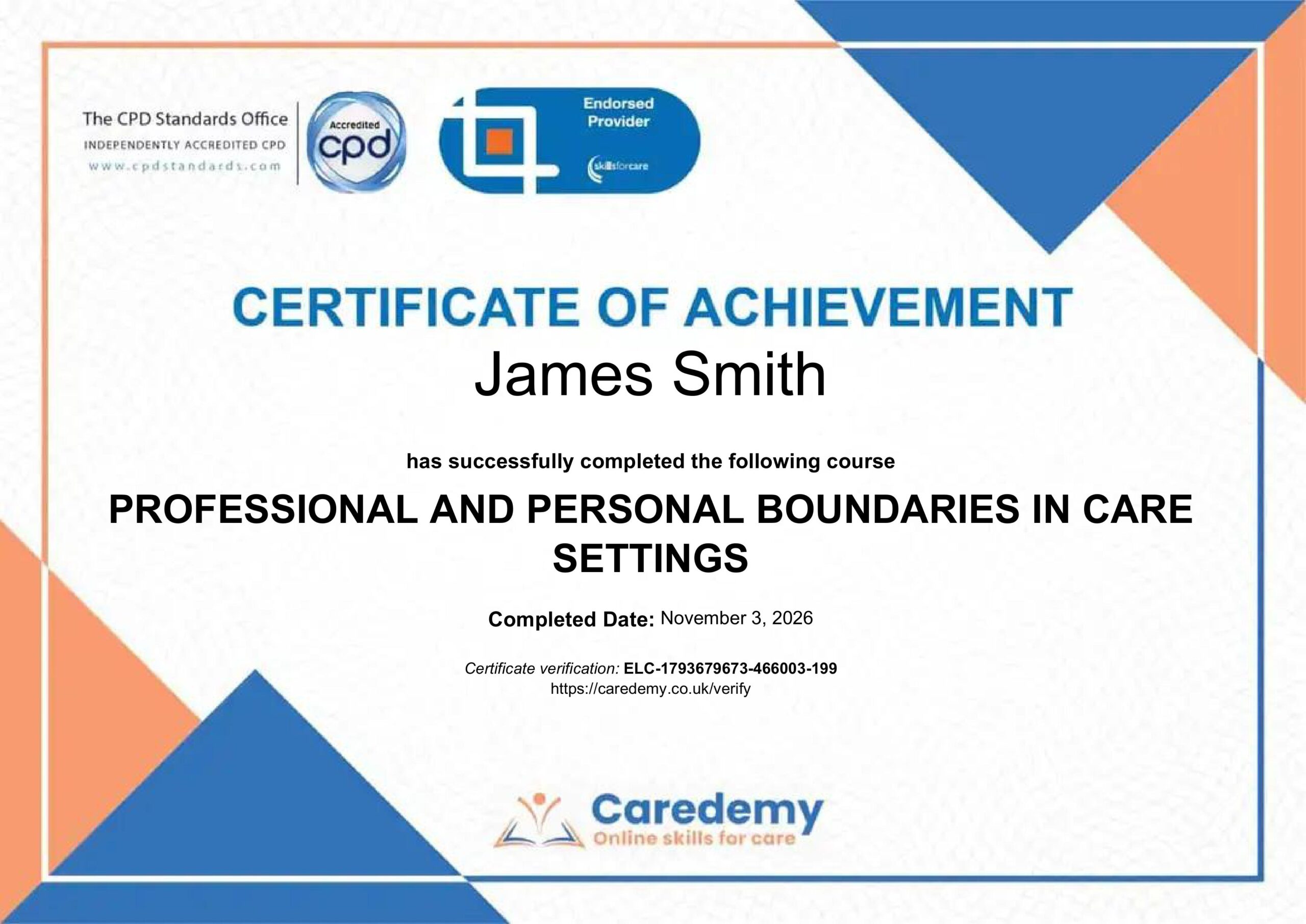
Instant Course Certificate
Is Professional and Personal Boundaries in Care Settings training a legal requirement in the UK?
There is no general UK law requiring every care worker to complete a standalone professional boundaries course.
However, employers must meet relevant safeguarding, dignity and professional conduct requirements.
In England, Regulation 13 of the Health and Social Care Act 2008 (Regulated Activities) Regulations 2014 requires registered providers to protect people from abuse and improper treatment.
Regulation 10 requires care providers to respect service users’ dignity, privacy and independence.
The Code of Conduct for Healthcare Support Workers and Adult Social Care Workers in England also establishes expectations for maintaining appropriate professional relationships.
Employers should provide appropriate training, supervision and clear policies to help staff meet these responsibilities.
This course supports professional development and safeguarding awareness but does not replace role-specific safeguarding training or workplace competency assessments.
Trusted by 120,000+ learners
Trusted by care providers, healthcare organisations, businesses and workplace teams across the UK for high-quality online training
Office & Commercial
Health & Social Care
Industrial, Warehousing & Facilities
Hospitality, Retail & Public Services
Professional and Personal Boundaries in Care Settings training FAQ?
What are professional and personal boundaries in health and social care?
Professional boundaries are the limits that define appropriate relationships between care workers, people receiving care and their families.
They help staff remain compassionate and supportive without developing inappropriate personal, financial or emotional relationships. Examples include maintaining appropriate communication, respecting privacy, managing gifts and avoiding favouritism.
Clear boundaries protect service users, support professional decision-making and maintain trust in care services.
Who needs professional boundaries training in care settings?
Professional boundaries training is suitable for anyone working directly with people receiving health or social care.
This includes care assistants, support workers, healthcare assistants, nurses, social workers, mental health staff and care managers.
It is especially valuable for workers providing one-to-one support, home care or long-term residential care, where close relationships can develop over time. The course is suitable for both induction and refresher training.
Is professional boundaries training a legal requirement in the UK?
A standalone professional boundaries training course is not universally required by UK legislation.
However, care providers must ensure staff work safely, protect people from abuse and maintain appropriate professional conduct.
In England, CQC Regulations 10 and 13 establish relevant expectations for dignity, respect and safeguarding. Employers may include professional boundaries training within mandatory internal induction or safeguarding programmes to support compliance with these responsibilities.
How often should care workers complete professional boundaries refresher training?
There is no universal statutory refresher interval specifically for professional boundaries training.
Employers should determine suitable training intervals based on staff responsibilities, service risks, organisational policies and changes in guidance.
Refresher training may be particularly appropriate following safeguarding incidents, changes in responsibilities or identified concerns about professional conduct.
Managers should document training decisions and ensure staff can apply professional boundary principles during everyday care.
How long does the Professional and Personal Boundaries in Care Settings course take?
Caredemy’s Professional and Personal Boundaries in Care Settings online course takes approximately one hour to complete and provides one CPD point.
The training is delivered online, allowing learners to work through the material at their own pace.
After completing the learning content and successfully passing the online multiple-choice assessment, learners receive a downloadable CPD-accredited digital certificate.
What are examples of professional boundary breaches in care?
Professional boundary breaches can include accepting inappropriate gifts, borrowing money from service users, sharing excessive personal information or developing romantic relationships with people receiving care.
Other examples include favouritism, inappropriate personal contact and allowing emotional attachment to influence care decisions.
Some situations are less obvious and require professional judgement. Staff should follow workplace policies, seek management guidance and report concerning behaviour through appropriate safeguarding procedures.
Can care workers accept gifts from service users or their families?
Care workers should follow their employer’s gifts and hospitality policy and avoid accepting anything that could compromise their professional position.
Expensive gifts, money, loans or personal benefits may create conflicts of interest or raise safeguarding concerns.
Even small gifts require consideration of the circumstances and organisational rules.
Workers should seek guidance from their manager when uncertain and ensure that any permitted gifts are handled transparently and appropriately documented.
What certificate will I receive after completing the professional boundaries course?
After successfully completing the Professional and Personal Boundaries in Care Settings online assessment, learners receive an instant digital CPD-accredited certificate.
The certificate can be downloaded or printed and used as evidence of completed training for professional development, staff induction or refresher records.
Employers can retain the certificate alongside supervision records, training matrices and other workforce development evidence.
Need Training for Multiple Employees?
Train your entire workforce through Caredemy Teams with bulk enrolment, compliance reporting and access to 200+ CPD courses.
- CPD-accredited certificate
- Instant Certificate
- Learn of Any Device
- Money-back Guarantee
Related Courses You May Like


UK Regulations And Guidance
Useful References:
- Health and Social Care Act 2008 (Regulated Activities) Regulations 2014 – Regulation 13: Safeguarding Service Users from Abuse and Improper Treatment
- Health and Social Care Act 2008 (Regulated Activities) Regulations 2014 – Regulation 10: Dignity and Respect
- Code of Conduct for Healthcare Support Workers and Adult Social Care Workers in England – Skills for Care

£15 + Vat
Professional and Personal Boundaries in Care Settings Course
- CPD Accredited
- Instant Certificate
- Instant Access
- Bulk Discounts Available