CQC Training Requirements: What Training Do Care Staff Actually Need?
What training does CQC require care staff to have?
CQC does not publish one universal mandatory training list for every care worker. Providers must ensure staff receive appropriate training, supervision and development to perform their roles safely and competently. Required training should therefore reflect legislation, staff responsibilities, workplace risks, people’s needs, commissioner requirements and the regulated activities being delivered.
That distinction is important.
Searching for a definitive “CQC mandatory training list” can give care managers the wrong impression that compliance means putting every employee through the same collection of courses once a year.
It does not.
CQC’s requirements are centred on whether providers have enough suitably qualified, competent, skilled and experienced staff and whether those staff receive the training, support, professional development, supervision and appraisal necessary to carry out their duties.
The provider must therefore be able to answer three questions:
- What does this worker need to know and be able to do?
- How have we determined that?
- What evidence shows they are competent and remain competent?
This guide explains how care providers in England can approach those questions.
What Does CQC Actually Say About Staff Training?
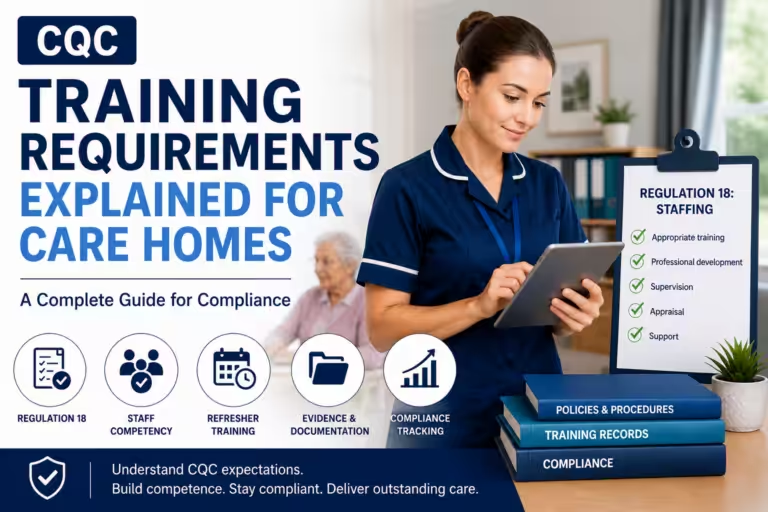
The main CQC requirement is found in Regulation 18 of the Health and Social Care Act 2008 (Regulated Activities) Regulations 2014.
Regulation 18 requires providers to deploy sufficient numbers of suitably qualified, competent, skilled and experienced people.
It also requires people employed in providing regulated activities to receive the appropriate support, training, professional development, supervision and appraisal necessary for them to carry out their duties.
CQC’s guidance goes further by stating that providers must:
- have an induction programme that prepares staff for their role
- assess individual training, learning and development needs at the beginning of employment
- review those needs at appropriate intervals
- support staff to undertake the training and development required for their role
- supervise staff where appropriate until they demonstrate an acceptable level of competence
- provide ongoing or periodic supervision to help maintain competence
- monitor required training and take appropriate action when requirements are not being met
- provide regular appraisal and identify development needs
- support regulated professionals to maintain relevant professional requirements.
CQC also specifically requires staff to receive training in how to interact appropriately with autistic people and people with a learning disability, at a level appropriate to their role.
The important point is that Regulation 18 does not say that every care worker must complete an identical set of 10, 12 or 15 courses.
CQC itself distinguishes between statutory training, mandatory training defined by the provider for a particular role, and additional training required to meet the needs of people receiving care.
Source: Care Quality Commission, Regulation 18: Staffing.
Relevant CQC Regulations
Training compliance does not sit within Regulation 18 alone. Staff competence can affect compliance with several Fundamental Standards.
| Regulation | Relevance to staff training |
|---|---|
| Regulation 9 – Person-centred care | Staff need sufficient knowledge and skills to deliver care appropriate to people’s assessed needs and preferences. |
| Regulation 10 – Dignity and respect | Workers must understand how to maintain dignity, privacy and respectful care. |
| Regulation 11 – Need for consent | Relevant staff need to understand consent and how mental capacity affects decision-making. |
| Regulation 12 – Safe care and treatment | Providers must ensure staff have the qualifications, competence, skills and experience required to provide safe care and treatment. |
| Regulation 13 – Safeguarding service users from abuse and improper treatment | Staff need appropriate safeguarding knowledge and must understand how to identify and respond to concerns. |
| Regulation 14 – Meeting nutritional and hydration needs | Staff involved in food, drink or nutritional support need appropriate skills and knowledge. |
| Regulation 17 – Good governance | Providers need effective systems for monitoring quality and safety, which can include oversight of staff training and competence. |
| Regulation 18 – Staffing | Requires suitably qualified, competent, skilled and experienced staff and appropriate training, supervision, development and appraisal. |
Regulation 12 is particularly relevant. CQC states that providers must assess risks to people’s health and safety and ensure staff have the qualifications, competence, skills and experience needed to keep people safe.
The question for managers therefore should not simply be:
“Has this employee completed their mandatory training?”
It should also be:
“Is this employee competent to perform the tasks we are asking them to undertake?”
Statutory Training, Mandatory Training And Additional Training
Skills for Care’s Statutory and mandatory training guide for adult social care employers, updated in December 2025, provides a useful framework.
It describes statutory training as training generally required by law or where a statutory body requires training because of specific legislation.
Mandatory training is training that an organisation or commissioner determines is essential for safe and efficient service delivery.
There is then additional training that the employer identifies according to the needs of the service and the people receiving care.
For CQC-regulated providers, Skills for Care makes an important point: identifying and providing appropriate additional training remains the provider’s legal responsibility.
This is why copying another care provider’s training matrix is not necessarily sufficient.
Two domiciliary care providers, for example, may require different training because one supports people with epilepsy, diabetes and complex medication needs while the other provides mainly companionship and personal care.
Training, Competence And Supervision
Completing training and being competent are not necessarily the same thing.
Skills for Care states that employers are responsible for checking and evidencing workers’ competence on an ongoing basis.
Competency checks can include:
- direct observation of practice
- questions about procedures
- scenario discussions
- supervision discussions
- reflective practice
- quizzes and knowledge checks
- practical demonstrations
- review of workplace records.
Formal observation is particularly important for practical tasks.
For example, an employee might successfully complete a medication awareness course and pass the online assessment.
That provides useful evidence of learning.
It does not, by itself, demonstrate that the employee can safely administer medicines to a person in accordance with the organisation’s procedures.
The provider may also need to observe the worker administering medication and formally assess their competence.
Skills for Care specifically highlights activities such as assisting and moving people and medication administration when discussing workplace competency checks.
The Care Certificate For New Care Staff
The Care Certificate standards remain an important framework for induction in health and social care.
The standards were updated in March 2025 and now contain 16 standards, including a new standard covering awareness of learning disability and autism.
The Care Certificate standards define the knowledge, skills and behaviours expected of workers in relevant health and social care roles and can be used to structure induction for people who are new to care.
A crucial compliance point is that the Care Certificate is not simply an online course.
Workers need to be assessed on what they know and what they do.
Skills for Care explains that assessment should establish that the worker understands the standards and can apply them within their role. Assessors should have appropriate understanding and direct experience of what they are assessing.
Care providers should therefore avoid treating an online Care Certificate learning programme and a workplace Care Certificate competency assessment as interchangeable.
Online learning can provide the underpinning knowledge. Workplace assessment provides evidence that the worker can apply that knowledge appropriately.
The separate Level 2 Adult Social Care Certificate qualification should also not be confused with the employer-led Care Certificate standards. The qualification builds on the same foundations but does not remove an employer’s responsibility for appropriate induction, mandatory training, supervision, competency assessment and professional development.
What Training Do Care Staff Need?
There is no single answer because training should be matched to the worker’s duties.
Skills for Care’s current guidance identifies areas applicable across the workforce alongside others that depend on roles and responsibilities.
Typical considerations include:
| Role | Typical training considerations |
|---|---|
| Care worker/support worker | Health and safety, fire safety, infection prevention and control, adult safeguarding, learning disability and autism, relevant Care Certificate standards, person-centred care and role-specific subjects. |
| Home care worker | Core subjects plus lone working, moving and assisting where required, medication where involved, infection control in people’s homes, personal care and condition-specific training. |
| Care home worker | Core subjects plus fire procedures specific to the home, moving and assisting where required, safeguarding, infection control, emergency procedures and training relevant to residents’ needs. |
| Worker administering medication | Appropriate medicines training followed by assessment of competence, plus additional training for specialist administration where necessary. |
| Worker assisting people to move | Assisting and moving people training relevant to the equipment and techniques used, plus practical competency assessment. |
| Worker preparing or handling food | Appropriate food safety and hygiene knowledge and training. |
| Dementia care worker | Appropriate dementia knowledge and skills reflecting the people supported and complexity of their needs. |
| Learning disability/autism support worker | Learning disability and autism training appropriate to role, plus additional specialist training where duties require it. |
| Senior care worker/team leader | Relevant frontline requirements plus supervision, delegation, safeguarding responsibilities, leadership, incident management and quality assurance as appropriate. |
| Registered manager | Regulatory responsibilities, governance, safeguarding leadership, safe staffing, supervision, quality assurance, risk management and service-specific competence. |
| Office/administrative staff | Training based on duties and contact with people using services; for example health and safety, data protection, fire procedures, safeguarding awareness and appropriate learning disability/autism training. |
| Agency/temporary worker | Evidence of relevant current training plus service-specific induction, competency assessment and any additional training necessary for the placement. |
The matrix should therefore follow the role, not simply the employee.
Typical Core Training Areas
Skills for Care’s current statutory and mandatory training guidance includes several areas care providers commonly need to consider.
| Training area | Why it matters | Who may require it | Evidence to retain |
|---|---|---|---|
| Health and safety awareness | Helps workers understand hazards, responsibilities, risk assessment and safe working practices. | Workers generally, with content relevant to role. | Completion record, assessment results, induction evidence and relevant competency evidence. |
| Fire safety | Staff need to know how to prevent and respond to fire in their particular care environment. | Workers according to setting and responsibilities. | Training record, local induction, fire drill records and relevant competency evidence. |
| Infection prevention and control | Supports safe practice around hygiene, PPE, cleaning, waste and preventing infection. | Care workers and others according to exposure and role. | Training records, assessments, observations/audits and supervision evidence where relevant. |
| Adult safeguarding | Staff must recognise potential abuse or neglect and know how to respond and report concerns. | Care staff and others according to role. | Training completion, assessment, safeguarding induction and competency/supervision evidence. |
| Learning disability and autism | Regulation 18 specifically requires appropriate training for staff in interacting with autistic people and people with a learning disability. | All relevant staff, at a level appropriate to role. | Training records, training needs assessment, competency/supervision evidence and development plans. |
| Basic life support/first aid | Ensures appropriate response to accidents, sudden illness and emergencies. | Determined according to duties, risk and first-aid arrangements. | Certificates, assessment/competency evidence and refresher dates. |
| Assisting and moving people | Unsafe practice can cause significant injury to people receiving care and staff. | Workers whose duties include assisting or moving people. | Training, practical assessment, equipment-specific competency and refresher/reassessment records. |
| Medication | Medicines must be supported and administered safely and according to the worker’s responsibilities. | Staff supporting or administering medicines. | Training certificate, competency assessment, supervision and relevant specialist training. |
| Food hygiene | Protects people from food-related risks. | Workers handling, preparing or supporting people with food as relevant to their role. | Training record and relevant workplace competency evidence. |
| Child safeguarding | Care workers may encounter children and need to understand how to respond to concerns. | As determined by role and Care Certificate requirements. | Completion and assessment records. |
| Mental capacity | Supports lawful, person-centred decision-making and appropriate consent processes. | Staff whose duties require relevant understanding. | Training record, assessment and evidence through care practice/supervision. |
| Condition-specific training | Enables workers to respond appropriately to the actual needs of people they support. | Staff supporting people with relevant conditions. | Training, care-plan-specific instruction, competency assessment and supervision. |
This table should be treated as a framework for training decisions, not a universal CQC course checklist.
Role-Specific And Service-Specific Training
After identifying core requirements, providers should consider what additional knowledge and skills are necessary because of:
- the regulated activities provided
- the care setting
- individual job descriptions
- people’s assessed needs
- equipment being used
- medication responsibilities
- identified workplace risks
- incidents and lessons learned
- safeguarding risks
- commissioner requirements
- changes to legislation or guidance.
Skills for Care gives examples of additional training such as:
- communication needs
- nutrition and hydration
- positive behavioural support
- oral healthcare and personal care
- person-centred care
- mental capacity
- end-of-life care
- dementia
- specific healthcare conditions
- digital skills
- data protection.
The list is explicitly not exhaustive.
For example, if a supported living service begins supporting someone with epilepsy whose care plan includes emergency rescue medication, the provider should assess whether particular staff need additional epilepsy and medication training and practical competency assessment.
The fact that “epilepsy training” does not appear on a supposed generic mandatory training checklist does not remove that responsibility.
Practical Competency vs Online Learning
Online learning can be highly effective for delivering knowledge, policies, legal principles, awareness and theoretical understanding.
However, some skills cannot reasonably be demonstrated through eLearning alone.
Consider moving and assisting.
An online course can teach:
- relevant legislation
- risk assessment principles
- anatomy and injury risks
- safe moving principles
- responsibilities
- when to seek assistance.
It cannot demonstrate that a particular employee can correctly use the hoist and sling required by an individual’s moving and handling plan.
That requires practical assessment.
The same principle can apply to:
- medication administration
- moving and assisting people
- specialist medicines
- basic life support
- use of specialist equipment
- clinical procedures
- condition-specific interventions.
A sensible training system therefore separates:
Knowledge acquired → training/course evidence
from
Competence demonstrated → workplace assessment evidence.
Caredemy’s online courses can support the knowledge component and provide completion records and certificates, but providers remain responsible for arranging and recording practical assessment wherever the role requires it.
Refresher Training: Does CQC Require Annual Training?
Another common misconception is that all mandatory care training must be repeated annually.
There is no universal CQC rule requiring every course to be retaken every 12 months.
Skills for Care’s December 2025 guidance provides recommended refresher considerations for specific areas.
For example, its guidance recommends a minimum refresher period of three years for several areas, including health and safety awareness, fire safety, moving and handling objects, infection prevention and control and adult safeguarding, subject to earlier refreshers where circumstances change.
Basic life support has different considerations: formal BLS training is required when identified or at least annually.
Medication is different again. Where a worker has not undertaken additional medication training within a year, Skills for Care says their training needs and competency requirements should be reviewed and assessed.
For additional training determined by the employer, Skills for Care does not prescribe standard refresher periods.
Instead, employers should consider factors such as:
- new risks
- changes in people’s needs
- changes to the care environment
- significant changes within teams
- new care activities
- changes to legislation, guidance, policy or practice
- whether the worker remains competent.
Providers should document their chosen refresher frequencies and the rationale behind them.
Keeping Staff Knowledge Up To Date
Training compliance is not simply a diary of expiry dates.
A competent workforce needs a wider learning system.
Knowledge may need updating because:
- guidance changes
- legislation changes
- organisational policies change
- equipment changes
- someone starts receiving a new type of care
- an incident exposes a knowledge gap
- audits identify poor practice
- supervision identifies uncertainty
- a worker has not performed a skill for a long period
- a commissioner introduces a contractual requirement.
Updates do not always require staff to repeat an entire course.
Depending on the issue, appropriate learning might include:
- toolbox talks
- team meetings
- policy briefings
- supervision
- reflective discussions
- practical demonstrations
- shadowing
- competency reassessment
- targeted refresher modules.
Skills for Care specifically recognises that learning can involve a mixture of formal and informal activities.
Agency And Temporary Workers
Using agency staff does not remove the provider’s responsibility to ensure that people receive safe care.
Skills for Care advises providers using temporary workers to check that they have the appropriate values, skills and knowledge for their role and to assess competence before workers operate unsupervised.
Where agency workers bring previous training or qualifications, providers should check that these are appropriate and current.
They should also provide a suitable induction covering the organisation’s policies, procedures and equipment.
This matters because a certificate from an agency cannot demonstrate that a worker understands:
- your emergency procedures
- your safeguarding reporting route
- an individual’s care plan
- your medication procedures
- your equipment
- your building’s fire procedures.
A sensible agency-worker record might therefore combine external training evidence with a short local induction and any necessary competency checks.
Managers And Supervisors Need Training Too
Training matrices sometimes focus heavily on care workers while overlooking managers.
Regulation 18 applies to people employed in providing the regulated activity according to the requirements of their role.
Managers and supervisors may require development in areas including:
- safeguarding leadership
- supervision and appraisal
- incident investigation
- risk assessment
- medicines governance
- complaints
- quality assurance
- auditing
- mental capacity
- safe staffing
- regulatory compliance
- leadership and management.
Registered professionals may also have continuing professional development and revalidation requirements imposed by their professional regulator.
Training requirements should therefore extend through the organisation rather than stopping at frontline staff.
Training Records: What Should Care Providers Keep?
A good training matrix should allow a manager to determine quickly:
Who needs what training, who has completed it, who remains competent and what needs attention?
Useful records can include:
- employee name and role
- start date
- required training by role
- training completion dates
- provider/course details
- assessment results where appropriate
- certificates
- renewal or review dates
- competency assessments
- Care Certificate progress
- induction records
- supervision records
- appraisal and development plans
- specialist training
- professional qualifications
- evidence of previous learning accepted by the provider
- action taken when training becomes overdue.
The matrix itself is only part of the evidence.
A green cell saying “Medication – Complete” is much stronger when the provider can also produce the learning record and relevant workplace competency assessment.
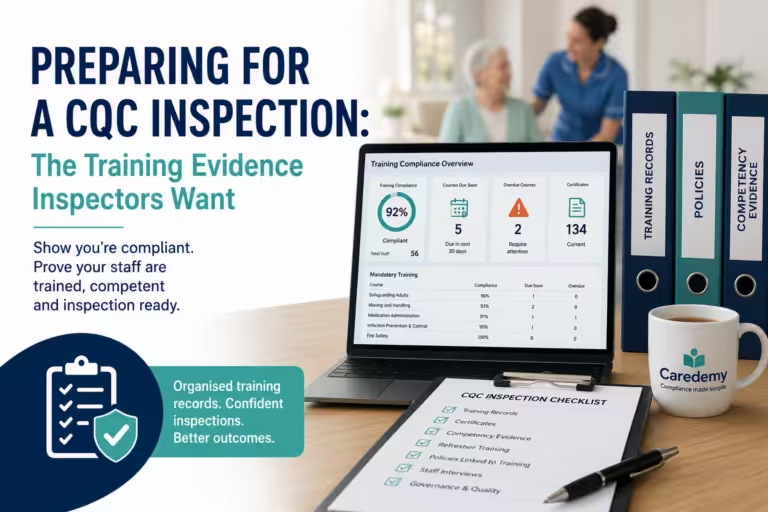
How To Prepare Training Records For A CQC Inspection
CQC’s current assessment approach can include evidence from staff records covering appraisal, training, development and competency.
Preparation should therefore be about demonstrating an effective workforce development system rather than creating paperwork immediately before an inspection.
1. Review the training matrix
Check for:
- missing training
- overdue learning
- incorrect job roles
- former employees still appearing as active
- new starters without induction evidence
- upcoming refresher requirements.
2. Check training requirements against roles
Ask whether every course assigned to each role has a reason for being there.
Then ask the opposite:
Is anything missing because of the person’s actual duties or the needs of people receiving care?
3. Check competency evidence
Pay particular attention to activities where practical competence matters, such as medicines and moving and assisting.
4. Review new starters
Check induction, Care Certificate arrangements where applicable, supervision and competency sign-off.
5. Review agency workers
Make sure you can evidence both the checks made on existing training and the service-specific induction provided.
6. Reconcile records
Training records should make sense alongside:
- personnel files
- rotas
- job descriptions
- supervision records
- care plans
- risk assessments
- incident reports.
For example, if a rota shows a worker regularly administering medication but their file contains no evidence of appropriate medicines training or competency assessment, that discrepancy requires attention.
7. Document outstanding actions
A provider does not necessarily need a completely flawless matrix at every moment.
What matters is having effective oversight.
If training is outstanding, managers should know:
- what is overdue
- why
- what risk it creates
- what interim controls are necessary
- when it will be completed.
Caredemy’s Team Training platform can assist here through centralised learner management, a colour-coded reporting matrix, bulk reporting, certificate management and automated course renewal. These tools can make oversight easier, but the provider still needs to decide what training each employee requires and retain practical competency evidence separately where necessary.
What May CQC Inspectors Look For?
CQC’s assessment of safe and effective staffing can draw on several forms of evidence.
This may include:
- staff records
- training and development records
- competency records
- appraisal information
- feedback from staff and leaders
- observations of staff practice
- recruitment information
- staff interviews
- people’s experiences of care.
CQC’s current guidance also indicates inspectors may consider whether staff have received sufficient training to support people’s particular needs.
This means an inspector does not necessarily have to find an expired certificate to identify a workforce problem.
For example, staff interviews might show that several employees do not understand the organisation’s safeguarding procedure despite the training matrix showing 100% completion.
Equally, strong practice may be demonstrated by workers confidently explaining how they apply their learning to the people they support.
The quality of care is therefore the ultimate test of the training system.
What Evidence Should Providers Retain?
Think of training evidence in layers.
Layer 1: Why was the training required?
Evidence might include:
- job description
- training needs analysis
- organisational training policy
- risk assessments
- people’s assessed needs
- commissioner requirements.
Layer 2: Was appropriate learning provided?
Evidence might include:
- course records
- certificates
- attendance records
- induction records
- qualifications
- learning materials.
Layer 3: Did the worker understand it?
Evidence might include:
- assessments
- quizzes
- discussions
- reflective accounts
- supervision records.
Layer 4: Can they apply it?
Evidence might include:
- workplace observation
- practical competency assessment
- medication competency sign-off
- moving and assisting assessment
- observed practice.
Layer 5: Is competence being maintained?
Evidence might include:
- supervision
- appraisal
- audits
- refresher training
- competency reassessment
- incident reviews
- development plans.
Together, these tell a much stronger compliance story than certificates alone.
Common Staff Training Mistakes That Can Cause Problems During Inspection
Most training problems are preventable and do not require an unnecessarily complicated compliance system.
Mistake 1: Treating a generic course list as “the CQC mandatory training list”
There is no universal list suitable for every employee and every service.
Better approach: Build training requirements around legislation, Skills for Care guidance, role responsibilities, risks and people’s needs.
Mistake 2: Giving everyone exactly the same training
A cook, administrator, care worker, medication-trained senior and registered manager do not necessarily require identical learning.
Better approach: Use role-based training profiles and add individual requirements where necessary.
Mistake 3: Treating certificates as proof of competence
Course completion proves completion of learning. It does not necessarily demonstrate safe practical performance.
Better approach: Identify skills requiring workplace competency assessment.
Mistake 4: Automatically refreshing everything annually
This can create unnecessary training while distracting attention from genuine competency gaps.
Better approach: Follow relevant guidance and document a risk-based refresher policy.
Mistake 5: Forgetting service-specific training
A generic mandatory programme may look complete while failing to address epilepsy, dementia, diabetes, positive behaviour support or another need central to the service.
Better approach: Compare the training matrix against people’s current care and support needs.
Mistake 6: Assuming agency training certificates are enough
Temporary workers still need to understand the service, people, procedures and equipment.
Better approach: Verify existing training and provide appropriate local induction and competency assessment.
Mistake 7: Allowing the matrix to become disconnected from practice
A spreadsheet may say everyone is compliant while supervision, incidents or observations show otherwise.
Better approach: Connect training oversight with supervision, audits, incidents and competency checks.
Mistake 8: Failing to act on overdue training
Occasional overdue training is very different from a provider having no system for identifying or managing it.
Better approach: Monitor compliance, record actions and manage any resulting risks promptly.
Building A Defensible Care Training Matrix
A practical approach for managers is:
Step 1: List every job role.
Step 2: Identify legal, regulatory and contractual requirements.
Step 3: Map the activities each role actually performs.
Step 4: Review the needs of people using the service.
Step 5: Identify relevant workplace and care risks.
Step 6: Assign appropriate training to each role.
Step 7: Identify training requiring practical competency assessment.
Step 8: Set evidence-based refresher/review periods.
Step 9: Add individual training where people’s needs or worker development requires it.
Step 10: Review the matrix whenever roles, risks, people, equipment, legislation or guidance change.
This creates a training system that can be explained and defended rather than simply inherited.
CQC Training Requirements: The Bottom Line
The most important thing for care managers to understand is that CQC compliance is not achieved by purchasing a standard bundle labelled “CQC mandatory training”.
CQC Regulation 18 requires staff to receive the training, support, professional development, supervision and appraisal necessary to perform their duties.
Regulation 12 requires people delivering care and treatment to have the appropriate qualifications, competence, skills and experience.
Skills for Care then provides practical guidance to help employers distinguish between statutory and mandatory subjects and additional training determined by people’s needs, workers’ responsibilities and the service.
A strong provider should therefore be able to demonstrate:
Role → training need → learning → assessment → competence → supervision → review.
That is a more useful model for CQC compliance than simply asking whether every box on a generic mandatory training list is green.
Frequently Asked Questions About CQC Training Requirements
Does CQC have a mandatory training list?
Not in the sense of one fixed list of courses that every care worker must complete.
CQC Regulation 18 requires appropriate training, support, development, supervision and appraisal. Providers must determine what training is necessary according to legislation, workers’ roles, responsibilities, risks and the needs of people receiving care.
Skills for Care publishes statutory and mandatory training guidance that helps providers make these decisions.
What is mandatory training for care workers?
Mandatory training is training determined as essential for safe and effective service delivery. Some requirements arise from legislation or regulatory guidance, while other subjects are made mandatory by the employer or commissioners according to the worker’s role and service.
Typical areas include health and safety, fire safety, infection prevention and control, safeguarding and learning disability and autism, with other subjects required according to duties.
What training do care staff need?
Care staff need training appropriate to their role and the people they support.
For example, a worker who administers medicines needs appropriate medication training and competency assessment. A worker who assists people to move needs relevant moving and assisting training and practical competency assessment.
Additional training may be necessary for dementia, epilepsy, diabetes, end-of-life care, positive behavioural support or other needs.
Does CQC require annual mandatory training?
There is no CQC requirement saying every mandatory course must be repeated annually.
Refresher frequencies differ according to the subject, legislation, guidance, worker competence, changes in risk and organisational policy. Skills for Care’s December 2025 guidance recommends different approaches for different subjects.
How often should safeguarding training be refreshed?
Skills for Care’s December 2025 guidance recommends adult safeguarding refreshers at least every three years where the worker has not completed relevant recognised learning during that period, and earlier where people’s needs change or a new risk or activity is introduced.
Providers should also take account of commissioner requirements, local procedures and identified learning needs.
How often should medication training be refreshed?
Skills for Care advises reviewing and assessing medication training needs and competency where the worker has not undertaken additional training within a year. Training should also be considered when needs, risks, medication activities, policies or practices change.
Competence to administer medicines is particularly important and should not be assumed solely from course completion.
Does online training meet CQC requirements?
Online learning can form an effective part of a compliant training programme where it is appropriate to the subject and learner.
However, online course completion alone may not demonstrate practical competence. Providers should arrange workplace observation or practical assessment where necessary.
Is practical moving and handling training required?
Where workers assist and move people, Skills for Care states that training is required. Providers should also assess competence in the actual tasks, techniques and equipment relevant to the worker’s duties.
Theory-only training should not be treated as evidence that a worker can safely perform a practical moving task.
Is medication awareness training enough to administer medication?
Not necessarily.
Workers responsible for supporting or administering medicines require training appropriate to their responsibilities, and designated staff should be assessed as competent by their employer.
Additional training may also be necessary for particular forms of medication or specialist administration.
Do agency care workers need mandatory training?
Agency and temporary workers must have appropriate knowledge, skills and competence for the work they perform.
Providers should verify existing training and qualifications, provide service-specific induction and assess competence before allowing workers to undertake responsibilities unsupervised where appropriate.
Does every employee need the Care Certificate?
The Care Certificate standards are primarily intended to support induction and define foundational knowledge, skills and behaviours for relevant health and social care workers, particularly those new to care.
Employers should determine how the standards apply to individual workers and should not confuse completing learning materials with achieving the standards through assessment.
Can the Care Certificate be completed entirely online?
The underpinning knowledge can be delivered online, but the Care Certificate requires workers to demonstrate both what they know and what they do.
Some standards therefore require workplace assessment and observation. An online certificate alone should not automatically be treated as evidence that the full Care Certificate standards have been achieved.
What are the 2025 Care Certificate changes?
The Care Certificate standards were updated in March 2025. There are now 16 standards, including a new standard addressing awareness of learning disability and autism.
Is learning disability and autism training mandatory?
CQC’s Regulation 18 guidance states that providers must ensure all staff receive training in how to interact appropriately with people with a learning disability and autistic people, at a level appropriate to their role.
The Oliver McGowan Code of Practice provides further guidance for registered providers on meeting the statutory training requirement.
What training records does CQC expect?
There is no single prescribed training spreadsheet.
Providers should be able to evidence appropriate training, development and competency. Useful records include training requirements, completion dates, certificates, assessments, competency records, induction, Care Certificate progress, supervision, appraisal and professional development.
Will CQC ask to see the training matrix?
CQC may review staff records including training, development, appraisal and competency evidence as part of assessing safe and effective staffing.
A clear training matrix is therefore extremely useful, but CQC may also gather evidence through staff interviews, observations, people’s experiences and other records.
What happens if some staff training is overdue?
Managers should identify the gap, assess any resulting risk and take appropriate action.
For example, the worker may need additional supervision or temporary restrictions on particular duties until training or competency assessment is completed.
The important point is that the provider understands and actively manages the issue rather than allowing training compliance to go unmonitored.
Are CPD certificates enough for CQC?
Certificates provide useful evidence that learning has been completed but are only one part of the evidence.
Where a role requires practical competence, providers should also be able to demonstrate appropriate assessment, supervision and ongoing competency.
Who is responsible for deciding what mandatory training care workers need?
The provider/employer has responsibility for identifying appropriate training, taking account of legislation, CQC requirements, Skills for Care guidance, commissioner requirements, workplace risks, job responsibilities and the needs of people receiving care.
How can care providers manage training compliance more effectively?
Start with a role-based training matrix rather than a generic course list. Link training requirements to job descriptions, risks and people’s needs; distinguish learning from practical competency; establish appropriate refresher periods; and regularly review completion, competency, supervision and development records.
A learning management system such as Caredemy can help centralise course assignments, certificates, reporting, renewals and learner records, but management oversight and workplace competency assessment remain the provider’s responsibility.
Sources And Further Guidance
This article is based primarily on current guidance from:
- Care Quality Commission (CQC) – Regulation 18: Staffing
- Care Quality Commission (CQC) – Regulation 12: Safe care and treatment
- Care Quality Commission (CQC) – current assessment framework and evidence categories
- Skills for Care – Statutory and mandatory training guide for adult social care employers, December 2025
- Skills for Care – Care Certificate standards, updated March 2025
- Skills for Care – workforce learning and development and workplace competency guidance
- Skills for Care – guidance on recruiting and using temporary workers
- Oliver McGowan Code of Practice – learning disability and autism training requirements
Providers should always check current legislation, CQC guidance, Skills for Care guidance and any relevant commissioner or local authority requirements when setting their own training policies.