
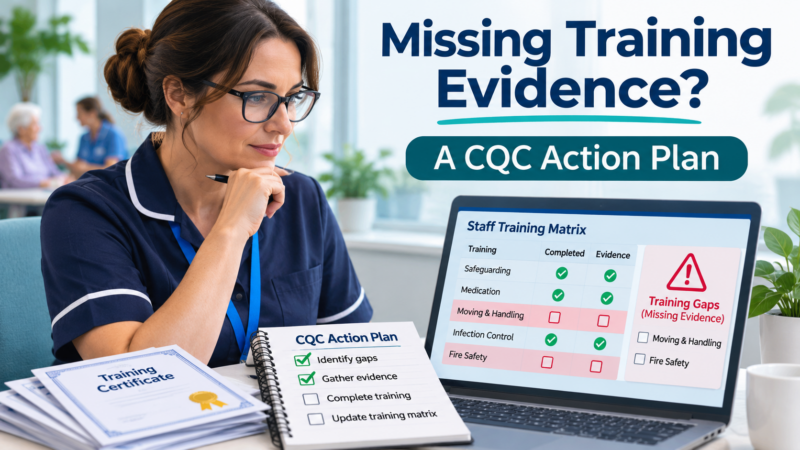
What to Do When Staff Training Evidence Is Missing: A CQC Action Plan
A missing certificate is not necessarily proof that a care worker has not been trained. But it is a gap that needs investigating. For care home managers, homecare managers and training leads, the important question is not simply whether a spreadsheet shows a green tick. It is whether the provider can verify the worker’s learning, demonstrate appropriate competence and respond to any risk.
When training evidence is incomplete, the right response is to investigate, assess the implications for people’s safety, take proportionate action and keep a clear record of the outcome. This guide explains a practical process for CQC-regulated adult social care services in England.
Watch: How to Resolve Missing Staff Training Evidence
Watch our short guide to identifying training evidence gaps, assessing risks and taking corrective action.
Why missing training evidence matters to CQC
CQC Regulation 18 (Staffing) requires staff to receive the support, training, supervision and appraisal needed for their roles. CQC guidance also says that completed learning and required training should be monitored, with appropriate action taken quickly when requirements are not being met.
Regulation 17 (Good governance) requires effective systems for monitoring quality and risk and secure, accurate records relating to staff and the management of the service.
These regulations do not prescribe one particular training spreadsheet or insist that every missing certificate means a worker must automatically repeat a course. Managers need to establish what happened and whether the worker has the knowledge and competence needed for their current duties.
Five steps to resolve a training evidence gap
1. Identify precisely what is missing
Start with the individual requirement, not just a headline compliance percentage. Is the completion date absent? Has a certificate been misplaced? Is refresher training overdue under the service’s policy? Was workplace competency assessment never recorded? These are different problems and may require different responses.
Record the employee or staff reference, role, training requirement, date the problem was identified and the evidence currently available. Check that the training requirement still matches the person’s responsibilities.
2. Verify the evidence before assuming training was not completed
Check the learning platform, archived reports, training provider records and authorised personnel files. Ask the employee and relevant manager what training took place. If evidence exists elsewhere, link or securely store it with the current record and record how it was verified.
Do not retrospectively invent a completion date, backdate a record or mark an unverified course as complete. If evidence cannot be established, retain the gap as open while deciding what learning or assessment is needed.
3. Assess any immediate risk to people receiving care
Consider the worker’s actual duties and the potential consequences of the gap. A missing awareness-course certificate may present a different risk from absent evidence of competence for administering medicines or using moving-and-handling equipment.
Where competence cannot be confirmed for a safety-critical task, a responsible manager should consider suitable interim controls before that task continues. These may include closer supervision, reallocating duties, a competency check or other steps determined by the provider’s risk assessment and applicable requirements. Urgent concerns should follow the service’s safeguarding, incident and escalation procedures where relevant.
4. Assign an owner, deadline and corrective action
For each outstanding issue, decide exactly what will close the gap. That could be obtaining the original certificate, correcting a data error, arranging training, completing an observed competency assessment or reviewing a role-specific training requirement. Name the responsible person and set a deadline proportionate to risk.
Do not treat booking a course as the same as completing it. The action remains open until sufficient evidence has been reviewed and accepted.
5. Verify closure and look for the underlying cause
A manager should check the supporting evidence, record the date of review and mark the action closed only when the issue is genuinely resolved. If the same gap appears across a team or branch, review why it happened. Possible causes include manual spreadsheet updates, inconsistent induction handovers or certificates held in separate systems.
Improvements might include clearer ownership of training records, routine exception reports, defined evidence requirements and regular management reviews. The objective is to prevent recurrence, not just tidy the records before an inspection.
Worked example: medicines training recorded, competency evidence missing
Illustrative scenario: A care home training matrix marks a senior care worker’s medicines learning as complete. During a management review, the manager finds an online course certificate but cannot locate the workplace assessment required by the service’s medicines policy.
- Gap recorded: Knowledge-course completion is verified; practical competency evidence is not.
- Risk assessed: The manager reviews the worker’s medicines responsibilities and whether safe performance has been demonstrated.
- Interim action: Appropriate supervision or restriction of duties is considered in line with the provider’s risk assessment and procedures until competence can be established.
- Owner and deadline: A competent assessor is assigned to complete the required assessment and document the outcome.
- Closure: The manager verifies the assessment, updates the training record and checks whether other staff have the same missing evidence.
The key distinction is that a course certificate demonstrates completion of learning; it does not necessarily demonstrate safe performance of a practical task.
What to include in a training evidence corrective-action record
A useful action record should make the decision trail easy for authorised managers to follow. Suggested fields are:
- Staff reference, role and service or branch
- Training or competency requirement and reason it applies
- Evidence missing or inconsistent, and date identified
- Risk assessment and any immediate safeguards
- Corrective action, named owner and target date
- Evidence obtained, verification outcome and date closed
- Any follow-up review to prevent the issue recurring
Protect personal information: store employee-level details in approved internal systems with access limited to authorised staff. A generic downloadable template should not contain real employee or service-user information.
Use the right resource for the right job
If you are checking the overall completeness of training arrangements, use Caredemy’s Care Training Compliance Checklist 2026/27. If you need to organise current learning and renewal information, use the Staff Training Matrix Template. For assembling inspection documentation, see the CQC Inspection Training Evidence Checklist.
For background on maintaining records routinely, see How to Keep Staff Training Records CQC Inspection Ready. This article focuses on what happens after a particular gap has been detected.
How Team Training supports better oversight
Corrective actions depend on managerial judgement, and no learning platform can replace workplace competency assessment where it is required. However, centralised course assignments, learner progress, certificates and training reports can help managers find gaps sooner and spend less time searching through disconnected records.
Explore Caredemy Team Training
Team Training helps manage online learning records and reporting. Each provider remains responsible for its own training requirements, risk assessments, supervision and practical competency sign-off.
Frequently asked questions
Does a missing training certificate automatically mean a CQC breach?
No. A missing certificate alone does not establish a regulatory breach. The circumstances matter, including whether training and competence can be verified, the risks involved, and what the provider does when the gap is identified.
Can an online course certificate prove practical competence?
Not by itself where workplace practical competence needs to be demonstrated. The provider should retain suitable evidence of assessment by an appropriately competent person.
Should a manager wait until the next inspection to correct records?
No. Training requirements and evidence should be monitored routinely, with action taken promptly when problems arise. The response should be proportionate to the risk and properly documented.
Is there a single CQC-required training evidence action-plan template?
CQC does not prescribe one universal action-plan spreadsheet for this purpose. A provider can use a suitable secure process that identifies gaps, records decisions and demonstrates follow-through.
Scope: This guidance concerns CQC-regulated services in England. Apply your organisation’s policies, professional requirements and risk assessments; seek specialist advice where appropriate.