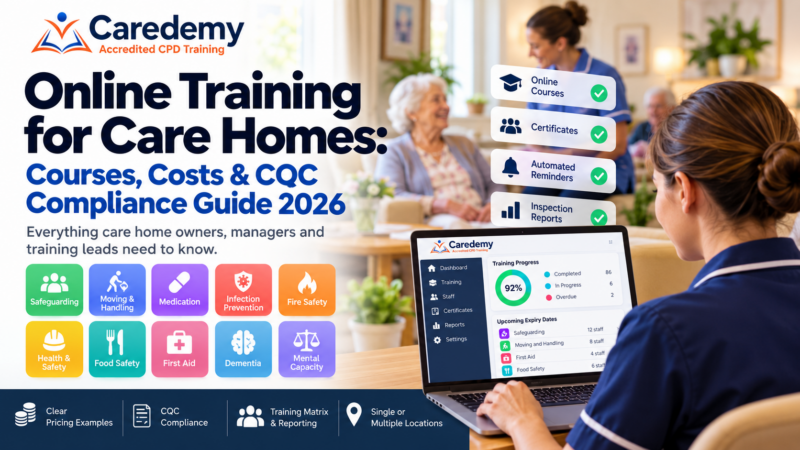
Online Training for Care Homes: Courses, Costs & CQC Compliance Guide 2026
A practical guide to care home training, costs and CQC requirements in 2026.
Running a care home means ensuring staff have the knowledge, skills and competence to provide safe, effective and person-centred care. Training is therefore not simply an induction exercise or a collection of certificates. It is part of how a care home demonstrates that its workforce is capable of meeting residents’ needs safely.
But what training does a care home actually need? Which courses can be completed online? When is practical competency assessment required? And how much should care home training cost?
This guide explains the main training areas care homes should consider in 2026, how online training fits alongside practical assessment, what CQC expects from providers and how to compare different care training providers and pricing models.
What online training does a care home need?
There is no single universal list of online courses that every care home employee must complete.
Instead, care homes should identify training requirements according to:
the employee’s role and responsibilities
the needs of the people receiving care
risks within the service
relevant legislation and statutory guidance
CQC requirements
organisational policies and procedures
professional requirements where applicable
individual learning and development needs.
Skills for Care’s current statutory and mandatory training guidance states that training should relate to the context of the setting, the needs of people accessing care and support, and workers’ individual roles and responsibilities.
CQC Regulation 18 also requires staff to receive the support, training, professional development, supervision and appraisal necessary for them to carry out their roles. CQC expects providers to assess learning and development needs when staff start employment and review them at appropriate intervals.
For most care homes, the training programme will therefore combine core training, induction, the Care Certificate, refresher training and role-specific learning.
Common areas include safeguarding, moving and handling, infection prevention and control, medicines, fire safety, health and safety, first aid, food safety, dementia awareness and mental capacity.
However, completing an online course does not automatically demonstrate that somebody is competent to perform a practical task.
That distinction is crucial.
Core training areas for care home staff
A care home’s training matrix should be built around the work its employees actually perform and the needs and risks of its residents.
The following areas commonly form part of a care home’s training programme.
Care Certificate
The Care Certificate provides a recognised set of standards for people beginning work in health and adult social care.
The Care Certificate was updated in 2025 and now contains 16 standards, with Awareness of Learning Disability and Autism added as Standard 16.
The standards cover areas including:
understanding your role
personal development
duty of care
equality, diversity, inclusion and human rights
person-centred working
communication
privacy and dignity
fluids and nutrition
mental health and dementia
adult safeguarding
safeguarding children
basic life support
health and safety
handling information
infection prevention and control
learning disability and autism awareness.
Online learning can support the knowledge elements of the Care Certificate.
However, the Care Certificate is not simply an e-learning certificate. Employers remain responsible for ensuring that workers can demonstrate the required knowledge, skills and behaviours in practice.
CQC’s current registration guidance for care homes specifically asks providers to identify how their staff training plan will meet the Care Certificate standards and align with Regulation 18 and other statutory and regulatory requirements.
Care home requirement: use online learning to support knowledge acquisition, but complete any required workplace assessment and competency evidence separately.
Safeguarding adults
Staff need to understand how to recognise, respond to and report abuse, neglect and other safeguarding concerns.
Training should reflect the worker’s level of responsibility. A care assistant, senior carer, safeguarding lead and registered manager may therefore require different levels of knowledge.
Relevant learning may include:
types and indicators of abuse
neglect and self-neglect
responding to disclosures
reporting concerns
whistleblowing
safeguarding procedures
record keeping
roles and responsibilities
escalation.
Safeguarding is also explicitly represented within CQC’s current assessment framework.
Suitable for online learning? Yes for substantial elements of knowledge and awareness, supported by organisational procedures, supervision and appropriate role-specific development.
Moving and handling
Moving and handling training is particularly important where staff support residents with transfers, mobility, repositioning or specialist equipment.
Online learning can cover subjects such as:
moving and handling legislation
risk assessment
safer principles
avoiding hazardous manual handling
equipment awareness
responsibilities of employees and employers.
But an online course cannot by itself demonstrate that somebody can safely use a hoist, sling or other moving and handling equipment.
CQC Regulation 12 requires equipment to be used safely and staff using equipment to have the necessary training, competency and skills.
Suitable for online learning? Yes for theory and knowledge. Practical instruction and competency assessment should be provided where staff undertake practical moving and handling activities.
Medication and medicines management
Care home staff involved in medicines need training appropriate to the responsibilities they perform.
Subjects may include:
medicines awareness
administration
storage
recording
MAR documentation
medication errors
controlled drugs
PRN medicines
covert administration
consent and capacity
safe disposal.
CQC Regulation 12 requires the proper and safe management of medicines and states that staff responsible for managing and administering medication must be suitably trained and competent, with competence kept under review.
This is another area where the distinction between knowledge and competence matters.
In a 2026 care-service assessment, CQC specifically identified a problem where staff had completed online medicines training but had not received appropriate in-person competency assessment.
Suitable for online learning? Yes for knowledge. Staff administering medicines should also have their practical competence assessed appropriately.
Infection prevention and control
Care home staff should understand how infections spread and how to reduce the risk to residents, colleagues and visitors.
Training commonly includes:
standard infection control precautions
hand hygiene
personal protective equipment
cleaning
waste
sharps
respiratory hygiene
outbreak management
transmission of infection.
Regulation 12 specifically requires providers to assess infection risks and prevent, detect and control the spread of infection.
Suitable for online learning? Yes, although workplace practice, policies and observation remain important.
Fire safety
Care home fire safety presents particular challenges because residents may have limited mobility, cognitive impairment or require assistance during evacuation.
Training requirements should reflect the care home’s fire risk assessment and each employee’s responsibilities.
Online training can support knowledge of:
fire prevention
common fire hazards
alarm procedures
evacuation principles
fire doors
extinguishers
individual responsibilities.
Staff may also need workplace-specific instruction and drills.
Suitable for online learning? Yes for underpinning knowledge, supplemented by practical and site-specific training where required.
Health and safety
Care home health and safety training can cover a broad range of risks, including:
slips, trips and falls
COSHH
workplace equipment
accident reporting
risk assessment
lone working
personal safety
hazardous substances
electrical safety
manual handling.
Training requirements should be proportionate to employees’ roles and workplace risks.
Suitable for online learning? Many health and safety subjects are well suited to e-learning, but practical training may be required for particular equipment or activities.
Food safety and hygiene
Care homes that prepare, handle or serve food need staff with appropriate food safety knowledge.
Different employees may require different levels of training depending on whether they simply assist residents at mealtimes or are directly involved in food preparation, handling or catering.
Subjects may include:
food hygiene
contamination
allergens
temperature control
cleaning
storage
personal hygiene
food safety management.
Suitable for online learning? Yes for knowledge-based food safety training, supported by safe workplace practice.
First aid and basic life support
Staff should receive first aid and emergency-response training appropriate to their responsibilities and the needs of the service.
CQC’s Regulation 18 guidance specifically includes first aid training within the learning and development that may be required for people working in adult social care.
Online training can provide valuable theoretical preparation, but courses involving practical skills may require practical demonstration and assessment.
Suitable for online learning? Theory can be delivered online. Where practical competence is required, appropriate hands-on assessment should also be completed.
Dementia training
Many care homes support people living with dementia, making dementia training a significant part of workforce development.
Training may include:
understanding dementia
communication
person-centred dementia care
behaviour and distress
nutrition and hydration
meaningful activity
safeguarding
end-of-life care
dementia medicines.
The depth of training should reflect residents’ needs and employees’ responsibilities.
Suitable for online learning? Yes, particularly for awareness and knowledge, combined with supervision and workplace development.
Mental capacity and consent
Staff should understand how the Mental Capacity Act 2005 affects care and support.
Training may include:
the principles of the Mental Capacity Act
assessing capacity
supporting decision-making
best-interests decisions
consent
restrictions and deprivation of liberty
record keeping.
Mental capacity also interacts with other areas including medicines, safeguarding and person-centred care.
For example, CQC Regulation 12 guidance specifically refers to Mental Capacity Act requirements when medicines are administered covertly.
Suitable for online learning? Yes for underpinning knowledge, with workplace application supported through policies, supervision and appropriate decision-making processes.
Role-specific care home training
Mandatory training should not become a generic checklist where every employee completes exactly the same courses.
A care home’s programme should reflect the people it supports.
Depending on the service, additional training might include:
pressure ulcer prevention
dysphagia
nutrition and hydration
falls prevention
epilepsy
diabetes
catheter care
stoma care
continence care
oxygen therapy
end-of-life care
palliative care
Parkinson’s disease
multiple sclerosis
learning disability
autism
positive behaviour support
tissue viability
PEG feeding
oral health
sepsis awareness
venepuncture
wound care.
A nursing home supporting people with complex clinical needs will therefore require a different training matrix from a residential home where residents require lower levels of clinical support.
Skills for Care explicitly advises that training requirements depend on the setting, worker’s responsibilities and needs of people receiving care.
Does care home training need refreshing every year?
Not every course automatically requires annual renewal.
This is another area where blanket statements about “CQC annual training” can be misleading.
Skills for Care’s current statutory and mandatory training guidance does not prescribe a universal refresher period for every additional training subject. Instead, employers should determine refresher requirements based on factors such as:
new risks
changes in people’s care needs
changes to the care environment
changes within teams
new care activities
changes to legislation, guidance or organisational policy
whether the employee remains competent.
Some subjects may have specific recommended or organisational renewal periods.
Your LMS should therefore allow managers to record different expiry and renewal dates for different courses, rather than simply treating all training as expiring annually.
Online training versus practical competency assessment
This is one of the most important distinctions when purchasing online care home training.
A certificate demonstrates that someone has completed a course and, where applicable, passed its knowledge assessment.
It does not automatically prove practical competence.
Consider these examples:
| Training area | Online learning | Additional evidence may be needed |
|---|---|---|
| Safeguarding awareness | Yes | Policies, supervision and role-specific application |
| Infection prevention | Yes | Observation of workplace practice where appropriate |
| Moving and handling | Theory | Practical instruction and competency |
| Medication | Theory | Workplace competency assessment |
| Basic life support | Theory | Practical demonstration where required |
| Fire safety | Theory | Site-specific procedures and drills |
| Care Certificate | Knowledge | Workplace assessment against applicable standards |
| Equipment use | Theory | Practical instruction and competency |
CQC Regulation 12 repeatedly refers to competence, skills and experience, not simply course completion.
Regulation 18 similarly states that staff should be supervised where appropriate until they demonstrate the required level of competence.
A strong care home training system should therefore track more than certificates.
It should help managers distinguish between:
Learning completed → knowledge assessed → practical competence demonstrated → competence maintained.
How much does care home training cost?
Online care home training prices vary significantly according to how training is purchased.
Common pricing models include:
| Pricing model | How it works | Usually suitable for |
|---|---|---|
| Individual courses | Pay each time a course is purchased | Individuals or occasional training |
| Bulk courses | Price per course falls as volume increases | Predictable training requirements |
| Course credits | Buy credits and allocate them as required | Flexible purchasing |
| Course bundles | Several related courses for one price | Defined mandatory or induction programmes |
| Per-learner subscription | Pay for each learner to access multiple courses | Care homes with ongoing requirements |
| Unlimited training | Learners access a large or complete course library | Staff requiring multiple courses |
| Bespoke organisational pricing | Negotiated contract | Larger providers and care groups |
Published UK pricing in 2026 ranges from low-cost individual courses through to approximately £24–£80+ per learner annually for some unlimited packages. The important issue is what is actually included.
A £5 course is not necessarily cheaper than a £5-per-month learner licence.
If an employee requires 15 individual £5 courses:
15 × £5 = £75 per employee.
A £5-per-month unlimited licence would cost:
£5 × 12 = £60 per employee per year.
The subscription may also include LMS functionality, reporting and additional courses.
This is why care homes should calculate the total annual training cost, rather than comparing headline course prices.
Care home training costs: worked examples
Caredemy’s currently published Team Training pricing provides an example of how a per-learner subscription works.
Published bands are:
10–30 learners: £5 per learner/month + VAT
31–50 learners: £4 per learner/month + VAT
51–100 learners: £3 per learner/month + VAT
101+ learners: quotation.
Based on those published prices:
| Care home workforce | Monthly cost | Approx. annual cost | Annual cost per employee |
|---|---|---|---|
| 20 staff | £100 | £1,200 + VAT | £60 |
| 40 staff | £160 | £1,920 + VAT | £48 |
| 60 staff | £180 | £2,160 + VAT | £36 |
| 100 staff | £300 | £3,600 + VAT | £36 |
These examples assume all staff require Team Training access for 12 months.
For comparison, suppose each employee needed 10 separate courses at £5 per course.
The equivalent course cost would be:
| Employees | Course enrolments | Cost at £5/course |
|---|---|---|
| 20 | 200 | £1,000 |
| 40 | 400 | £2,000 |
| 60 | 600 | £3,000 |
| 100 | 1,000 | £5,000 |
That comparison still does not tell the whole story.
Care homes should also consider whether the price includes:
additional courses during the year
refresher training
specialist training
Care Certificate learning
LMS access
training reports
certificates
new starters
replacement learners
manager accounts
compliance tracking
automated reminders
administrative support.
A cheap course price can become expensive when staff need numerous courses or turnover is high.
Conversely, a subscription may not represent good value for an organisation where employees only require one or two courses.
The correct calculation is:
Annual training cost + LMS charges + certificates + additional courses + new-starter costs + replacement licences + administration = true training cost.
What should a care home LMS include?
For a care home with dozens or hundreds of employees, buying courses is only one part of the problem.
Managers also need to know:
Who needs training? Who has started? Who has completed it? What is expiring? Who is overdue? And can we demonstrate all of this quickly?
This is where the learning management system becomes commercially important.
Training matrix
A care home LMS should provide a clear training or compliance matrix showing the status of training across the workforce.
Managers should be able to identify:
completed training
incomplete training
overdue training
upcoming renewals
courses assigned to each employee.
This becomes particularly valuable when preparing for audits, inspections and internal compliance reviews.
Expiry dates
Different subjects may have different refresher requirements.
The system should therefore record course completion and expiry dates rather than relying on managers to maintain separate spreadsheets.
Automated reminders
Managers should not have to manually email every employee whenever training becomes due.
Automated reminders can help reduce administration and minimise overdue training.
Inspection reporting
Training information should be easy to retrieve.
CQC Regulation 18 states that required learning and development should be monitored and appropriate action taken quickly when training requirements are not being met.
A useful LMS should therefore allow managers to produce clear evidence of training status rather than spending hours assembling records before an inspection.
Certificates
Certificates should be stored centrally and available for managers to access.
For larger organisations, bulk certificate downloading can significantly reduce administration.
Multiple care homes or locations
Care groups need visibility at both organisational and location level.
Ideally, senior managers should be able to review the organisation while individual managers can monitor their own care home or branch.
This enables management teams to identify compliance differences between locations.
Staff turnover
Staff turnover can substantially affect training costs.
If a care home pays for a 12-month licence and an employee leaves after two months, a replacement licence may need to be purchased unless the training provider allows learner replacements.
For organisations with frequent recruitment, this should be considered when comparing providers.
What training evidence might CQC consider?
CQC does not assess a care home’s training simply by counting certificates.
Its assessment framework considers broader evidence around areas including safe staffing, safeguarding, infection prevention and control, medicines optimisation, governance and workforce development.
In practical terms, care homes should be able to demonstrate that:
appropriate training requirements have been identified
staff have completed required learning
overdue training is identified and addressed
training reflects people’s needs
employees are competent to perform their duties
practical competencies are assessed where required
staff receive appropriate supervision
training needs are reviewed
records are accurate and accessible
learning translates into safe practice.
A certificate can form part of this evidence.
It should not be treated as the entire evidence base.
How to choose a care home training provider
Price matters, but it should not be the only procurement criterion.
Skills for Care advises employers to consider whether a learning provider monitors and evaluates its learning, provides learning flexibly and safely, uses suitably qualified or experienced trainers and assessors, helps employers select appropriate learning and appropriately supports and assesses learners.
Skills for Care also recommends checking whether programmes use current legislation, guidance and best practice and assess learners’ knowledge or skills fairly and reliably.
Use the following checklist when comparing providers.
Care home training provider comparison checklist
| Question | Check |
|---|---|
| Does the provider specialise in health or social care? | ☐ |
| Are courses regularly reviewed and updated? | ☐ |
| Does content reflect current legislation and guidance? | ☐ |
| Are courses independently accredited or quality assured where claimed? | ☐ |
| Is the current 16-standard Care Certificate available? | ☐ |
| Is there sufficient mandatory and role-specific training? | ☐ |
| Are learners assessed? | ☐ |
| Does the provider explain where practical competency is also required? | ☐ |
| Are certificates included? | ☐ |
| Can managers assign courses centrally? | ☐ |
| Is there a training/compliance matrix? | ☐ |
| Can managers monitor completion and expiry dates? | ☐ |
| Are automated reminders available? | ☐ |
| Can reports be produced for audits and inspections? | ☐ |
| Can certificates be downloaded in bulk? | ☐ |
| Does the system support multiple locations? | ☐ |
| Can departing employees be replaced without buying another full licence? | ☐ |
| Is manager training/support included? | ☐ |
| Is pricing transparent? | ☐ |
| Are there setup or hidden administration charges? | ☐ |
| Can the organisation access specialist courses as needs change? | ☐ |
Do not rely solely on marketing claims such as “CQC approved”.
CQC regulates care providers and regulated activities; purchasing a particular online course does not make a care home CQC compliant.
Compliance depends on what the provider does in practice.
Where does Caredemy fit?
Caredemy provides online health and social care training for individual learners and organisations, including care homes.
For care organisations requiring ongoing training, Caredemy Team Training currently includes access to a large online course library alongside LMS and compliance-management functionality.
Current published features include:
access to 250+ online courses
learner and course management
compliance reporting
colour-coded training reporting
automated training reminders
automated course renewal
bulk course assignment
bulk certificate access
multi-branch reporting
free learner replacements
free manager training and support
Care Certificate access
dedicated support
text-to-speech
translation functionality.
Caredemy also provides CPD-accredited online training.
Caredemy has documented historic Skills for Care Endorsed Provider status, including endorsement from July 2023 to July 2024. Skills for Care’s current quality assurance system is the Quality Assured Care Learning Service (QACLS), which assesses courses and qualifications under its current framework. These should not be represented as the same scheme.
For a care home, the main commercial benefit of a team-based model is therefore not simply access to courses.
It is the combination of:
training + learner management + compliance monitoring + reporting + certificates + refresher management.
This is particularly relevant to care homes where employees require numerous mandatory, induction, refresher and specialist courses throughout the year.
[Explore Caredemy Team Training]
Frequently asked questions about care home training
What mandatory training does a care home need?
There is no universal CQC list of courses that every employee in every care home must complete. Employers should identify statutory, mandatory and role-specific training according to employees’ responsibilities, workplace risks and the needs of people receiving care. Common subjects include safeguarding, moving and handling, infection prevention, medicines, health and safety, fire safety, first aid and food safety.
Does CQC require staff training?
Yes. Regulation 18 requires employees involved in regulated activities to receive appropriate support, training, professional development, supervision and appraisal necessary for their duties.
Does CQC require annual training?
Not every subject automatically requires annual renewal. Refresher frequency should reflect applicable requirements, risks, changes to guidance, the needs of the service and whether staff remain competent. Skills for Care’s current guidance specifically advises employers to determine refresher requirements based on relevant service and workforce factors.
Can all care home training be completed online?
No. Many knowledge-based elements can be delivered effectively online, but practical activities may require face-to-face instruction, workplace observation or competency assessment. Moving and handling, medicines administration and some first-aid skills are examples where online learning alone may not demonstrate competence.
Is online medication training sufficient for care home staff?
Online medication training can provide the required underpinning knowledge, but staff responsible for administering medicines must also be competent. CQC Regulation 12 states that staff responsible for managing and administering medicines must be suitably trained and competent.
Can moving and handling training be completed online?
Moving and handling theory can be delivered online. Employees who physically move or assist people or use specialist equipment may also require practical training and competency assessment appropriate to their duties.
How many Care Certificate standards are there in 2026?
There are 16 Care Certificate standards. The standards were updated in 2025 with Awareness of Learning Disability and Autism becoming Standard 16.
Does every care worker need the same training?
No. Training should be appropriate to the employee’s role and the needs of the people they support. A kitchen assistant, care assistant, senior carer, nurse and registered manager will not necessarily require identical training.
How much does online care home training cost?
Pricing varies considerably. Individual online courses can cost approximately £5–£15 or more, while team subscriptions can reduce the effective cost where employees require numerous courses. Caredemy’s current published Team Training prices range from £3–£5 per learner/month for organisations with 10–100 learners, depending on workforce size, excluding VAT.
Is unlimited care training cheaper than buying individual courses?
It depends on how many courses each employee requires. Pay-per-course training can be economical where only a few courses are needed. An unlimited subscription can become more cost-effective when employees need multiple mandatory, induction, refresher and specialist courses.
What is a care home training matrix?
A training matrix provides an overview of employee training requirements and completion status. It can show which courses employees have completed, which are outstanding and which are approaching renewal or expiry.
Do care homes need to keep staff training certificates?
Care homes should maintain appropriate evidence of employees’ learning and development. Certificates can provide useful evidence of course completion, but providers should also maintain evidence of practical competency where required.
What should a care home training LMS do?
A suitable LMS should allow managers to assign training, monitor progress, identify overdue courses, track renewals, access certificates and produce compliance reports. Larger organisations may also require multi-location reporting and central oversight.
Does completing an online course prove competence?
Not necessarily. An online course can demonstrate completion and assess knowledge. Practical competence may need to be demonstrated through workplace observation, practical assessment, supervision or another appropriate competency process.
Is Caredemy CQC approved?
CQC does not operate a general approval scheme for commercial online training providers. Caredemy courses can support employers with learning relevant to CQC requirements, but responsibility for regulatory compliance remains with the registered care provider.
Is Caredemy Skills for Care endorsed?
Caredemy has documented historic Skills for Care Endorsed Provider status, including endorsement from July 2023 to July 2024. Skills for Care now operates the Quality Assured Care Learning Service for current course and qualification quality assurance, so historical provider endorsement and current QACLS quality assurance should be distinguished.
What should I look for when comparing care home training companies?
Compare course coverage, quality, assessment, accreditation or quality-assurance evidence, LMS functionality, reporting, certificates, renewal management, practical competency requirements, customer support and total annual cost. Do not compare providers using course price alone.
How can care homes reduce training administration?
Using a central LMS can reduce manual administration by automating course assignment, reminders, renewal tracking, reporting and certificate management. Free learner replacement can also reduce administration and cost where staff turnover is high.
What happens when a member of staff leaves?
This depends on the training provider. Some subscriptions attach the licence permanently to the original employee, while others allow replacement learners. Caredemy Team Training includes free learner replacement, which can be particularly useful for care organisations experiencing staff turnover.
What evidence should a care home have ready for CQC?
Providers should be able to demonstrate how training needs are identified, what employees have completed, whether outstanding requirements are being addressed, how competency is assessed where required and how learning relates to employees’ roles and the needs of residents.
The objective should not simply be to produce certificates.
It should be to demonstrate that the organisation has a trained, supported and competent workforce capable of delivering safe and person-centred care.
Simplify care home training with Caredemy
Managing training across a care home can quickly become complicated.
New starters need induction. Existing staff need refreshers. Different roles need different courses. Specialist needs change. Certificates expire. Employees leave and new employees join.
Caredemy Team Training brings online learning and compliance management together in one system.
Care organisations can access 250+ online courses, assign training, monitor learner progress, manage certificates, receive automated reminders and produce clear compliance reports.
With volume pricing, free learner replacements, multi-branch reporting and manager support, Team Training is designed for organisations that need more than occasional individual courses.