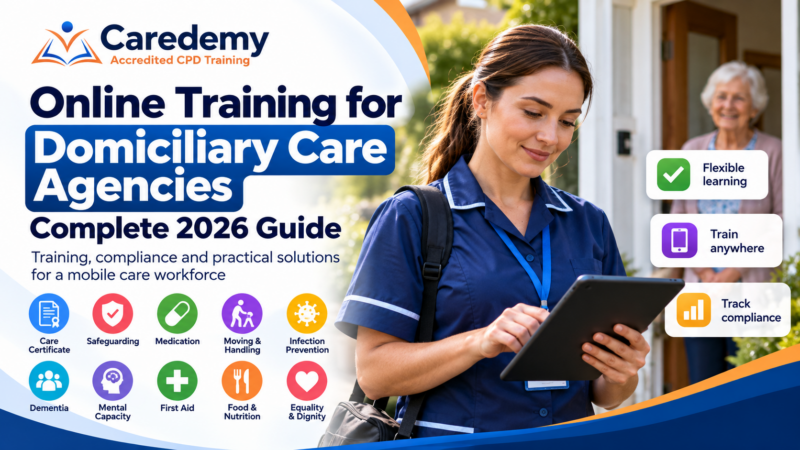
Online Training for Domiciliary Care Agencies: Complete 2026 Guide
A Practical Guide to Home Care Training and Compliance.
Online training for domiciliary care agencies should cover the knowledge, skills and behaviours care workers need to provide safe, person-centred care in people’s own homes. This will typically include the Care Certificate for workers new to care, safeguarding, medication, moving and handling, infection prevention and control, health and safety, lone working, mental capacity, dignity, equality, nutrition and hydration, first aid and any additional training required for the individual worker’s role and the people they support.
There is not one universal CQC-approved list of courses that every domiciliary care worker must complete.
Instead, home care providers must identify the training their workforce requires according to staff responsibilities, risks, the regulated activities being delivered and the needs of people receiving care.
Under Regulation 18 of the Health and Social Care Act 2008 (Regulated Activities) Regulations 2014, providers must ensure staff receive the support, training, professional development, supervision and appraisal necessary to carry out their roles. CQC guidance also requires providers to assess training and development needs at the beginning of employment and review them at appropriate intervals.
For domiciliary care agencies, however, training presents a particular challenge.
Care workers may rarely visit an office. They work across different locations, frequently work alone and may need to complete training around changing rotas, evenings or weekends. Managers must therefore not only provide appropriate training but also maintain evidence of learning, competency and compliance across a geographically dispersed workforce.
This guide explains what domiciliary care training typically involves, how to manage training for mobile care teams and how much different online training models can cost in 2026.
What Training Do Domiciliary Care Workers Need?
The exact training required depends on the care worker’s responsibilities and the people they support.
Skills for Care distinguishes between statutory training applying across the adult social care workforce and mandatory or additional training determined by employers according to roles and service needs. Its current guidance identifies areas including health and safety awareness, fire safety, moving and handling objects, infection prevention and control, safeguarding adults and learning disability and autism awareness among statutory training categories.
Other learning may become necessary because a worker administers medication, assists people with mobility, supports someone with dementia or epilepsy, prepares food, carries out delegated healthcare tasks or encounters other specific risks.
A sensible training matrix should therefore contain a core requirement for relevant staff plus role-specific and person-specific learning, rather than automatically assigning every available course to every employee.
Care Certificate
The Care Certificate remains an important foundation for workers who are new to health and social care.
The Care Certificate standards were updated in March 2025. There are now 16 standards, with learning disability and autism awareness added as Standard 16. The standards define the knowledge, skills and behaviours expected of relevant health and social care workers and can be used to structure induction.
Domiciliary and home care workers are specifically among the roles for which the standards may be relevant.
The Care Certificate should not, however, be treated as simply an online course and multiple-choice test.
Employers must ensure that employees can demonstrate the required skills and competence in practice. Skills for Care states that new staff should receive appropriate training, supervision and workplace assessment before working unsupervised.
Online learning can deliver much of the underpinning knowledge efficiently, while the employer remains responsible for workplace observation, assessment and sign-off where required.
The Care Certificate standards should also not be confused with the Level 2 Adult Social Care Certificate qualification. The latter is an Ofqual-regulated qualification involving formal assessment and does not replace the Care Certificate standards used for induction.
Safeguarding Adults
Home care workers are often in a particularly important position for identifying safeguarding concerns.
Because they visit people in their own homes, workers may notice signs of:
physical abuse;
neglect or acts of omission;
financial abuse;
domestic abuse;
psychological or emotional abuse;
discriminatory abuse;
organisational abuse;
self-neglect;
sexual abuse;
modern slavery.
Training should help workers recognise indicators of abuse or neglect, understand their safeguarding responsibilities, respond appropriately to disclosures and know how and when concerns should be reported.
Safeguarding training should reflect the worker’s responsibilities and local organisational procedures.
Medication Training
Medication is one of the areas where online knowledge training must be supported by competency assessment.
CQC guidance for home care providers states that workers should only provide medicines support when it is clearly documented in the care plan. Relevant training and support must be provided to workers involved in medicines support.
CQC also states that home care workers providing medicines support must have the necessary knowledge and skills, that these should be updated annually and that competency assessments should include observation.
Medication learning may cover:
safe administration;
prompting and assisting;
Medicines Administration Records (MARs);
medication errors;
storage;
refusals;
PRN medication;
controlled drugs;
reporting concerns;
consent;
record keeping.
Additional training and assessment may be required for specialist or delegated healthcare tasks.
An online medication course can therefore provide essential knowledge, but course completion alone should not automatically be treated as evidence that somebody is competent to administer medicines.
Moving and Handling
Training requirements should reflect the actual activities performed.
Workers who assist people with moving and positioning need appropriate training in areas such as risk assessment, safe movement, dignity, equipment and the limits of their responsibilities.
Skills for Care’s December 2025 statutory and mandatory training guidance says assisting and moving people training is required where the worker has responsibilities to support people with these activities. Learning should be refreshed when needs, risks, activities or equipment change, and at least every three years if no additional training has been undertaken within that period.
Practical competency remains critical.
If staff use hoists, slide sheets or other moving and handling equipment, employers should ensure that workers are competent with the actual procedures and equipment they will use.
Infection Prevention and Control
Domiciliary care creates different infection-control challenges from residential care.
Workers move between multiple people’s homes during a shift and may encounter different environments, equipment and infection risks.
Training should address areas such as:
hand hygiene;
PPE;
infection transmission;
safe disposal of waste;
respiratory hygiene;
cleaning;
exposure incidents;
preventing cross-contamination between visits.
Staff should also understand the agency’s infection prevention procedures and any person-specific requirements within care plans.
Lone Working
Lone working is particularly important in domiciliary care because staff routinely provide care without another colleague present.
Risks can include:
challenging behaviour;
violence or aggression;
unsafe environments;
travel;
entering unfamiliar homes;
manual handling;
emergencies;
inability to summon immediate assistance.
HSE guidance states that lone workers may require additional training because it can be harder for them to obtain help. Workers should understand the risks involved, how those risks are controlled, the limits of what they should do alone and when to seek advice or assistance.
A domiciliary care agency should combine training with appropriate lone-working risk assessments, communication procedures and escalation arrangements.
Health and Safety
Health and safety awareness should reflect the fact that care workers operate in environments controlled primarily by the people receiving care rather than by their employer.
Workers may encounter:
slips and trips;
unsafe electrical equipment;
hazardous substances;
pets;
smoking;
poor lighting;
unsafe access;
fire risks;
manual handling hazards;
violence or aggression.
Training should help workers recognise hazards, follow risk assessments and report changes in the home environment.
Mental Capacity and Consent
Workers supporting adults who may have difficulty making particular decisions need to understand the principles of the Mental Capacity Act 2005.
The Act is decision-specific: a person should not simply be described as having or lacking capacity for every decision.
Paid health and social care workers supporting people who may lack capacity have a legal duty to have regard to the Mental Capacity Act Code of Practice.
Relevant learning should cover:
the five statutory principles;
presumption of capacity;
supporting people to make decisions;
assessing capacity;
best-interests decisions;
consent;
restrictive practices;
record keeping;
recognising when further advice is required.
Dementia Awareness
Dementia training is particularly relevant where an agency supports people living with dementia.
Training can help care workers understand:
different types of dementia;
how dementia can affect cognition and behaviour;
communication;
person-centred support;
distress;
independence;
dignity;
nutrition;
safeguarding;
capacity and consent.
More advanced or specialist training may be appropriate depending on the complexity of people’s needs.
Equality, Diversity and Dignity
Care takes place inside a person’s private home.
Respect for privacy, choice, beliefs, relationships, culture and personal preferences is therefore fundamental.
CQC Regulation 10 requires service users to be treated with dignity and respect, while equality duties are underpinned by the Equality Act 2010.
Workers should understand discrimination, protected characteristics, inclusive practice, privacy, dignity and person-centred care.
Food, Nutrition and Hydration
Some home care workers prepare meals, support people to eat or drink or monitor nutrition and hydration.
Training requirements should reflect those responsibilities.
Relevant topics may include:
food hygiene;
safe preparation and storage;
allergies;
nutrition and hydration;
recognising dehydration or malnutrition;
recording food and fluid intake;
supporting choice and independence;
dysphagia awareness where relevant.
Workers supporting somebody with dysphagia or a prescribed texture-modified diet may require additional role-specific training and competency support.
First Aid and Basic Life Support
The appropriate level of first aid training should be determined through the employer’s needs assessment and the worker’s responsibilities.
Skills for Care’s current guidance says employers are responsible for determining how many workers need first aid training and at what level. It recommends formal basic life support learning when identified or at least annually, while formal first aid training is generally refreshed every three years.
For domiciliary care providers, the assessment should take account of staff working alone and potentially being the only person present when a medical emergency occurs.
Role-Specific Training
Core mandatory training is only the starting point.
Additional courses may be required according to the people an agency supports.
Examples include:
diabetes;
epilepsy;
catheter care;
continence care;
PEG feeding;
pressure ulcer prevention;
oxygen therapy;
end-of-life care;
learning disability;
autism;
mental health;
stroke awareness;
Parkinson’s disease;
multiple sclerosis;
acquired brain injury;
positive behaviour support;
delegated healthcare tasks.
CQC’s current registration guidance specifically expects a home care agency’s training plan to reflect the service-user groups identified in its application and Statement of Purpose.
That principle should continue after registration: training should follow the needs of the people the organisation actually supports.
How Often Should Domiciliary Care Training Be Refreshed?
There is no single rule stating that every care course must automatically be repeated annually.
Skills for Care advises that refreshing learning should not become a simple tick-box repetition exercise.
Refreshers may be triggered by:
legislation or guidance changing;
new best practice;
a new risk;
changes to someone’s care needs;
new equipment;
an incident or near miss;
competency concerns;
organisational policy;
commissioner requirements;
recommended refresher intervals.
Some areas have more specific expectations. CQC’s home-care medicines guidance, for example, states that medicines knowledge and skills should be updated annually and supported by observed competency assessment.
A good learning management system should therefore allow managers to set renewal periods according to the subject rather than forcing every course onto an identical expiry schedule.
Training a Mobile Domiciliary Care Workforce
The biggest operational difference between a care home and a domiciliary care agency is simple:
your workforce is rarely in one place.
A residential care provider may be able to organise a classroom session for staff working within one building.
A domiciliary care manager may have 50 care workers spread across an entire county, working split shifts and travelling between people’s homes.
Training infrastructure therefore matters almost as much as course content.
Mobile-Friendly Learning
Care workers should be able to access learning on:
smartphones;
tablets;
laptops;
desktop computers.
Requiring workers to travel to the office simply to log into a training platform undermines one of the major advantages of e-learning.
Mobile-friendly course design allows staff to complete suitable knowledge-based training wherever appropriate.
Training From Home
Online training can remove substantial logistical costs for domiciliary care providers.
Instead of repeatedly organising training rooms, travel and large group sessions, suitable knowledge learning can be completed remotely.
This is particularly valuable for agencies covering large geographic areas.
However, remote learning does not remove the employer’s responsibility to assess practical competence where required.
A useful model is:
online knowledge learning + supervision + practical assessment/observation where required.
Tracking Remote Learners
The manager needs visibility even when the learner is remote.
A suitable LMS should show:
courses assigned;
courses started;
courses completed;
overdue learning;
assessment results;
renewal dates;
certificates.
Without central reporting, training records can quickly become fragmented between spreadsheets, emails, paper certificates and individual learner accounts.
Certificates
Certificates provide useful evidence that learning has been completed, but agencies should distinguish between:
course completion evidence and evidence of workplace competence.
For subjects such as medicines administration or moving and assisting people, additional observation and competency records may be necessary.
Managers should ideally be able to access certificates centrally rather than relying on every employee to forward them individually.
Automated Training Reminders
Manually chasing 100 employees about expiring courses creates unnecessary administration.
Automated reminders can alert learners when:
training has been assigned;
a deadline is approaching;
learning is overdue;
refresher training is due.
This becomes increasingly important as an agency grows.
Managing New Starters
Recruitment in home care is continuous for many agencies.
Training systems therefore need to support rolling onboarding rather than one annual training event.
A new worker may require:
organisational induction;
Care Certificate learning where appropriate;
statutory and mandatory training;
shadowing;
supervision;
workplace competency assessment;
person-specific training.
Managers should be able to assign appropriate courses quickly without rebuilding a training programme for every new employee.
High Staff Turnover
Turnover changes the economics of training.
Imagine an agency purchasing a 12-month licence for a care worker who leaves after six weeks.
If that licence cannot be transferred, the agency may then need to buy another licence for the replacement worker.
For a mobile workforce with regular recruitment, learner replacement policies should therefore form part of the purchasing decision.
Ask potential training providers:
If one of our carers leaves, can we replace that learner without buying another annual licence?
The answer can materially change the real annual cost of training.
Training Matrices
A training matrix gives managers an organisation-wide view of compliance.
Instead of checking individual certificates one at a time, managers should be able to identify:
compliant learners;
upcoming renewals;
overdue courses;
incomplete training;
missing training.
For domiciliary care agencies, this is particularly useful because workers may have little routine contact with the central office.
Multiple Branches
Larger home care providers may operate from several branches.
A suitable system should allow senior managers to monitor the whole organisation while still making it practical for branch managers to oversee their own teams.
Consider whether a provider supports:
branch or group structures;
different managers;
central reporting;
local reporting;
organisation-wide training assignment;
branch-level compliance monitoring.
Compliance Reporting
CQC Regulation 18 guidance says required learning and development should be monitored and appropriate action taken quickly when training requirements are not being met.
That makes reporting more than an administrative convenience.
A strong system should enable a registered manager to answer questions such as:
Who is currently compliant?
Whose training has expired?
Which workers have not completed medication training?
Which new starters are still completing induction?
Which employees require refresher training?
Can we produce evidence quickly for an audit or inspection?
How Much Does Domiciliary Care Training Cost?
Online care training is sold through several different pricing models.
The cheapest model depends on:
number of carers;
number of courses required per employee;
staff turnover;
Care Certificate requirements;
specialist training requirements;
frequency of refresher learning;
whether an LMS is included;
whether replacement learners are charged;
whether reporting and certificates are included.
PAYG Training
Pay-as-you-go means purchasing each course enrolment separately.
This works particularly well where workers need only a few courses or where an organisation wants maximum flexibility.
The disadvantage is that costs multiply as more courses are required.
For example:
25 carers × 10 courses × £5 = £1,250
If those workers require 15 courses:
25 × 15 × £5 = £1,875
At that point, an unlimited package may become competitive.
Training Credits
Credits allow an agency to buy training in bulk and allocate courses later.
This can suit agencies with:
changing staffing levels;
unpredictable recruitment;
different learning requirements between employees;
no desire to commit every employee to an annual unlimited licence.
Check whether credits expire and whether one credit always equals one course.
Per-User Subscriptions
A subscription normally charges for each learner rather than each course.
The advantage is predictable budgeting.
For example:
50 carers × £4 per month × 12 months = £2,400 per year.
The crucial questions are what courses are included and whether departed workers can be replaced.
Unlimited Training
Unlimited access can be attractive when each worker requires numerous induction, mandatory, refresher and specialist courses.
But “unlimited” should not automatically be assumed to be cheapest.
Compare the actual annual cost against the number of courses employees are likely to complete.
Caredemy Domiciliary Care Training Costs
Caredemy currently provides PAYG, bulk course purchasing, credits and team subscription options. Published prices exclude VAT.
Its current PAYG volume pricing for standard individual CPD courses reduces as purchasing volume increases, while its team subscription provides unlimited access to the course library alongside LMS and compliance functionality.
Current published Team Training rates are:
| Number of learners | Price per learner/month | Approx. annual cost per learner |
|---|---|---|
| 10–30 | £5 + VAT | £60 |
| 31–50 | £4 + VAT | £48 |
| 51–100 | £3 + VAT | £36 |
| 101+ | Quote | Quote |
This produces the following illustrative annual subscription costs.
| Domiciliary care workforce | Monthly cost | Approx. annual cost |
|---|---|---|
| 10 carers | £50 | £600 + VAT |
| 25 carers | £125 | £1,500 + VAT |
| 50 carers | £200 | £2,400 + VAT |
| 100 carers | £300 | £3,600 + VAT |
| 250 carers | Bespoke quote | Bespoke quote |
For 250 carers, a quotation should be obtained rather than extrapolating a price that is not publicly advertised.
What About PAYG?
For agencies requiring fewer courses, PAYG can sometimes cost less.
Caredemy pricing currently publishes the following bulk standard-course rates:
| Number of course enrolments | Published price per course |
|---|---|
| 5–9 | £9.49 |
| 10–29 | £8.49 |
| 30–49 | £7.99 |
| 50–99 | £6.49 |
| 100–249 | £4.99 |
| 250–499 | £3.99 |
| 500–999 | £2.49 |
| 1,000–1,999 | £1.99 |
| 2,000+ | £1.45 |
For example, an agency with 10 carers requiring five courses each would need 50 enrolments:
50 × £6.49 = £324.50 + VAT
The published unlimited Team Training price for those 10 carers would be:
10 × £5 × 12 = £600 + VAT
PAYG could therefore be cheaper if those workers genuinely only require five online courses.
At 15 courses each:
150 enrolments × £4.99 = £748.50 + VAT
The £600 unlimited subscription becomes financially competitive before considering its additional LMS features.
The lesson is simple:
Compare total annual training requirements rather than headline course prices.
Credits
Caredemy’s credit packages currently state that credits do not expire and one credit can be used for one individual course.
Published rates range from £8.43 per credit for 10 credits through progressively lower volume bands to £1 per credit for 4,000 credits.
Credits can be particularly useful for domiciliary agencies where recruitment and course requirements fluctuate but unlimited access is unnecessary.
Why Staff Turnover Changes the Calculation
Suppose a domiciliary care agency employs 50 carers but replaces 15 employees during the year.
A provider charging purely for named annual licences could effectively require the organisation to purchase access for 65 people.
A transferable licence changes that calculation.
Caredemy Team Training currently includes free learner replacement with its subscription package, alongside access to the full course library.
This is particularly relevant to domiciliary care because workforce churn can make a seemingly inexpensive per-user price considerably more expensive if licences cannot be reassigned.
Choosing a Domiciliary Care Training Provider
Do not choose an e-learning platform solely by comparing the price of one course.
Use a broader buyer checklist.
| Question | Why it matters |
|---|---|
| Does the provider offer relevant adult social care courses? | Your training library must reflect your service and the people you support. |
| Is the provider experienced in health and social care? | Generic workplace learning may not adequately address care-specific scenarios. |
| Is training CPD accredited where appropriate? | Provides external recognition of learning standards. |
| Is the provider Skills for Care endorsed? | Skills for Care Endorsement provides an additional quality benchmark for adult social care learning providers. |
| Can carers learn on mobile devices? | Essential for a geographically dispersed workforce. |
| Can staff train remotely? | Reduces unnecessary travel and office-based training administration. |
| Is an LMS included? | Centralises assignments, progress and records. |
| Is there a training matrix? | Helps managers identify compliance gaps quickly. |
| Can managers download certificates? | Avoids chasing employees individually. |
| Can certificates be downloaded in bulk? | Valuable for audits and large teams. |
| Are automated renewal reminders available? | Reduces manual compliance administration. |
| Can courses be assigned in bulk? | Important during induction and refresher campaigns. |
| Can different course bundles be created? | Useful for different job roles. |
| Are learner licences replaceable? | Particularly important for staff turnover. |
| Can multiple branches be managed? | Important for expanding and multi-location providers. |
| Does the platform provide audit/compliance reports? | Managers need evidence, not merely course access. |
| Does it support accessible learning? | Training needs to work for a diverse workforce. |
| Are practical competency requirements clearly distinguished? | E-learning certificates should not be misrepresented as practical competence. |
| Is support available? | Managers need rapid assistance when onboarding or reporting problems. |
| Are there hidden setup or LMS fees? | Headline prices can otherwise be misleading. |
| What happens when the organisation grows? | Pricing and administration should scale with the workforce. |
Caredemy for Domiciliary Care Agencies
Caredemy Team Training is designed for organisations that need to combine online learning with centralised workforce management.
Current published features include:
access to 200+ CPD courses through Team Training;
mobile, tablet, laptop and desktop access;
learner management;
audit compliance and reporting;
colour-coded reporting matrix;
bulk course assignment;
bulk certificate download;
downloadable workbooks;
automated course renewal;
course bundles;
Care Certificate access with subscription plans;
free manager training;
free learner replacement;
dedicated account management;
text-to-speech functionality;
translation functionality;
no setup charges;
a best-price guarantee.
The wider Caredemy course library now advertises access to 250+ courses, covering areas including mandatory and statutory training, safeguarding, moving and handling, medication and medicines, mental health, first aid, health and safety, food safety and management and leadership.
For a domiciliary care agency, the commercial advantage is therefore not simply access to online courses.
It is the ability to manage training across a dispersed workforce from one platform.
A registered manager can assign learning, monitor progress, identify gaps, manage certificates and track renewals without requiring every care worker to attend the office simply to manage their training record.
Online Training Does Not Replace Practical Competency
This distinction is essential.
Online learning is highly effective for delivering and assessing knowledge.
It does not mean every care activity can be signed off remotely.
Practical assessment, supervision or observation may still be required for areas such as:
moving and assisting people;
medicines administration;
delegated healthcare tasks;
specialist equipment;
clinical procedures;
practical first aid skills where required;
Care Certificate competency outcomes.
CQC’s medicines guidance is particularly explicit: workers administering or supporting medicines need appropriate training and their competency should be assessed, including through observation.
Domiciliary care providers should therefore use e-learning as part of a wider learning and competency framework rather than treating an online certificate as proof of competence for every practical task.
Building an Effective Domiciliary Care Training System
A scalable home care training strategy can be built around five stages:
1. Define the core training matrix.
Identify statutory requirements and the subjects required across relevant roles.
2. Create role-based training pathways.
A care worker, senior carer, field care supervisor, coordinator and registered manager will not necessarily require identical learning.
3. Add person-specific learning.
Review care plans and the needs of people receiving support to identify specialist requirements such as dementia, diabetes, epilepsy, PEG feeding or end-of-life care.
4. Combine knowledge with competency.
Use online learning for knowledge acquisition while maintaining practical assessment, supervision and workplace observations where required.
5. Monitor continuously.
Use an LMS or training matrix to identify upcoming renewals, incomplete courses, new starters and emerging learning requirements.
This is closer to what CQC expects than simply purchasing a generic “mandatory training bundle” and assigning it to everyone indefinitely.
Frequently Asked Questions
What training is mandatory for domiciliary care workers?
There is no single universal course list applying identically to every domiciliary care worker. Employers must identify statutory, mandatory, role-specific and person-specific training according to the worker’s responsibilities, workplace risks and the needs of people receiving care. Common areas include safeguarding, health and safety, infection prevention, moving and handling, medication where relevant, first aid/basic life support, mental capacity, dignity, equality and role-specific learning.
Do domiciliary care workers need the Care Certificate?
The Care Certificate standards are designed to support induction for relevant workers who are new to health and social care. The updated 2025 Care Certificate contains 16 standards. Employers must also assess workplace competence rather than relying solely on online learning.
Can domiciliary care training be completed online?
Many knowledge-based subjects can be delivered effectively online. Practical skills and competency must still be assessed appropriately where required. Online learning should therefore form part of the agency’s overall training, supervision and competency framework.
Does CQC accept online training?
CQC’s focus is not simply whether learning was delivered online or face-to-face. Providers must demonstrate that staff receive appropriate training and are competent to perform their roles. Regulation 18 requires appropriate training, development, supervision and appraisal.
How often should care workers repeat mandatory training?
There is no universal annual renewal rule for every subject. Refreshers should reflect legislation, guidance, risks, worker competence, changing care needs and organisational or commissioner requirements. Skills for Care publishes recommended refresher frequencies for particular areas.
Does medication training need a practical assessment?
Workers providing medicines support need appropriate knowledge and skills. CQC guidance for home care providers states that competency assessments should include observation and medicines knowledge and skills should be updated annually.
Is moving and handling online training enough?
Online learning can provide underpinning knowledge, but workers who physically assist people need to demonstrate that they can perform relevant tasks safely. Training and assessment should reflect the people, equipment and techniques involved.
What training do lone home care workers need?
Lone-working training should help staff understand risks, control measures, emergency procedures, communication systems, personal safety, the limits of what they can safely do alone and when to obtain assistance. HSE states that lone workers may require additional training because immediate help and supervision are less readily available.
How should a domiciliary care agency track training?
A central LMS or training matrix is usually preferable to relying on separate spreadsheets and employee-held certificates. Managers should be able to see assigned, completed, overdue and expiring training and retrieve certificates and compliance evidence.
What is the cheapest way to train domiciliary care staff?
It depends on training volume. PAYG can be economical when employees need only a few courses. Credits provide flexibility where training demand varies. Unlimited subscriptions can become more attractive when employees need numerous induction, mandatory, refresher and specialist courses. Staff turnover and whether learner licences can be replaced should also be included in the calculation.
How much does Caredemy Team Training cost?
Current published prices are £5 per learner/month for 10–30 learners, £4 for 31–50 and £3 for 51–100, excluding VAT. Organisations with 101+ learners should request a quotation. Pricing should always be checked before purchase because rates and offers can change.
Can a training licence be transferred when a care worker leaves?
This depends on the provider. Caredemy Team Training currently includes free learner replacement with its subscription option, which can be particularly useful for domiciliary care organisations managing staff turnover.
Can one system manage several home care branches?
Some learning management systems support multi-team or organisational management. Agencies operating multiple branches should specifically check whether managers can monitor individual teams while senior staff retain organisation-wide reporting.
Make Domiciliary Care Training Easier to Manage
Running a domiciliary care agency means managing learning across a workforce that may rarely be together in one location.
The right training system should therefore do more than provide courses.
It should help you:
onboard new starters;
train staff remotely;
assign role-specific learning;
monitor completion;
identify overdue training;
manage refresher learning;
access certificates;
replace departing learners;
track compliance;
prepare evidence for audits and inspections.
Caredemy Team Training combines access to a large library of online health and social care courses with learner management, compliance reporting, a colour-coded training matrix, bulk certificate management, automated course renewals and free learner replacements.
For organisations that do not require unlimited training, Caredemy pricing options also include PAYG course purchasing and non-expiring training credits.
Training a mobile care workforce? Explore Caredemy Team Training and compare the most cost-effective option for your agency.