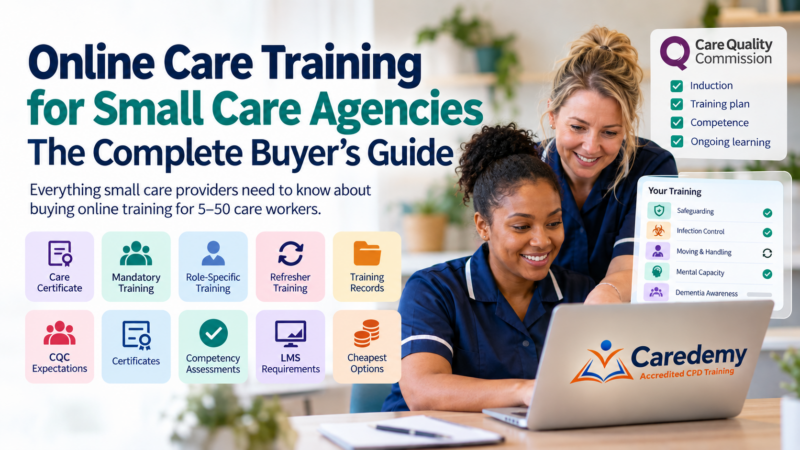
Online Care Training for Small Care Agencies: The Complete Buyer’s Guide
A practical guide to choosing cost-effective online training for small care teams.
For a small care agency, choosing online training is not simply a matter of finding the cheapest course.
If you employ 5–50 care workers, you need a training system that helps you answer five practical questions:
What training does each employee need? When is it due? Have they completed it? Can they demonstrate competence where required? Can you produce evidence when you need it?
That means looking beyond the headline price and considering course coverage, the Care Certificate, refresher training, certificates, competency assessment, staff turnover and the learning management system (LMS).
CQC Regulation 18 requires providers to ensure staff receive the appropriate support, training, professional development, supervision and appraisal necessary for their roles. CQC also expects providers to identify learning and development needs when somebody starts employment and review those needs at appropriate intervals.
For small providers, the objective should therefore be straightforward:
Buy the training your workforce actually needs, while making it as easy as possible to demonstrate that training and competence are being properly managed.
This guide explains how.
What Training Do New Care Agencies Need?
There is no single universal list of online courses that every care agency must buy.
The training you require should reflect:
the regulated activities you provide
the roles performed by your staff
the needs of the people you support
risks associated with those activities
relevant legislation and guidance
individual learning and competency needs
your own policies and procedures.
This distinction matters.
CQC Regulation 18 refers to statutory training, mandatory training defined by the provider and additional training required for staff to perform their duties safely.
For a domiciliary care agency supporting older adults, for example, the training matrix may include subjects such as safeguarding adults, infection prevention and control, moving and handling, medicines, health and safety, fire safety, food safety, basic life support, equality and diversity, mental capacity, dementia and duty of care.
An organisation supporting people with learning disabilities or autistic people may require additional role-specific learning.
A provider supporting people with complex medication needs may need more extensive medicines training and competency assessment.
The correct starting point is therefore not:
“What courses does CQC require?”
It is:
“What knowledge, skills and competence do our staff need to provide the service described in our Statement of Purpose safely and effectively?”
This is particularly relevant to new providers. CQC’s current registration guidance requires home care agencies, supported living services and care homes to submit a staff training plan. The plan should show how the provider intends to meet the Care Certificate standards and relevant statutory and regulatory requirements, and it should reflect the service-user groups identified in the application and Statement of Purpose.
New Starter Training
Every new employee should receive an appropriate induction.
CQC’s Regulation 18 guidance specifically states that providers must have an induction programme that prepares staff for their role. Training and development needs should also be assessed when the person starts employment.
For a new care worker, induction may combine:
online knowledge training
company policies and procedures
orientation to the service
information about the people they will support
shadowing experienced staff
practical instruction
supervision
competency assessments
the Care Certificate where appropriate.
This is why buying an online “mandatory training bundle” should not be confused with delivering a complete induction programme.
Online learning can provide and assess knowledge efficiently, but some elements of care work require observation and workplace competency assessment.
The Care Certificate
The Care Certificate remains an important framework for people beginning work in health and adult social care.
The Care Certificate standards were updated in March 2025 and there are now 16 standards, including Standard 16: Awareness of Learning Disability and Autism.
The standards cover areas including duty of care, safeguarding, privacy and dignity, communication, fluids and nutrition, mental health, dementia, learning disability, infection prevention and control and basic life support.
However, there is an important point for employers:
The Care Certificate cannot be completed through e-learning alone.
Skills for Care states that workers need to be assessed on both what they know and what they do. Assessors must have sufficient understanding and direct experience of what they are assessing.
Online Care Certificate training can therefore support the knowledge component, while the employer remains responsible for the required workplace assessment and competency sign-off.
The Care Certificate should also form part of a wider induction rather than replacing it.
Mandatory and Core Training
“Mandatory training” is often used as though it describes a fixed national list of courses.
In practice, employers need to identify appropriate training according to their service and workforce.
Common core subjects for adult social care workers can include:
safeguarding adults
infection prevention and control
moving and handling
health and safety
fire safety
basic life support
food safety where relevant
equality, diversity and human rights
mental capacity and consent
duty of care
medicines awareness or administration where relevant.
The precise combination and level should be based on role and risk.
For example, somebody who administers medicines will normally need different learning and competency evidence from somebody whose role does not involve medicines.
CQC’s medicines guidance makes clear that providers should identify the training needs of staff responsible for managing and administering medicines.
Role-Specific Training
Small providers sometimes focus so heavily on their core mandatory matrix that they overlook role-specific training.
This can create a significant gap.
Consider a domiciliary care agency supporting people with dementia, diabetes and Parkinson’s disease.
A generic mandatory training package may cover basic safeguarding, infection control and health and safety, but it may not provide employees with all the knowledge required to support those particular individuals appropriately.
Additional training might therefore include subjects such as:
dementia awareness
diabetes awareness
Parkinson’s disease
epilepsy
pressure ulcer prevention
catheter care
end-of-life care
continence care
nutrition and hydration
challenging or distressed behaviour
learning disability
autism
specific medicines or clinical procedures.
Training requirements should evolve as the needs of people using the service change.
CQC Regulation 12 requires providers to ensure people delivering care have the qualifications, competence, skills and experience necessary to do so safely.
Refresher Training
Training management does not finish when an employee completes their induction.
Providers should determine when learning needs to be refreshed based on legislation, recognised guidance, organisational policy, risk, changes to practice and individual competence.
Refresher learning may also be required following:
an incident or near miss
a competency concern
a change in somebody’s responsibilities
new equipment
changes to policies or procedures
changes to the people being supported
updated guidance
an extended absence from a particular task.
This is where an LMS becomes particularly valuable.
Instead of relying on a spreadsheet that somebody must continually check manually, a suitable LMS can identify training that is approaching renewal and help managers monitor outstanding learning.
Training Records
Small care agencies need a reliable way to demonstrate who has completed what.
A useful training record should make it possible to establish:
Employee → role → required training → completion status → completion date → renewal date → competency evidence where applicable.
Simply storing hundreds of PDF certificates in employee folders does not necessarily provide effective oversight.
A registered manager should ideally be able to answer questions such as:
Who has overdue safeguarding training?
Which employees need a refresher within the next 30 days?
Who is trained to administer medicines?
Has workplace competence also been assessed?
Which new starters have not completed induction?
That is the difference between storing training records and actively managing workforce compliance.
What Does CQC Expect From Staff Training?
CQC does not approve individual commercial training providers or guarantee that purchasing a particular online course will make a service compliant.
The provider remains responsible for ensuring employees are appropriately trained and competent.
Regulation 18 requires appropriate support, training, professional development, supervision and appraisal. CQC also expects training needs to be identified at the start of employment and reviewed subsequently.
Regulation 12 additionally requires staff providing care and treatment to have the qualifications, competence, skills and experience required to do so safely.
For a small provider, that means being able to demonstrate a coherent process:
Identify need → provide training → assess learning → assess practical competence where required → record evidence → monitor renewal → respond to gaps.
That process matters more than simply being able to produce a collection of course certificates.
Certificates
Certificates are still valuable evidence.
A useful online training certificate should clearly identify:
the learner
course completed
completion date
training provider
relevant accreditation where applicable.
But certificates should sit within the wider training record.
Where practical competence is required, an online certificate demonstrates completion of learning; it does not automatically demonstrate that the employee can safely perform a practical task in the workplace.
This distinction is particularly important for activities such as moving and handling, medicines administration and other higher-risk tasks.
Competency Assessments
Knowledge and competence are related, but they are not identical.
Someone may successfully complete an online medicines course but still require workplace assessment before being authorised to administer medicines independently.
Likewise, Care Certificate completion requires assessment of appropriate workplace competence rather than online knowledge assessment alone.
Small providers should therefore consider how their training platform works alongside:
observations
supervision
competency checklists
practical assessments
Care Certificate sign-off
probation reviews
appraisal.
The objective is not merely to demonstrate that an employee has completed training.
It is to demonstrate that they are appropriately prepared for their role.
What Should a Small Care Agency Look for in an LMS?
For five employees, a spreadsheet may initially appear sufficient.
At 20, 30 or 50 employees—with different start dates, roles, courses and renewal dates—the administrative burden increases quickly.
A useful care training LMS should allow managers to:
add and remove learners
allocate individual courses
assign multiple courses in bulk
create role-specific training programmes
monitor progress
identify overdue learning
monitor renewal dates
download certificates
produce training reports
distinguish different branches or teams where relevant.
Also ask what happens when an employee leaves.
This is particularly important in social care because repeatedly paying for licences for employees who leave during the year can significantly increase the real cost of a training contract.
WHAT IS THE CHEAPEST WAY TO TRAIN A SMALL CARE TEAM?
There is no single cheapest purchasing model for every care agency.
The correct answer depends mainly on:
Number of employees × number of courses per employee × staff turnover + administration costs.
There are five main models to compare.
1. Buying Individual Courses
Pay-as-you-go training can be economical when you only need a small number of courses.
For example, a five-person agency needing one specialist course for each employee does not necessarily need an unlimited annual subscription.
Caredemy currently lists standard individual courses at £15 + VAT, with automatic bulk discounts reducing the per-course cost as purchase volume increases.
PAYG therefore works particularly well when training requirements are limited or predictable.
2. Course Bundles
Bundles sit between individual purchasing and unlimited training.
For example, Caredemy currently offers a mix-and-match five-course bundle for £47 + VAT.
Bundles can work well for an individual who needs a defined group of courses but does not require a large annual training library.
Always check whether the bundle actually contains the training required for the learner’s role.
3. Training Credits
Credits allow an organisation to purchase training capacity and use it as requirements arise.
This can be useful for agencies where training needs vary between employees.
For example, one employee may need dementia training while another requires medicines training and another needs a safeguarding refresher.
Caredemy’s Team Training service offers a credit model alongside PAYG and subscription options, with its current team page stating that credits do not expire.
The important questions to ask are:
How much does each credit cost? How many credits does each course use? Do credits expire? What happens to unused credits?
4. Per-Learner Subscriptions
A per-learner subscription charges for each member of staff rather than every course.
This becomes increasingly attractive when employees complete multiple courses.
For example, paying £5 for each of 15 separate courses equals £75 per employee.
An unlimited subscription costing £60 per employee annually could therefore cost less while providing access to additional learning.
5. Unlimited Training
Unlimited training is usually most attractive where employees require a substantial combination of induction, mandatory, refresher and role-specific courses.
Caredemy’s currently published team subscription pricing is:
| Team size | Monthly cost per learner | Approx. annual cost per learner |
|---|---|---|
| 10–30 | £5 + VAT | £60 + VAT |
| 31–50 | £4 + VAT | £48 + VAT |
| 51–100 | £3 + VAT | £36 + VAT |
Current published information states that the subscription includes access to the course library, Care Certificate training, compliance reporting, certificate management, automated course renewal, manager training and free learner replacement.
For organisations with fewer than ten employees, compare current individual, bundle and team quotations rather than assuming a team subscription will automatically be cheaper.
Worked Examples: 5, 10, 20, 30 and 50 Employees
To illustrate how quickly the calculation changes, assume each employee requires 10 online courses during the year.
Using Caredemy’s current published standard volume PAYG rates, the approximate calculation is:
| Employees | Courses required | Approx. PAYG cost* |
|---|---|---|
| 5 | 50 | £324.50 |
| 10 | 100 | £499 |
| 20 | 200 | £998 |
| 30 | 300 | £1,197 |
| 50 | 500 | £1,245 |
*Illustrative calculation using the applicable published bulk course rate and excluding VAT. Check current pricing before purchasing.
Now compare that with published Caredemy Team Training subscription pricing where the published bands apply:
| Employees | Approx. annual subscription cost* |
|---|---|
| 5 | Obtain current small-team/PAYG quotation |
| 10 | £600 |
| 20 | £1,200 |
| 30 | £1,800 |
| 50 | £2,400 |
*Excluding VAT and based on current published monthly team pricing.
At exactly 10 courses per employee, PAYG can therefore have the lower headline training cost in these examples.
But that is not the whole calculation.
If employees need 15, 20 or more courses, unlimited access becomes increasingly competitive.
The subscription also includes LMS functionality and features such as reporting, automated renewal, course-library access and free learner replacement. Those benefits should be included when calculating the real annual cost.
Do not compare £4.99 per course with £5 per learner per month as though they are equivalent products.
One buys a single course enrolment.
The other provides ongoing course access and workforce-management functionality.
Staff Turnover Changes the Calculation
Turnover can materially affect training expenditure.
Consider a 20-person agency.
If four employees leave during the year and four replacements are recruited, the organisation has actually needed to induct and train 24 people, even though it only employs 20 people at any one time.
That creates additional costs for:
induction
mandatory training
Care Certificate learning where applicable
certificates
administration
account setup
replacement training licences.
For illustration, consider a provider with 20% annual workforce turnover:
| Normal workforce | Approx. replacements during year | People potentially requiring training |
|---|---|---|
| 5 | 1 | 6 |
| 10 | 2 | 12 |
| 20 | 4 | 24 |
| 30 | 6 | 36 |
| 50 | 10 | 60 |
This is an illustrative turnover scenario rather than an assumption about an individual provider.
When comparing training companies, ask whether a licence belongs permanently to the named employee or whether it can be reassigned when somebody genuinely leaves.
Why Free Learner Replacement Matters
Free learner replacement can be particularly valuable for small care organisations.
Suppose you employ 30 people and buy 30 annual training licences.
Six people subsequently leave.
If licences cannot be reassigned, you may need to purchase another six licences for their replacements.
With free learner replacement, those unused places may instead be transferred to genuine replacement employees, subject to the provider’s terms.
Caredemy includes free learner replacement within its Team Training subscription.
The financial benefit increases as turnover increases.
It also makes budgeting easier because the registered manager is less likely to have to request additional training expenditure every time somebody leaves.
For this reason, small agencies should calculate:
Annual training cost = initial training + new starter training + replacement licences + specialist training + LMS/platform charges + administration.
That figure is much more useful than simply comparing the advertised price of one course.
WHAT A NEW CARE AGENCY SHOULD HAVE READY FOR CQC
Training is only one element of CQC registration and ongoing regulatory compliance.
For new provider registration, CQC currently requires all provider applicants to submit specified documents including policies covering complaints, consent, equality and human rights, governance and quality assurance, infection prevention and control, medicines, recruitment and safeguarding, alongside a Statement of Purpose and other applicable documentation.
Home care agencies must additionally submit documents including a business plan and financial forecast, evidence of legal occupancy, service-user guides and a staff training plan.
From a workforce training perspective, a new agency should therefore be ready to demonstrate:
what training each role requires
how training requirements relate to the service being provided
how new starters are inducted
how the Care Certificate will be delivered and assessed where appropriate
how staff competence will be assessed
how refresher requirements are determined
how training completion is monitored
what happens when training becomes overdue
how supervision and appraisal identify development needs
how additional training is introduced when people’s needs change
how training and competency evidence is retained.
CQC’s current staff training plan guidance specifically states that the plan should reflect the service-user bands identified in the application and Statement of Purpose.
This is why copying another care agency’s training matrix is not a robust approach.
Your training plan should reflect your service.
Choosing the Right Training Model for Your Agency
For a very small agency with five employees, buying individual courses or bundles may initially provide better value.
Once you reach around 10 employees, compare PAYG against a managed team solution rather than looking only at course price.
For organisations with 20–50 employees, LMS functionality becomes increasingly important because the number of training records, renewals and new starters being managed can grow rapidly.
A useful rule is:
Few learners + few courses = consider PAYG.
Few learners + defined set of courses = consider bundles or credits.
Multiple learners + many courses + ongoing refreshers = compare unlimited/team training.
Higher staff turnover = place greater value on transferable or replacement learner licences.
Complex workforce + multiple roles = place greater value on LMS reporting and role-specific allocation.
The cheapest option is the one that meets your actual training requirements at the lowest total annual cost, not necessarily the provider advertising the cheapest individual course.
Caredemy Training Options for Small Care Providers
Caredemy provides several purchasing routes so smaller organisations do not have to use the same model as large care groups.
Individual courses can be purchased online with volume discounts for organisations requiring a defined number of enrolments.
The five-course bundle can suit individual learners requiring several specific subjects.
Credits provide flexibility where organisations need to allocate different courses to different people.
For organisations requiring ongoing induction, mandatory and refresher learning, Caredemy Team Training combines course access with learner management, compliance reporting, certificate management, automated renewal and other LMS functionality. Current subscription features also include free learner replacement and free manager training.
The right option depends on your workforce size, expected number of courses and staff turnover.
Frequently Asked Questions
What training does a small domiciliary care agency need?
There is no single universal course list. Training should reflect employees’ roles, the regulated activities provided, risks within the service and the needs of the people receiving care. CQC requires appropriate induction, training, development, supervision and competence rather than prescribing one identical course package for every provider.
How many Care Certificate standards are there?
There are 16 Care Certificate standards. The standards were updated in March 2025, with Awareness of Learning Disability and Autism added as Standard 16.
Can the Care Certificate be completed entirely online?
No. Online training can provide evidence of learning and knowledge, but the Care Certificate also requires appropriate workplace assessment. Skills for Care states that workers need to demonstrate both what they know and what they do.
Does CQC require annual refresher training?
Providers must ensure staff receive the training and development necessary to perform their roles and that needs are reviewed at appropriate intervals. The appropriate refresher frequency can depend on legislation, recognised guidance, organisational policy, role, risk and individual competence rather than every course automatically having the same annual renewal requirement.
Is online training accepted by CQC?
CQC focuses on whether staff have the necessary knowledge, skills and competence to perform their roles safely. Online learning can form part of an organisation’s training programme, but employers remain responsible for assessing competence and providing practical or workplace assessment where required.
What is the cheapest way to train five care workers?
If each person needs only a small number of courses, PAYG or course bundles may be more economical than an annual team subscription. Calculate the total number of course enrolments required before choosing.
What is the cheapest way to train 20 care workers?
It depends on how many courses each employee needs. PAYG may have a lower headline cost where employees need relatively few courses, while unlimited team training becomes more attractive as the number of courses, refreshers, new starters and administrative requirements increases.
Do care agencies need an LMS?
There is no general requirement to buy a particular commercial LMS. However, providers need effective systems for monitoring required training and taking action where requirements are not being met. An LMS can make this substantially easier as workforce size and training complexity increase.
Are training certificates enough to demonstrate staff competence?
Not necessarily. A certificate can demonstrate completion of a learning activity. Where a role involves practical skills or safety-critical activities, additional workplace competency assessment, supervision or observation may be required.
What happens to training licences when an employee leaves?
This depends on the provider. Some licences remain attached to the original learner, while others allow replacement or reassignment. Caredemy Team Training subscriptions currently include free learner replacement, which can reduce the cost of staff turnover.
Should a new care agency buy unlimited training?
Not automatically. Estimate how many employees you will have, the courses each role requires, expected recruitment and turnover, and the value of LMS functionality. Compare the total annual cost of PAYG, credits, bundles and unlimited training before deciding.
Does a new domiciliary care agency need a staff training plan for CQC registration?
Yes. CQC’s current registration guidance lists a staff training plan among the additional documents home care agencies must submit. CQC says the plan should identify how the provider will meet the Care Certificate standards and relevant statutory and regulatory requirements and should reflect the service-user groups described in the application and Statement of Purpose.
How should small care providers compare training companies?
Do not compare headline prices alone. Compare course coverage, Care Certificate provision, certificates, LMS functionality, reporting, refresher management, competency-support tools, replacement learners, support and the total annual cost for your expected workforce.