
Best Mandatory Training Packages for Care Staff in the UK
CQC requirements, essential training and choosing the right package. The best mandatory training package for care staff is not simply the package containing the greatest number of courses, but one that helps an employer provide training the workforce actually needs based on legislation, CQC expectations, Skills for Care guidance, staff roles, workplace risks and individual care needs.
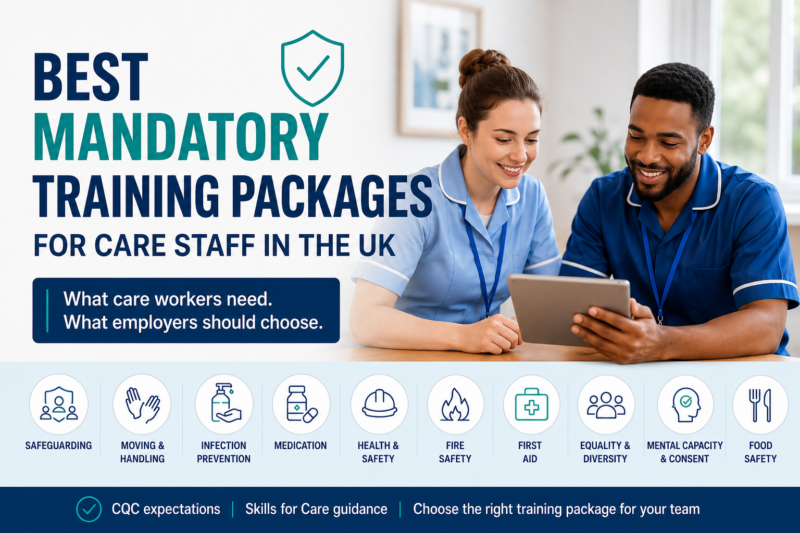
For many adult social care workers, core training includes safeguarding, infection prevention and control, health and safety, fire safety, moving and handling, equality and human rights, and learning disability and autism. Other subjects—such as medication, food safety, first aid and specialist clinical training—depend strictly on role responsibilities and the service provided.
Importantly, the CQC does not publish a universal list of mandatory courses. Instead, providers must ensure workers possess the appropriate qualifications, competence, skills and experience, supported by regular training, supervision, and appraisal under Regulation 18.
What is Mandatory Training in Health and Social Care?
The phrase mandatory training is commonly used to describe training an employer requires staff to complete so they can perform their roles safely, effectively and in accordance with relevant legal, regulatory and organisational requirements. However, managers should distinguish between three different categories:
- Statutory or regulatory requirements: Some requirements arise directly from legislation or regulation (for example, legally required training on learning disability and autism under the Oliver McGowan Code of Practice).
- Training needed to meet regulatory expectations: Regulations such as Regulation 18 (Staffing) and Regulation 12 (Safe Care and Treatment) require providers to achieve safe outcomes and ensure staff have the necessary qualifications, competence, skills and experience.
- Training determined by the employer, role and risk: Additional learning identified according to worker responsibilities, type of service, care recipient needs, workplace risk assessments, and equipment used.
Skills for Care specifically describes additional training as being defined by the employer based on service needs. This explains why two care organisations may legitimately have different training matrices.
Does CQC Specify Mandatory Courses?
Not as one universal course list. This is an important distinction because the phrase "CQC mandatory training" is widely used by training providers and employers. CQC’s regulations focus on whether staff are suitably qualified, competent, skilled and experienced and receive the training and support necessary for their responsibilities.
CQC Regulation 19 also expects providers to have processes for assessing and checking that employees have the competence required for their role before working unsupervised.
What Training Do Care Workers Typically Need?
Although there is no universal CQC course list, several areas appear frequently in adult social care training programmes. The exact programme should always be adjusted to the role and service:
- New starter and induction training: Introduces employees to policies, safeguarding, health and safety, infection control, fire procedures, moving and handling, confidentiality, person-centred care, and emergency procedures.
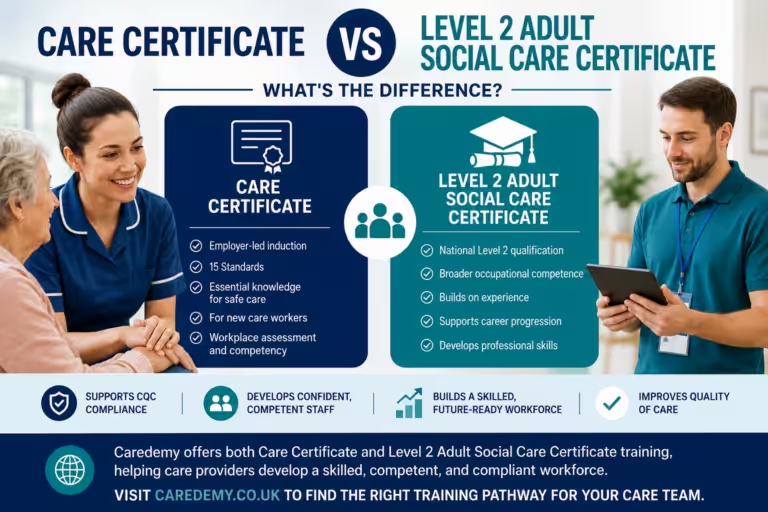
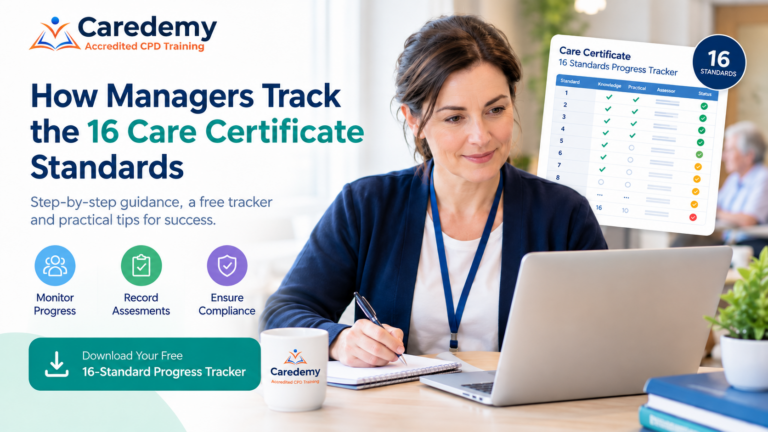
- The Care Certificate: Built upon the current 16 Care Certificate standards (including Standard 16 covering awareness of learning disability and autism). Explore Caredemy's comprehensive Care Certificate course.
- Safeguarding Adults & Children: Mandated under Regulation 13 to protect people from abuse and improper treatment, with levels reflecting staff responsibilities.
- Moving and Handling: Essential for staff assisting individuals or objects, combining online theory with practical competency assessments.
- Infection Prevention and Control: Covers hand hygiene, standard precautions, PPE, cleaning, and decontamination.
- Medication Management: Tailored for workers supporting or administering medicines, ensuring both theoretical learning and workplace competency sign-off. Explore our Safe Handling and Administration of Medicines course.
- Health and Safety & Fire Safety: Site-specific risk awareness and emergency evacuation procedures.
- Food Safety & First Aid: Role-appropriate hygiene and basic life support standards.
- Equality, Diversity and Human Rights: Embedding respect for personal rights, culture, and individual preferences.
- Mental Capacity and Consent: Ensuring lawful, person-centred decision-making aligned with the Mental Capacity Act.
- Learning Disability and Autism: Explicit statutory training requirement aligned with the Oliver McGowan Code of Practice.
Mandatory Care Training: Quick Comparison Table
| Training Topic | Who May Need It | Why It Matters | Typical Refresher Considerations | Online / Practical Considerations |
|---|---|---|---|---|
| Safeguarding Adults | Staff working with adults receiving care | Recognise, prevent and report abuse or neglect | Update at appropriate intervals and when guidance changes | Knowledge online; competence reflected in practice |
| Infection Prevention | Most frontline care workers | Reduce infection risks and maintain hygiene | Refresh according to risk, employer assessment and guidance | Online theory works well; practical methods checked |
| Moving and Handling | Staff moving objects or assisting people | Reduce injury and unsafe handling practices | New risks or equipment trigger additional training | Practical demonstration and assessment necessary |
| Medication Management | Staff supporting or administering medicines | Safe medicines management and record-keeping | Based on responsibilities, competence, and incidents | Theory online; workplace competency required |
| Health and Safety | Staff according to workplace hazards | Manage workplace risks and work safely | Review when risks, equipment or procedures change | Often suitable for blended learning approaches |
| Fire Safety | Staff according to workplace responsibilities | Prevent fires and respond appropriately in emergencies | Consider changes to environment and fire guidance | Site-specific procedures and drills remain vital |
| Learning Disability & Autism | CQC-registered providers at role-appropriate level | Explicit statutory training requirement | Follow current legal requirements and Code of Practice | Ensure delivery meets role-appropriate standards |
How Often Should Mandatory Care Training Be Refreshed?
There is no single universal rule that every care training course must be repeated annually. Refresher decisions should consider legislation, statutory guidance, professional requirements, risk assessments, staff competence, and changes in practice. Skills for Care’s guidance specifies different considerations depending on the topic—for instance, recommending a minimum three-year refresher period for certain subjects like fire safety and moving and handling objects, while basic life support is typically refreshed annually.
Ways Employers Can Buy Mandatory Training Packages
Different purchasing models suit different care organizations:
- Individual courses: Best for very small organisations or occasional training needs.
- Mandatory training bundles: Convenient pre-packaged core subjects for onboarding workers.
- Training credits: Flexible bulk purchasing where credits are allocated as needed without immediate course assignment.
- Per-learner subscriptions: Fixed fees giving learners access to a defined range or library over a period.
- Unlimited training: Comprehensive access packages ideal for care providers with substantial ongoing induction, mandatory, and specialist learning requirements.
Streamline Compliance with Caredemy Team Training
Get unlimited access to 200+ CPD-accredited courses, robust compliance reporting matrices, automated renewal reminders, free manager accounts, and free learner replacements with Caredemy Team Training.
Explore Caredemy Team TrainingChoosing Mandatory Training for a CQC Inspection
A CQC inspection should not prompt a last-minute scramble to complete online modules. A stronger approach is demonstrating an active workforce development system. Managers preparing evidence should maintain:
- A role-based training matrix: Showing required training by role and why it is assigned.
- Up-to-date completion records: Quick identification of completed, outstanding, and upcoming learning.
- Evidence of induction: Structured onboarding and supervision for new starters.
- Care Certificate implementation: Current 16-standard framework backed by workplace assessment.
- Competency evidence: Practical sign-offs for medication, moving and handling, and emergency procedures.
- Role-specific training: Tailored learning for dementia, learning disabilities, or complex care needs.
- Refresher management and incident learning: Systems tracking renewal dates and feeding lessons learned from audits into training.
Download Free Care Training Resources
Need help organizing your training matrices and compliance audits? Access Caredemy's free downloadable checklists and guides to keep your service inspection-ready.
Get Free ResourcesFAQs: Mandatory Training for Care Staff
What training is mandatory for care workers in the UK?
There is no single universal list that applies identically to every care worker. Requirements stem from legislation, regulation, statutory guidance, job roles, workplace risks, and care recipient needs. Common subjects include safeguarding, health and safety, infection control, fire safety, and moving and handling.
Does CQC have a mandatory training list?
No. CQC does not publish a universal mandatory-course checklist. Providers must ensure workers are appropriately qualified, competent, skilled, experienced, and trained for their specific roles.
Does mandatory care training have to be completed every year?
Not necessarily. There is no universal requirement for every course to be repeated annually. Refresher intervals depend on guidance, legislation, risk, and role requirements.
Is the Care Certificate mandatory?
The Care Certificate is a recommended induction framework and a CQC expectation for relevant new health and adult social care workers, underpinned by Regulation 19 competence assessments.
Are there 15 or 16 Care Certificate standards?
There are currently 16 standards following the March 2025 update, which introduced Standard 16 covering awareness of learning disability and autism.
Is learning disability and autism training mandatory?
Yes. For CQC-registered providers, staff must receive role-appropriate training on learning disability and autism, supported by the Oliver McGowan Code of Practice.
Authoritative Sources & Legislation
This guide aligns with current UK health and social care legislation and regulatory frameworks: