
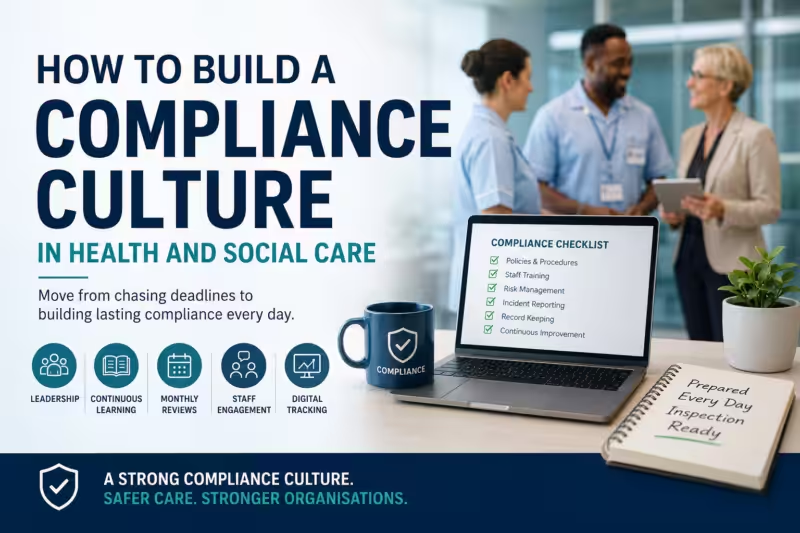
Creating a Compliance Culture Instead of Chasing Deadlines
Building a Stronger Compliance Culture
In health and social care, compliance should never be something an organisation thinks about only when an inspection is approaching.
A strong health and social care compliance culture is built into everyday practice. It influences how leaders make decisions, how staff are trained, how policies are followed, how risks are managed and how evidence is recorded.
For managers and care providers, the goal should be to move away from a cycle of chasing expired training, updating records at the last minute and preparing for inspections under pressure. Instead, compliance should become part of the organisation’s normal way of working.
This means creating a culture where staff understand what is expected of them, managers have visibility of training and performance, and everyone takes responsibility for maintaining safe, effective and person-centred care.
According to Skills for Care, ongoing learning and development helps ensure that social care workers have the skills and knowledge needed to carry out their roles effectively. It also highlights the importance of assessing competence rather than assuming that completing training automatically means learning has been applied in practice.
So, how can organisations build a compliance culture that lasts?
What Is a Compliance Culture?
A compliance culture is an organisational environment where meeting legal, regulatory, professional and internal standards is treated as part of everyday work rather than an administrative exercise.
In a care setting, this can include:
- Keeping mandatory and role-specific training up to date
- Supporting continuous learning and professional development
- Regularly reviewing policies and procedures
- Monitoring staff competency
- Recording incidents, concerns and actions
- Managing risks proactively
- Maintaining accurate documentation
- Reviewing compliance information regularly
- Encouraging staff to speak up about concerns
- Preparing for inspections through good everyday practice
A compliance culture is therefore about much more than having a folder full of policies or a spreadsheet showing completed training.
It is about demonstrating that the organisation understands its responsibilities and has effective systems in place to meet them.
1. Leadership Sets the Standard
Compliance starts at the top.
Senior leaders, registered managers and supervisors play an important role in determining how seriously compliance is taken across an organisation. If managers only discuss training when certificates are about to expire, staff can easily view compliance as a tick-box exercise.
By contrast, when leaders consistently demonstrate that quality, safety, learning and accountability matter, those expectations become embedded within the wider workforce.
Effective leadership means asking questions such as:
- Are our staff appropriately trained for their roles?
- Do we know who has completed their required learning?
- Are staff applying what they have learnt?
- Are policies being followed in practice?
- Have previous incidents or complaints resulted in learning?
- Are there recurring risks that need additional action?
- Can we demonstrate our approach with reliable evidence?
Leadership should also create an environment where staff feel comfortable raising concerns. Compliance should not be about finding someone to blame. It should be about identifying weaknesses, understanding why they occurred and taking appropriate action.
Skills for Care’s workforce resources emphasise the importance of workplace assessment, supervision and ensuring that workers are competent to provide safe and effective care.
Make compliance a leadership responsibility
Rather than delegating compliance entirely to one administrator or manager, make it a shared organisational responsibility.
Leaders should set expectations, allocate resources, review performance and ensure that identified issues are followed through to completion.
When leadership consistently reinforces these behaviours, compliance becomes part of the organisation’s culture rather than an occasional management task.
2. Make Continuous Learning Part of Everyday Practice
Training should not stop once a new employee completes their induction.
Health and social care is constantly changing. Guidance, expectations, technologies, risks and best practice can develop over time. Staff therefore need opportunities to refresh their knowledge and build their skills throughout their careers.
Skills for Care states that everyone working in adult social care should have opportunities to develop, learn and grow, with learning and development supporting both quality care and workforce retention.
Continuous learning can include:
- Mandatory training
- Refresher training
- Role-specific training
- CPD
- Supervision
- Workplace assessments
- Team discussions
- Reflective learning
- Learning from incidents and complaints
- Updates following changes to guidance or procedures
Organisations should also distinguish between training completion and competence.
A completed online course can provide valuable knowledge, but managers may also need to assess whether staff can apply that knowledge appropriately in their role.
This is particularly important for practical areas of care where competency needs to be demonstrated in the workplace.
3. Conduct Monthly Compliance Reviews
One of the simplest ways to stop compliance becoming a last-minute task is to review it regularly.
A monthly compliance review gives managers an opportunity to identify gaps before they become urgent problems.
A review might cover:
Training
- Who has completed required training?
- Which certificates are approaching expiry?
- Which staff have overdue courses?
- Are new starters receiving appropriate training?
- Does training match individual roles and responsibilities?
Competence
- Are competency assessments up to date?
- Are staff applying training appropriately?
- Have supervision records identified any learning needs?
Policies and procedures
- Are policies current?
- Have relevant legislative or regulatory changes been considered?
- Do staff know where to find the latest procedures?
Quality and safety
- What incidents have occurred?
- What complaints or concerns have been raised?
- What lessons have been identified?
- Have agreed actions been completed?
Evidence
- Can the organisation demonstrate what it is doing?
- Are records accurate and accessible?
- Can managers quickly identify gaps?
A monthly review creates a rhythm of accountability.
Instead of discovering ten problems shortly before an inspection, managers can identify one or two issues each month and address them systematically.
4. Engage Staff in Compliance
Compliance should not feel like something that is imposed on staff by management.
Employees are more likely to follow procedures and engage with learning when they understand why those requirements matter.
For example, instead of simply telling a care worker that they must complete infection prevention training, explain how effective infection prevention helps protect residents, colleagues, visitors and the wider community.
Staff engagement can be encouraged through:
- Team meetings
- Regular supervision
- Short compliance discussions
- Feedback sessions
- Learning from real incidents
- Recognition of good practice
- Opportunities to suggest improvements
- Open conversations about risks and concerns
A positive compliance culture should also encourage staff to speak up when something is not working.
If employees are worried about reporting mistakes or concerns, organisations may miss valuable opportunities to identify risks and improve services.
The aim should be to create an environment where raising a concern is viewed as a contribution to quality improvement rather than a problem.
5. Use Digital Tracking to Stay Ahead
Manual compliance tracking can become increasingly difficult as an organisation grows.
A spreadsheet may be sufficient for a small number of employees, but managers can quickly lose visibility when they are responsible for larger teams, multiple courses and different renewal dates.
Digital training management systems can help organisations monitor:
- Course completion
- Learner progress
- Certificates
- Training expiry dates
- CPD records
- Outstanding learning
- Staff compliance
- Reporting requirements
Caredemy provides a Learner Management System designed to help organisations monitor learner progress, reporting and certification.
This type of system can reduce the amount of time managers spend manually checking individual records.
It can also make it easier to identify potential problems early.
For example, if several employees have training approaching expiry within the next month, managers can take action before those certificates become overdue.
Digital tracking should support management, not replace it
Technology is valuable, but it should not become the compliance strategy itself.
A dashboard can show that an employee completed a course. It cannot necessarily demonstrate how effectively they apply that knowledge in practice.
The strongest approach combines digital records with supervision, competency assessment, observation and ongoing management.
6. Create Clear Accountability
A compliance culture requires clear ownership.
If everyone is responsible for compliance but nobody is specifically accountable for individual tasks, important actions can easily be missed.
Organisations should establish clear responsibilities for areas such as:
- Mandatory training
- Induction
- Competency assessments
- Policy reviews
- Risk assessments
- Incident reporting
- Complaints
- Safeguarding
- Quality monitoring
- Inspection preparation
Managers should know who is responsible for each area and what evidence needs to be maintained.
Accountability should also include follow-up.
If a monthly review identifies a training gap, for example, the process should not end with recording the gap. Someone should be responsible for contacting the employee, assigning the relevant learning, monitoring completion and confirming that the issue has been resolved.
This creates a simple cycle:
Identify → Act → Monitor → Review → Improve
That cycle is at the heart of sustainable compliance.
7. Prepare for Inspections Every Day
One of the biggest changes an organisation can make is to stop treating inspection preparation as a separate project.
The best inspection preparation is good everyday practice.
Instead of asking:
“What do we need to do before the inspection?”
Ask:
“If an inspector arrived today, could we demonstrate how we maintain safe, effective and high-quality care?”
That change in mindset can have a significant impact.
Managers should regularly consider whether they can demonstrate:
- Staff have appropriate training
- Learning needs are identified and addressed
- Staff understand their responsibilities
- Policies are being followed
- Risks are identified and managed
- Incidents and complaints lead to learning
- Records are accurate
- Managers monitor quality
- Staff are encouraged to raise concerns
- Improvements are documented and followed through
The aim is not to create an organisation that looks compliant for an inspection.
The aim is to create an organisation that operates compliantly every day.
Compliance Should Be About Improvement, Not Just Inspection
It is easy to associate compliance with inspections, paperwork and regulatory requirements.
However, a mature compliance culture should ultimately be about improving outcomes for the people receiving care.
Training should help staff provide better care.
Supervision should help employees develop.
Incident reviews should reduce the likelihood of problems happening again.
Complaints should provide opportunities for learning.
Audits should identify areas for improvement.
Digital systems should give managers better visibility.
Policies should provide practical guidance rather than simply sitting in a folder.
When these elements work together, compliance becomes part of quality improvement.
A Practical Monthly Compliance Cycle
Organisations looking to strengthen their approach can introduce a simple monthly cycle.
Week 1: Review
Check training, certificates, policies, incidents, complaints, risks and competency records.
Week 2: Identify
Identify gaps, overdue actions, emerging risks and areas where staff may need additional support.
Week 3: Act
Assign responsibilities and complete the necessary actions, such as refresher training, competency assessments or policy updates.
Week 4: Monitor
Check that actions have been completed and consider whether the changes have improved practice.
Then start again the following month.
This creates a continuous improvement cycle rather than an annual compliance rush.
Build Compliance Into the Employee Journey
Compliance should begin before an employee completes their first shift.
A structured approach can include:
Recruitment → Induction → Mandatory training → Competency assessment → Supervision → Refresher learning → Performance review → Continuous development
This approach also aligns with the wider emphasis on structured development within the adult social care workforce. Skills for Care’s Care Workforce Pathway provides a framework for developing knowledge, skills, values and behaviours across different social care roles.
Learning should therefore be viewed as an ongoing journey rather than a one-off requirement.
Common Mistakes That Can Weaken Compliance
Even organisations with good intentions can fall into common compliance traps.
Waiting until training expires
Renewal should be planned before expiry rather than treated as an emergency.
Treating certificates as proof of competence
Completion demonstrates participation in learning, but competency may require additional workplace assessment.
Keeping information in too many places
Scattered spreadsheets, emails and paper records make it harder to maintain an accurate overview.
Making compliance the responsibility of one person
A sustainable culture requires involvement from leadership, managers and staff.
Ignoring employee feedback
Frontline employees often see risks and operational problems that may not be obvious from management reports.
Preparing only when an inspection is announced
Inspection readiness should be the result of good systems operating throughout the year.
The Business Benefits of a Strong Compliance Culture
A proactive approach to compliance can deliver benefits beyond meeting regulatory expectations.
It can help organisations:
- Reduce avoidable training gaps
- Improve staff confidence
- Strengthen workforce development
- Identify risks earlier
- Improve record keeping
- Support consistent standards
- Demonstrate effective management
- Make inspection preparation less stressful
- Encourage continuous improvement
- Support better-quality care
Skills for Care also highlights that investing in learning and development can help staff feel valued while supporting workforce development and retention.
In other words, compliance and staff development do not need to be separate priorities. Done properly, they can reinforce each other.
How Caredemy Can Support Your Compliance Strategy
Online learning can form an important part of a wider health and social care compliance strategy.
Caredemy offers a broad range of online courses covering areas across health care, social care, health and safety, safeguarding, first aid, food hygiene, fire safety and other workplace training needs. Its online platform also provides tools for monitoring learner progress and certification.
For organisations managing multiple employees, having training and learner information accessible through a central system can make it easier to monitor progress and identify outstanding learning.
However, training should always sit within a wider compliance framework that includes leadership, supervision, competency assessment, policies, audits and continuous improvement.
Caredemy helps organisations build long-term compliance through online learning and training management.
You can also explore Caredemy’s health and social care online training courses to find training suitable for your workforce.
Final Thoughts: Stop Chasing Compliance and Start Building It
A strong compliance culture does not appear overnight.
It develops through consistent leadership, regular learning, staff engagement, effective monitoring and clear accountability.
The most effective organisations do not wait for an inspection to ask whether they are compliant. They build systems that help them understand their position throughout the year.
That means reviewing compliance monthly, keeping learning up to date, monitoring competency, listening to staff and using technology to maintain accurate records.
Most importantly, it means understanding that compliance is not simply about passing an inspection.
It is about creating an organisation where safe, effective and high-quality care is supported by the right people, the right knowledge and the right systems.
The goal is simple: don’t prepare for compliance once a year. Build compliance into every working day.
Further Resources
For additional guidance on workforce learning and development, Skills for Care provides resources covering staff development, competency assessment and career progression.
You can also explore Caredemy’s CPD online courses and its help and support resources for information about managing learners, progress and certification.
Ready to Strengthen Your Compliance Culture?
Whether you are a registered manager, care provider, HR professional, training manager or senior leader, a proactive approach to compliance can help you stay organised, support your workforce and maintain high standards of care.
Visit caredemy.co.uk to discover compliance-focused online training.