
- Home
- Health & Safety
- Vicarious Trauma Course
Vicarious Trauma Course
£15 + VAT


Written By Allison
- CPD Accredited | Instant Certificate | Mobile Friendly | Bulk Discounts Available
Trusted by care providers, healthcare organisations, businesses and workplace teams
This CPD-accredited Vicarious Trauma Course explores how repeated indirect exposure to trauma can affect wellbeing, professional practice and working relationships. Learners examine signs of vicarious traumatisation, risk factors, stress and trauma responses, self-care, resilience, compassion satisfaction and organisational responsibilities. It is suitable for professionals and volunteers regularly exposed to traumatic experiences, disclosures or material through their work.
Vicarious Trauma Course Summary
Course Name: Vicarious Trauma Course
Duration: 1 Hour
Delivery: Online Training Course
Certificate Included: Instant Digital Certificate
Accreditation: CPD Accredited – 1 CPD Point
Suitable For: Healthcare, social care, emergency services, counselling, education, criminal justice, charity, community and trauma-exposed roles
Assessment: Online Multiple Choice Test
Access: Instant Access
Duration
1 hour
CPD Points
1
Last Updated:
19 Feb 2026
What is Vicarious Trauma training?
Vicarious trauma training helps people understand the psychological and emotional impact that can develop through repeated exposure to other people’s traumatic experiences.
This may occur when professionals listen to traumatic disclosures, support people following abuse or violence, respond to distressing incidents or regularly review traumatic information or material.
The Vicarious Trauma Course explains direct and indirect trauma exposure, traumatic stress, cumulative stress and the signs that vicarious traumatisation may be affecting someone’s personal or professional life. Learners also explore personal and organisational risk factors, appropriate colleague and supervisory support, self-care, resilience and vicarious resilience.
Importantly, the course goes beyond placing responsibility solely on the individual. It examines how supervision, team support, workload, organisational culture and leadership can contribute to safer, more sustainable trauma-exposed work.
CPD Accredited
User friendly interactive courses
Instant Access
Enrol Now – Start Instantly
Certify Instantly
Certificate Available Immediately
Learn on Any Device
Train on Phone, Tablet or Computer
Money Back Guarantee
14 Day Money Back Guaratnee
How Would You Like to Access This Course?
Flexible options for individuals, staff teams and organisations
1
Instant Online Purchase
From 1 to 100+ learners • Bulk discounts available • Instant online access and certificates included
- Instant Access - No Quote Required
- CPD Accredited Certificates Included
- 100% Online & Mobile Friendly
- Assign Courses to Staff, Friends or Family
- Track Progress and Completions Online
- 14 Day Money Back Guarantee
£15 + VAT
CPD • Certificate included • Start instantly
Quantity
Per Course Price
1+ Courses
£15 + Vat
5+ Courses
£9.40 + Vat
10+ Courses
£8.49 + Vat
30+ Courses
£7.99 + Vat
50+ Courses
£6.49 + Vat
100+ Courses
£4.99 + Vat
2
Need Ongoing Staff Training?
Best value for teams of 8+ learners who need regular mandatory, induction and refresher training.
- Save Money on Staff Training
- Access Our Full 200+ Course Library
- Instant certificates issued
- Track Compliance Across Your Team
- Free Learner Replacements
- Reporting & Certificate Management
- CQC inspection ready
- Lowest price guarantee
- Dedicated Support
Best Price Guarantee • CQC Inspection Ready
When should I choose Caredemy Teams?
Caredemy Teams is ideal for organisations with 8+ learners who need access to multiple courses for mandatory training, induction training, and annual refreshers. Benefit from our best-value pricing, free learner replacements, compliance reporting, and access to our full course library. If you only need a small number of CPD courses, you can buy online instantly.
Access friendly, dedicated expert support whenever you need it, with guidance available throughout your learning journey
All-access individual subscription
Get unlimited access to 200+ CPD-accredited courses. One low monthly price. Learn anytime.
Buy any 5 courses for £47
Mix and max any courses.
CPD accredited - Certificates included.
Who Is This Course For?
The Vicarious Trauma Course is suitable for employees, managers, professionals and volunteers whose work regularly exposes them to traumatic experiences, disclosures, incidents or material.
Relevant roles include nurses, doctors, paramedics, mental health practitioners, social workers, care workers, safeguarding professionals, counsellors, psychotherapists, police and emergency service personnel, probation staff, legal professionals, teachers, pastoral and education staff, housing and community workers, charity and voluntary-sector workers, victim support staff and other professionals supporting trauma-affected people.
The training is also relevant to managers, supervisors, HR professionals and occupational health teams responsible for supporting trauma-exposed employees. It can be used for induction, refresher training, professional development or to strengthen organisational approaches to staff wellbeing and work-related stress.
Key Benefits
✓ Recognise signs of vicarious traumatisation
✓ Identify personal and workplace risk factors
✓ Respond appropriately to trauma-related stress
✓ Strengthen resilience and sustainable practice
✓ Support trauma-exposed colleagues effectively
✓ Build healthier organisational support systems
Course Modules
- Vicarious Trauma – Course Introduction
- What Is Vicarious Trauma?
- How Does Vicarious Trauma Affect People?
- Vicarious Trauma Toolkit Model
- Who is Most at Risk?
- Common Negative Responses to Vicarious Trauma
- How Colleagues Can Offer Support
- Guidance for Supervisors
- Advice for Family Members
- Becoming a Vicarious Trauma-Informed Organisation
- Securing Organisational Commitment
- Appointing a Lead Individual or Coordinating Group
- Supportive Organisations
- Organisational Practices That Increase Risk
- Supervision, Team Support, and Work Culture
- Training, Development, and Professional Growth
- Stress and Trauma
- The Stress Response
- Cumulative Stress
- Understanding Trauma and Traumatic Stress
- What Makes an Event Traumatic?
- Work-Related Trauma Exposure
- Traumatic Stress and Vicarious Traumatization
- Direct and Indirect Trauma Exposure
- Empathy and Changes in World View
- Secondary Responses to Stress and Trauma
- Signs of Vicarious Traumatization: Personal Impact
- Signs of Vicarious Traumatization: Impact at Work
- Risk Factors for Vicarious Traumatization
- Self-Care
- Resilience and Vicarious Resilience
- Compassion Satisfaction and Vicarious Transformation
- Beyond Self-Care
Ready to start?
Learning Outcomes
| Learner Outcome | Covered |
|---|---|
| Define vicarious trauma and vicarious traumatisation | ✓ |
| Identify roles with increased exposure to vicarious trauma | ✓ |
| Recognise personal signs of vicarious traumatisation | ✓ |
| Recognise how vicarious trauma can affect workplace performance | ✓ |
| Explain the difference between direct and indirect trauma exposure | ✓ |
| Identify personal and professional risk factors | ✓ |
| Explain how cumulative stress can affect wellbeing | ✓ |
| Recognise how empathy can influence world view | ✓ |
| Apply appropriate self-care principles to trauma-exposed work | ✓ |
| Explain the role of resilience and vicarious resilience | ✓ |
| Recognise compassion satisfaction and vicarious transformation | ✓ |
| Identify how colleagues and supervisors can provide support | ✓ |
| Recognise organisational practices that can increase risk | ✓ |
| Explain how supervision, team support and culture can reduce risk | ✓ |
| Identify organisational responsibilities beyond individual self-care | ✓ |
Training 8+ Staff Across Multiple Courses?
Purchasing multiple licences for this training course? Simply adjust the quantity and buy online today.
If you need ongoing training for 10+ employees across multiple subjects, our Team Training platform provides access to 200+ CPD accredited courses, compliance reporting, learner management and bulk enrolment tools.
- Access 200+ CPD Accredited Courses
- Manage All Learners In One Place
- Compliance & Audit Reporting
- Bulk Enrolment & Certificate Tracking
- Dedicated Account Support
Team Training Solutions
Ideal for care providers, healthcare organisations and workplace teams training multiple employees.
Why Choose Caredemy?
- Instant Certificate
- CPD-accredited courses
- Money Back Guarantee
- Expert-designed training
- 120,000 learners trained
- Flexible online learning
- Compliance-focused
- Dedicated support
What Our Learners Say?
“Helped me recognise warning signs in myself and colleagues without making the subject feel overwhelming.”
Rebecca Collins
Social Worker
“Particularly useful around supervision, workload and why managing vicarious trauma cannot rely on self-care alone.”
Marcus Benett
Safeguarding Lead
“Clear, relevant training that gave me practical ways to support staff dealing with difficult disclosures.”
Joanne Hughes
Care Manager
4.79/5 from 29+ learners
Why Is Vicarious Trauma training important?
Professionals repeatedly exposed to other people’s trauma can experience changes in their emotional wellbeing, relationships, beliefs and approach to work. Recognising these effects early can help individuals and organisations respond before problems become more serious.
Vicarious trauma training helps employees recognise warning signs, understand risk factors and identify appropriate sources of support. It also helps managers consider supervision, workload, team culture and other organisational factors rather than treating resilience as solely an individual’s responsibility.
This is particularly important in healthcare, social care, safeguarding, counselling, emergency response and other trauma-exposed services where staff wellbeing can affect professional judgement, relationships and sustainable service delivery.
UK health and safety law also requires employers to manage risks to employees’ health, including work-related stress. HSE recommends addressing organisational causes rather than relying only on individual interventions.
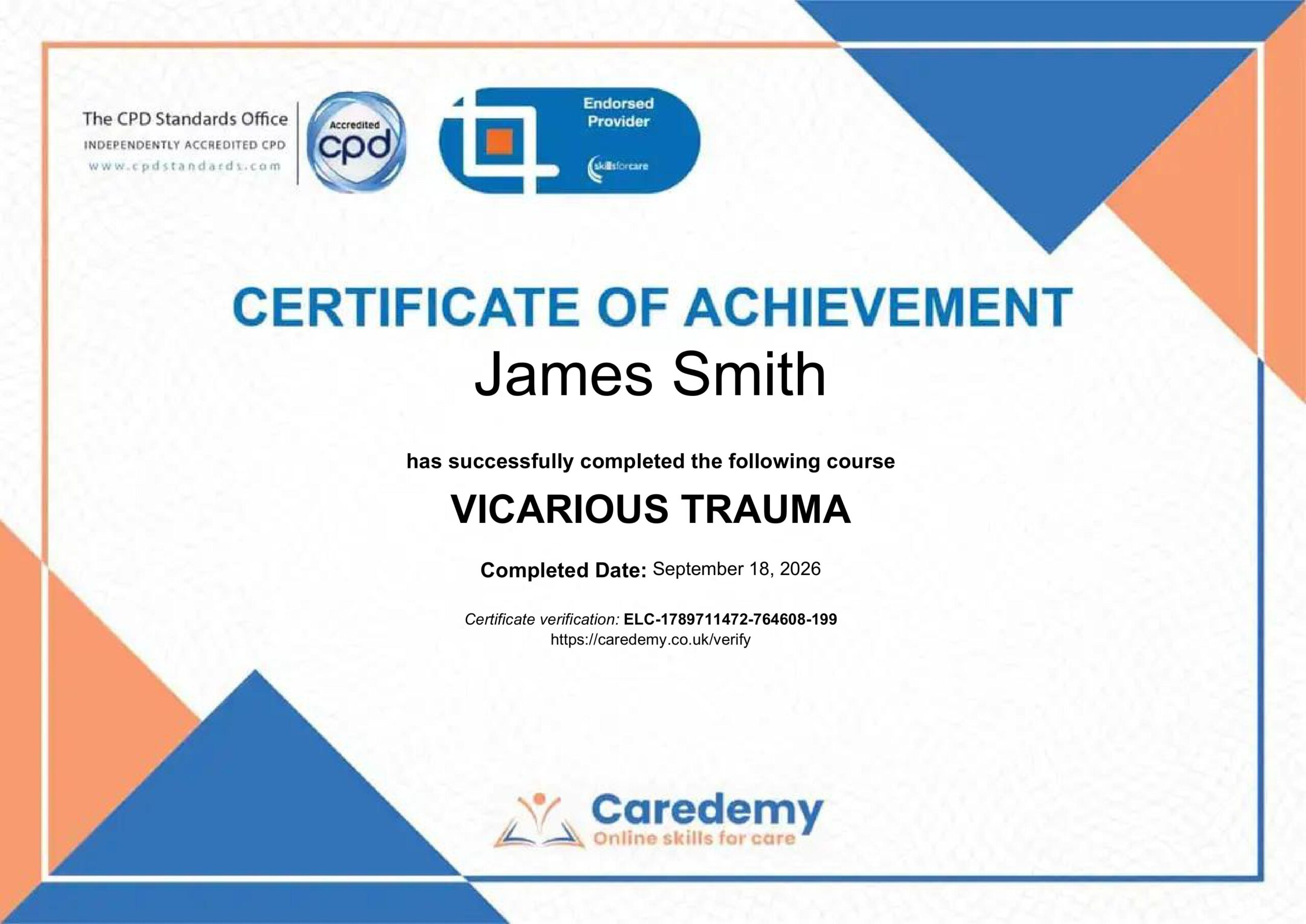
Instant Course Certificate
Is Vicarious Trauma training a legal requirement in the UK?
There is no general UK law that specifically requires employees to complete a course titled Vicarious Trauma Training.
However, employers have wider legal duties concerning employee health, safety and welfare. The Health and Safety at Work etc. Act 1974 requires employers, so far as reasonably practicable, to provide a working environment that is safe and without risks to health.
The Management of Health and Safety at Work Regulations 1999 require employers to assess workplace health and safety risks and put appropriate preventive arrangements in place. HSE specifically states that employers have a legal duty to assess and act on risks from work-related stress.
For organisations whose employees are routinely exposed to traumatic material or experiences, vicarious trauma training can therefore form part of a broader approach to identifying, reducing and managing psychosocial workplace risks.
Trusted by 120,000+ learners
Trusted by care providers, healthcare organisations, businesses and workplace teams across the UK for high-quality online training
Office & Commercial
Health & Social Care
Industrial, Warehousing & Facilities
Hospitality, Retail & Public Services
Vicarious Trauma training FAQ?
What is vicarious trauma?
Vicarious trauma describes changes that can occur when someone is repeatedly exposed to other people’s traumatic experiences through their work. Exposure may come from listening to traumatic accounts, supporting survivors, responding to incidents or reviewing distressing material. It can affect emotions, beliefs, relationships, wellbeing and professional practice.
Who needs vicarious trauma training?
Vicarious trauma training is relevant to anyone regularly exposed to trauma through their work. This can include healthcare professionals, social workers, care workers, counsellors, safeguarding teams, emergency service personnel, teachers, legal and criminal justice professionals, charity workers and community support staff. Managers and supervisors of trauma-exposed teams can also benefit significantly.
Is vicarious trauma training a legal requirement?
There is no general UK legal requirement to complete a specifically named vicarious trauma course. However, employers have duties to protect employees’ health and safety and assess workplace risks. HSE confirms that employers must assess risks from work-related stress and take appropriate action to protect workers.
What are the signs of vicarious trauma?
Signs can vary between individuals and may affect both personal wellbeing and professional practice. They can include emotional changes, altered beliefs or world view, difficulties maintaining professional boundaries, reduced engagement with work and negative responses to repeated trauma exposure. Recognising changes early can help individuals seek appropriate supervision and support.
What is the difference between vicarious trauma and burnout?
Vicarious trauma is specifically associated with exposure to other people’s traumatic experiences and may affect someone’s beliefs, emotions and world view. Burnout is generally associated with prolonged workplace pressures such as excessive demands and insufficient resources or support. The two can overlap, which makes good supervision, workload management and organisational support important.
How can employers reduce the risk of vicarious trauma?
Employers can consider workload and exposure to traumatic material, provide effective supervision and peer support, encourage open discussion, train managers, review working practices and ensure employees know where to obtain additional support. HSE guidance emphasises tackling organisational sources of work-related stress rather than focusing only on individual coping strategies.
How often should vicarious trauma training be completed?
There is no universal statutory refresher period for vicarious trauma training. Employers should determine appropriate refresher arrangements through risk assessment, staff roles, levels of trauma exposure, organisational policies and identified learning needs. Refresher training may also be appropriate following significant changes in responsibilities, working practices or exposure risks.
How long does the Vicarious Trauma Course take?
The Caredemy Vicarious Trauma Course takes approximately 1 hour to complete and provides 1 CPD point. The course is delivered online and can be accessed immediately after enrolment. Learners complete an online assessment and receive a digital CPD-accredited certificate after successful completion.
Need Training for Multiple Employees?
Train your entire workforce through Caredemy Teams with bulk enrolment, compliance reporting and access to 200+ CPD courses.
- CPD-accredited certificate
- Instant Certificate
- Learn of Any Device
- Money-back Guarantee
Related Courses You May Like


UK Regulations And Guidance
£15 + Vat
Vicarious Trauma Course
- CPD Accredited
- Instant Certificate
- Instant Access
- Bulk Discounts Available