
- Home
- Health & Safety
- Infection Prevention and Control for Non-Clinical Workers
Infection Prevention and Control for Non-Clinical Workers
£15 + VAT


Written By Allison
- CPD Accredited | Instant Certificate | Mobile Friendly | Bulk Discounts Available
Trusted by care providers, healthcare organisations, businesses and workplace teams
This Infection Prevention and Control for Non-Clinical Workers course covers healthcare-associated infections (HCAIs), the chain of infection, hand hygiene, PPE, environmental cleaning, blood and body fluid spillages, sharps, linen and waste management. It is designed for non-clinical workers who need practical infection control knowledge to reduce transmission risks and follow safe workplace procedures.
Infection Prevention and Control for Non-Clinical Workers Course Summary
Course Name: Infection Prevention and Control for Non-Clinical Workers
Duration: 1 hour
Delivery: Online Training Course
Certificate Included: Instant Digital Certificate
Accreditation: CPD Accredited – 2 CPD Points
Suitable For: Non-clinical staff, support workers, administrative staff, receptionists, cleaners, facilities staff and other workers who may encounter infection risks
Assessment: Online Multiple Choice Test
Access: Instant Access
Duration
1 hour
CPD Points
2
Last Updated:
25 Jul 2026
What is Infection Prevention and Control for Non-Clinical Workers training?
Infection Prevention and Control for Non-Clinical Workers training teaches staff who do not perform clinical duties how infections can spread and what they can do to reduce transmission.
The course explains healthcare-associated infections (HCAIs), the chain of infection, duty of care and the standard precautions used to protect people from infectious agents. Learners explore practical measures including effective hand hygiene, appropriate PPE, environmental cleanliness, safe handling of linen, blood and body fluid spillages, sharps and healthcare waste.
These principles reflect recognised infection prevention and control practice. NHS England states that Standard Infection Control Precautions (SICPs) are fundamental measures for reducing transmission from recognised and unrecognised sources of infection. NHS England
The training helps non-clinical workers recognise where their own actions affect infection risk and follow their organisation’s infection control procedures confidently.
CPD Accredited
User friendly interactive courses
Instant Access
Enrol Now – Start Instantly
Certify Instantly
Certificate Available Immediately
Learn on Any Device
Train on Phone, Tablet or Computer
Money Back Guarantee
14 Day Money Back Guaratnee
How Would You Like to Access This Course?
Flexible options for individuals, staff teams and organisations
1
Instant Online Purchase
From 1 to 100+ learners • Bulk discounts available • Instant online access and certificates included
- Instant Access - No Quote Required
- CPD Accredited Certificates Included
- 100% Online & Mobile Friendly
- Assign Courses to Staff, Friends or Family
- Track Progress and Completions Online
- 14 Day Money Back Guarantee
£15 + VAT
CPD • Certificate included • Start instantly
Quantity
Per Course Price
1+ Courses
£15 + Vat
5+ Courses
£9.40 + Vat
10+ Courses
£8.49 + Vat
30+ Courses
£7.99 + Vat
50+ Courses
£6.49 + Vat
100+ Courses
£4.99 + Vat
2
Need Ongoing Staff Training?
Best value for teams of 8+ learners who need regular mandatory, induction and refresher training.
- Save Money on Staff Training
- Access Our Full 200+ Course Library
- Instant certificates issued
- Track Compliance Across Your Team
- Free Learner Replacements
- Reporting & Certificate Management
- CQC inspection ready
- Lowest price guarantee
- Dedicated Support
Best Price Guarantee • CQC Inspection Ready
When should I choose Caredemy Teams?
Caredemy Teams is ideal for organisations with 8+ learners who need access to multiple courses for mandatory training, induction training, and annual refreshers. Benefit from our best-value pricing, free learner replacements, compliance reporting, and access to our full course library. If you only need a small number of CPD courses, you can buy online instantly.
Access friendly, dedicated expert support whenever you need it, with guidance available throughout your learning journey
All-access individual subscription
Get unlimited access to 200+ CPD-accredited courses. One low monthly price. Learn anytime.
Buy any 5 courses for £47
Mix and max any courses.
CPD accredited - Certificates included.
Who Is This Course For?
The Infection Prevention and Control for Non-Clinical Workers course is suitable for employees whose work does not involve delivering clinical treatment but who may work around patients, service users, colleagues, customers or environments where infection transmission is possible.
This includes receptionists, administrators, office staff, care support staff with non-clinical responsibilities, cleaners, domestic staff, facilities and maintenance teams, security staff, porters, volunteers and other support personnel.
It can also support workers in customer-facing and public environments, including hospitality, retail, charities and community organisations, where appropriate infection prevention practices form part of maintaining a safe workplace.
The course is suitable for induction, refresher training and knowledge development. Staff working within health and social care should also follow the infection prevention and control procedures, risk assessments and role-specific training requirements established by their employer.
Key Benefits
✓ Understand how infections and healthcare-associated infections can spread
✓ Recognise how to break links in the chain of infection
✓ Apply effective hand hygiene and infection prevention practices
✓ Understand appropriate use of gloves, aprons and face protection
✓ Follow safer procedures for spillages, sharps, linen and healthcare waste
✓ Support a cleaner, safer environment for staff, patients, service users and visitors
Course Modules
- Infection Prevention and Control for Non-Clinical Workers – Introduction
- Introduction
- Overview
- Knowledge Check – How are HCAIs Spread?
- What are HCAIs?
- Types of HCAIs
- How HCAIs Spread
- Illnesses Cause by HCAIs
- Patient Experiences
- Knowledge Check – Who is Responsible?
- Appearance and Hygiene
- Duty of Care
- Caring for Your Health
- Bloodborne Viruses
- Skin Condition
- Fit to Work
- Prevent the Spread
- Managing Infection Prevention and Control
- The Chain of Infection
- Knowledge Check – Chain of Infection
- Standard Principles
- Types of Hand Cleaning
- Proper Hand Hygiene
- Using Alcohol-Based Handrubs
- Hand Washing
- Knowledge Check – Hand Hygiene
- Personal Protective Equipment
- Types of Gloves
- Types of Aprons
- Face Protection
- Knowledge Check – Gloves
- Responsibilities
- Managing the Environment
- Knowledge Check – Dust Danger
- Cleaning Schedules
- Storing Cleaning Equipment
- National Colour Scheme for Cleaning Materials
- Blood and Body Fluid Spillage
- Spillage Kits
- Safe Handling and Disposal
- Types of Sharps
- Sharps Disposal Containers
- Sharps Injuries
- Handling Linen
- Linen Classification
- Separating Linen
- Safe Linen Handling
- Healthcare Waste Disposal
- Hazardous Waste
- Waste Streams
- Disposing of Medicines
- Hazardous Waste Bags
- Anatomical Waste
- Non-Hazardous Waste
Ready to start?
Learning Outcomes
| Learner Outcome | Covered |
|---|---|
| Explain what healthcare-associated infections (HCAIs) are and their potential consequences | ✓ |
| Identify common routes through which infections can spread | ✓ |
| Explain the links in the chain of infection | ✓ |
| Recognise personal responsibilities for preventing infection transmission | ✓ |
| Apply appropriate hand hygiene principles | ✓ |
| Distinguish between hand washing and alcohol-based handrub use | ✓ |
| Identify appropriate uses for gloves, aprons and face protection | ✓ |
| Explain how environmental cleanliness helps reduce infection risks | ✓ |
| Recognise safe procedures for managing blood and body fluid spillages | ✓ |
| Identify principles for safe sharps handling and disposal | ✓ |
| Explain how contaminated and used linen should be handled safely | ✓ |
| Recognise different healthcare waste streams and disposal requirements | ✓ |
| Identify how personal hygiene, skin condition and fitness to work affect infection control | ✓ |
| Explain individual responsibilities for maintaining effective infection prevention and control | ✓ |
Training 8+ Staff Across Multiple Courses?
Purchasing multiple licences for this training course? Simply adjust the quantity and buy online today.
If you need ongoing training for 10+ employees across multiple subjects, our Team Training platform provides access to 200+ CPD accredited courses, compliance reporting, learner management and bulk enrolment tools.
- Access 200+ CPD Accredited Courses
- Manage All Learners In One Place
- Compliance & Audit Reporting
- Bulk Enrolment & Certificate Tracking
- Dedicated Account Support
Team Training Solutions
Ideal for care providers, healthcare organisations and workplace teams training multiple employees.
Why Choose Caredemy?
- Instant Certificate
- CPD-accredited courses
- Money Back Guarantee
- Expert-designed training
- 120,000 learners trained
- Flexible online learning
- Compliance-focused
- Dedicated support
What Our Learners Say?
“Clear explanations of infection risks and practical steps I can use in my role.”
Sarah Mitchell
Receptionist
“The sections on hand hygiene, cleaning and PPE were particularly useful and easy to follow.”
James Patel
Facilities Assistant
“Useful refresher covering the infection control responsibilities relevant to non-clinical staff.”
Claire Evans
Care Home Administrator
4.86/5 from 174+ learners
Why Is Infection Prevention and Control for Non-Clinical Workers training important?
Infection prevention is not solely a clinical responsibility. Non-clinical employees can encounter contaminated surfaces, equipment, waste, linen, blood or body fluids and can contribute to transmission if appropriate precautions are not followed.
Effective infection prevention reduces opportunities for pathogens to spread and helps protect patients, service users, visitors, colleagues and workers themselves. Government guidance for adult social care emphasises that understanding how infection spreads is crucial to effective infection prevention and control and states that limiting infection transmission is everyone’s responsibility. GOV.UK
Training helps workers understand their responsibilities and apply appropriate measures such as hand hygiene, PPE, environmental cleaning and safe waste management. It also supports employers in maintaining consistent workplace standards and demonstrating that staff have received information and instruction appropriate to their roles.
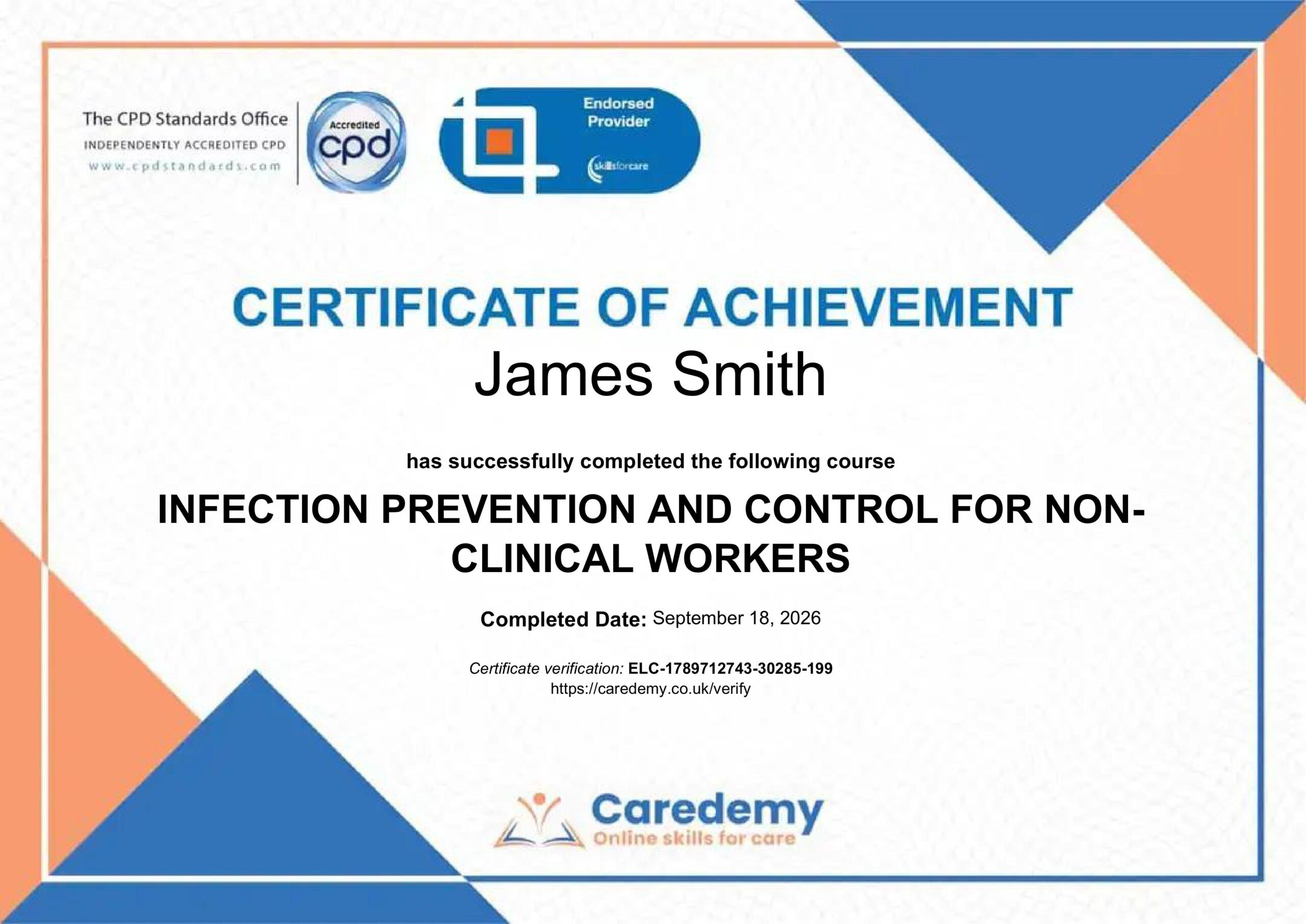
Instant Course Certificate
Is Infection Prevention and Control for Non-Clinical Workers training a legal requirement in the UK?
There is no single UK law stating that every non-clinical worker must complete a course with this exact title.
However, employers have legal responsibilities to protect employees and others from workplace health risks. The Health and Safety at Work etc. Act 1974 establishes general duties relating to employee and workplace safety. Where workers may be exposed to biological agents or other hazardous substances, the Control of Substances Hazardous to Health Regulations 2002 (COSHH) may also apply.
In regulated health and social care, additional infection prevention requirements apply. NHS England’s National Infection Prevention and Control Manual sets out evidence-based infection control practice and supports healthcare providers in meeting relevant standards. NHS England
Employers should therefore assess infection risks and provide appropriate information, instruction, training and workplace procedures according to employees’ duties and level of exposure.
Trusted by 120,000+ learners
Trusted by care providers, healthcare organisations, businesses and workplace teams across the UK for high-quality online training
Office & Commercial
Health & Social Care
Industrial, Warehousing & Facilities
Hospitality, Retail & Public Services
Infection Prevention and Control for Non-Clinical Workers training FAQ?
What is Infection Prevention and Control for Non-Clinical Workers training?
Infection Prevention and Control for Non-Clinical Workers training teaches employees who do not perform clinical duties how infections spread and how workplace practices can reduce transmission. It covers HCAIs, the chain of infection, hand hygiene, PPE, environmental cleaning, spillages, sharps, linen and healthcare waste.
Who needs infection prevention and control training?
Training may be appropriate for non-clinical employees who work around patients, service users, customers or environments where infection transmission could occur. This can include receptionists, administrators, cleaners, domestic staff, facilities teams, porters, security personnel, volunteers and other support staff. The appropriate level of training should reflect the person’s responsibilities and workplace infection risks.
Is infection prevention and control training a legal requirement?
There is no general UK law requiring every worker to complete a specifically named infection prevention and control course. However, employers have statutory health and safety responsibilities and must assess workplace risks and provide appropriate information, instruction and training. Health and social care organisations may also have sector-specific infection prevention standards and regulatory obligations.
How long does the Infection Prevention and Control for Non-Clinical Workers course take?
The online Infection Prevention and Control for Non-Clinical Workers course takes approximately 1 to 1.5 hours to complete. As an online course, learners can work through the training at their own pace and access the course for up to 12 months.
How often should non-clinical staff complete infection control training?
There is no universal statutory refresher interval applying to every non-clinical worker. Employers should determine refresher frequency according to workplace risks, employee responsibilities, organisational policy and applicable sector guidance. Refresher training may also be appropriate following changes to procedures, guidance, responsibilities or identified gaps in infection prevention practice.
What infection control precautions should non-clinical workers know?
Relevant precautions depend on the role and setting. They can include effective hand hygiene, respiratory hygiene, appropriate PPE, environmental cleaning, safe management of blood and body fluid spillages, linen and waste, and procedures following accidental exposure. NHS England identifies these areas among its Standard Infection Control Precautions.
Why is hand hygiene important for infection prevention?
Hands can transfer infectious agents between people, surfaces and equipment. Effective hand hygiene therefore helps interrupt the chain of infection. NHS England describes hand hygiene as one of the most important measures for reducing transmission of infectious agents responsible for healthcare-associated infections.
Do I receive a certificate after completing the course?
Yes. After successfully completing the online assessment, learners receive an instant digital certificate confirming completion of the CPD-accredited Infection Prevention and Control for Non-Clinical Workers course. The certificate can provide evidence of training for personal development, induction, refresher training and employer training records.
Need Training for Multiple Employees?
Train your entire workforce through Caredemy Teams with bulk enrolment, compliance reporting and access to 200+ CPD courses.
- CPD-accredited certificate
- Instant Certificate
- Learn of Any Device
- Money-back Guarantee
Related Courses You May Like
UK Regulations And Guidance
£15 + Vat
Infection Prevention and Control for Non-Clinical Workers
- CPD Accredited
- Instant Certificate
- Instant Access
- Bulk Discounts Available