
- Home
- Health & Safety
- Physical Intervention & Restraint Awareness: Children and Education
Physical Intervention & Restraint Awareness: Children and Education
£15 + VAT


Written By Allison
- CPD Accredited | Instant Certificate | Mobile Friendly | Bulk Discounts Available
Trusted by care providers, healthcare organisations, businesses and workplace teams
Physical Intervention & Restraint Awareness: Children and Education helps education professionals understand when physical intervention may be considered, why prevention must come first and how restrictive practices can affect children’s safety and wellbeing.
The course covers behavioural triggers, de-escalation, reasonable force, SEND, safeguarding responsibilities, recording and incident review. It emphasises child-centred, proportionate responses and the importance of reducing restrictive interventions wherever possible.
Physical Intervention & Restraint Awareness: Children and Education Summary
Course Name: Physical Intervention & Restraint Awareness: Children and Education
Duration: 1 Hour
Delivery: Online Training Course
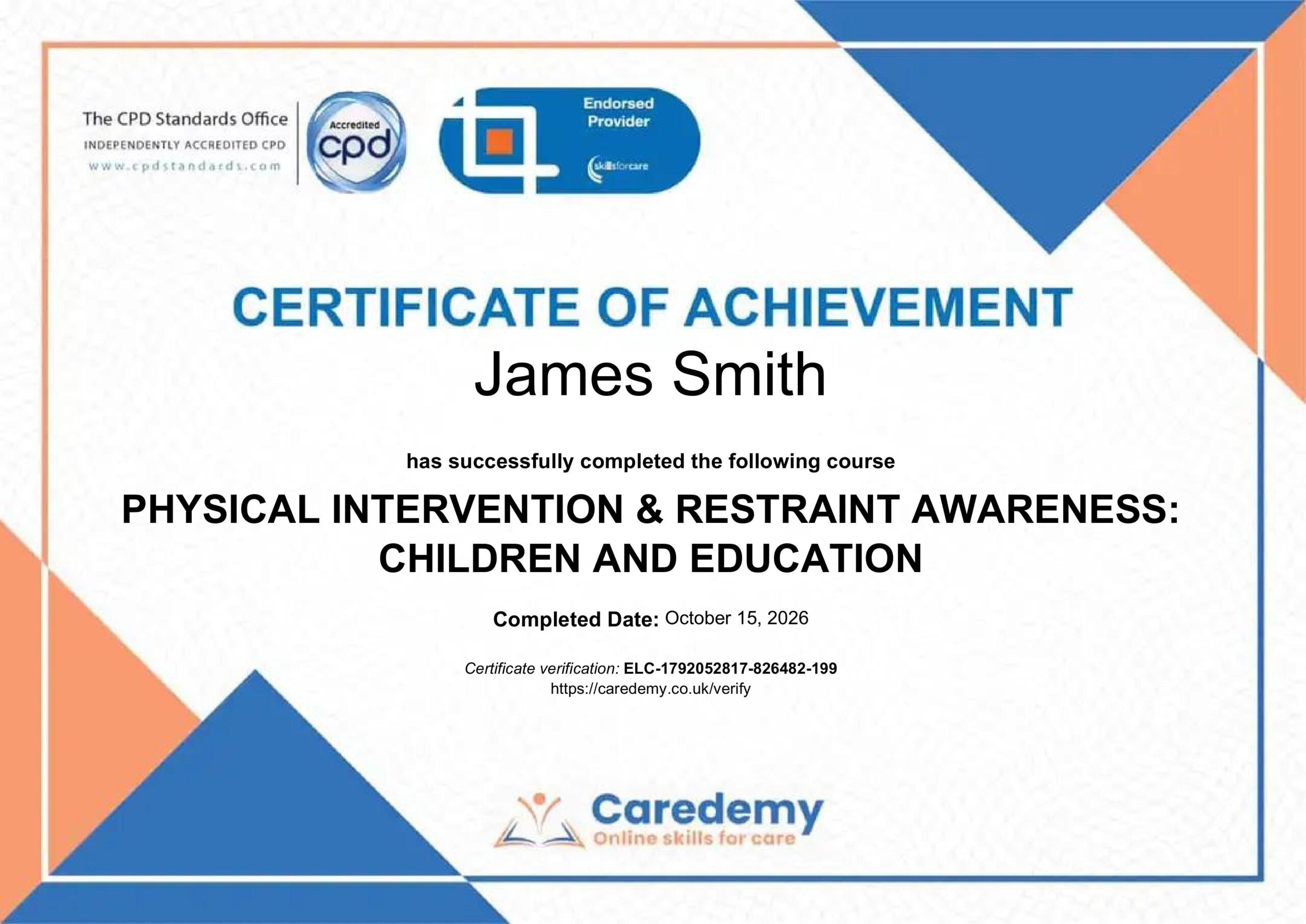
Certificate Included: Instant Digital Certificate
Accreditation: CPD Accredited
Suitable For: Teachers, teaching assistants, SENCOs, pastoral staff, learning support assistants, school leaders, behaviour support staff and professionals working with children
Assessment: Online Multiple Choice Test
Access: Instant Access – 12 Months
Duration
1 hour
CPD Points
1
Last Updated:
15 Oct 2026
What is Physical Intervention & Restraint Awareness training?
Physical Intervention & Restraint Awareness training provides introductory knowledge about the use of restrictive interventions when supporting children and young people in educational settings.
The course explains the distinction between physical intervention, restraint and reasonable force, alongside the legal, safeguarding and professional considerations involved.
Learners explore why prevention, positive behaviour support, effective communication and de-escalation should be prioritised before physical intervention is considered.
The training also examines the needs of children with special educational needs and disabilities (SEND), including autism, sensory differences and emotional dysregulation.
Practical scenarios help learners recognise escalating situations, consider safer responses and understand the importance of recording, reporting and reviewing incidents.
This is an awareness course. It does not provide practical restraint techniques, hands-on assessment or certification of physical intervention competence.
CPD Accredited
User friendly interactive courses
Instant Access
Enrol Now – Start Instantly
Certify Instantly
Certificate Available Immediately
Learn on Any Device
Train on Phone, Tablet or Computer
Money Back Guarantee
14 Day Money Back Guaratnee
How Would You Like to Access This Course?
Flexible options for individuals, staff teams and organisations
1
Instant Online Purchase
From 1 to 100+ learners • Bulk discounts available • Instant online access and certificates included
- Instant Access - No Quote Required
- CPD Accredited Certificates Included
- 100% Online & Mobile Friendly
- Assign Courses to Staff, Friends or Family
- Track Progress and Completions Online
- 14 Day Money Back Guarantee
£15 + VAT
CPD • Certificate included • Start instantly
Quantity
Per Course Price
1+ Courses
£15 + Vat
5+ Courses
£9.40 + Vat
10+ Courses
£8.49 + Vat
30+ Courses
£7.99 + Vat
50+ Courses
£6.49 + Vat
100+ Courses
£4.99 + Vat
2
Need Ongoing Staff Training?
Best value for teams of 8+ learners who need regular mandatory, induction and refresher training.
- Save Money on Staff Training
- Access Our Full 200+ Course Library
- Instant certificates issued
- Track Compliance Across Your Team
- Free Learner Replacements
- Reporting & Certificate Management
- CQC inspection ready
- Lowest price guarantee
- Dedicated Support
Best Price Guarantee • CQC Inspection Ready
When should I choose Caredemy Teams?
Caredemy Teams is ideal for organisations with 8+ learners who need access to multiple courses for mandatory training, induction training, and annual refreshers. Benefit from our best-value pricing, free learner replacements, compliance reporting, and access to our full course library. If you only need a small number of CPD courses, you can buy online instantly.
Access friendly, dedicated expert support whenever you need it, with guidance available throughout your learning journey
All-access individual subscription
Get unlimited access to 200+ CPD-accredited courses. One low monthly price. Learn anytime.
Buy any 5 courses for £47
Mix and max any courses.
CPD accredited - Certificates included.
Who Is This Course For?
This course is designed for professionals who work with children and young people in educational and related settings.
It is suitable for teachers, teaching assistants, learning support assistants, SENCOs, pastoral support workers, school leaders, behaviour support staff, special school employees and professionals supporting children with additional needs.
It may also benefit staff working in alternative provision, early years environments, children’s services and other settings where challenging behaviour or distress may arise.
The course is particularly relevant to employees who need to understand prevention, de-escalation, reasonable force, safeguarding and incident reporting without undertaking practical restraint training.
Organisations should ensure that any staff expected to carry out physical interventions receive additional role-appropriate instruction, supervised practical training and competency assessment where required.
Key Benefits
✓ Understand the principles of reasonable force and restrictive intervention
✓ Recognise behavioural triggers and early signs of escalation
✓ Apply communication and de-escalation strategies before considering intervention
✓ Understand additional safeguarding considerations for children with SEND
✓ Recognise the importance of necessity, proportionality and safety
✓ Record, report and review incidents to help reduce future restrictive interventions
Course Modules
- Welcome to Physical Intervention & Restraint Awareness: Children and Education
- Who Is This Course For
- What Will You Learn?
- What Is a Restrictive Intervention?
- Reasonable Force and Physical Restraint
- Prevention Comes First
- Behaviour Is Communication
- Recognising Triggers
- Recognising Escalation
- Your Behaviour Can Change the Situation
- Communicating With a Distressed Child
- Space, Time and Environment
- When De-escalation Is Not Working
- Protecting Everyone Present
- Classroom Escalation
- When Might Reasonable Force Be Used?
- Necessary, Reasonable and Proportionate
- What Physical Intervention Must Never Become
- Safety During an Intervention
- Is Physical Intervention Appropriate?
- SEND and Restrictive Intervention
- Autism, Sensory Needs and Dysregulation
- Individual Planning
- SEND Scenario
- Physical Intervention Is a Safeguarding Matter
- Immediately After an Incident
- Recording and Reporting Significant Incidents
- Write What Happened, Not What You Assume
- Review, Learn and Reduce Future Intervention
- Final Practical Scenario: From Trigger to Review
- Your Physical Intervention Checklist
- Course Summary
Ready to start?
Learning Outcomes
| Learner Outcome | Covered |
|---|---|
| Explain what physical intervention and restrictive practices mean in educational settings | ✓ |
| Distinguish reasonable force from physical restraint | ✓ |
| Explain why prevention and de-escalation should be prioritised | ✓ |
| Recognise how behaviour may communicate distress or unmet needs | ✓ |
| Identify common triggers and early warning signs of behavioural escalation | ✓ |
| Describe how staff communication and behaviour can influence a situation | ✓ |
| Recognise appropriate approaches to communicating with distressed children | ✓ |
| Explain how space, time and environmental adjustments may support de-escalation | ✓ |
| Identify considerations when de-escalation is unsuccessful | ✓ |
| Explain the principles of necessity, reasonableness and proportionality | ✓ |
| Recognise circumstances in which reasonable force may be considered | ✓ |
| Identify inappropriate, punitive or unsafe uses of physical intervention | ✓ |
| Recognise additional considerations for children with SEND, autism or sensory needs | ✓ |
| Explain the importance of individual support and behaviour planning | ✓ |
| Recognise physical intervention as a potential safeguarding concern | ✓ |
| Identify appropriate immediate actions following an intervention | ✓ |
| Record and report significant incidents accurately and factually | ✓ |
| Explain how incident review can help reduce future restrictive interventions | ✓ |
Training 8+ Staff Across Multiple Courses?
Purchasing multiple licences for this training course? Simply adjust the quantity and buy online today.
If you need ongoing training for 10+ employees across multiple subjects, our Team Training platform provides access to 200+ CPD accredited courses, compliance reporting, learner management and bulk enrolment tools.
- Access 200+ CPD Accredited Courses
- Manage All Learners In One Place
- Compliance & Audit Reporting
- Bulk Enrolment & Certificate Tracking
- Dedicated Account Support
Team Training Solutions
Ideal for care providers, healthcare organisations and workplace teams training multiple employees.
Why Choose Caredemy?
- Instant Certificate
- CPD-accredited courses
- Money Back Guarantee
- Expert-designed training
- 120,000 learners trained
- Flexible online learning
- Compliance-focused
- Dedicated support
What Our Learners Say?
“The course explained reasonable force and de-escalation clearly. The classroom scenarios were particularly relevant to everyday school situations.”
Sarah Mitchell
Teaching Assistant
“Very useful coverage of SEND and sensory needs. It reinforced why understanding triggers is essential before responding to behaviour.”
Daniel Foster
Learning Support Assistant
“The safeguarding and incident reporting sections were especially helpful. Clear guidance on prevention, proportionality and professional responsibilities.”
Rebecca Collins
Pastoral Support Officer
0/5 from 0+ learners
Why Is Physical Intervention & Restraint Awareness training important?
Physical intervention involving children carries significant safeguarding, physical safety and emotional wellbeing considerations.
In educational settings, staff may encounter situations involving distress, behavioural escalation, aggression or immediate risks to safety.
Without appropriate awareness, staff may respond in ways that unintentionally increase distress, create additional risks or result in unnecessary restrictive intervention.
Training helps employees understand how behaviour may communicate unmet needs, recognise early warning signs and use preventative approaches.
It also reinforces that physical intervention must never be used as punishment, humiliation or a substitute for appropriate behaviour support.
For children with SEND, autism or sensory differences, individual needs and communication difficulties may significantly affect how situations develop.
Understanding safeguarding responsibilities, factual recording and post-incident review supports accountability and helps organisations identify opportunities to reduce restrictive practices.
Instant Course Certificate
Is Physical Intervention & Restraint Awareness training a legal requirement in the UK?
There is no universal UK law requiring education staff to hold a certificate specifically titled Physical Intervention & Restraint Awareness.
However, schools and education providers have legal responsibilities relating to safeguarding, health and safety, equality and the appropriate use of reasonable force.
In England, Section 93 of the Education and Inspections Act 2006 provides certain school staff with statutory powers to use reasonable force in specified circumstances, subject to the applicable legal conditions.
The Equality Act 2010 also requires education providers to consider their responsibilities towards disabled pupils, including reasonable adjustments.
Applicable requirements differ across England, Wales, Scotland and Northern Ireland. Staff must therefore follow the legislation, statutory guidance and organisational procedures relevant to their setting.
Online awareness training can support understanding but does not establish practical competence or authorise staff to undertake particular restraint techniques.
Trusted by 120,000+ learners
Trusted by care providers, healthcare organisations, businesses and workplace teams across the UK for high-quality online training
Office & Commercial
Health & Social Care
Industrial, Warehousing & Facilities
Hospitality, Retail & Public Services
Physical Intervention & Restraint Awareness training FAQ?
What is Physical Intervention & Restraint Awareness training?
Physical Intervention & Restraint Awareness training helps education staff understand restrictive practices, reasonable force, prevention, de-escalation and safeguarding. It explains when physical intervention may be considered, the importance of proportionality and how incidents should be recorded and reviewed. Awareness training does not qualify learners to perform physical restraint techniques.
What is the difference between physical intervention and physical restraint?
Physical intervention is a broad term covering physical actions used to manage a situation, which may include guiding or preventing movement. Physical restraint is more restrictive and involves limiting a person’s movement or freedom. Whether an action constitutes restraint depends on what occurs, its purpose and its effect on the child, not simply the terminology used.
When can teachers use reasonable force in schools?
In England, Section 93 of the Education and Inspections Act 2006 provides certain school staff with powers to use reasonable force in specified circumstances, including preventing injury, offences or serious disruption. Any force used must be reasonable in the circumstances. Staff should follow applicable guidance, safeguarding procedures and their school’s policies. Different legal frameworks apply elsewhere in the UK.
Is physical restraint training mandatory for teaching assistants?
There is no universal requirement for every teaching assistant to complete practical physical restraint training. The training required depends on their responsibilities, the setting, identified risks and applicable organisational requirements. Staff who may be expected to undertake physical interventions should receive appropriate training and assessment rather than relying solely on an online awareness certificate.
What should staff do before considering physical intervention?
Staff should prioritise prevention and de-escalation wherever possible. This includes recognising triggers, adjusting communication, allowing appropriate space and time, reducing environmental stressors and seeking assistance when needed. Responses should consider the child’s individual needs and immediate safety risks. Physical intervention should not be used simply because a child is refusing an instruction.
How does SEND affect decisions about physical intervention?
Children with SEND may experience communication differences, sensory sensitivities, anxiety or difficulties regulating emotions. These factors can affect how distress develops and how physical contact is experienced. Staff should consider reasonable adjustments, individual support plans, communication needs and known triggers. Restrictive intervention must not replace appropriate support or be used simply because a child has additional needs.
What should happen after a physical restraint incident in school?
The immediate priority is the child’s safety and wellbeing, including checking for injuries or distress and arranging appropriate support. Staff should follow safeguarding and incident reporting procedures, inform relevant people as required and make an accurate factual record. Significant incidents should be reviewed to identify triggers, assess the response and consider how future interventions might be prevented.
Does this online course qualify staff to physically restrain children?
No. This course provides awareness of physical intervention, reasonable force, safeguarding and de-escalation. It does not teach or assess hands-on restraint techniques and should not be treated as evidence of practical competence. Where physical intervention is part of an employee’s role, the organisation must determine what additional practical training, supervision and competency assessment are necessary.
Need Training for Multiple Employees?
Train your entire workforce through Caredemy Teams with bulk enrolment, compliance reporting and access to 200+ CPD courses.
- CPD-accredited certificate
- Instant Certificate
- Learn of Any Device
- Money-back Guarantee
Related Courses You May Like


UK Regulations And Guidance

£15 + Vat
Physical Intervention & Restraint Awareness: Children and Education
- CPD Accredited
- Instant Certificate
- Instant Access
- Bulk Discounts Available