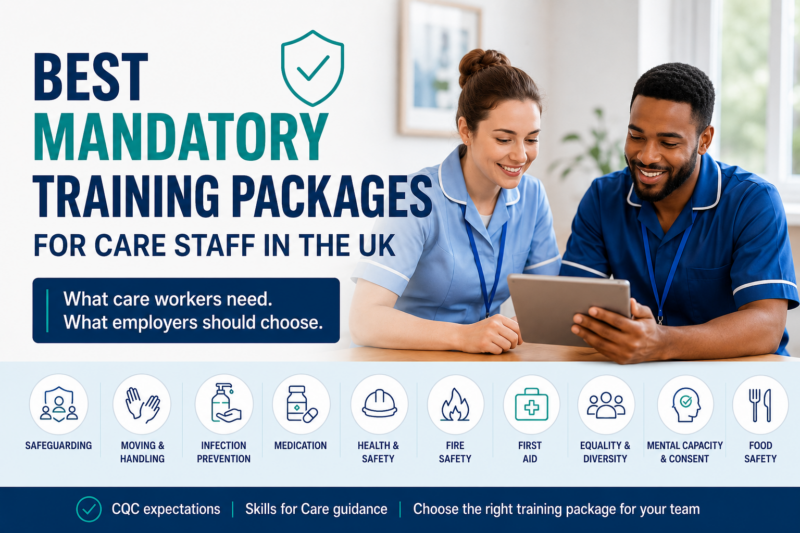
Best Mandatory Training Packages for Care Staff in the UK
CQC requirements, essential training and choosing the right package.
Quick answer: The best mandatory training package for care staff is not simply the package containing the greatest number of courses. It should help an employer provide the training its workforce actually needs based on legislation, CQC requirements, Skills for Care guidance, staff roles, workplace risks and the needs of the people receiving care.
For many adult social care workers, this will include training in areas such as safeguarding, infection prevention and control, health and safety, fire safety, moving and handling, equality and human rights, and learning disability and autism. Other subjects — including medication, food safety, first aid and specialist clinical or condition-specific training — depend on the worker’s responsibilities and the service provided.
Importantly, CQC does not publish a single universal list of mandatory training courses that every care worker must complete. CQC requires providers to ensure workers have the qualifications, competence, skills and experience necessary to perform their roles safely, and Regulation 18 requires appropriate training, professional development, supervision and appraisal.
The best training package therefore combines appropriate learning with competency assessment where required, refresher management, certificates, reporting and evidence that managers can use to demonstrate how they maintain a competent workforce.
What is mandatory training in health and social care?
The phrase mandatory training is commonly used to describe training an employer requires staff to complete so they can perform their roles safely, effectively and in accordance with relevant legal, regulatory and organisational requirements.
However, managers should distinguish between three different categories.
1. Statutory or regulatory requirements
Some requirements arise directly from legislation or regulation.
For example, since July 2022, CQC-registered providers have been legally required to ensure staff receive training on learning disability and autism, including appropriate interaction with autistic people and people with a learning disability, at a level appropriate to the person’s role. The Oliver McGowan Code of Practice came into force in September 2025 and provides further guidance on meeting this requirement.
CQC regulations also create broader obligations around areas including safe care, safeguarding, consent, staffing and staff competence.
2. Training needed to meet regulatory expectations
A regulation may require a provider to achieve an outcome without prescribing one particular online course.
For example, Regulation 18 requires providers to ensure staff receive appropriate support, training, professional development, supervision and appraisal to enable them to perform their duties. Regulation 12 requires providers to assess risks and ensure staff have the qualifications, competence, skills and experience needed to provide safe care.
3. Training determined by the employer, role and risk
Employers must also identify additional learning according to:
- the worker’s responsibilities
- the type of service
- the people receiving care
- workplace and individual risk assessments
- equipment being used
- delegated healthcare activities
- contractual or commissioner requirements
- incidents, complaints and identified competency gaps
- changes to legislation, guidance or working practices.
Skills for Care specifically describes additional training as being defined by the employer based on the needs of the service and the people drawing on care and support. For CQC-regulated services, identifying and providing appropriate additional training remains the provider’s responsibility.
That is why two care organisations may legitimately have different training matrices.
Does CQC specify mandatory courses?
Not as one universal course list.
This is an important distinction because the phrase “CQC mandatory training” is widely used by training providers and employers.
CQC’s regulations focus on whether staff are suitably qualified, competent, skilled and experienced and receive the training and support necessary for their responsibilities.
CQC Regulation 19 also expects providers to have processes for assessing and checking that employees have the competence, skills and experience required for their role and to assess competence before staff work unsupervised.
Skills for Care’s current statutory and mandatory training guidance is designed to help adult social care employers translate legislation, statutory guidance, standards and recommendations into appropriate workforce development. Its current guide was updated in December 2025.
So instead of asking:
“What courses does CQC say everyone must do?”
a better question is:
“What knowledge, skills and competencies do our staff need to perform their particular roles safely, and what evidence do we have that they have them?”
What training do care workers typically need?
Although there is no universal CQC course list, several areas appear frequently in adult social care training programmes.
The exact programme should always be adjusted to the role and service.
New starter and induction training
Induction should introduce employees to their role, responsibilities, workplace procedures, the people they support and the risks relevant to their work.
A new starter’s programme might include:
- organisational policies and procedures
- safeguarding
- health and safety
- infection prevention and control
- fire procedures
- moving and handling relevant to the role
- confidentiality and information handling
- equality, diversity, inclusion and human rights
- person-centred working
- emergency procedures
- role-specific skills
- supervised practice and competency assessment.
Training records should not be treated as a substitute for determining whether the worker can actually perform their role safely.
Care Certificate
The Care Certificate standards provide a foundation for health and adult social care workers and can be used as part of a robust induction programme.
The standards were updated in March 2025 and there are now 16 Care Certificate standards, including the new Standard 16 covering awareness of learning disability and autism.
The Care Certificate covers:
- Understand your role
- Your personal development
- Duty of care
- Equality, diversity, inclusion and human rights
- Work in a person-centred way
- Communication
- Privacy and dignity
- Fluids and nutrition
- Awareness of mental health and dementia
- Adult safeguarding
- Safeguarding children
- Basic life support
- Health and safety
- Handling information
- Infection prevention and control
- Awareness of learning disability and autism.
The Care Certificate should not be confused with simply completing 16 online courses. Workers need to demonstrate what they know and what they do, and assessment must establish that they can apply the standards in their role.
It is also different from the Ofqual-regulated Level 2 Adult Social Care Certificate qualification.
Safeguarding
Safeguarding is central to adult social care.
CQC Regulation 13 requires providers to protect people from abuse and improper treatment. CQC guidance states that staff must receive safeguarding training relevant to their role as part of induction and that it should be updated at appropriate intervals. Staff should be able to recognise abuse and understand how to report concerns.
Training should therefore reflect the worker’s level of responsibility rather than giving every employee identical safeguarding training.
Managers and safeguarding leads may require more advanced knowledge than workers whose primary responsibility is recognising and reporting concerns.
Moving and handling
Moving and handling requirements depend heavily on the work being undertaken.
A worker who uses hoists and transfer equipment with residents in a care home may require substantially different training and competency assessment from an office-based administrator.
Skills for Care’s current guidance identifies moving and handling objects as a core training area and emphasises updating learning when new risks or activities are introduced.
Where staff physically assist people, employers should consider whether practical instruction, equipment familiarisation, supervision and observed competency are required.
An online course can provide important underpinning knowledge, but it should not be assumed that online completion alone proves competence to perform a physical moving and handling procedure.
Infection prevention and control
Care workers need to understand how infections spread and how appropriate precautions reduce risks to themselves and the people they support.
Training can cover:
- hand hygiene
- standard infection control precautions
- personal protective equipment
- cleaning and decontamination
- waste management
- exposure to bodily fluids
- outbreak procedures
- respiratory hygiene.
The content should be relevant to the setting. Infection risks in domiciliary care, for example, may differ from those in a residential or nursing home.
Skills for Care directs adult social care providers to current infection prevention and control resources and guidance tailored to the sector.
Medication
Not every care worker administers or supports people with medication.
Medication training should therefore follow the employee’s responsibilities.
Workers involved in medicines may need training covering areas such as:
- safe administration
- medication records
- storage
- errors and incidents
- PRN medicines
- controlled drugs where relevant
- consent
- self-administration
- reporting concerns.
Employers should also establish competence before workers undertake medication responsibilities independently.
A generic medication certificate should not automatically be treated as evidence that a worker is competent to perform every medicines-related task.
Health and safety
Health and safety learning should reflect the actual hazards staff encounter.
Depending on the workplace, this may cover:
- risk assessment
- accident and incident reporting
- hazardous substances
- slips, trips and falls
- lone working
- equipment safety
- workplace violence
- personal safety
- moving and handling
- emergency procedures.
Regulation 12 requires providers to assess risks to people’s health and safety and ensure staff have the necessary competence, skills and experience to provide care safely.
Fire safety
Workers need to know what to do if a fire occurs and understand the fire procedures relevant to their workplace.
Skills for Care stresses that fire safety training should be appropriate to the environment — for example, a care home, community service or someone’s own home.
This is particularly important because evacuation strategies and staff responsibilities can vary significantly between services.
Food safety where applicable
Food safety training should be based on what the employee actually does.
A member of staff who prepares meals or handles food may require more detailed food hygiene knowledge than someone who has no food preparation responsibilities.
Employers should consider:
- food handling duties
- food storage and preparation
- cross-contamination
- allergens
- personal hygiene
- the vulnerability of people receiving care.
Food safety is therefore a good example of why a mandatory training matrix should be role-based rather than simply organisation-wide.
First aid and basic life support where applicable
The required level of first aid or emergency-response training depends on the role, workplace and risk assessment.
The Care Certificate includes Basic Life Support as Standard 12, but employers should separately assess their workplace first aid requirements and determine which employees require additional training or recognised practical competency.
Online learning can support knowledge, but where a practical assessment or specific workplace first-aid qualification is required, online training alone will not necessarily be sufficient.
Equality, diversity and human rights
Care should respect people’s rights, dignity, culture, identity, beliefs and individual preferences.
The 2025 Care Certificate strengthened this area by explicitly incorporating human rights into Standard 4: Equality, Diversity, Inclusion and Human Rights.
Learning should help staff understand how these principles affect real decisions and interactions rather than treating equality as a theoretical compliance topic.
Mental capacity and consent
Workers need sufficient understanding of consent and mental capacity for the decisions they encounter.
Training needs will vary considerably.
A frontline care worker may need to understand how to seek valid consent, recognise concerns and escalate appropriately, while managers or staff involved in complex decision-making may require deeper knowledge of the Mental Capacity Act 2005, best-interest decision-making and restrictions.
This is another area where training should follow role and responsibility, not simply job title.
Learning disability and autism training
This deserves specific attention because it is subject to an explicit legal requirement.
Since 1 July 2022, all CQC-registered health and social care providers have been required to ensure staff receive training on learning disability and autism, including appropriate interaction with autistic people and people with a learning disability, at a level appropriate to their role.
The requirement applies across CQC-registered services and is not limited to specialist learning disability or autism providers.
The Oliver McGowan Code of Practice commenced on 6 September 2025 and provides further guidance on what role-appropriate training means.
Providers should therefore check that their current programme reflects the latest requirements rather than relying on older mandatory-training matrices.
Role-specific training
Core training is only the starting point.
Skills for Care explains that employers must identify additional training according to their service and the people they support. Examples can include areas such as:
- dementia
- end-of-life care
- positive behaviour support
- nutrition and hydration
- communication needs
- oral healthcare
- personal care
- digital skills
- specific health conditions
- delegated healthcare activities
- mental capacity
- data protection and information handling.
For example, a dementia care home, supported living service and domiciliary care agency could all require different additional learning despite sharing many core subjects.
Mandatory care training: quick comparison table
| Training | Who may need it | Why | Typical refresher considerations | Online/practical considerations |
|---|---|---|---|---|
| Safeguarding adults | Staff working with adults receiving care | Recognise, prevent and report abuse or neglect | Update at appropriate intervals and when guidance, role or risk changes | Knowledge can be online; competence must be reflected in practice |
| Safeguarding children | Staff who may encounter children or have relevant safeguarding responsibilities | Recognise and respond to child safeguarding concerns | Based on role, service and current guidance | Level should match responsibilities |
| Infection prevention and control | Most frontline care workers | Reduce infection risks | Refresh according to employer assessment, risk and current guidance | Online theory works well; practical practice should also be checked |
| Moving and handling | Staff moving objects or assisting people | Reduce injury and unsafe handling | New risks/equipment/activity may trigger additional training | Practical demonstration may be necessary |
| Medication | Staff supporting or administering medicines | Safe medicines management | Based on responsibilities, competence, incidents and employer policy | Theory can be online; workplace competency may also be required |
| Health and safety | Staff according to workplace hazards | Manage risks and work safely | Review when risks, equipment, responsibilities or procedures change | Often suitable for blended learning |
| Fire safety | Staff according to workplace responsibilities | Prevent fires and respond appropriately | Consider changes to environment/risk and current refresher guidance | Site-specific procedures and drills remain important |
| Food safety | Staff preparing or handling food | Prevent contamination and foodborne illness | Depends on duties, risk and policy | Online knowledge may be appropriate; safe practice also matters |
| Basic life support/first aid | Staff according to role and workplace assessment | Respond appropriately to emergencies | Depends on the training/qualification and workplace risk assessment | Practical competency may be required |
| Equality, diversity, inclusion and human rights | Broadly relevant across care roles | Deliver fair, respectful and person-centred care | Update where needs, responsibilities or guidance change | Well suited to online scenarios and case studies |
| Mental capacity and consent | Staff involved in care decisions | Support lawful, person-centred decision-making | Level should reflect responsibility and complexity | Scenario learning useful; complex roles may need additional training |
| Learning disability and autism | Staff in CQC-registered providers at a level appropriate to role | Explicit statutory training requirement | Providers should follow current legal requirements and Code of Practice | Ensure delivery meets current role-appropriate requirements |
| Specialist/condition-specific training | Workers supporting people with identified needs | Ensure care reflects actual needs and risks | Review as people’s needs, role or service change | May require online, classroom, practical or supervised learning |
Important: refresher periods should not be selected simply because a training provider labels a course “annual”. Skills for Care’s current guidance should be considered alongside legislation, risk, competence, qualifications, changes in practice and employer requirements. Its December 2025 guidance, for example, gives a minimum three-year refresher period for certain subjects such as fire safety and moving and handling objects, while also identifying circumstances that can trigger earlier learning.
How often should mandatory care training be refreshed?
There is no single universal rule that every care training course must be repeated annually.
This is another area where providers can inadvertently create unnecessary training.
Refresher decisions should consider:
- legislation and statutory guidance
- Skills for Care guidance
- professional requirements
- commissioner or contractual requirements
- manufacturer instructions
- workplace risk assessment
- staff competency
- incidents and near misses
- changes in equipment or working practices
- changes to the needs of people supported
- the worker’s existing qualifications.
Skills for Care’s guidance also recognises existing learning. Where a recognised adult social care qualification has covered a topic, its approach can reduce unnecessary duplication of refresher learning.
The objective is not to accumulate certificates. It is to maintain a workforce that remains competent.
Ways employers can buy mandatory training packages
There is no single purchasing model that suits every care organisation.
Individual courses
Employers purchase courses when required.
Best for: very small organisations or occasional training requirements.
Advantages: no large commitment and easy to purchase individual topics.
Limitations: costs and administration can increase when many workers need multiple courses.
Mandatory training bundles
Several common courses are packaged together.
Best for: organisations onboarding workers who need a similar core programme.
Advantages: convenient and usually cheaper than purchasing each course separately.
Watch for: a pre-built bundle should not become your training-needs assessment. Check whether every course is relevant and whether additional role-specific training is required.
Training credits
Employers purchase credits and allocate them to workers when courses are required.
Best for: organisations with changing training requirements.
Advantages: flexibility and the ability to purchase training in bulk without assigning everything immediately.
Watch for: expiry dates, course restrictions and whether an LMS/reporting system is included.
Per-learner subscriptions
A fixed fee gives each learner access to a defined range or full library for a period.
Best for: employers with ongoing induction, mandatory, refresher and professional-development requirements.
Advantages: predictable costs and broader access to learning.
Watch for: what happens when employees leave, whether replacements cost extra and whether managers receive useful compliance reporting.
Unlimited training
Unlimited-access packages allow eligible employees to complete multiple courses without the employer paying separately for each enrolment.
Best for: care organisations with substantial or changing learning requirements.
The value increases when workers require mandatory training plus specialist learning, induction and continuing development.
However, employers should still assign learning according to training needs rather than encouraging workers to complete courses purely because they are available.
What should a good mandatory training package include?
A good package should offer more than a collection of certificates.
When comparing providers, employers should look for:
| Feature | Why it matters |
|---|---|
| Care-specific content | Training should reflect real health and social care practice |
| Current course content | Courses should be reviewed when legislation or guidance changes |
| Appropriate accreditation/quality assurance | Gives employers confidence in the learning provider and content |
| Wide course library | Allows core and specialist learning to sit within one system |
| LMS | Managers need visibility of staff learning |
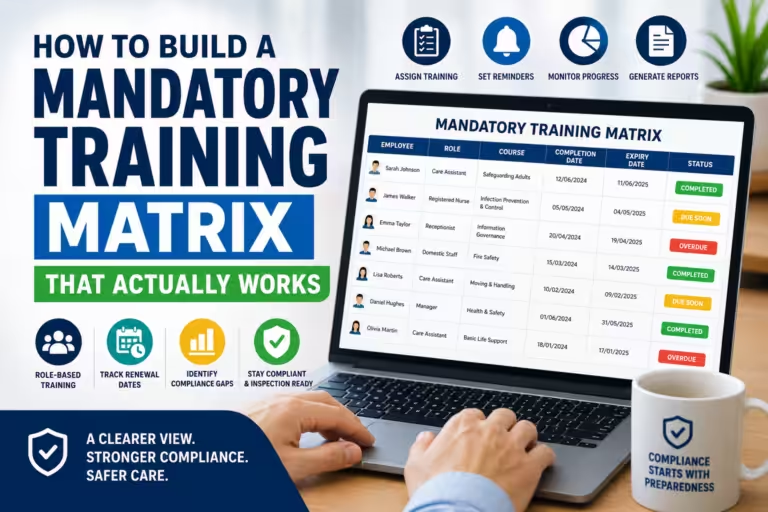
| Training matrix | Makes gaps and upcoming requirements easier to identify |
| Automated reminders | Reduces manual administration |
| Certificates | Provides accessible evidence of completion |
| Bulk reporting | Important for larger workforces and inspection preparation |
| Course assignment | Managers should be able to allocate learning by role |
| Multiple branches/locations | Important for groups and multi-site providers |
| Learner replacement | Valuable in a sector with regular staff turnover |
| Mobile access | Care staff may not work from desks |
| Practical/competency awareness | Provider should not imply an online certificate proves every practical competence |
| Support | Managers should be able to get help when required |
| Transparent pricing | Compare total annual cost, not simply headline course price |
Choosing mandatory training for a CQC inspection
A CQC inspection should not prompt a last-minute exercise in getting everybody to complete the same set of online courses.
A stronger approach is to be able to explain why each worker has received the training they have, how competence is checked and how the organisation responds when learning needs change.
Regulation 18 requires staff to receive appropriate training, professional development, supervision and appraisal. Regulation 19 requires providers to assess and check competence, skills and experience, including before workers undertake roles unsupervised.
Managers preparing their training evidence should therefore be able to demonstrate:
- A role-based training matrix
Show which training is required for different roles and why. - Up-to-date completion records
Managers should quickly identify completed, outstanding and upcoming learning. - Evidence of induction
New starters should receive appropriate induction, training and supervision. - Care Certificate implementation
Where applicable, employers should use the current 16-standard framework and ensure that achievement includes appropriate assessment rather than online knowledge alone. - Competency evidence
For areas such as moving and handling, medication and practical emergency procedures, completion of an online module may form only part of the evidence. - Role-specific training
A service supporting people with dementia, epilepsy, diabetes, behaviours of concern or complex communication needs should be able to demonstrate how those needs have influenced staff development. - Refresher management
There should be a clear system for determining when training or competency needs reviewing. - Learning from incidents and changes
Complaints, incidents, near misses, new equipment and changes in people’s needs should feed into training decisions. - Supervision and appraisal
Training should connect with the wider workforce-development process rather than exist as an isolated compliance exercise. - Accessible audit evidence
Managers should be able to produce records without spending hours searching through individual personnel files.
The strongest inspection position is therefore not:
“Everyone has 15 certificates.”
It is:
“We understand the training and competency requirements of each role, we know our workforce’s current compliance position, we address gaps and we can demonstrate why our staff are competent to support the people using our service.”
Caredemy mandatory training for care providers
Caredemy provides online health and social care training for both individual learners and organisations.
For employers, the current Caredemy Team Training platform provides access to more than 200 CPD-accredited courses alongside a learner management system. Current features include compliance and audit reporting, a colour-coded reporting matrix, bulk course assignment, bulk certificate downloads, course-time reporting and automated course renewal.
Caredemy currently offers employers different purchasing options including individual/pay-as-you-go training, credits and subscriptions. Credits do not expire, while subscription packages can provide access to the full course library.
Team subscription features currently include:
- access to the full course library
- free training for the manager
- free learner replacements
- Care Certificate access
- learner and compliance reporting
- bulk course assignment
- bulk certificate management
- creation and assignment of course bundles
- automated course renewal
- dedicated account management
- no setup charges
- best-price guarantee.
Caredemy’s current Care Certificate course has also been updated to cover all 16 Care Certificate standards introduced by the March 2025 update.
For organisations with ongoing induction, mandatory and refresher requirements, an LMS-based approach can make it considerably easier to see which workers have completed assigned learning and where gaps remain.
However, the same principle applies regardless of training provider: online learning should form part of the employer’s overall learning, competency and workforce-development system. Employers remain responsible for determining what training is appropriate and for assessing practical competence where necessary.
Which mandatory training package is best for your care organisation?
The answer depends primarily on workforce size and complexity.
For a very small organisation needing occasional courses, individual course purchases may be sufficient.
For an employer recruiting several workers with similar learning requirements, a bundle may be convenient.
For an organisation that wants to purchase training in bulk but allocate it gradually, credits can provide more flexibility.
For providers with regular recruitment, refresher training and specialist learning requirements, a per-learner or unlimited subscription with an LMS may provide better long-term value and significantly reduce administration.
Whatever purchasing model you choose, prioritise the system that helps you answer four questions:
Who needs training?
What do they need?
When does it need reviewing?
Can we demonstrate competence and compliance?
Those questions matter far more than how many courses appear in a provider’s “mandatory package”.
FAQs: mandatory training for care staff
What training is mandatory for care workers in the UK?
There is no single universal list that applies identically to every care worker. Training requirements come from legislation, regulation, statutory guidance, the worker’s responsibilities, workplace risks and the needs of people receiving care. Common subjects include safeguarding, health and safety, infection prevention and control, fire safety and moving and handling, with additional subjects determined by role.
Does CQC have a mandatory training list?
CQC does not publish one universal mandatory-course checklist for all care staff. CQC requires registered providers to ensure workers are appropriately qualified, competent, skilled, experienced and trained for their roles.
Does mandatory care training have to be completed every year?
Not necessarily. There is no universal requirement for every subject to be repeated annually. Refresher frequency should be determined from current guidance, legislation, risk, competence, role requirements and other relevant factors. Skills for Care’s current guidance specifies different considerations depending on the training topic.
Is the Care Certificate mandatory?
The Care Certificate standards are a recommended framework for induction and define the introductory knowledge, skills and behaviours expected of relevant health and adult social care workers. Skills for Care describes the Care Certificate as a CQC expectation and recommends employers have a strategy for implementing it.
CQC Regulation 19 also states that providers employing healthcare assistants and social care support workers are expected to follow the Care Certificate standards when assessing competence.
Are there 15 or 16 Care Certificate standards?
There are currently 16. The standards were updated in March 2025, when a new Standard 16 covering awareness of learning disability and autism was introduced.
Is learning disability and autism training mandatory?
For CQC-registered providers, yes. Since 1 July 2022, providers have been required to ensure staff receive training on learning disability and autism, including appropriate interaction, at a level appropriate to the person’s role. The Oliver McGowan Code of Practice commenced in September 2025.
Can all mandatory care training be completed online?
Many knowledge-based subjects can be delivered effectively through eLearning. Skills for Care recognises eLearning as a flexible way of supporting statutory, mandatory and specialist learning.
However, some responsibilities require practical training, workplace assessment or observation of competence. An online certificate should not be assumed to prove competence in a practical task.
Does completing an online Care Certificate course mean someone has achieved the Care Certificate?
Not by itself. The Care Certificate standards require assessment of both what a worker knows and what they do. Employers need appropriate assessment and evidence that the worker can meet the standards in practice.
Do experienced care workers need to repeat all their training when changing employers?
Not automatically. Employers should assess previous learning, qualifications, competence and the requirements of the new role. Skills for Care states that someone who already holds their Care Certificate should not ordinarily need to retake it, although the new employer may need them to demonstrate how previous learning aligns with its requirements and may identify refresher needs.
What training does a domiciliary care worker need?
Training should reflect the worker’s duties and the needs of people receiving support. Typical subjects may include safeguarding, infection prevention and control, moving and handling, medication where relevant, health and safety, lone working, mental capacity, fire awareness and condition-specific learning.
What additional training might care-home staff need?
This depends on residents’ needs and the employee’s responsibilities. Examples might include dementia, falls prevention, pressure-area care, nutrition and hydration, medication, end-of-life care, epilepsy, diabetes, positive behaviour support or specialist moving and handling.
What should a registered manager look for in a mandatory training provider?
Look beyond the course list. Check the relevance and currency of course content, quality assurance, reporting, training matrices, certificates, refresher management, bulk assignment, learner management, support and whether the provider clearly distinguishes online learning from practical competency assessment.
Is the cheapest mandatory training package always best?
No. Compare the total cost of training and administration. A slightly cheaper course can become more expensive if managers spend significant time manually assigning courses, chasing expiries, downloading certificates and producing inspection reports.
For larger teams, features such as automated reminders, reporting, free learner replacements and unlimited learning can materially affect the overall cost.
Conclusion
The best mandatory training package for care staff is not a fixed bundle of courses labelled “CQC mandatory”.
A strong training programme starts with the opposite approach: assess the service, workforce, responsibilities and needs of the people receiving care, then determine the learning and competency requirements that follow.
CQC’s focus is ultimately on whether providers deploy workers who are appropriately qualified, competent, skilled and experienced, while Skills for Care’s current guidance helps employers identify statutory, mandatory and additional learning requirements.
For employers, the best training provider is therefore one that combines relevant, current learning with the tools needed to assign training intelligently, monitor completion, manage refreshers and provide clear evidence of workforce development.
That turns mandatory training from a certificate-collection exercise into what it should be: a practical system for maintaining safe, competent and confident care staff.