
- Home
- Health & Safety
- Blood Transfusions Course
Blood Transfusions Course
£15 + VAT


Written By Allison
- CPD Accredited | Instant Certificate | Mobile Friendly | Bulk Discounts Available
Trusted by care providers, healthcare organisations, businesses and workplace teams
The Understanding Blood Transfusions course introduces blood components, compatibility, reasons for transfusion and possible alternatives. Learners explore sampling, collection from storage, pre-administration checks and patient monitoring. Designed for introductory learning and refresher knowledge, it helps healthcare staff understand how each stage contributes to patient safety. Completion supports theoretical learning but does not replace practical training or workplace competency assessment.
Blood Transfusions Course Summary
Course Name: Understanding Blood Transfusions
Duration: 1 hour
Delivery: Online Training Course
Certificate Included: Instant Digital Certificate on successful completion
Accreditation: CPD Accredited – 1 CPD point
Suitable For: Healthcare assistants, clinical support workers, nursing and medical students, and healthcare professionals seeking introductory or refresher knowledge
Assessment: Online Multiple Choice Test with unlimited retakes
Access: Instant Access with 12 months’ course access
Duration
1 hour
CPD Points
1
Last Updated:
25 Jul 2026
What is Blood Transfusions training?
Understanding Blood Transfusions training explains why patients receive blood components and how the transfusion process is organised to reduce avoidable harm.
The course introduces the ABO and RhD blood group systems, the purpose of different blood products, transfusion benefits and risks, and alternatives that clinicians may consider. It also explores the stages from blood sampling and collection through to preparation and patient monitoring.
Learners develop the background knowledge needed to understand clinical instructions, recognise the importance of safety checks and respond appropriately to patient questions within their role.
This is introductory education, particularly relevant to people who do not make transfusion decisions or take blood samples themselves. Staff undertaking clinical transfusion tasks also need the training, supervision and competency assessment required by their employer.
CPD Accredited
User friendly interactive courses
Instant Access
Enrol Now – Start Instantly
Certify Instantly
Certificate Available Immediately
Learn on Any Device
Train on Phone, Tablet or Computer
Money Back Guarantee
14 Day Money Back Guaratnee
How Would You Like to Access This Course?
Flexible options for individuals, staff teams and organisations
1
Instant Online Purchase
From 1 to 100+ learners • Bulk discounts available • Instant online access and certificates included
- Instant Access - No Quote Required
- CPD Accredited Certificates Included
- 100% Online & Mobile Friendly
- Assign Courses to Staff, Friends or Family
- Track Progress and Completions Online
- 14 Day Money Back Guarantee
£15 + VAT
CPD • Certificate included • Start instantly
Quantity
Per Course Price
1+ Courses
£15 + Vat
5+ Courses
£9.40 + Vat
10+ Courses
£8.49 + Vat
30+ Courses
£7.99 + Vat
50+ Courses
£6.49 + Vat
100+ Courses
£4.99 + Vat
2
Need Ongoing Staff Training?
Best value for teams of 8+ learners who need regular mandatory, induction and refresher training.
- Save Money on Staff Training
- Access Our Full 200+ Course Library
- Instant certificates issued
- Track Compliance Across Your Team
- Free Learner Replacements
- Reporting & Certificate Management
- CQC inspection ready
- Lowest price guarantee
- Dedicated Support
Best Price Guarantee • CQC Inspection Ready
When should I choose Caredemy Teams?
Caredemy Teams is ideal for organisations with 8+ learners who need access to multiple courses for mandatory training, induction training, and annual refreshers. Benefit from our best-value pricing, free learner replacements, compliance reporting, and access to our full course library. If you only need a small number of CPD courses, you can buy online instantly.
Access friendly, dedicated expert support whenever you need it, with guidance available throughout your learning journey
All-access individual subscription
Get unlimited access to 200+ CPD-accredited courses. One low monthly price. Learn anytime.
Buy any 5 courses for £47
Mix and max any courses.
CPD accredited - Certificates included.
Who Is This Course For?
This course is suitable for healthcare assistants, clinical support workers, student nurses, medical students and staff who support patients receiving blood transfusions.
Registered nurses, doctors, phlebotomists, laboratory support staff and other healthcare professionals may also use it to refresh foundational knowledge alongside their specialist training.
Relevant settings include hospital wards, surgical services, outpatient transfusion units, haematology and oncology services, and other clinical environments where patients receive blood components.
Social care staff supporting people who attend transfusion appointments may find the introductory content useful for understanding treatment and patient concerns. It does not qualify care workers to administer blood.
Employers should select the course according to the learner’s responsibilities and provide additional practical instruction for any sampling, blood collection, administration or monitoring duties.
Key Benefits
✓ Explain why blood group compatibility matters for patient safety.
✓ Understand the purpose of different blood components and products.
✓ Recognise transfusion risks and the importance of patient monitoring.
✓ Understand safety procedures from sampling to pre-administration checks.
✓ Support informed conversations about patient concerns and consent.
✓ Build transfusion knowledge for induction, refresher learning and CPD.
Course Modules
- Blood Transfusions – Course Introduction
- Blood Compliation
- Knowledge Check – Blood Components
- Blood Groups
- The ABO System
- The ABO System – Antibodies
- The Rd Blood Group
- Knowledge Check – Blood Groups
- Deciding to Transfuse – Alternatives
- Risks of Transfusion
- Knowledge Check – Risks of Transfusions
- Blood Sampling
- Blood Collection from Storage
- Blood Transfusion Pre- Administration
- Knowledge Check – Bloof Transfusion Benefits
- Patient Monitoring
- Blood Donations
Ready to start?
Learning Outcomes
| Learner Outcome | Covered |
|---|---|
| Identify the main components of blood and explain their functions. | ✓ |
| Name the ABO blood groups. | ✓ |
| Explain how ABO antibodies affect blood compatibility. | ✓ |
| Describe the significance of RhD status in blood grouping. | ✓ |
| Explain how a patient’s blood group is determined. | ✓ |
| Explain why a patient may need a blood transfusion. | ✓ |
| Identify different blood products and describe their purposes. | ✓ |
| Describe potential benefits and risks of transfusion. | ✓ |
| Identify alternatives that may reduce the need for transfusion. | ✓ |
| Outline the blood sampling process used before transfusion. | ✓ |
| Explain the importance of following blood storage and collection procedures. | ✓ |
| Describe the purpose of pre-administration safety checks. | ✓ |
| Explain why patients need monitoring during transfusion. | ✓ |
| Identify common patient concerns about receiving blood. | ✓ |
| Explain the importance of consent and reasons a patient may refuse transfusion. | ✓ |
Training 8+ Staff Across Multiple Courses?
Purchasing multiple licences for this training course? Simply adjust the quantity and buy online today.
If you need ongoing training for 10+ employees across multiple subjects, our Team Training platform provides access to 200+ CPD accredited courses, compliance reporting, learner management and bulk enrolment tools.
- Access 200+ CPD Accredited Courses
- Manage All Learners In One Place
- Compliance & Audit Reporting
- Bulk Enrolment & Certificate Tracking
- Dedicated Account Support
Team Training Solutions
Ideal for care providers, healthcare organisations and workplace teams training multiple employees.
Why Choose Caredemy?
- Instant Certificate
- CPD-accredited courses
- Money Back Guarantee
- Expert-designed training
- 120,000 learners trained
- Flexible online learning
- Compliance-focused
- Dedicated support
What Our Learners Say?
“The blood group explanations made compatibility easier to understand and helped me connect the theory with ward procedures.”
Sarah L
Healthcare Assistant
“A useful refresher on transfusion risks and monitoring. The short knowledge checks helped reinforce the main points.”
Daniel P
Registered Nurse
“Clear introductory learning that helped me understand the transfusion process and why each safety check matters.”
Aisha K
Student Nurse
4.95/5 from 168+ learners
Why Is Blood Transfusions training important?
Blood transfusions involve several linked stages, and mistakes in patient identification or blood component selection can cause serious harm. Understanding the purpose of checks helps staff appreciate why procedures must be followed consistently, even during busy shifts. NICE
Patients may also be anxious about receiving blood or unsure why treatment is recommended. Staff need appropriate knowledge to listen, recognise questions outside their competence and involve the responsible clinician.
Understanding Blood Transfusions training connects the science of blood groups with the practical importance of collection procedures, preparation and monitoring. It supports informed teamwork and helps learners understand their responsibilities.
Employers can use introductory learning as part of a wider transfusion education programme that includes local policies, practical assessment and ongoing review of competence.
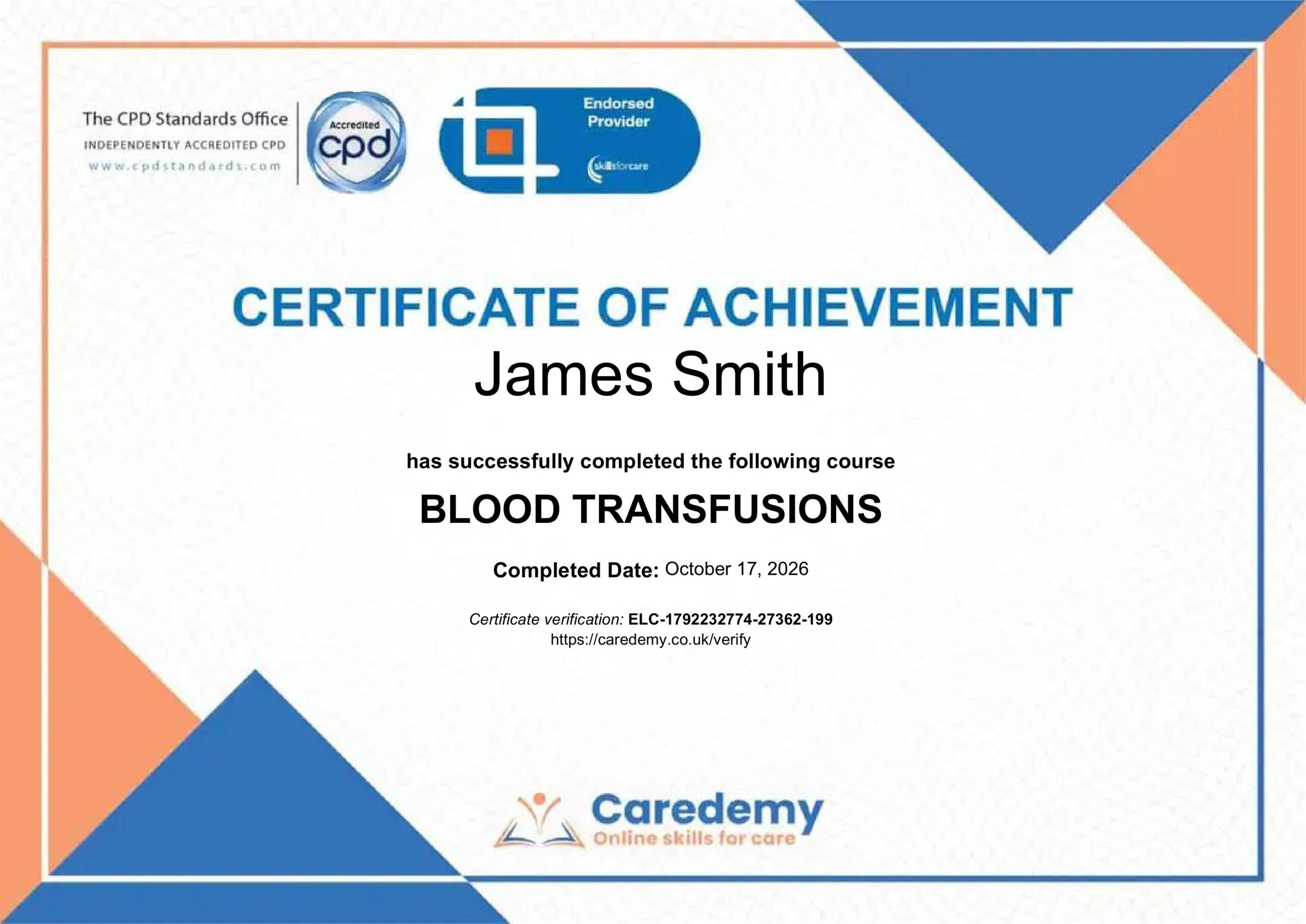
Instant Course Certificate
Is Blood Transfusions training a legal requirement in the UK?
There is no requirement to complete this particular Caredemy course. However, organisations involved in transfusion must meet applicable safety requirements and ensure staff are competent for their assigned duties.
The Blood Safety and Quality Regulations 2005, as amended, govern relevant blood establishments, hospital blood banks and facilities. Duties include applicable requirements for storage, traceability and reporting serious adverse events and reactions. For learners, this makes following local procedures and escalating concerns essential. GOV.UK
Recognised transfusion safety standards also expect training and competency assessment appropriate to staff responsibilities. Employers should identify the education, practical assessment and refresher arrangements each role needs. An online certificate can evidence theoretical learning, but it does not independently establish competence to sample, collect or administer blood.
Trusted by 120,000+ learners
Trusted by care providers, healthcare organisations, businesses and workplace teams across the UK for high-quality online training
Office & Commercial
Health & Social Care
Industrial, Warehousing & Facilities
Hospitality, Retail & Public Services
Blood Transfusions training FAQ?
What is blood transfusion awareness training?
Blood transfusion awareness training introduces blood groups, blood components, the reasons for transfusion and the risks involved. It explains the stages of the transfusion process and why checks and monitoring matter. Caredemy’s Understanding Blood Transfusions course provides introductory knowledge for staff and students supporting patients in relevant healthcare settings.
Who needs blood transfusion training?
Staff need training appropriate to their involvement in the transfusion process. This may include nurses, doctors, healthcare assistants, phlebotomists and laboratory personnel. This introductory course is particularly relevant to support staff and learners developing foundational knowledge. People carrying out clinical transfusion tasks require additional role-specific training and assessment under their employer’s arrangements.
How long does the Understanding Blood Transfusions course take?
The course takes approximately one hour to complete, although individual learning times vary. Delivery is online, with instant access after purchase and 12 months’ access to the course. Learners can use this period to work through the material and revisit topics such as blood groups, transfusion risks and patient monitoring.
Will I receive a blood transfusion training certificate?
Yes. After successfully completing the online multiple choice assessment, you receive a digital CPD-accredited certificate to download or print. The course carries one CPD point, and unlimited assessment retakes are included. The certificate records successful completion of the online learning; practical competence must be assessed separately where required for your role.
Does this course qualify me to administer blood transfusions?
No. This course provides introductory theoretical knowledge and does not authorise you to administer blood independently. Clinical duties require appropriate professional scope, employer authorisation and demonstrated competence. Before undertaking transfusion tasks, complete the practical training and assessment required by your organisation and follow its current transfusion procedures.
How often should blood transfusion training be refreshed?
Follow your employer’s transfusion training policy and the requirements for your specific duties. Refresher arrangements should reflect your role, clinical activity and competency needs. Changes to procedures, identified knowledge gaps or transfusion incidents may prompt additional learning. Do not assume that the course’s access period sets your workplace refresher interval.
Is blood transfusion training a legal requirement for all care workers?
No. There is no blanket requirement for every care worker to complete this particular course. Training should match the person’s duties and the service provided. Organisations handling blood for transfusion have specific regulatory responsibilities, while staff undertaking transfusion tasks need suitable education and competence. Employers determine which training is required for each role.
Why are consent and patient monitoring important during a blood transfusion?
Patients need an explanation of why transfusion is recommended, its benefits and risks, and any suitable alternatives so they can participate in decisions. Monitoring before, during and after transfusion helps staff identify possible reactions and obtain timely clinical support. NICE guidance also emphasises giving patients information and documenting relevant discussions.
Need Training for Multiple Employees?
Train your entire workforce through Caredemy Teams with bulk enrolment, compliance reporting and access to 200+ CPD courses.
- CPD-accredited certificate
- Instant Certificate
- Learn of Any Device
- Money-back Guarantee
Related Courses You May Like
UK Regulations And Guidance
£15 + Vat
Blood Transfusions Course
- CPD Accredited
- Instant Certificate
- Instant Access
- Bulk Discounts Available