- Home
- Health & Safety
- Learning Disabilities: Good Communication Practices for Persons with Learning Disabilities Course
Learning Disabilities: Good Communication Practices for Persons with Learning Disabilities Course
£15 + VAT


Written By Allison
- CPD Accredited | Instant Certificate | Mobile Friendly | Bulk Discounts Available
Trusted by care providers, healthcare organisations, businesses and workplace teams
The Learning Disabilities: Good Communication Practices for Persons with Learning Disabilities Course covers effective and ineffective communication, reasonable adjustments, relevant legislation, dysphagia and reporting concerns. It is suitable for care, healthcare, education and support workers who communicate with people with learning disabilities and want to promote safer, more inclusive and person-centred practice.
Learning Disabilities: Good Communication Practices for Persons with Learning Disabilities Course Summary
Course Name: Learning Disabilities: Good Communication Practices for Persons with Learning Disabilities Course
Duration: 1 Hour
Delivery: Online Training Course
Certificate Included: Instant Digital Certificate
Accreditation: CPD Accredited
Suitable For: Healthcare, social care, education, community support, care and support workers, and anyone whose role involves communicating with people with learning disabilities
Assessment: Online Multiple Choice Test
Access: Instant Access
Duration
1 hour
CPD Points
1
Last Updated:
25 Jul 2026
What is Learning Disabilities: Good Communication Practices for Persons with Learning Disabilities training?
This course provides introductory training on communicating effectively with people with learning disabilities. It explores different types of communication, how communication can be adapted, examples of good and poor practice, reasonable adjustments and relevant legislation.
Learners also examine dysphagia in people with learning disabilities, including why communication and recognition of concerns can be important when supporting a person’s health and wellbeing. A workplace scenario helps learners consider how communication approaches can be applied when situations become stressful.
The course supports staff to communicate more appropriately, recognise when adjustments may be needed and understand when concerns should be reported. It can contribute to induction, refresher and awareness training, while complementing an organisation’s wider competency, supervision and safeguarding arrangements.
CPD Accredited
User friendly interactive courses
Instant Access
Enrol Now – Start Instantly
Certify Instantly
Certificate Available Immediately
Learn on Any Device
Train on Phone, Tablet or Computer
Money Back Guarantee
14 Day Money Back Guaratnee
How Would You Like to Access This Course?
Flexible options for individuals, staff teams and organisations
1
Instant Online Purchase
From 1 to 100+ learners • Bulk discounts available • Instant online access and certificates included
- Instant Access - No Quote Required
- CPD Accredited Certificates Included
- 100% Online & Mobile Friendly
- Assign Courses to Staff, Friends or Family
- Track Progress and Completions Online
- 14 Day Money Back Guarantee
£15 + VAT
CPD • Certificate included • Start instantly
Quantity
Per Course Price
1+ Courses
£15 + Vat
5+ Courses
£9.40 + Vat
10+ Courses
£8.49 + Vat
30+ Courses
£7.99 + Vat
50+ Courses
£6.49 + Vat
100+ Courses
£4.99 + Vat
2
Need Ongoing Staff Training?
Best value for teams of 8+ learners who need regular mandatory, induction and refresher training.
- Save Money on Staff Training
- Access Our Full 200+ Course Library
- Instant certificates issued
- Track Compliance Across Your Team
- Free Learner Replacements
- Reporting & Certificate Management
- CQC inspection ready
- Lowest price guarantee
- Dedicated Support
Best Price Guarantee • CQC Inspection Ready
When should I choose Caredemy Teams?
Caredemy Teams is ideal for organisations with 8+ learners who need access to multiple courses for mandatory training, induction training, and annual refreshers. Benefit from our best-value pricing, free learner replacements, compliance reporting, and access to our full course library. If you only need a small number of CPD courses, you can buy online instantly.
Access friendly, dedicated expert support whenever you need it, with guidance available throughout your learning journey
All-access individual subscription
Get unlimited access to 200+ CPD-accredited courses. One low monthly price. Learn anytime.
Buy any 5 courses for £47
Mix and max any courses.
CPD accredited - Certificates included.
Who Is This Course For?
The Learning Disabilities: Good Communication Practices for Persons with Learning Disabilities Course is suitable for anyone whose role involves communicating with or supporting people with learning disabilities. This includes support workers, care assistants, healthcare staff, social care workers, residential care staff, community support workers, day service staff, educators, teaching assistants, therapists, social workers, mental health practitioners, youth workers and informal carers.
It is particularly useful for staff working in residential care homes, supported living, community services, healthcare environments, education and other settings where communication needs to be adapted to the individual.
The introductory Level 1 course can support new staff, refresher training, workplace induction and knowledge enhancement.
Key Benefits
✓ Apply appropriate communication practices when supporting people with learning disabilities
✓ Recognise good and poor communication practices in everyday care
✓ Identify reasonable adjustments that can support accessible communication
✓ Recognise how dysphagia can affect people with learning disabilities
✓ Understand when and how concerns should be reported
✓ Build confidence in providing more inclusive, person-centred support
Course Modules
- Learning Disabilities: Good Communication Practices for Persons with Learning Disabilities – Course Introduction
- Communication and Learning Disabilities
- Types of Communication & Learning Disabilities
- Adapting Communication
- Good Practices and Learning Disabilities
- Poor Practices and Learning Disabilities
- Reasonable Adjustments and Learning Disabilities
- Legislation and Learning Disabilities
- Dysphagia in those with Learning Disabilities
- Learning Disabilities and Dysphagia
- Scenario – Managing Stressful Situations
- Reporting Concerns and Learning Disabilities
Ready to start?
Learning Outcomes
| Learner Outcome | Covered |
|---|---|
| Describe good communication practices when communicating with people with a learning disability | ✓ |
| Identify different types of communication relevant to people with learning disabilities | ✓ |
| Explain how communication can be adapted to meet individual needs | ✓ |
| Distinguish between good and poor communication practices | ✓ |
| Identify reasonable adjustments that may support effective communication | ✓ |
| Explain why accessible and appropriate communication matters in health and social care settings | ✓ |
| Demonstrate knowledge of legislation relevant to communication and learning disabilities | ✓ |
| Explain how dysphagia may affect people with learning disabilities | ✓ |
| Recognise communication-related considerations when supporting someone with dysphagia | ✓ |
| Apply appropriate communication approaches when managing stressful situations | ✓ |
| Identify when concerns involving a person with a learning disability should be reported | ✓ |
| Explain the importance of following appropriate reporting procedures | ✓ |
Training 8+ Staff Across Multiple Courses?
Purchasing multiple licences for this training course? Simply adjust the quantity and buy online today.
If you need ongoing training for 10+ employees across multiple subjects, our Team Training platform provides access to 200+ CPD accredited courses, compliance reporting, learner management and bulk enrolment tools.
- Access 200+ CPD Accredited Courses
- Manage All Learners In One Place
- Compliance & Audit Reporting
- Bulk Enrolment & Certificate Tracking
- Dedicated Account Support
Team Training Solutions
Ideal for care providers, healthcare organisations and workplace teams training multiple employees.
Why Choose Caredemy?
- Instant Certificate
- CPD-accredited courses
- Money Back Guarantee
- Expert-designed training
- 120,000 learners trained
- Flexible online learning
- Compliance-focused
- Dedicated support
What Our Learners Say?
“Clear, practical and easy to follow. The communication examples were particularly useful.”
Sarah M
Support Worker
“A useful refresher that helped me think about how I adapt communication for individuals.”
David R
Care Assistant
“Short, informative and relevant to my day-to-day work supporting adults with learning disabilities.”
Kareen T
Community Support Worker
4.68/5 from 325+ learners
Why Is Learning Disabilities: Good Communication Practices for Persons with Learning Disabilities training important?
Effective communication is essential when supporting people with learning disabilities. Poor communication can contribute to misunderstanding, distress, reduced choice and difficulties accessing care or services. Staff therefore need to recognise when their usual communication approach may not meet an individual’s needs.
This training helps learners consider how to adapt communication, make appropriate reasonable adjustments and recognise good and poor practice. It also introduces dysphagia and reporting concerns, helping staff understand situations that may require further action or escalation.
In health and social care, accessible communication is closely connected with equality, person-centred care, informed decision-making and safe practice. The Accessible Information Standard sets out how NHS and adult social care organisations should identify, record, flag, share, meet and review communication and information needs.
The course therefore supports workplace awareness and complements an employer’s wider policies, supervision and competency arrangements.
Instant Course Certificate
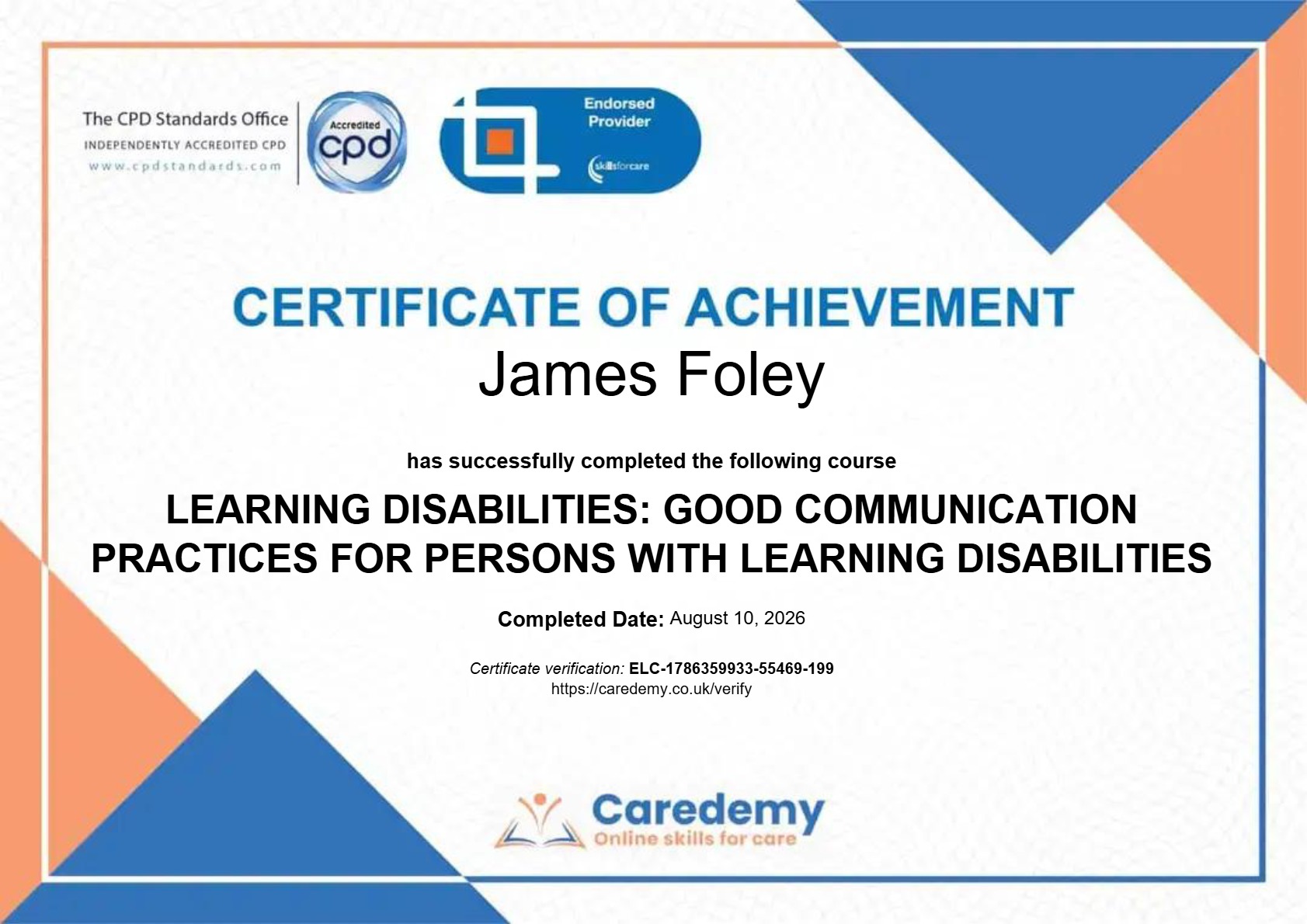
Is Learning Disabilities: Good Communication Practices for Persons with Learning Disabilities training a legal requirement in the UK?
There is no single UK law that specifically requires every worker to complete a course with this title. However, employers and service providers have legal and professional responsibilities relating to accessible communication, equality, safe care and appropriate support.
The Equality Act 2010 places duties to make reasonable adjustments for disabled people in relevant circumstances. For NHS and publicly funded adult social care in England, the Accessible Information Standard provides a framework for identifying, recording, flagging, sharing, meeting and reviewing people’s information and communication needs.
The Mental Capacity Act 2005 is also relevant in England and Wales where decisions involve people who may lack capacity. Staff working in relevant roles must understand how communication and support can help people participate in decisions.
Therefore, while this specific course is not universally mandatory by law, communication training may form part of an employer’s induction, refresher training, competency and compliance arrangements.
Trusted by 120,000+ learners
Trusted by care providers, healthcare organisations, businesses and workplace teams across the UK for high-quality online training
Office & Commercial
Health & Social Care
Industrial, Warehousing & Facilities
Hospitality, Retail & Public Services
Learning Disabilities: Good Communication Practices for Persons with Learning Disabilities training FAQ?
What is Learning Disabilities: Good Communication Practices for Persons with Learning Disabilities training?
This is an introductory online course covering effective communication with people with learning disabilities. It explores communication types, adapting communication, good and poor practice, reasonable adjustments, relevant legislation, dysphagia, stressful situations and reporting concerns. The course is designed to help learners apply more appropriate communication approaches in health, social care and support settings.
Who needs Learning Disabilities: Good Communication Practices training?
The course is suitable for staff who communicate with or support people with learning disabilities. This includes care assistants, support workers, healthcare staff, social care workers, residential care staff, community workers, educators, teaching assistants, therapists, social workers and mental health practitioners. It can also support induction, refresher training, awareness and knowledge enhancement.
How can staff improve communication with people with learning disabilities?
Staff can improve communication by adapting their approach to the individual, using appropriate language and communication methods, allowing sufficient time, checking understanding and making reasonable adjustments where needed. The course specifically explores adapting communication, good and poor practices and reasonable adjustments so learners can apply these principles in workplace situations.
What are reasonable adjustments for people with learning disabilities?
Reasonable adjustments are changes made to remove or reduce disadvantage experienced by disabled people. For someone with a learning disability, this may include clearer explanations, accessible information, additional time, communication support or changes to how information is presented. The Equality Act 2010 provides the legal framework for reasonable adjustments in relevant circumstances.
Is Learning Disabilities: Good Communication Practices training a legal requirement?
The specific Caredemy course is not legally mandatory for every worker. However, organisations have legal and regulatory responsibilities concerning equality, reasonable adjustments and accessible communication. In England, NHS and adult social care organisations must have regard to the Accessible Information Standard. Employers may therefore include communication training within their own mandatory or role-specific training programmes.
How often should learning disabilities communication training be completed?
There is no universal UK law requiring this specific communication course to be completed at a fixed interval. Employers should determine refresher requirements according to role, risk, organisational policy, competency assessments and changes in guidance or practice. Refresher training may be particularly appropriate where staff regularly support people with learning disabilities or where communication-related concerns have been identified.
Why is dysphagia included in learning disabilities communication training?
Dysphagia, or difficulty swallowing, can affect people with learning disabilities and may have important implications for health and safety. Staff need to recognise that communication difficulties can affect how a person expresses discomfort, difficulty or changing needs. This course introduces dysphagia and related considerations but does not replace specialist dysphagia assessment or clinical training.
How long does the Learning Disabilities: Good Communication Practices course take?
The course takes approximately 1 hour to complete online. It includes the course lessons followed by an online multiple-choice assessment. Learners have instant access after enrolment and can complete the training at their own pace. Successful completion provides an instant digital CPD-accredited certificate.
Need Training for Multiple Employees?
Train your entire workforce through Caredemy Teams with bulk enrolment, compliance reporting and access to 200+ CPD courses.
- CPD-accredited certificate
- Instant Certificate
- Learn of Any Device
- Money-back Guarantee
Related Courses You May Like


UK Regulations And Guidance
£15 + Vat
Learning Disabilities: Good Communication Practices for Persons with Learning Disabilities Course
- CPD Accredited
- Instant Certificate
- Instant Access
- Bulk Discounts Available