- Home
- Health & Safety
- Medicines Optimisation: Management Plan, Systems, and Reconciliation Level 3 Course
Medicines Optimisation: Management Plan, Systems, and Reconciliation Level 3 Course
£15 + VAT


Written By Allison
- CPD Accredited | Instant Certificate | Mobile Friendly | Bulk Discounts Available
Trusted by care providers, healthcare organisations, businesses and workplace teams
The Medicines Optimisation: Management Plan, Systems, and Reconciliation Level 3 Course covers medicines-related communication, care transitions, medicines reconciliation, medication reviews, self-management plans and decision support. Designed for healthcare and social care professionals, it develops practical knowledge for reducing medication discrepancies, improving communication and supporting safer, person-centred medicines use across different care settings.
Medicines Optimisation: Management Plan, Systems, and Reconciliation Level 3 Course Summary
Course Name: Medicines Optimisation: Management Plan, Systems, and Reconciliation Level 3 Course
Duration: 1 Hour
Delivery: Online Training Course
Certificate Included: Instant Digital Certificate
Accreditation: CPD Accredited – 1 CPD Point
Suitable For: Healthcare and social care professionals involved in medicines management, medication review, reconciliation, prescribing, pharmacy and patient care
Assessment: Online Multiple Choice Test
Access: Instant Access
Duration
1 hour
CPD Points
1
Last Updated:
25 Jul 2026
What is Medicines Optimisation: Management Plan, Systems, and Reconciliation Level 3 training?
Medicines optimisation is a person-centred approach to achieving the best possible outcomes from medicines while reducing avoidable harm. NICE guidance highlights medicines reconciliation, medication review, communication during transfers of care and involving people in decisions about their medicines as important elements of medicines optimisation.
This Level 3 course examines the systems that support safer medicines use. Learners explore medicines-related communication when patients move between care settings, the medicines reconciliation process, medication reviews, self-management plans, patient decision aids and clinical decision support.
The course also considers organisational and cross-sector working, helping learners understand how effective collaboration between professionals and services can reduce medication discrepancies and improve continuity of care.
CPD Accredited
User friendly interactive courses
Instant Access
Enrol Now – Start Instantly
Certify Instantly
Certificate Available Immediately
Learn on Any Device
Train on Phone, Tablet or Computer
Money Back Guarantee
14 Day Money Back Guaratnee
How Would You Like to Access This Course?
Flexible options for individuals, staff teams and organisations
1
Instant Online Purchase
From 1 to 100+ learners • Bulk discounts available • Instant online access and certificates included
- Instant Access - No Quote Required
- CPD Accredited Certificates Included
- 100% Online & Mobile Friendly
- Assign Courses to Staff, Friends or Family
- Track Progress and Completions Online
- 14 Day Money Back Guarantee
£15 + VAT
CPD • Certificate included • Start instantly
Quantity
Per Course Price
1+ Courses
£15 + Vat
5+ Courses
£9.40 + Vat
10+ Courses
£8.49 + Vat
30+ Courses
£7.99 + Vat
50+ Courses
£6.49 + Vat
100+ Courses
£4.99 + Vat
2
Need Ongoing Staff Training?
Best value for teams of 8+ learners who need regular mandatory, induction and refresher training.
- Save Money on Staff Training
- Access Our Full 200+ Course Library
- Instant certificates issued
- Track Compliance Across Your Team
- Free Learner Replacements
- Reporting & Certificate Management
- CQC inspection ready
- Lowest price guarantee
- Dedicated Support
Best Price Guarantee • CQC Inspection Ready
When should I choose Caredemy Teams?
Caredemy Teams is ideal for organisations with 8+ learners who need access to multiple courses for mandatory training, induction training, and annual refreshers. Benefit from our best-value pricing, free learner replacements, compliance reporting, and access to our full course library. If you only need a small number of CPD courses, you can buy online instantly.
Access friendly, dedicated expert support whenever you need it, with guidance available throughout your learning journey
All-access individual subscription
Get unlimited access to 200+ CPD-accredited courses. One low monthly price. Learn anytime.
Buy any 5 courses for £47
Mix and max any courses.
CPD accredited - Certificates included.
Who Is This Course For?
The Medicines Optimisation: Management Plan, Systems, and Reconciliation Level 3 Course is suitable for healthcare and social care professionals whose roles involve medicines management, prescribing, reviewing medication, coordinating care or supporting safe transitions between services.
Relevant learners may include pharmacists, pharmacy managers, clinical pharmacists, medication safety officers, prescribing leads, doctors, nurses, senior healthcare professionals, medicines management staff, medication reconciliation specialists, care managers and other appropriately responsible health and social care practitioners.
It is particularly relevant where staff need to understand how medicines information should follow a patient or service user between settings, such as admission to hospital, discharge into the community or transfer into a care service. NICE emphasises accurate information sharing and medicines reconciliation during transfers of care.
Key Benefits
✓ Strengthen medicines reconciliation and medication review knowledge
✓ Reduce risks caused by incomplete or inaccurate medicines information
✓ Improve communication during admission, discharge and transfers of care
✓ Support safer, more person-centred medicines management
✓ Understand self-management plans and patient decision aids
✓ Develop knowledge that supports safer medicines systems and professional practice
Course Modules
- Medicines Optimisation: Management Plan, Systems, and Reconciliation Level 3 – Course Introduction
- PINCER Intervention
- Medicines-related Communication Systems
- Discharging a Patient
- Medicines Reconciliation
- Who Carries Out Medicines Reconciliation
- Medication Review
- Self-Management Plans
- Developing a Self-Management Plan
- Patient Decision Aids
- Clinical Decision Support
- Medicines-related Models of Organisational and Cross-Sector Working
Ready to start?
Learning Outcomes
| Learner Outcome | Covered |
|---|---|
| Understand how medicines information should be shared safely between care settings | ✓ |
| Recognise how PINCER can help identify and reduce medication-related risks | ✓ |
| Understand safe medicines communication when a patient is discharged | ✓ |
| Explain what medicines reconciliation is and why it matters | ✓ |
| Identify who may be responsible for carrying out medicines reconciliation | ✓ |
| Understand the difference between medicines reconciliation and medication review | ✓ |
| Recognise how medication reviews support safer and more effective treatment | ✓ |
| Understand how self-management plans can help people manage their medicines | ✓ |
| Identify what should be considered when developing a self-management plan | ✓ |
| Recognise how patient decision aids support informed choices about medicines | ✓ |
| Understand how clinical decision support can improve medicines safety | ✓ |
| Recognise the importance of effective cross-sector working in medicines management | ✓ |
Training 8+ Staff Across Multiple Courses?
Purchasing multiple licences for this training course? Simply adjust the quantity and buy online today.
If you need ongoing training for 10+ employees across multiple subjects, our Team Training platform provides access to 200+ CPD accredited courses, compliance reporting, learner management and bulk enrolment tools.
- Access 200+ CPD Accredited Courses
- Manage All Learners In One Place
- Compliance & Audit Reporting
- Bulk Enrolment & Certificate Tracking
- Dedicated Account Support
Team Training Solutions
Ideal for care providers, healthcare organisations and workplace teams training multiple employees.
Why Choose Caredemy?
- Instant Certificate
- CPD-accredited courses
- Money Back Guarantee
- Expert-designed training
- 120,000 learners trained
- Flexible online learning
- Compliance-focused
- Dedicated support
What Our Learners Say?
“Clear explanation of medicines reconciliation and what needs to happen when patients move between services.”
Sarah M
Registered Nurse
“Very relevant to my role and particularly useful for understanding medication reviews and discharge processes.”
James T
Clinical Pharmacist
“Practical course that helped clarify responsibilities around medicines information and continuity of care.”
Priya S
Care Manager
4.91/5 from 212+ learners
Why Is Medicines Optimisation: Management Plan, Systems, and Reconciliation Level 3 training important?
Medicines can cause avoidable harm when information is incomplete, medicines are unintentionally omitted or duplicated, changes are poorly communicated, or different services hold conflicting medication information.
Effective medicines optimisation helps professionals identify and manage these risks. NICE recommends systems for medicines-related communication when people move between care settings, medicines reconciliation, medication review and greater involvement of people in decisions about their medicines.
This training helps learners understand these processes and how they work together. In practice, that can mean recognising the importance of reconciling medicines following admission, ensuring medication changes are communicated at discharge, involving patients in decisions and supporting effective multidisciplinary working.
For regulated services in England, effective medicines management also supports CQC expectations around safe care and treatment.
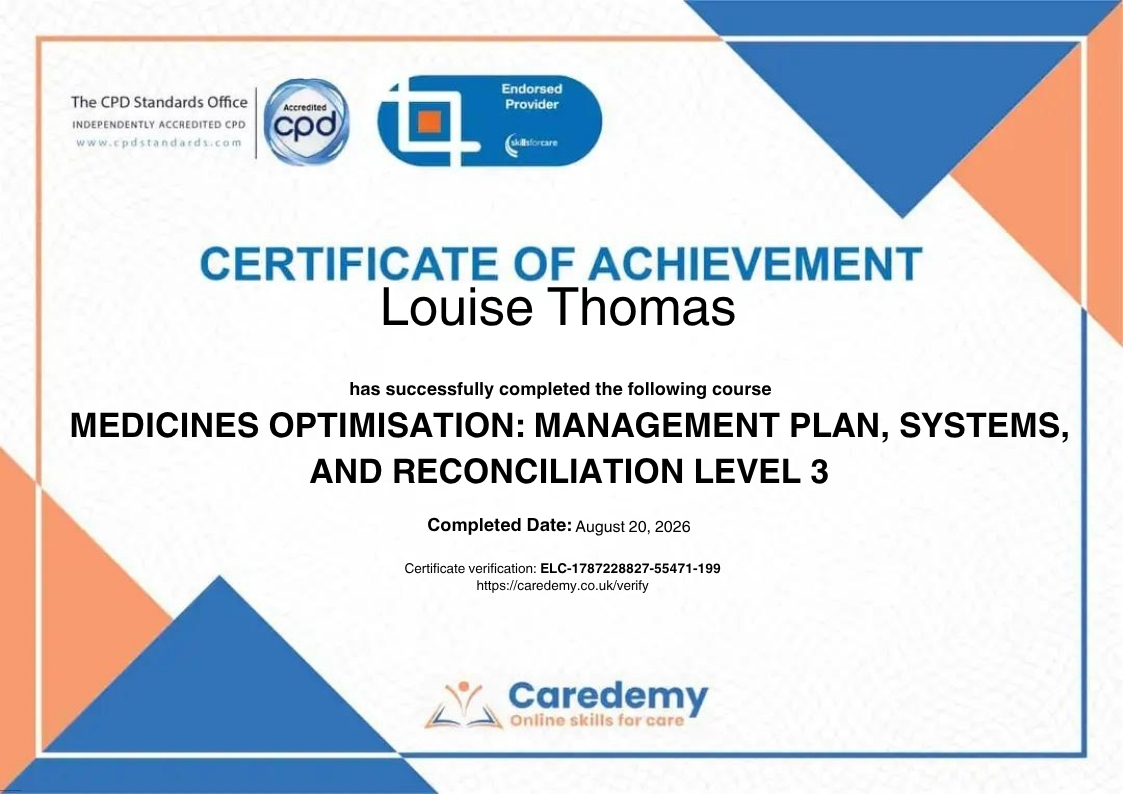
Instant Course Certificate
Is Medicines Optimisation: Management Plan, Systems, and Reconciliation Level 3 training a legal requirement in the UK?
There is no general UK law requiring every healthcare or social care worker to complete a course with this exact title or level.
However, organisations and professionals have legal and professional responsibilities relating to medicines safety. In England, Regulation 12 of the Health and Social Care Act 2008 (Regulated Activities) Regulations 2014 requires regulated providers to provide safe care and treatment, including the proper and safe management of medicines and ensuring staff have appropriate competence, skills and experience.
CQC also assesses medicines optimisation when considering how providers manage medicines safely.
Employers should therefore determine appropriate training and competency requirements according to each worker’s responsibilities, service type, professional requirements, organisational policies and the medicines-related tasks they perform.
Trusted by 120,000+ learners
Trusted by care providers, healthcare organisations, businesses and workplace teams across the UK for high-quality online training
Office & Commercial
Health & Social Care
Industrial, Warehousing & Facilities
Hospitality, Retail & Public Services
Medicines Optimisation: Management Plan, Systems, and Reconciliation Level 3 training FAQ?
What is medicines optimisation?
Medicines optimisation is a person-centred approach to ensuring medicines are used safely and effectively to achieve the best possible outcomes. It involves more than administering medication correctly. It includes communication, medicines reconciliation, medication reviews, shared decision-making and effective collaboration between professionals, patients, carers and services. NICE NG5 provides national guidance on medicines optimisation.
Who needs Medicines Optimisation Level 3 training?
The course is particularly relevant to pharmacists, pharmacy managers, nurses, doctors, prescribing leads, medication safety officers, medicines management teams, care managers and other healthcare or social care professionals with responsibility for medicines. Employers should select training according to the learner’s role, responsibilities, competence requirements and level of involvement in medicines management.
What is medicines reconciliation?
Medicines reconciliation is the process of establishing an accurate list of a person’s current medicines and comparing this with available medication information, particularly during transitions between care settings. It helps identify discrepancies and supports accurate communication. NICE recommends medicines reconciliation as an important part of safe medicines management.
Why is medicines reconciliation important when a patient is discharged?
Discharge is a point where medication errors can occur because medicines may have been started, stopped or changed during treatment. Accurate information needs to follow the patient into the next care setting. NICE recommends that relevant information about a person’s medicines is shared when responsibility for their care transfers between services.
What is the difference between medicines reconciliation and a medication review?
Medicines reconciliation focuses on establishing an accurate and complete list of the medicines a person is taking, particularly during transitions of care. A medication review considers the person’s medicines more broadly, including whether they remain appropriate and effective. Both processes contribute to safer and more effective medicines optimisation.
Is Medicines Optimisation Level 3 training a legal requirement?
There is no blanket legal requirement to complete a course with this specific title. However, regulated providers in England have legal responsibilities for safe care and treatment, including the proper and safe management of medicines. They must also ensure staff providing care have appropriate qualifications, competence, skills and experience.
How often should medicines optimisation training be refreshed?
There is no single statutory refresher period applying to every role. Employers should determine refresher training based on responsibilities, competency assessments, organisational policy, changes in guidance or systems, incidents and identified learning needs. Higher-risk medicines responsibilities may require closer monitoring of competence and more frequent updating than roles with limited involvement in medicines.
How long does the Medicines Optimisation: Management Plan, Systems, and Reconciliation Level 3 Course take?
The online course takes approximately 1 hour to complete and provides 1 CPD point. Learners can access the training online and complete the course and assessment remotely. After successfully completing the end-of-course quiz, learners receive their CPD-accredited digital certificate.
Need Training for Multiple Employees?
Train your entire workforce through Caredemy Teams with bulk enrolment, compliance reporting and access to 200+ CPD courses.
- CPD-accredited certificate
- Instant Certificate
- Learn of Any Device
- Money-back Guarantee
Related Courses You May Like


UK Regulations And Guidance
Useful References:
£15 + Vat
Medicines Optimisation: Management Plan, Systems, and Reconciliation Level 3 Course
- CPD Accredited
- Instant Certificate
- Instant Access
- Bulk Discounts Available