
- Home
- Health & Safety
- Allergy and Anaphylaxis for Schools and Early Years Course
Allergy and Anaphylaxis for Schools and Early Years Course
£15 + VAT


Written By Allison
- CPD Accredited | Instant Certificate | Mobile Friendly | Bulk Discounts Available
Trusted by care providers, healthcare organisations, businesses and workplace teams
Learn how to manage childhood allergies, recognise anaphylaxis and understand the emergency response in schools and early years settings. Topics include allergy action plans, adrenaline auto-injectors, food safety, medication storage and communication with families. Designed for staff supporting children, the course connects prevention with emergency preparedness, helping teams organise everyday care and respond confidently when a child becomes unwell.
Allergy and Anaphylaxis for Schools and Early Years Course Summary
Course Name: Allergy and Anaphylaxis for Schools and Early Years
Duration:1 hour
Delivery: Online Training Course
Certificate Included: Instant Digital Certificate on successful completion
Accreditation: CPD Accredited
Suitable For: Teachers, teaching assistants, early years practitioners, school nurses, catering teams, lunchtime supervisors and school support staff
Assessment: Online Multiple Choice Test with unlimited retakes
Access: Instant Access with 12 months’ course access.
Duration
1 hour
CPD Points
1
Last Updated:
30 Sep 2025
What is Allergy and Anaphylaxis for Schools and Early Years training?
Allergy and Anaphylaxis for Schools and Early Years training prepares staff to support children with allergies and understand their responsibilities during an allergic emergency.
Anaphylaxis is a rapidly developing, potentially life-threatening allergic reaction. Recognising warning signs and acting promptly are essential. NHS
The course explores prevention and response across school and nursery routines, including meals, physical activity and weaning. Learners examine allergy action plans, emergency medication, adrenaline auto-injector (AAI) arrangements and partnership working with parents and carers.
It also addresses allergy-related bullying and the importance of including children safely in everyday activities. The training supports staff knowledge and local procedures; practical device training and child-specific instruction remain necessary where staff have medication responsibilities.
CPD Accredited
User friendly interactive courses
Instant Access
Enrol Now – Start Instantly
Certify Instantly
Certificate Available Immediately
Learn on Any Device
Train on Phone, Tablet or Computer
Money Back Guarantee
14 Day Money Back Guaratnee
How Would You Like to Access This Course?
Flexible options for individuals, staff teams and organisations
1
Instant Online Purchase
From 1 to 100+ learners • Bulk discounts available • Instant online access and certificates included
- Instant Access - No Quote Required
- CPD Accredited Certificates Included
- 100% Online & Mobile Friendly
- Assign Courses to Staff, Friends or Family
- Track Progress and Completions Online
- 14 Day Money Back Guarantee
£15 + VAT
CPD • Certificate included • Start instantly
Quantity
Per Course Price
1+ Courses
£15 + Vat
5+ Courses
£9.40 + Vat
10+ Courses
£8.49 + Vat
30+ Courses
£7.99 + Vat
50+ Courses
£6.49 + Vat
100+ Courses
£4.99 + Vat
2
Need Ongoing Staff Training?
Best value for teams of 8+ learners who need regular mandatory, induction and refresher training.
- Save Money on Staff Training
- Access Our Full 200+ Course Library
- Instant certificates issued
- Track Compliance Across Your Team
- Free Learner Replacements
- Reporting & Certificate Management
- CQC inspection ready
- Lowest price guarantee
- Dedicated Support
Best Price Guarantee • CQC Inspection Ready
When should I choose Caredemy Teams?
Caredemy Teams is ideal for organisations with 8+ learners who need access to multiple courses for mandatory training, induction training, and annual refreshers. Benefit from our best-value pricing, free learner replacements, compliance reporting, and access to our full course library. If you only need a small number of CPD courses, you can buy online instantly.
Access friendly, dedicated expert support whenever you need it, with guidance available throughout your learning journey
All-access individual subscription
Get unlimited access to 200+ CPD-accredited courses. One low monthly price. Learn anytime.
Buy any 5 courses for £47
Mix and max any courses.
CPD accredited - Certificates included.
Who Is This Course For?
This course is for people responsible for children’s safety, care and participation in schools and early years settings.
Relevant roles include teachers, teaching assistants, nursery practitioners, preschool staff, childminders, school nurses, first aiders, lunchtime supervisors, catering staff and school administrators. It also supports headteachers, nursery managers, governors and staff coordinating medical needs or special educational needs and disabilities.
Breakfast club, after-school club and holiday club teams can use the learning when supporting children with allergies. Volunteers helping with meals, activities or educational visits may also benefit.
The introductory content suits induction and refresher learning. Healthcare professionals supporting educational settings can use it to review how allergy management connects with staff responsibilities and family communication.
Key Benefits
✓ Recognise allergic reactions and warning signs requiring urgent action.
✓ Understand how to follow a child’s allergy action plan.
✓ Reduce allergen exposure during meals and everyday activities.
✓ Support accessible medication storage and timely AAI replacement.
✓ Strengthen communication between staff, parents and carers.
✓ Address allergy-related bullying and support safe participation.
Course Modules
- Allergy and Anaphylaxis for Schools and Early Years – Course Introduction
- Managing Allergies in Schools
- Legal Duties and Responsibilities
- Roles and Responsibilities
- Understanding Allergy and Anaphylaxis
- Emergency Management of Anaphylaxis
- Emergency Response
- Spare AAIs in Schools
- Staff Training
- Allergies and Bullying
- Working in Partnership with Parents and Carers
- Sports and Physical Activity
- Storing and Accessing AAIs
- Expiry Date Management
- Catering and Food Allergies
- Build a Strong Partnership with Parents and Carers
- Encouraging Cooperation from All Families
- Supporting a Food-Allergic Baby Who Is Weaning
- Emergency Medication
Ready to start?
Learning Outcomes
| Learner Outcome | Covered |
|---|---|
| Identify allergy risks within school and early years routines. | ✓ |
| Explain staff responsibilities for supporting children with allergies. | ✓ |
| Distinguish between allergic reactions and signs of anaphylaxis. | ✓ |
| Describe the purpose of an allergy action plan and emergency response plan. | ✓ |
| Explain the immediate response to suspected anaphylaxis. | ✓ |
| Describe the role of adrenaline auto-injectors in emergency treatment. | ✓ |
| Explain the arrangements needed for spare AAIs in schools. | ✓ |
| Identify staff training needs for allergy management and emergency response. | ✓ |
| Recognise allergy-related bullying and explain why it requires action. | ✓ |
| Explain how parents and carers contribute to consistent allergy management. | ✓ |
| Identify precautions supporting participation in sports and physical activity. | ✓ |
| Describe safe storage and prompt access arrangements for AAIs. | ✓ |
| Explain how expiry-date checks support reliable emergency medication supplies. | ✓ |
| Identify measures to manage food allergy risks in catering. | ✓ |
| Describe considerations when supporting a food-allergic baby who is weaning. | ✓ |
Training 8+ Staff Across Multiple Courses?
Purchasing multiple licences for this training course? Simply adjust the quantity and buy online today.
If you need ongoing training for 10+ employees across multiple subjects, our Team Training platform provides access to 200+ CPD accredited courses, compliance reporting, learner management and bulk enrolment tools.
- Access 200+ CPD Accredited Courses
- Manage All Learners In One Place
- Compliance & Audit Reporting
- Bulk Enrolment & Certificate Tracking
- Dedicated Account Support
Team Training Solutions
Ideal for care providers, healthcare organisations and workplace teams training multiple employees.
Why Choose Caredemy?
- Instant Certificate
- CPD-accredited courses
- Money Back Guarantee
- Expert-designed training
- 120,000 learners trained
- Flexible online learning
- Compliance-focused
- Dedicated support
What Our Learners Say?
“Clear explanations of allergy action plans and emergency procedures. Helpful for reviewing how our school supports pupils with allergies.”
Sarah Mitchell
Teaching Assistant
“The weaning and parent communication sections helped me think more carefully about allergy management in our baby room.”
Priya Shah
Early Years Practitioner
“Useful coverage of medication storage and expiry checks. A straightforward refresher for staff involved in managing pupils’ medical needs.”
Daniel Harris
School First Aider
4.90/5 from 50+ learners
Why Is Allergy and Anaphylaxis for Schoo ls and Early Yearstraining important?
Children depend on adults to recognise when an allergic reaction is becoming serious. Anaphylaxis can progress quickly, so uncertainty about symptoms, medication location or emergency responsibilities can delay treatment. NHS
Allergy management also involves everyday decisions: checking meal arrangements, sharing information with cover staff and planning access to medication during activities.
This training helps staff connect these responsibilities with a coordinated response. It encourages consistent communication with families, attention to medication readiness and an inclusive approach to children’s participation.
For managers, the learning supports reviews of staff preparedness and local procedures. For children, effective arrangements help reduce avoidable exposure while protecting their wellbeing, confidence and access to education.
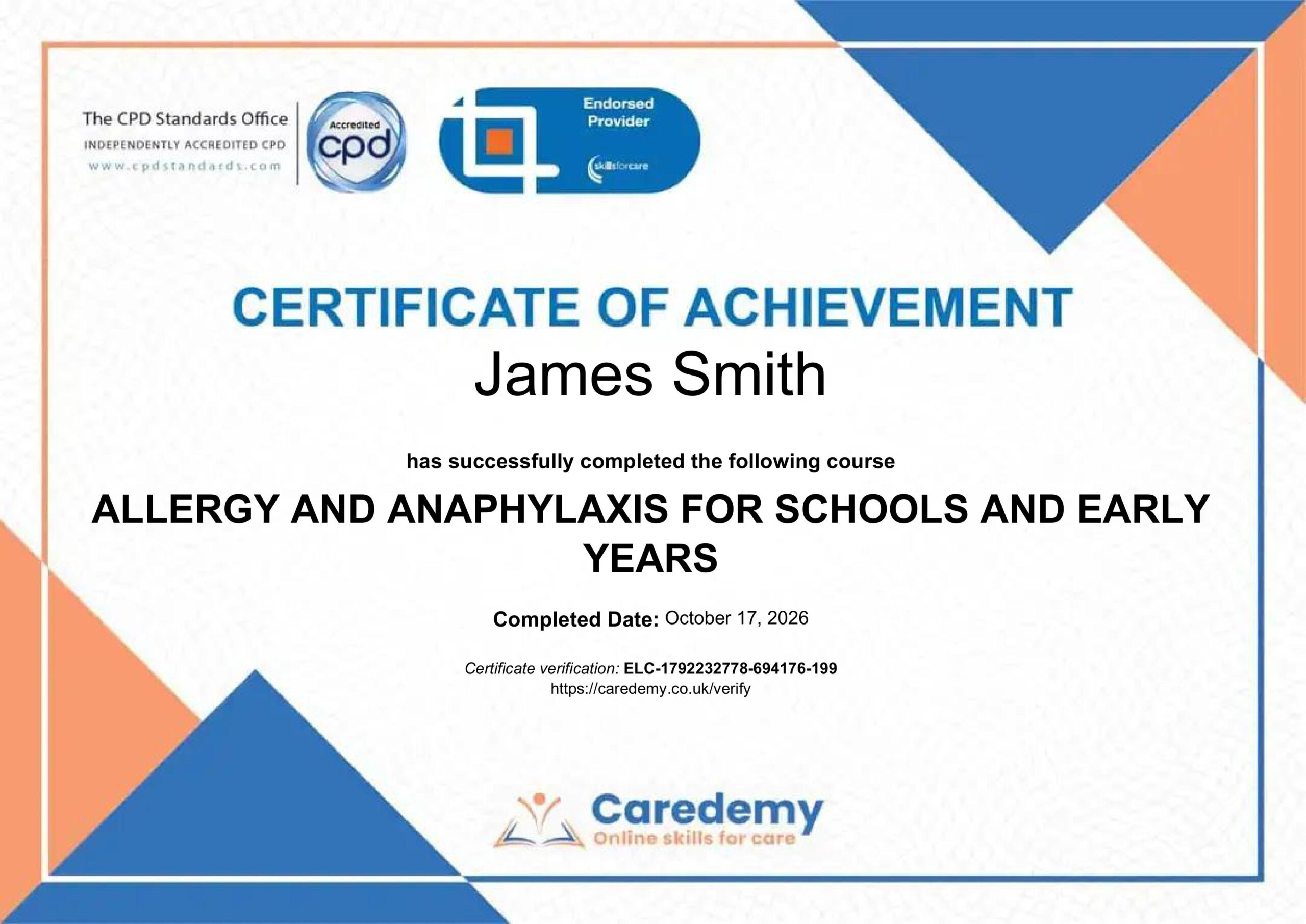
Instant Course Certificate
Is Allergy and Anaphylaxis for Schools and Early Years training a legal requirement in the UK?
There is no UK-wide requirement to complete this specific course. However, settings must meet applicable duties to protect children and support their medical needs.
In England, section 100 of the Children and Families Act 2014 requires maintained schools, academies and pupil referral units within its scope to arrange support for pupils with medical conditions. Associated statutory guidance addresses staff training and support. assets.publishing.service.gov.uk
Early years providers in England must follow the applicable Early Years Foundation Stage framework, including relevant health, medicines and welfare requirements. assets.publishing.service.gov.uk
Employers should identify role-specific training needs, maintain suitable procedures and ensure staff can carry out assigned responsibilities. Completing an online course alone does not demonstrate practical competence or complete compliance.
Requirements differ across the UK; settings in Scotland, Wales and Northern Ireland should follow their own national frameworks and local policies.
Trusted by 120,000+ learners
Trusted by care providers, healthcare organisations, businesses and workplace teams across the UK for high-quality online training
Office & Commercial
Health & Social Care
Industrial, Warehousing & Facilities
Hospitality, Retail & Public Services
Allergy and Anaphylaxis for Schools and Early Years training FAQ?
What is allergy and anaphylaxis training for schools and early years?
It is training that helps education and childcare staff prevent avoidable allergen exposure and understand how to respond to allergic emergencies. It connects children’s individual allergy arrangements with everyday responsibilities, such as meals, activities and medication access. The emphasis is on recognising concerns, following agreed plans and coordinating staff action.
Who needs allergy and anaphylaxis training in a school or nursery?
Staff who supervise, feed or care for children with allergies need knowledge appropriate to their responsibilities. This includes teaching teams, early years practitioners, lunchtime supervisors, catering teams and designated medication staff. Managers should also consider cover staff and volunteers. Those expected to administer emergency medication need relevant practical instruction alongside awareness learning.
How often should allergy and anaphylaxis training be refreshed?
Set refresher intervals through your setting’s training policy, risk assessment and professional advice. Review learning sooner when a child’s needs, prescribed device or emergency arrangements change, or after an incident identifies gaps. Staff should remain familiar with current action plans and practise their assigned response; a previous certificate alone does not establish continuing competence.
Is an allergy and anaphylaxis certificate legally required for school staff?
There is no universal UK requirement for every school employee to hold this particular certificate. In England, statutory guidance expects appropriate training for staff supporting pupils with medical conditions. Employers must consider actual responsibilities and children’s needs. A certificate records completed learning, but must sit alongside suitable procedures, child-specific information and any required practical training.
How long does the course take, and will I receive a certificate?
The course takes approximately one hour and is completed online. After successfully completing the multiple choice assessment, you can download your digital CPD certificate. Unlimited assessment retakes are included. Access begins immediately after purchase and lasts for 12 months, allowing you to revisit the learning during that period.
Does this online course qualify me to use an adrenaline auto-injector?
Online learning supports knowledge of anaphylaxis and emergency medication, but does not by itself verify practical competence. Staff with AAI responsibilities should receive device-specific instruction and practical familiarisation, alongside the child’s agreed plan and local procedures. This course also does not replace a paediatric first aid qualification required for an early years role.
Can schools keep spare adrenaline auto-injectors?
Schools in England can choose to purchase spare AAIs without a prescription for emergency use under the relevant arrangements. They need a policy covering eligibility, consent, staff training, storage and access. A spare device provides backup when a child’s own device is unavailable or fails. Standalone nurseries should not assume school-specific arrangements automatically apply to them.
What should staff do if a child develops anaphylaxis?
Use the child’s adrenaline auto-injector immediately and call 999, stating “anaphylaxis”. Follow the device instructions. Keep the child lying flat; if breathing is difficult, allow them to sit with legs outstretched. Do not let them stand or walk. If symptoms have not improved after five minutes, give a second AAI if available. Stay with them and follow emergency advice.
Need Training for Multiple Employees?
Train your entire workforce through Caredemy Teams with bulk enrolment, compliance reporting and access to 200+ CPD courses.
- CPD-accredited certificate
- Instant Certificate
- Learn of Any Device
- Money-back Guarantee
Related Courses You May Like


UK Regulations And Guidance
£15 + Vat
Allergy and Anaphylaxis for Schools and Early Years Course
- CPD Accredited
- Instant Certificate
- Instant Access
- Bulk Discounts Available