
- Home
- Health & Safety
- Conflict Resolution: Contributing Factors Level 2 Course
Conflict Resolution: Contributing Factors Level 2 Course
£15 + VAT


Written By Allison
- CPD Accredited | Instant Certificate | Mobile Friendly | Bulk Discounts Available
Trusted by care providers, healthcare organisations, businesses and workplace teams
The Conflict Resolution: Contributing Factors Level 2 course explores why workplace conflict develops and how situations can escalate. Learners examine warning signs, stages of anger, long-term and temporary contributing factors, communication breakdown, cultural diversity and organisational influences. It is suitable for healthcare, social care and other customer or public-facing roles where recognising and responding appropriately to potential conflict can help protect staff and others.
Conflict Resolution: Contributing Factors Level 2 Course Summary
Course Name: Conflict Resolution: Contributing Factors Level 2 Course
Duration: 1 Hour
Delivery: Online Training Course
Certificate Included: Instant Digital Certificate
Accreditation: CPD Accredited – 1 CPD Point
Suitable For: Healthcare, social care, education, public services, customer-facing roles and other workplaces where conflict may occur
Assessment: Online Multiple Choice Test
Access: Instant Access
Duration
1 hour
CPD Points
1
Last Updated:
25 Jul 2026
What is Conflict Resolution: Contributing Factors Level 2 training?
Conflict Resolution: Contributing Factors Level 2 training is an online course focused on identifying the factors that can cause, influence or escalate conflict at work.
Learners explore early warning signs and stages of anger before examining causes of conflict, including long-term and temporary factors, personal distance, organisational issues, cultural diversity and communication breakdown. The course also considers common responses to conflict and strategies that can help manage developing situations.
These skills are particularly important for people working with patients, service users, relatives, customers or members of the public. Recognising potential triggers before behaviour escalates can help workers make safer decisions, adapt their communication and follow appropriate workplace procedures.
The training also supports employers’ wider arrangements for managing risks associated with workplace violence and aggression.
CPD Accredited
User friendly interactive courses
Instant Access
Enrol Now – Start Instantly
Certify Instantly
Certificate Available Immediately
Learn on Any Device
Train on Phone, Tablet or Computer
Money Back Guarantee
14 Day Money Back Guaratnee
How Would You Like to Access This Course?
Flexible options for individuals, staff teams and organisations
1
Instant Online Purchase
From 1 to 100+ learners • Bulk discounts available • Instant online access and certificates included
- Instant Access - No Quote Required
- CPD Accredited Certificates Included
- 100% Online & Mobile Friendly
- Assign Courses to Staff, Friends or Family
- Track Progress and Completions Online
- 14 Day Money Back Guarantee
£15 + VAT
CPD • Certificate included • Start instantly
Quantity
Per Course Price
1+ Courses
£15 + Vat
5+ Courses
£9.40 + Vat
10+ Courses
£8.49 + Vat
30+ Courses
£7.99 + Vat
50+ Courses
£6.49 + Vat
100+ Courses
£4.99 + Vat
2
Need Ongoing Staff Training?
Best value for teams of 8+ learners who need regular mandatory, induction and refresher training.
- Save Money on Staff Training
- Access Our Full 200+ Course Library
- Instant certificates issued
- Track Compliance Across Your Team
- Free Learner Replacements
- Reporting & Certificate Management
- CQC inspection ready
- Lowest price guarantee
- Dedicated Support
Best Price Guarantee • CQC Inspection Ready
When should I choose Caredemy Teams?
Caredemy Teams is ideal for organisations with 8+ learners who need access to multiple courses for mandatory training, induction training, and annual refreshers. Benefit from our best-value pricing, free learner replacements, compliance reporting, and access to our full course library. If you only need a small number of CPD courses, you can buy online instantly.
Access friendly, dedicated expert support whenever you need it, with guidance available throughout your learning journey
All-access individual subscription
Get unlimited access to 200+ CPD-accredited courses. One low monthly price. Learn anytime.
Buy any 5 courses for £47
Mix and max any courses.
CPD accredited - Certificates included.
Who Is This Course For?
The Conflict Resolution: Contributing Factors Level 2 course is suitable for workers who may encounter disagreement, anger, aggression or escalating behaviour during their role.
This includes nurses, healthcare assistants, care workers, support workers, social care staff, allied health professionals, receptionists, GP and primary care staff, administrators, social workers and community-based workers. It is also relevant to education staff, public-sector employees, retail workers, customer service teams, hospitality employees, security-related roles, supervisors and managers.
The course can support induction, refresher training and continuing professional development for staff whose work involves regular interaction with patients, service users, families, customers or members of the public.
Employers should determine the appropriate level and frequency of conflict resolution training through workplace and role-specific risk assessment.
Key Benefits
✓ Recognise early warning signs that conflict may be developing
✓ Identify behaviours associated with different stages of anger
✓ Understand personal, environmental and organisational conflict triggers
✓ Recognise how poor communication can increase tension
✓ Apply appropriate strategies to help manage developing conflict
✓ Support safer working practices and workplace violence risk management
Course Modules
- Conflict Resolution: Contribution Factors Course Introduction
- Warning Signs
- Stages of Anger
- Causes of Conflict
- Long-Term and Temporary Factors
- Distance
- Organisational Factors
- Cultural Diversity
- Communication Breakdown
- Contributing Factors
- Common Responses
- Strategies
Ready to start?
Learning Outcomes
| Learner Outcome | Covered |
|---|---|
| Identify early warning signs of conflict | ✓ |
| Recognise the different stages of anger | ✓ |
| Identify common causes of workplace conflict | ✓ |
| Recognise long-term and temporary conflict factors | ✓ |
| Explain how personal space can affect conflict | ✓ |
| Identify organisational factors that may cause conflict | ✓ |
| Recognise how cultural differences can affect interactions | ✓ |
| Identify communication breakdowns that may escalate conflict | ✓ |
| Recognise factors that contribute to challenging situations | ✓ |
| Identify common responses to conflict | ✓ |
| Apply appropriate strategies to manage conflict | ✓ |
Training 8+ Staff Across Multiple Courses?
Purchasing multiple licences for this training course? Simply adjust the quantity and buy online today.
If you need ongoing training for 10+ employees across multiple subjects, our Team Training platform provides access to 200+ CPD accredited courses, compliance reporting, learner management and bulk enrolment tools.
- Access 200+ CPD Accredited Courses
- Manage All Learners In One Place
- Compliance & Audit Reporting
- Bulk Enrolment & Certificate Tracking
- Dedicated Account Support
Team Training Solutions
Ideal for care providers, healthcare organisations and workplace teams training multiple employees.
Why Choose Caredemy?
- Instant Certificate
- CPD-accredited courses
- Money Back Guarantee
- Expert-designed training
- 120,000 learners trained
- Flexible online learning
- Compliance-focused
- Dedicated support
What Our Learners Say?
“Helped me recognise warning signs much earlier and think about what may be driving someone’s behaviour.”
Sarah M
Healthcare Assistant
“Clear examples of how communication and workplace pressures can turn a difficult conversation into conflict.”
James T
Support Worker
“Practical and relevant. The sections on anger, personal space and contributing factors were particularly useful.”
Priya R
Care Team Leader
4.87/5 from 254+ learners
Why Is Conflict Resolution: Contributing Factors Level 2 training important?
Conflict can develop quickly, particularly in workplaces involving stressful situations, waiting times, difficult decisions, vulnerable people or frequent contact with the public.
Recognising contributing factors gives workers an opportunity to respond before a situation escalates. Warning signs, changes in behaviour, frustration, communication difficulties, environmental pressures and organisational problems can all influence conflict.
This is especially important in healthcare and social care, where staff may interact with people experiencing anxiety, distress, pain or frustration.
Conflict resolution training contributes to professional competence by helping workers recognise risk, communicate appropriately and use suitable strategies. It can also support employers in managing work-related violence and aggression. HSE guidance states that training can help workers identify underlying causes, recognise warning signs and develop relevant communication skills.
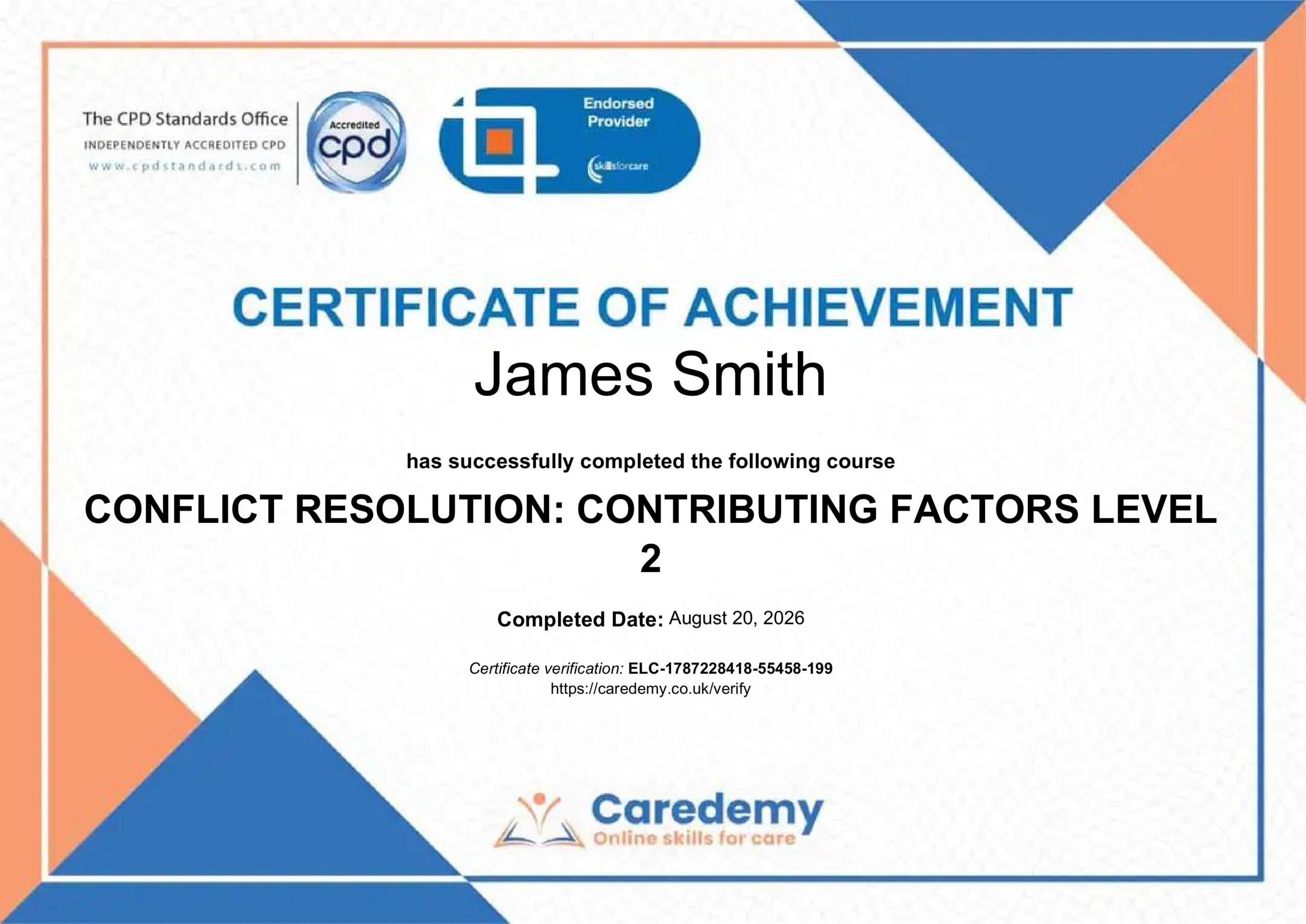
Instant Course Certificate
Is Conflict Resolution: Contributing Factors Level 2 training a legal requirement in the UK?
There is no general UK law stating that every employee must complete a course specifically titled Conflict Resolution: Contributing Factors Level 2.
However, employers have legal responsibilities for workplace health and safety. Under the Health and Safety at Work etc. Act 1974, employers must protect employees’ health, safety and welfare so far as reasonably practicable. HSE confirms that this includes protection from work-related violence. The Management of Health and Safety at Work Regulations 1999 also require employers to assess risks, including risks associated with violence, and provide appropriate information and training.
Where a risk assessment identifies potential violence or aggression, suitable conflict resolution training may therefore form part of the employer’s control measures. Training should reflect the actual risks associated with the employee’s role and workplace.
For NHS-funded services, the NHS Violence Prevention and Reduction Standard provides an additional risk-based framework for preventing and reducing violence and abuse against staff.
Trusted by 120,000+ learners
Trusted by care providers, healthcare organisations, businesses and workplace teams across the UK for high-quality online training
Office & Commercial
Health & Social Care
Industrial, Warehousing & Facilities
Hospitality, Retail & Public Services
Conflict Resolution: Contributing Factors Level 2 training FAQ?
What is Conflict Resolution: Contributing Factors Level 2 training?
Conflict Resolution: Contributing Factors Level 2 training teaches learners to recognise factors that can trigger or escalate workplace conflict. It covers warning signs, stages of anger, causes of conflict, personal distance, organisational factors, cultural diversity, communication breakdown, common responses and strategies for managing conflict.
Who needs Conflict Resolution: Contributing Factors Level 2 training?
The course is suitable for staff who may encounter conflict, anger or challenging interactions at work. This can include healthcare professionals, care workers, support workers, receptionists, social workers, customer service employees, public-sector staff, education workers, retail teams, hospitality employees and managers. The appropriate training should reflect the risks associated with the person’s role.
Is conflict resolution training a legal requirement in the UK?
There is no universal legal requirement for every worker to complete a course with this specific title. However, employers must manage risks to workers’ health and safety, including foreseeable work-related violence and aggression. Where conflict or aggression is an identified workplace risk, suitable training may form part of the measures needed to manage that risk.
How long does the Conflict Resolution: Contributing Factors Level 2 course take?
The course takes approximately 1 hour to complete and provides 1 CPD point. Because it is delivered online, learners can access the training without attending a classroom session. After successfully completing the course assessment, learners receive their digital course certificate.
What are common contributing factors to workplace conflict?
Conflict rarely has a single cause. Factors can include frustration, anxiety, poor communication, misunderstandings, waiting or delays, lack of information, environmental conditions, organisational pressures and issues around personal space. In healthcare settings, HSE guidance also identifies factors including impatience, frustration, anxiety, resentment, alcohol or drugs and workplace design.
How can recognising warning signs help prevent conflict from escalating?
Early recognition gives workers more opportunity to adapt their approach before behaviour escalates. Changes in communication, behaviour, body language or emotional responses may indicate increasing tension. Workers can then consider factors affecting the situation, maintain appropriate personal space, communicate calmly and follow their organisation’s procedures for managing risk.
How often should conflict resolution training be refreshed?
There is no single statutory renewal period that applies to every UK workplace. Employers should determine refresher frequency according to risk assessment, job role, workplace policy, incidents and changes in working practices. HSE recommends monitoring training needs and providing periodic refresher training so workers’ skills remain up to date.
Is this conflict resolution course suitable for healthcare and social care staff?
Yes. The course is particularly relevant to healthcare and social care workers who interact with patients, service users, relatives or members of the public. Understanding anger, communication breakdown and other contributing factors can help workers identify developing risks and respond appropriately. Employers should combine training with suitable risk assessments, procedures and role-specific controls.
Need Training for Multiple Employees?
Train your entire workforce through Caredemy Teams with bulk enrolment, compliance reporting and access to 200+ CPD courses.
- CPD-accredited certificate
- Instant Certificate
- Learn of Any Device
- Money-back Guarantee
Related Courses You May Like


UK regulations And Guidance
£15 + Vat
Conflict Resolution: Contributing Factors Level 2 Course
- CPD Accredited
- Instant Certificate
- Instant Access
- Bulk Discounts Available