
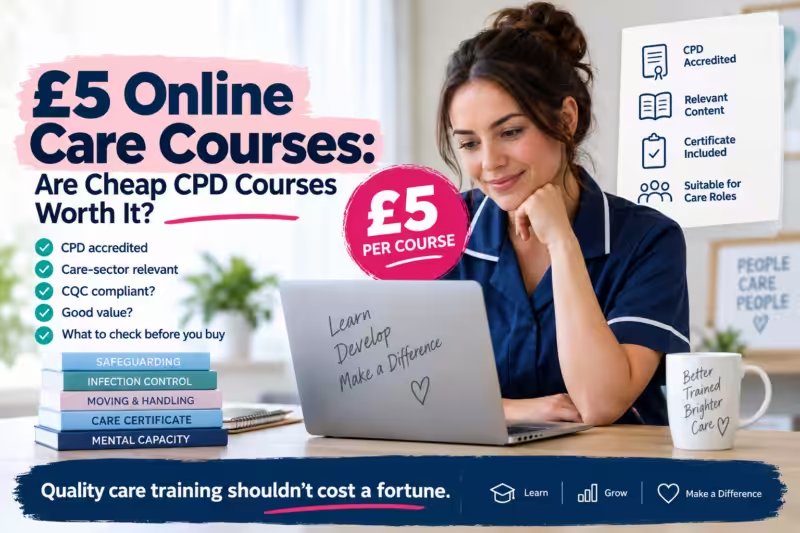
£5 Online Care Courses: Are Cheap CPD Courses Worth It?
Is £5 Care Training Really Enough?
Yes, legitimate online care training is available for around £5 per course in the UK. Low price does not automatically mean low-quality training.
Several care training providers currently advertise individual courses at or around the £4–£5 mark, while bulk purchasing can bring the cost of CPD-accredited training below £5 per course.
The important question is therefore not simply:
“Is a £5 care course any good?”
It is:
“What exactly am I getting for £5, and does it meet the training needs of the learner or care organisation?”
For an individual who needs one safeguarding or infection control refresher, a £5 online course can represent excellent value.
For an employer with 30 care workers who each need 10–15 courses, however, buying individual £5 courses could cost thousands of pounds. An unlimited training package or team training subscription may cost considerably less overall.
This guide explains how to compare cheap online care courses properly, what to check before purchasing and when £5-per-course training makes financial sense.
Can You Get Legitimate Online Care Training for Around £5?
Yes.
There are genuine UK online training providers offering care-related courses for approximately £5.
For example, CareTuition currently advertises its Safeguarding Adults course for £5. The Health & Safety Group also lists individual Care Certificate standards at £4.95 excluding VAT.
Prices and packages change, so buyers should always check the provider’s current website before purchasing.
Caredemy uses a different pricing structure.
A standard individual Caredemy course costs more when purchased on its own, but the price falls significantly when courses are purchased in volume. Current published Caredemy pricing includes:
| Number of courses purchased | Price per course* |
|---|---|
| 5–9 | £9.49 |
| 10–29 | £8.49 |
| 30–49 | £7.99 |
| 50–99 | £6.49 |
| 100–249 | £4.99 |
| 250–499 | £3.99 |
| 500–999 | £2.49 |
| 1,000–1,999 | £1.99 |
| 2,000+ | £1.45 |
*Published Caredemy prices exclude VAT and should be checked before purchase.
Caredemy also offers credits and unlimited/team training options, so organisations do not necessarily have to purchase every course individually.
The key lesson is simple:
£5 can buy legitimate online care training. Price alone does not tell you whether a course is suitable.
You need to look at what is included.
What Should You Check When Buying a £5 Online Care Course?
1. Is the Course CPD Accredited?
Start by checking exactly what the provider means by terms such as CPD accredited, CPD certified or CPD aligned.
These phrases are not necessarily interchangeable.
Look for information about the organisation that accredits or certifies the training and check what appears on the learner’s certificate.
CPD accreditation can provide useful independent recognition of learning, but accreditation alone does not determine whether a course meets every requirement of a particular job.
Employers still need to decide what training is appropriate for each employee’s role.
Caredemy’s online courses are CPD accredited, with downloadable certificates available following successful completion.
2. What Does the Course Actually Cover?
A cheap course is only good value if it covers what you need.
Do not purchase a course simply because its title sounds appropriate.
Check the:
- Course description
- Modules or curriculum
- Learning outcomes
- Approximate duration
- Target audience
- Relevant legislation and guidance
- Assessment method
- Practical or workplace requirements
For example, a basic Medication Awareness course is not automatically sufficient training for an employee who will be responsible for administering medicines.
Likewise, a short moving and handling awareness course cannot replace practical training and competency assessment where these are required.
Compare the content, rather than just the course title and price.
3. Are Clear Learning Outcomes Provided?
A good training provider should explain what the learner should know or be able to understand after completing the course.
Learning outcomes make it easier for an employer to determine whether the training is appropriate for a particular role.
Instead of accepting a vague description such as “learn about safeguarding”, look for specific outcomes covering areas such as:
- Types and indicators of abuse
- Responding to safeguarding concerns
- Reporting procedures
- Roles and responsibilities
- Relevant legislation and guidance
- Whistleblowing
- Record keeping
The same principle applies across medication, infection prevention, moving and handling, fire safety, first aid and other care-related subjects.
4. Is a Certificate Included?
Check whether the advertised price includes the certificate.
Questions worth asking include:
Is the certificate included in the course price?
Can it be downloaded immediately?
Does it show the learner’s name and course completed?
Does it show CPD accreditation where applicable?
Can managers access staff certificates?
Is there an additional certificate fee?
A £4.99 course followed by a £10 certificate charge is no longer a £4.99 course.
Caredemy includes an instant digital certificate following successful course completion.
5. Is There an Assessment?
Watching videos or clicking through slides does not necessarily demonstrate that somebody has understood the subject.
Look at how knowledge is assessed.
This may include multiple-choice questions, quizzes, scenarios, knowledge checks or a final assessment.
Employers should also distinguish between knowledge assessment and workplace competence.
Some subjects require practical demonstration or workplace assessment in addition to online learning.
The Care Certificate is an important example.
Skills for Care states that workers need to be assessed on both what they know and what they do. Completing an online Care Certificate course can provide the knowledge component, but employers still need appropriate workplace assessment of competence.
6. When Was the Course Last Updated?
Care training should not remain unchanged indefinitely.
Legislation, statutory guidance, professional recommendations and sector frameworks change.
Before buying a very cheap course, look for evidence that the provider reviews and updates its content.
This is particularly important in subjects such as:
- Safeguarding
- Medicines
- Infection prevention and control
- Mental capacity
- Moving and handling
- First aid
- Health and safety
- Care Certificate training
For example, the Care Certificate was updated in March 2025 and now contains 16 standards, including a new standard covering awareness of learning disability and autism.
A provider still teaching an outdated version should therefore raise questions regardless of price.
7. Is the Training Designed for the Care Sector?
There is an important difference between a general workplace course and training specifically written for health and social care.
Consider safeguarding.
A generic safeguarding course might provide useful introductory information, but a care worker may need content relating specifically to adult social care responsibilities, reporting procedures, duty of care, person-centred practice and relevant care-sector guidance.
The same applies to medication, infection prevention, moving and handling and other subjects.
Cheap generic training and cheap care-specific training are not necessarily the same product.
Do £5 Online Courses Meet CQC Requirements?
There is no general CQC rule stating that a training course must cost a particular amount.
CQC’s Regulation 18 requires providers to ensure staff receive appropriate support, training, professional development, supervision and appraisal necessary to perform their duties.
Providers are expected to identify learning and development requirements when somebody starts employment and review them at appropriate intervals. Required training should also be monitored.
That means CQC compliance is not achieved simply by purchasing a course with “CQC compliant” in its title.
Care providers need to be able to demonstrate that employees receive training appropriate to their:
- Role
- Responsibilities
- Level of competence
- People they support
- Service type
- Identified training needs
The £5 price is largely irrelevant to that assessment.
A suitable £5 course could form part of a compliant training programme. An unsuitable £50 course would not become appropriate simply because it costs more.
What About Skills for Care Endorsement?
Skills for Care endorsement is another factor employers may wish to consider when comparing training providers.
It is different from CPD accreditation.
Caredemy is a Skills for Care endorsed learning provider as well as offering CPD-accredited courses.
Not every course or training provider needs Skills for Care endorsement to be legitimate. Buyers should therefore treat endorsement as one factor in the overall assessment rather than assuming training without it is automatically unsuitable.
Consider accreditation, course content, sector expertise, learning outcomes, assessment, course updates and employer requirements together.
£5 PER COURSE VS £5 PER LEARNER: A Crucial Difference
This is one of the most important pricing distinctions in online care training.
£5 per course
A learner completes one course:
1 course × £5 = £5
If that learner requires 10 courses:
10 × £5 = £50
If they require 15:
15 × £5 = £75
£5 per learner per month
Now consider an unlimited training subscription costing £5 per learner per month.
Over 12 months:
£5 × 12 = £60 per learner per year
But that learner may have access to the provider’s entire course library.
The correct comparison is therefore not:
£5 versus £5.
It is:
How many courses does the learner actually need during the year?
Worked Example: An Employee Needs 10 Courses
Suppose an employee needs the following training:
- Safeguarding Adults
- Infection Prevention and Control
- Moving and Handling
- Health and Safety
- Fire Safety
- Medication Awareness
- Equality and Diversity
- Mental Capacity
- Food Safety
- Basic Life Support
At £5 per individual course:
10 × £5 = £50 per employee
For 10 employees:
£500
For 25 employees:
£1,250
For 50 employees:
£2,500
At this point, an employer should compare the total against bundles, bulk discounts, credits and unlimited training.
Worked Example: An Employee Needs 15 Courses
If the employee requires 15 courses:
15 × £5 = £75 per learner
That becomes:
| Employees | 15 courses at £5 each |
|---|---|
| 1 | £75 |
| 10 | £750 |
| 25 | £1,875 |
| 50 | £3,750 |
| 100 | £7,500 |
This illustrates why the cheapest individual course does not necessarily produce the cheapest workforce training programme.
When Cheap Individual Courses Make Sense
Cheap pay-per-course training can make excellent financial sense.
It is particularly attractive when:
- An individual needs one course for CPD
- A worker needs a single refresher
- An employer needs to close one specific training gap
- Only a few employees need specialist training
- Training requirements are infrequent
- An organisation already has most mandatory training covered elsewhere
- There is no need for extensive LMS functionality
Imagine an employee whose safeguarding training needs refreshing.
If an appropriate, current and properly assessed course costs £5, purchasing that single course may make much more sense than buying a £50 or £60 annual subscription.
Do not buy unlimited training simply because it sounds better value if the learner will not use it.
When Unlimited or Team Training May Be Cheaper
The calculation changes when employees require multiple courses.
Care workers commonly need a mixture of:
- Induction training
- Mandatory training
- Refresher training
- Role-specific learning
- Specialist training
- Care Certificate learning
- Additional development during the year
Once somebody is completing 10–15 courses, a £5 pay-per-course model means approximately £50–£75 per learner.
An unlimited package costing £36–£60 per learner per year may therefore be financially competitive before considering administration and LMS functionality.
Caredemy currently publishes team subscription examples of:
| Team size | Monthly price per learner* | Approx. annual price |
|---|---|---|
| 10–30 | £5 | £60 |
| 31–50 | £4 | £48 |
| 51–100 | £3 | £36 |
| 101+ | Quote | Quote |
*Published prices exclude VAT.
The subscription includes access to the course library alongside features such as compliance reporting, a colour-coded training matrix, certificate management, bulk course assignment, automated course renewal and free learner replacement.
Therefore, the number of courses is only part of the calculation.
LMS and Reporting: The Cost Buyers Often Forget
For an individual learner, an LMS may not matter very much.
For a registered manager responsible for 50 employees, it can matter enormously.
Consider the administrative work involved in manually tracking:
50 employees × 15 courses = 750 training records.
The manager needs to know:
- Who has completed training?
- Who has not started?
- Which training is overdue?
- What needs refreshing?
- Where are the certificates?
- Which employee belongs to which branch?
- What evidence can be produced during an inspection?
A £5 individual course may still be the cheapest option, but buyers should establish whether the price includes the management tools they require.
Look for Hidden Costs
When comparing cheap CPD courses, investigate the total cost, not simply the headline price.
Check for:
- VAT
- Certificate charges
- Resit fees
- LMS charges
- Setup fees
- Administration charges
- Minimum purchases
- Minimum contract periods
- Course expiry
- Renewal costs
- Charges for replacing learners
- Charges for manager accounts
A £5 advertised price is genuinely attractive when the product provides everything required for £5.
It is less attractive if essential features have to be purchased separately.
Care Certificate Costs Need Separate Attention
Do not assume that a provider’s £5 individual course price also applies to its complete Care Certificate programme.
The Care Certificate now consists of 16 standards.
Published Care Certificate prices vary considerably between providers.
Caredemy currently advertises its complete 16-standard Care Certificate online course from £15 + VAT, with volume discounts bringing the published price down further for organisations purchasing larger quantities.
It includes approximately 20 hours of online learning and 21 CPD points.
Most importantly, employers should understand that an online certificate does not replace the employer’s responsibility to assess workplace competence.
Skills for Care states that workers must demonstrate both knowledge and what they can do in practice.
What About Refresher Training?
Training costs should be calculated over time rather than only at induction.
Different subjects, employers and roles may have different refresher requirements.
Employers should use legislation, statutory guidance, sector recommendations, risk assessments, organisational policy and individual learning needs to determine when training needs refreshing.
Before choosing a provider, ask:
How easy will it be to identify training that needs renewing next year?
For larger organisations, automated renewal and reporting tools can become as important as the initial course price.
Learner Replacement and Staff Turnover
This is particularly relevant in social care.
Suppose an organisation purchases annual licences for 50 employees and several employees leave during the year.
Can those licences be reassigned?
Or does the employer have to purchase new licences for their replacements?
The answer can materially change the real cost of training.
Caredemy’s team subscription currently includes free learner replacement, allowing organisations to replace departing learners rather than automatically losing the value of the training licence.
When comparing annual subscriptions, ask competitors the same question.
Before Buying a £5 Care Course, Check These 10 Things
Use this checklist before purchasing:
| ✓ | Question to ask |
|---|---|
| ✓ | 1. Is it CPD accredited or independently recognised, and by whom? |
| ✓ | 2. Does the curriculum cover the learning my role actually requires? |
| ✓ | 3. Are clear learning outcomes published? |
| ✓ | 4. Is the certificate included in the advertised price? |
| ✓ | 5. Is there a meaningful assessment and are resits included? |
| ✓ | 6. When was the course last reviewed or updated? |
| ✓ | 7. Is the content specifically relevant to UK health and social care? |
| ✓ | 8. Does online learning need additional practical competency assessment? |
| ✓ | 9. Are there additional VAT, LMS, certificate, setup or renewal charges? |
| ✓ | 10. If buying for staff, does the provider offer reporting, training records and learner management? |
If the answers are satisfactory, there is no reason to reject a course simply because it costs £5.
How Does Caredemy Compare?
Caredemy’s pricing is designed to accommodate several different types of buyer rather than relying on one purchasing model.
Individuals and small organisations can purchase courses individually. Larger purchases receive automatic volume discounts, with standard course prices currently falling to £4.99 at 100+ courses, £3.99 at 250+, £2.49 at 500+, £1.99 at 1,000+ and £1.45 at 2,000+.
Credits are available from approximately £1 per course per learner at the highest published volume and do not expire.
For organisations requiring broader training, Caredemy’s team subscriptions provide access to 200+ courses, alongside an LMS and compliance-management tools.
Caredemy currently provides:
- CPD-accredited online courses
- Skills for Care endorsed provider status
- 200+ course library
- Online assessments
- Digital certificates
- Downloadable workbooks
- LMS access
- Colour-coded compliance reporting
- Bulk course assignment
- Bulk certificate management
- Automated course renewal on subscriptions
- Free learner replacement on subscriptions
- Dedicated account management on subscriptions
- Care Certificate access with team subscriptions
- No advertised setup fee on team subscriptions
This does not mean Caredemy will always be the cheapest option for every learner.
Someone who needs one £4 course may spend less with a pay-per-course provider charging £4.
The economics change considerably when an organisation needs to train multiple employees across multiple subjects.
Compare the annual cost of delivering all required training rather than simply comparing the cheapest advertised course.
So, Are £5 Online Care Courses Worth It?
They certainly can be.
There is nothing inherently wrong with a £5 online care course. Digital training can be delivered at scale, and competition between providers has made online CPD significantly more affordable.
A low price should therefore be treated as something to investigate, not something to automatically distrust.
For somebody needing one or two courses, cheap individual training can offer excellent value.
For employers whose staff need 10, 15 or more courses, however, the calculation changes. At that point, compare individual course costs against bundles, credits and unlimited team training.
Most importantly, assess the training itself.
The best-value course is the one that provides appropriate, current and relevant learning at the lowest total cost for your requirements.
Frequently Asked Questions
Can I get an online care course for £5?
Yes. UK providers currently advertise individual care courses at approximately £4–£5. Bulk purchasing can also reduce the effective cost of individual courses below £5.
Are £5 online care courses legitimate?
They can be. Price alone does not determine legitimacy or quality. Check accreditation, course content, learning outcomes, assessment, certificates, updates and relevance to the learner’s role.
Are cheap online care courses CPD accredited?
Some are and some are not. Check the individual provider and course rather than assuming accreditation from the price.
Will CQC accept a £5 online training course?
CQC does not set a minimum price that employers must pay for training. Under Regulation 18, providers must ensure staff receive the training, development, supervision and support necessary to carry out their roles. Employers must therefore determine whether particular training is appropriate to the role and service.
Does an online course prove that a care worker is competent?
Not necessarily. Online learning can assess knowledge, but some care activities also require practical training, observation, supervision or workplace competency assessment.
Can I complete the Care Certificate entirely online?
Online learning can support the knowledge requirements, but the Care Certificate also requires appropriate workplace assessment. Skills for Care states that workers need to demonstrate what they know and what they do.
How many standards are in the Care Certificate?
There are currently 16 Care Certificate standards. The standards were updated in March 2025, adding awareness of learning disability and autism as Standard 16.
Is £5 per course the same as £5 per learner?
No. £5 per course means every course costs £5. Ten courses therefore cost £50 per learner. A £5-per-learner monthly subscription may provide access to many or all of a provider’s courses, so the two prices should not be compared directly.
When is pay-per-course training cheapest?
It tends to make most sense when an individual or employee needs only a small number of courses or a specific refresher or specialist subject.
When does unlimited care training make sense?
Unlimited training becomes increasingly attractive when employees require numerous induction, mandatory, refresher and role-specific courses throughout the year. Employers should also factor LMS, reporting, certificates, administration and staff turnover into the calculation.
Does Caredemy offer £5 online care courses?
Caredemy’s standard individual course price is higher when purchasing a single course, but current bulk discounts reduce standard CPD courses to £4.99 each from 100 course purchases, with prices falling further at larger volumes. Caredemy also offers credits and unlimited team training.