Cheapest Online Care Training Providers UK: Price vs Value Compared 2026
Compare UK care training prices and find the best value for your team.
The cheapest online care training provider depends on how many employees you have, how many courses each person needs, whether you require the Care Certificate and whether you need an LMS to manage training compliance.
For a single course, providers advertising very low bulk rates include Careskills Academy from 99p per course, Social Care TV from £1.49 and Caredemy from £1.45 at sufficiently high purchasing volumes. These are “from” prices and are not necessarily available when buying one course for one learner.
For organisations requiring several courses per employee, an unlimited annual package can be cheaper. Current advertised options range from very low-cost restricted training packages to broader subscriptions covering large course libraries, Care Certificate training and compliance-management tools.
That means there is no meaningful answer to “who charges the least?” until you know exactly what training your organisation needs.
A £5 course may be excellent value for someone needing one course. It could cost £75 per employee if that employee needs 15 courses.
This guide compares the lowest published prices we could verify in September 2026 and calculates what different purchasing models can actually cost.
Prices and offers were checked in September 2026. Prices can change and some providers quote excluding VAT. “From” prices should never be assumed to apply to every organisation or purchasing volume. Obtain a current quotation before purchasing.
Cheapest online care training providers: quick comparison
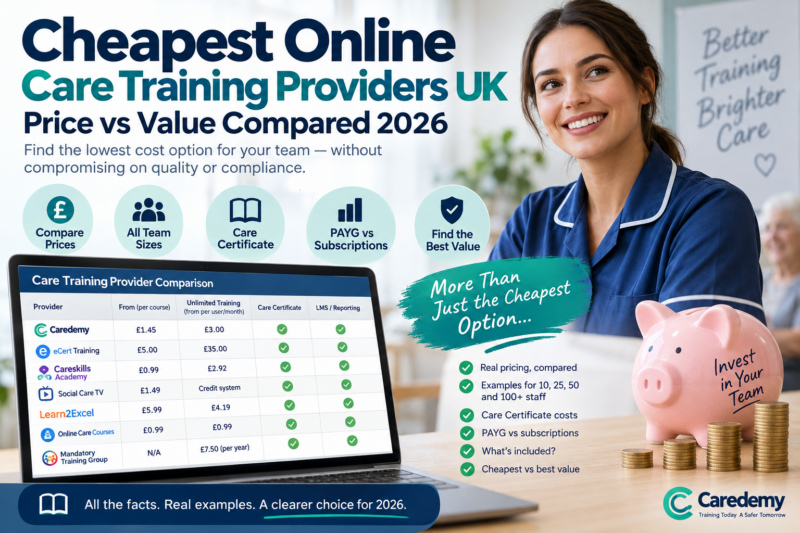
| Provider | PAYG / course pricing | Unlimited / subscription | Care Certificate | LMS / reporting | Important pricing point |
|---|---|---|---|---|---|
| Caredemy | £15 standard; bulk rates down to £1.45 + VAT | Team subscriptions £5 pp/month for 10–30, £4 for 31–50 and £3 for 51–100; 101+ quoted | £15 retail with volume discounts; included with team subscription | Yes | Particularly competitive at high PAYG volumes and for larger teams |
| eCert Training | Individual courses have previously been advertised around £5 | Site advertises annual training from £35; pricing page currently displays £0, so confirm current commercial price | £15 per credit on current pricing page | Yes | Current public pricing is inconsistent |
| Careskills Academy | Credits advertised from 99p on some pages; current main pricing page lists credits from £12.30 | £6.67–£2.92 pp/month according to workforce size on current pricing page | Included with Unlimited according to provider | Yes | Different provider pages currently show materially different “from” pricing |
| Social Care TV | £9.49 for 1–9 credits; down to £1.49 at volume | Credit model | Care Certificate from £23.80 at volume | Yes | Credits do not expire |
| Learn2Excel | £5.99 PAYG; from £3 at 500+ courses | From £4.19 pp/month at 100+ employees | Check current package | Yes | Straightforward low PAYG pricing |
| Online Care Courses | PAYG available | From 99p pp/month | Available | Yes | Exact package determines the price |
| Mandatory Training Group | Individual/package pricing varies | Standard eLearning currently advertised at £7.50 pp/year; Premium £19.50 | Check package | ComplyPlus LMS | Very low published annual price where its defined package covers your requirements |
| Florence Academy | Learning can be free; certificate charges may apply depending on account/status | Free learning model | Training available | Individual-focused | Particularly relevant to individual care professionals rather than conventional employer LMS procurement |
Sources: current provider pricing pages checked September 2026. Caredemy publishes volume pricing down to £1.45 per course and team subscriptions with LMS functionality. Social Care TV currently starts at £9.49 for low-volume credits but advertises prices down to £1.49 at volume. Learn2Excel lists £5.99 PAYG, £3 at 500+ courses and subscription pricing from £4.19 per user/month at 100+ employees.
The Mandatory Training Group currently advertises its Standard eLearning plan at £7.50 + VAT per user annually and Premium at £19.50, although buyers should compare the courses included with their actual training matrix rather than assuming either package covers every requirement.
Cheapest individual care courses
If you need only one or two courses, PAYG is usually the place to start.
Learn2Excel currently advertises standard online eLearning at £5.99 per course. Social Care TV charges £9.49 per credit when buying 1–9 credits, although its bulk price can eventually fall to £1.49.
Caredemy’s standard individual course price is generally £15 + VAT, but its automatic bulk discounts reduce this significantly as more course enrolments are purchased:
| Number of Caredemy course enrolments | Published price per course |
|---|---|
| 1–4 | £15.00 |
| 5–9 | £9.49 |
| 10–29 | £8.49 |
| 30–49 | £7.99 |
| 50–99 | £6.49 |
| 100–249 | £4.99 |
| 250–499 | £3.99 |
| 500–999 | £2.49 |
| 1,000–1,999 | £1.99 |
| 2,000+ | £1.45 |
Prices exclude VAT.
This demonstrates why “cheapest course” and “cheapest provider” are different questions.
For an individual buying one course, Caredemy’s £15 headline price will not be the cheapest option in this comparison.
For an employer purchasing 1,000 course enrolments, Caredemy’s effective price falls to £1.99 each.
Cheapest training for small teams
For a small team, the number of courses required per employee matters more than headcount alone.
Consider 10 employees.
If each employee needs five courses, that is already 50 course enrolments.
Using Caredemy’s published PAYG volume pricing:
50 × £6.49 = £324.50 + VAT
If each employee needs 10 courses:
100 × £4.99 = £499 + VAT
At 15 courses:
150 × £4.99 = £748.50 + VAT
Alternatively, Caredemy’s published 10–30 learner team subscription is £5 per learner/month:
10 × £5 × 12 = £600 + VAT annually
Therefore, for 10 employees, Caredemy PAYG is cheaper at five or 10 courses per employee, while the unlimited package becomes much closer once each learner reaches around 15 courses. The subscription also adds features and protections that PAYG pricing alone does not measure.
Careskills Academy’s current main pricing page lists 5–10 staff at £6.67 per learner/month, equivalent to approximately £800.40 annually for 10 employees.
The Mandatory Training Group’s £7.50 annual Standard plan would theoretically cost only £75 + VAT for 10 users, provided its defined course package contains all the courses those employees actually require.
That proviso is critical: unlimited access to a smaller or defined package should not be compared as if it were identical to unlimited access to a much larger library.
Cheapest training for 25–50 staff
At 25–50 employees, bulk course purchasing becomes considerably more competitive.
For 25 employees requiring 10 courses each:
25 × 10 = 250 enrolments.
Caredemy’s 250+ rate is £3.99, producing an annual PAYG training cost of:
250 × £3.99 = £997.50 + VAT
For 50 employees completing 10 courses:
50 × 10 = 500 enrolments.
The applicable Caredemy published rate falls to £2.49:
500 × £2.49 = £1,245 + VAT
Caredemy’s unlimited team subscription would cost approximately:
25 employees × £5 × 12 = £1,500 + VAT
50 employees × £4 × 12 = £2,400 + VAT
Careskills Academy currently publishes £4.58 per learner/month for organisations with 21–50 employees. That produces annual costs of approximately £1,374 for 25 employees and £2,748 for 50 employees.
For organisations in this range, therefore, bulk PAYG deserves serious consideration rather than automatically assuming an unlimited subscription is cheaper.
Cheapest training for 100+ staff
Volume changes the calculation again.
At 100 employees completing five courses each, an organisation requires 500 enrolments.
At Caredemy’s published £2.49 bulk rate:
500 × £2.49 = £1,245 + VAT
At 10 courses each:
1,000 × £1.99 = £1,990 + VAT
At 15 courses each:
1,500 × £1.99 = £2,985 + VAT
Caredemy’s published team subscription rate for 51–100 learners is £3 per learner/month:
100 × £3 × 12 = £3,600 + VAT
Careskills Academy also currently lists £3 per learner/month for 51–100 staff, producing the same headline annual calculation of £3,600.
This produces a slightly counter-intuitive result: at sufficiently high purchasing volumes, PAYG can remain cheaper than unlimited training even when employees complete 15 courses each.
But that is only true if PAYG provides everything else the organisation needs.
Annual cost examples: 10, 25, 50 and 100 employees
The following table uses Caredemy’s current published PAYG volume bands because these allow exact calculations without inventing quotation-only prices.
| Staff | Courses each | Total enrolments | Applicable rate | Annual PAYG cost |
|---|---|---|---|---|
| 10 | 5 | 50 | £6.49 | £324.50 |
| 10 | 10 | 100 | £4.99 | £499.00 |
| 10 | 15 | 150 | £4.99 | £748.50 |
| 25 | 5 | 125 | £4.99 | £623.75 |
| 25 | 10 | 250 | £3.99 | £997.50 |
| 25 | 15 | 375 | £3.99 | £1,496.25 |
| 50 | 5 | 250 | £3.99 | £997.50 |
| 50 | 10 | 500 | £2.49 | £1,245.00 |
| 50 | 15 | 750 | £2.49 | £1,867.50 |
| 100 | 5 | 500 | £2.49 | £1,245.00 |
| 100 | 10 | 1,000 | £1.99 | £1,990.00 |
| 100 | 15 | 1,500 | £1.99 | £2,985.00 |
Prices exclude VAT. Calculations assume all required enrolments are purchased within the same applicable volume band.
PAYG versus unlimited: annual comparison
| Staff | Caredemy PAYG: 5 courses | Caredemy PAYG: 10 courses | Caredemy PAYG: 15 courses | Caredemy unlimited team subscription | Careskills Unlimited published rate |
|---|---|---|---|---|---|
| 10 | £324.50 | £499 | £748.50 | £600 | £800.40 |
| 25 | £623.75 | £997.50 | £1,496.25 | £1,500 | £1,374 |
| 50 | £997.50 | £1,245 | £1,867.50 | £2,400 | £2,748 |
| 100 | £1,245 | £1,990 | £2,985 | £3,600 | £3,600 |
These figures illustrate course cost rather than claiming every package is functionally equivalent. Unlimited plans may include Care Certificate training, additional courses and LMS features that PAYG purchases do not include on identical terms.
Cheapest unlimited online care training
“Unlimited” sounds simple, but there are two questions to ask:
Unlimited courses – but which courses?
Unlimited learners – or unlimited courses for a fixed number of licensed learners?
The Mandatory Training Group currently advertises a Standard eLearning plan at £7.50 + VAT per user/year and Premium at £19.50. The Standard healthcare package lists 15 courses, while Premium provides a much broader selection.
Online Care Courses advertises subscriptions starting from 99p per user/month, although its website states that prices depend on the package and number of courses required.
Caredemy publishes team pricing of £5 per learner/month for 10–30 staff, £4 for 31–50 and £3 for 51–100, with quotations for larger organisations. Its subscription provides access to the entire course library rather than a small mandatory-only bundle.
Careskills Academy’s current pricing page advertises £6.67 per month for 5–10 employees, £5.83 for 11–20, £4.58 for 21–50, £3 for 51–100 and £2.92 for 101–150.
Interestingly, some Careskills marketing pages still advertise prices “from 47p” per user/month and PAYG courses “from 99p”, so organisations should obtain a current quotation rather than assuming those lowest advertised rates apply to their workforce size.
Why £5 per course isn’t necessarily £5 per employee
This is the most important calculation in this guide.
A £5 course costs £5 per enrolment, not necessarily £5 per employee for their annual training.
If each care worker needs:
| Courses per employee | Cost at £5/course |
|---|---|
| 1 | £5 |
| 5 | £25 |
| 10 | £50 |
| 15 | £75 |
| 20 | £100 |
For 100 employees completing 15 courses:
100 × 15 × £5 = £7,500 annually
That £5 headline price suddenly looks very different beside an unlimited package costing £35–£60 per employee annually.
There are other costs too.
Multiple courses
Care staff commonly require different combinations of safeguarding, infection prevention and control, moving and handling, health and safety, medication, food safety, equality, dementia, mental capacity and role-specific training.
There is no universal list applicable to every care worker. Training requirements should reflect the employee’s role, responsibilities, risks and the needs of people receiving care.
Renewals and refresher training
Training is not necessarily a one-off induction cost. Employers need to identify when knowledge and competence should be refreshed.
Therefore, calculate the annual and multi-year cost, not simply the cost of onboarding someone today.
Care Certificate charges
Some providers include the Care Certificate within unlimited training. Others charge separately.
A low annual training licence can therefore become more expensive when new starters require additional Care Certificate credits.
Staff turnover
Suppose a 100-person care organisation replaces 30 employees during the year.
If every replacement requires a new £35 training licence, that could add:
30 × £35 = £1,050
before considering Care Certificate charges.
Caredemy’s team subscription includes free learner replacement, meaning a departing learner can be replaced rather than the organisation automatically losing the value of that training place.
LMS costs and administration
A spreadsheet is cheap until a manager spends hours maintaining it.
For larger organisations, consider whether the price includes learner management, course assignment, certificates, training matrices, expiry monitoring, reporting and audit evidence.
Caredemy’s team platform includes LMS functionality, audit and compliance reporting, a colour-coded reporting matrix, course-time reporting, bulk certificate downloads and bulk course assignment.
The correct cost calculation is therefore:
Training + Care Certificate + additional courses + replacement learners + LMS + administration = true annual training cost.
Care Certificate pricing compared
The Care Certificate was updated in March 2025 and now contains 16 standards, including the new standard covering awareness of learning disability and autism.
Current published examples include:
| Provider | Published Care Certificate price | Important point |
|---|---|---|
| Caredemy | £15 + VAT individual; bulk discounts available | 16 standards; team subscription includes Care Certificate |
| eCert Training | £15 per Care Certificate credit | Separately charged on current pricing page |
| Social Care TV | £69.80 for 1–9; advertised from £23.80 at bulk volume | 20-course induction pack |
| CareTutor | £59.99 online shop price | Care Home/Home Care bundles |
Caredemy’s current Care Certificate page is displaying inconsistent volume figures in different sections, so organisations should confirm the price shown at checkout before relying on a particular bulk tier.
There is another important issue when comparing Care Certificate prices.
Completing online learning is not, by itself, sufficient evidence that an employee has achieved the Care Certificate.
Skills for Care’s assessor and employer guidance states that eLearning without appropriate summative assessment of what has been learned is not evidence of achievement. Workplace competence and appropriate assessment therefore remain important.
A £10 online Care Certificate product and a £20 product with assessment resources may consequently not be equivalent.
Credits vs subscriptions: which is cheaper?
Credits work particularly well when training demand is predictable but not high enough to justify unlimited licences.
Social Care TV uses a credit system. One credit provides one course for one person, and its credits do not expire. Current low-volume pricing starts at £9.49 per credit, while the advertised high-volume price can fall to £1.49.
Caredemy also offers credits from £1 per course per learner, with credits that do not expire, alongside PAYG and subscription models.
Subscriptions are easier to budget because the annual training cost is largely determined by workforce size rather than course consumption.
Credits can be cheaper when only some employees need specialist courses.
The strongest purchasing strategy is therefore often to calculate both.
For example:
PAYG/credits: employees × expected annual course enrolments × effective credit price.
Subscription: employees × annual licence cost.
Then add any separate Care Certificate, replacement learner, LMS or administration costs.
What is actually included in the advertised price?
Two providers can both advertise “£3 training” while selling completely different products.
| Feature to check | Why it matters |
|---|---|
| Number of courses | A cheap 20-course package may not replace a 200+ course library |
| Certificates | Some providers include them; others may charge |
| Care Certificate | May be included or separately charged |
| LMS | Important for larger teams |
| Training matrix | Reduces manual compliance administration |
| Reporting | Useful when preparing evidence for inspections |
| Automated renewals | Reduces the risk of expired training |
| Learner replacement | Can materially affect costs where staff turnover is high |
| Manager accounts | Check whether administrators are charged |
| Setup fees | Affects first-year cost |
| Course expiry | PAYG access may be time-limited |
| Credit expiry | Unused credits can become wasted expenditure |
| Specialist courses | Check whether the subjects your service actually requires are included |
| VAT | Ensure competing quotations are compared on the same basis |
This is why the cheapest advertised rate is not automatically the cheapest contract.
What about eCert Training?
eCert deserves specific attention because it is positioned as a low-cost care training provider.
One current eCert page advertises 60+ courses and annual training “as low as £35 per learner annually”.
However, when checked for this article, eCert’s dedicated pricing page was displaying £0 per seat per year for its Care Professional package, while continuing to charge £15 per Care Certificate credit.
Because those two live figures conflict, we would not use £0 or £35 as a guaranteed organisational quotation without confirmation from eCert.
If the £35 rate is available to your organisation, it is clearly competitive.
The important comparison is what happens once Care Certificate requirements, course breadth and employee turnover are added.
Cheapest vs best value: they are not the same question
Cheap training is not inherently bad.
If two providers supply the courses, evidence, functionality and support your organisation genuinely requires, choosing the cheaper one is entirely rational.
The mistake is assuming that the lowest advertised unit price automatically produces the lowest annual organisational cost.
For an individual needing one straightforward course, Caredemy may not be the cheapest provider in this comparison.
For a company requiring only a small defined mandatory-training package, a low-cost restricted subscription could beat a broader LMS subscription.
For organisations purchasing hundreds or thousands of course enrolments, however, Caredemy’s PAYG pricing becomes significantly more competitive, falling to £2.49 at 500+, £1.99 at 1,000+ and £1.45 at 2,000+.
Caredemy’s subscription becomes more relevant when the organisation also values full-library access, the Care Certificate, free learner replacement, manager training, automated course renewal and compliance-management functionality.
At 100 employees, Caredemy’s published subscription works out at approximately £36 + VAT per learner annually.
That is very close to eCert’s separately advertised £35 “from” figure, while Caredemy includes the Care Certificate and free learner replacement within its team subscription.
For a care organisation with substantial employee turnover, those differences can materially change the final cost.
The sensible approach is therefore not:
“Who has the cheapest course?”
It is:
“Which provider can meet our actual annual training requirements at the lowest total cost?”
Which pricing model is likely to be cheapest for you?
| Requirement | Pricing model to investigate first |
|---|---|
| One individual needing one course | PAYG |
| Individual needing several courses | Course bundle or individual subscription |
| Small team needing 1–3 courses each | PAYG / credits |
| Small team needing 10–15 courses each | Compare bulk PAYG with subscription |
| 25–50 staff | Bulk PAYG and team subscription |
| 50–100 staff | High-volume PAYG versus LMS subscription |
| 100+ staff | Bulk credits/PAYG plus bespoke subscription quotation |
| High employee turnover | Subscription with learner replacement |
| Many new starters | Package including Care Certificate |
| Need 15+ courses per employee | Unlimited and high-volume PAYG should both be modelled |
| Need central compliance reporting | LMS/team package |
Frequently asked questions
What is the cheapest online care training provider in the UK?
There is no single cheapest provider for every requirement. Careskills Academy advertises PAYG prices from 99p, Social Care TV from £1.49 and Caredemy from £1.45 at high volume, while some subscription providers advertise very low annual or monthly learner prices. The actual cheapest option depends on purchasing volume and what is included.
How much does online care training cost per employee?
It can range from a few pounds for limited training to £50–£100+ annually when several PAYG courses are required. Bulk discounts and unlimited subscriptions can reduce the effective cost significantly.
Is £5 per care course cheap?
For one course, £5 is inexpensive. For an employee needing 15 courses, it becomes £75 annually. Always multiply the course price by the number of enrolments required.
Is unlimited care training cheaper than PAYG?
Not always. At high purchasing volumes, PAYG rates can become extremely low. Caredemy, for example, currently reduces its published PAYG price to £1.99 at 1,000 enrolments and £1.45 at 2,000+.
What is the cheapest way to train 100 care staff?
Calculate both high-volume PAYG and unlimited team pricing. Using Caredemy’s published rates, 100 employees completing 10 courses each would require 1,000 enrolments at £1.99, or £1,990 + VAT. Its published unlimited subscription for 100 employees is £3,600 + VAT annually. PAYG is cheaper in pure course-cost terms in that scenario, while the subscription includes additional features.
How much does the Care Certificate cost online?
Prices vary considerably. Caredemy currently advertises its full 16-standard Care Certificate from £15 + VAT with bulk discounts, while eCert currently lists £15 per Care Certificate credit. Social Care TV advertises its Care Certificate induction from £23.80 at sufficient purchasing volume.
Does cheap online training meet CQC requirements?
Price itself does not determine whether training is appropriate. Employers need to ensure staff receive the training, support and development necessary for their roles and should select training according to role, service, risk and competence requirements. A cheap course that meets the required learning need can be perfectly appropriate; a more expensive course that does not meet it is not automatically better.
Should care providers choose credits or subscriptions?
Credits tend to suit organisations with relatively low or variable training consumption. Unlimited subscriptions become more attractive when staff require numerous courses or when the subscription includes valuable LMS, Care Certificate and workforce-management functionality.
What hidden costs should I check before buying care training?
Check Care Certificate charges, certificate fees, LMS fees, setup charges, manager licences, credit expiry, learner replacement rules, specialist-course charges, contract length and VAT. These can change the real annual cost significantly.
Is Caredemy one of the cheapest online care training providers?
For single retail courses, Caredemy is not always the cheapest. Its pricing becomes much more competitive with volume: published PAYG prices currently fall to £4.99 at 100+, £2.49 at 500+, £1.99 at 1,000+ and £1.45 at 2,000+. Its team subscriptions also combine training with LMS and compliance features, Care Certificate access and free learner replacement.
Final verdict
There is no universal cheapest online care training provider in the UK because providers use fundamentally different pricing models.
For occasional training, compare individual PAYG prices.
For small teams, calculate the number of courses actually required before deciding between PAYG and unlimited training.
For 25–50 employees, bulk discounts can dramatically change the result.
For 100+ employees, do not accept retail prices: compare high-volume PAYG, credits and a negotiated LMS subscription.
Most importantly, calculate the total annual cost, including Care Certificate requirements, refresher training, staff turnover, learner replacement and administration.
Caredemy is particularly competitive where organisations purchase training at volume. Its published PAYG rate falls progressively to £1.45 per enrolment, while its team subscriptions combine access to 200+ courses with Care Certificate training, compliance reporting, automated course renewal, bulk management tools and free learner replacement.
The cheapest provider is ultimately the one that can deliver all the training and compliance functionality you actually require for the lowest total annual cost, not necessarily the company with the smallest number on its homepage.