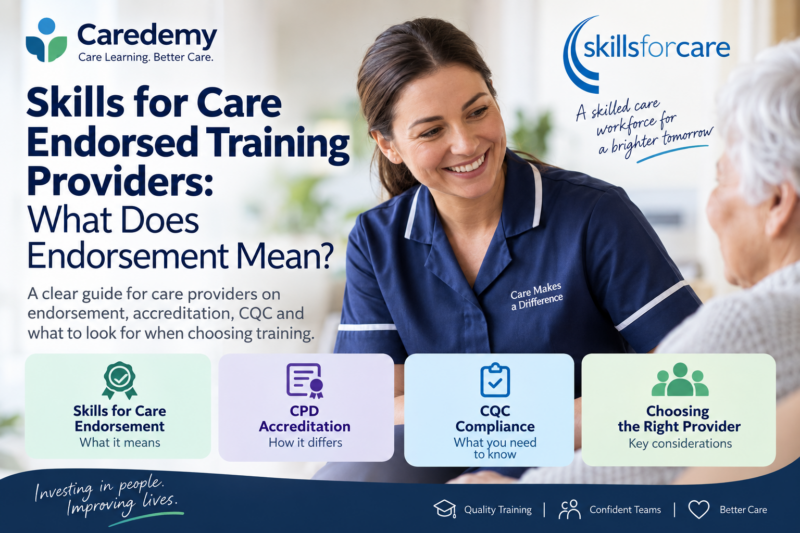
Skills for Care Endorsed Training Providers: What Does Endorsement Mean?
Understanding endorsement, CPD accreditation and CQC compliance.
If you are choosing training for a care home, domiciliary care agency, supported living service or other adult social care organisation, you may see providers describing themselves as “Skills for Care endorsed”, “CPD accredited”, “CQC compliant” or even “CQC approved”.
These terms do not mean the same thing.
Understanding the difference is important when deciding whether training is appropriate for your workforce and whether you will be able to demonstrate effective staff learning, development and competence.
What is a Skills for Care endorsed training provider?
A Skills for Care Endorsed Provider was a learning and development provider that had successfully completed Skills for Care’s provider endorsement process.
Skills for Care described its endorsement as a bespoke quality mark for learning and development providers in adult social care. The scheme took a holistic view of the provider, including whether it had appropriate policies, procedures and processes in place to operate as a good-quality training provider.
Importantly, provider endorsement did not automatically mean that every individual course offered by that organisation had been separately “approved” or “accredited” by Skills for Care.
This distinction has become even more important because the Skills for Care quality-assurance landscape has changed.
Skills for Care now operates the Quality Assured Care Learning Service (QACLS) on behalf of the Department of Health and Social Care. Unlike the previous endorsement model, QACLS reviews the quality of individual courses and qualifications delivered by training providers.
Employers therefore need to check exactly what a provider means when it uses terms such as “endorsed”, “quality assured”, “approved” or “accredited”.
What is Skills for Care?
Skills for Care is the strategic workforce development and planning body for adult social care in England.
Its work includes supporting employers, managers and the wider adult social care workforce with areas such as:
- workforce development
- recruitment and retention
- leadership and management
- the Care Certificate
- the Care Workforce Pathway
- statutory and mandatory training guidance
- workforce data
- qualifications
- learning and development
- quality assurance of relevant training.
Skills for Care works with the Department of Health and Social Care, employers and other sector organisations to support a skilled and confident adult social care workforce.
It is important, however, not to confuse Skills for Care with the Care Quality Commission (CQC).
Skills for Care is concerned with workforce development and standards.
The CQC is the independent regulator of health and adult social care in England.
That distinction explains why Skills for Care endorsement and CQC compliance are different concepts.
What did Skills for Care endorsement mean?
The former Skills for Care endorsement scheme provided a quality mark for learning and development providers operating within adult social care.
Skills for Care’s own guidance explains that its endorsement scheme took a holistic view of a training provider to determine whether the organisation had the appropriate policies, procedures and processes to be considered a good-quality training provider.
Historically, Skills for Care also explained that endorsed providers had to demonstrate that learning made a meaningful difference not only to the learner but also to people accessing care and support.
For an employer, endorsement therefore provided an additional form of independent assurance when selecting a training company.
It indicated that the provider had been assessed against Skills for Care’s endorsement requirements.
That is different from saying:
“Every course delivered by this provider has been individually approved by Skills for Care.”
Those statements are not interchangeable.
What Skills for Care endorsement does NOT mean
This is where much of the confusion arises.
Being a Skills for Care Endorsed Provider did not automatically mean:
Every course was individually approved by Skills for Care
Provider endorsement assessed the organisation. It should not automatically be represented as individual Skills for Care approval of every course in the provider’s catalogue.
The provider was regulated by CQC
CQC regulates health and social care services and regulated activities. It does not regulate commercial e-learning companies in the same way that it regulates a care home or domiciliary care service.
Every course automatically satisfies an employer’s CQC obligations
Training must be relevant to the worker’s role, the needs of the people they support and the risks associated with the service.
Employers remain responsible for identifying training needs and ensuring staff are competent.
Online course completion always demonstrates practical competence
Some subjects require practical assessment, workplace observation, supervision or another form of competency assessment.
Passing an online knowledge assessment does not automatically demonstrate that somebody can safely perform a practical task.
Endorsement is the same as CPD accreditation
It is not.
They are separate forms of external recognition with different purposes.
“Endorsed” means “accredited”
These words should not be used interchangeably unless the relevant organisation specifically uses them that way.
How did providers become Skills for Care endorsed?
Under the endorsement model, providers applied to Skills for Care and were assessed against its endorsement framework.
The process focused on the quality and operation of the learning provider rather than simply allowing an organisation to purchase and display a logo.
Skills for Care’s subsequent QACLS guidance provides a useful clarification of the historical model. It says the endorsement scheme took a holistic view of the training provider to determine whether the provider had appropriate policies, procedures and processes.
That is fundamentally different from the current QACLS approach.
What replaced the old approach?
The Quality Assured Care Learning Service was launched in October 2024.
The service is delivered by Skills for Care and funded by the Department of Health and Social Care.
Under QACLS, Skills for Care reviews the quality of individual courses and qualifications to establish whether learning is:
- high quality
- accessible
- appropriate for the adult social care workforce
- suitable for the needs of people who draw on care and support.
Courses and qualifications that successfully meet the relevant quality standards can receive the Quality Assured Care Learning Mark.
Skills for Care also maintains a current list of training providers, courses and accredited qualifications that have been quality assured through QACLS.
For employers purchasing training in 2026, this is an important distinction: historical Skills for Care provider endorsement and current QACLS course-level quality assurance are related to training quality, but they are not the same scheme.
Why does Skills for Care recognition matter?
Independent quality assurance can help employers reduce some of the uncertainty involved in selecting training.
There are many training companies operating in the health and social care sector, and their courses can differ considerably in content, assessment, learning design, sector expertise and quality assurance.
External recognition can therefore provide useful evidence during procurement.
However, it should form part of the employer’s due diligence rather than replacing it.
Skills for Care’s current guidance for choosing a learning provider recommends considering whether a provider:
- monitors, reviews and evaluates its learning
- delivers learning safely and flexibly
- employs suitably qualified and experienced trainers or assessors
- helps employers choose appropriate learning
- supports and assesses learners appropriately.
Skills for Care also recommends examining whether the learning itself uses current legislation, guidance and best practice, assesses learners fairly and has a genuine impact on staff development and the quality of care and support.
Those are useful questions whether or not a provider displays an endorsement or accreditation badge.
Is Skills for Care endorsement mandatory?
No. Skills for Care endorsement is not a general legal requirement for an adult social care employer to purchase training.
A course does not automatically become unsuitable simply because the training provider is not Skills for Care endorsed.
What matters is whether employers meet their legal and regulatory obligations and ensure their workforce receives appropriate learning, development, support and supervision.
For CQC-regulated providers, one of the central requirements is Regulation 18 of the Health and Social Care Act 2008 (Regulated Activities) Regulations 2014.
Regulation 18 requires staff to receive appropriate:
- support
- training
- professional development
- supervision
- appraisal
as necessary to enable them to perform their duties.
The employer therefore needs to determine what training is required according to the worker’s role and the needs of people using the service.
Does CQC require Skills for Care endorsed training?
No. CQC does not generally require care providers to buy training from a Skills for Care Endorsed Provider.
CQC’s Regulation 18 guidance focuses on whether staff have appropriate training, support, professional development and supervision and whether they have the competence, skills and experience necessary to perform their roles.
CQC also expects providers to identify individual training and development needs and review them at appropriate intervals.
This is a crucial distinction.
CQC is interested in the outcome and adequacy of workforce training and competence, rather than simply whether a particular commercial training provider’s logo appears on a certificate.
CQC has made this particularly clear in relation to learning disability and autism training. Its guidance states that Regulation 18 does not prescribe a particular training package and that CQC cannot promote, endorse or require providers to undertake a named commercial training programme.
Employers should therefore avoid treating phrases such as “CQC approved course” as a substitute for proper due diligence.
Skills for Care endorsement vs CPD accreditation vs CQC regulation
These three concepts are frequently confused.
| Skills for Care endorsement | CPD accreditation | CQC regulation | |
|---|---|---|---|
| Primary purpose | Historical quality assurance of learning providers in adult social care | External assurance relating to continuing professional development learning | Regulation of health and adult social care services |
| Who is assessed? | The learning provider under the former endorsement scheme | Courses/training or providers depending on the CPD body and scheme | Registered providers, regulated activities and relevant registered managers |
| Sector specific? | Yes – adult social care | Not necessarily; CPD covers many professions and sectors | Yes – regulated health and adult social care |
| Does it mean CQC approved? | No | No | Not applicable |
| Does it prove every course is suitable for every role? | No | No | No |
| Does it replace employer competency assessment? | No | No | No |
| Is it mandatory for all care training? | No | No general requirement | CQC requirements apply to regulated providers/activities |
| Current Skills for Care development | Historical provider endorsement model | Separate external CPD quality assurance | Separate regulatory framework |
| Current Skills for Care course assurance | QACLS now provides course/qualification-level quality assurance | Separate from QACLS | Separate from QACLS |
The simplest way to understand the difference
Skills for Care endorsement was a quality mark relating to the training provider.
CPD accreditation relates to continuing professional development and provides a separate form of external quality assurance.
CQC regulation concerns whether registered health and social care providers comply with regulatory requirements, including requirements around staffing, training and competence.
And in the current Skills for Care framework, QACLS quality assurance can apply to specific courses and qualifications.
These terms should not be treated as synonyms.
Skills for Care endorsement vs CPD accreditation
A training provider may have both Skills for Care recognition and CPD accreditation because the two serve different purposes.
Skills for Care’s historic endorsement scheme was specifically concerned with adult social care learning providers.
CPD accreditation is broader. CPD stands for Continuing Professional Development and can apply to learning across numerous industries and professions.
For care employers, CPD accreditation can provide useful independent evidence concerning the structure and quality of professional-development learning.
However, CPD accreditation alone does not establish that:
- the training is appropriate for a particular care role
- it covers every relevant Skills for Care learning outcome
- it satisfies a particular CQC requirement
- the learner has demonstrated practical competence
- the employer has fulfilled all its training obligations.
Likewise, historic Skills for Care endorsement should not be presented as though it were individual CPD accreditation of every course.
An organisation can legitimately have several different forms of quality assurance, but employers need to understand what each one actually covers.
Skills for Care endorsement vs CQC compliance
“CQC compliant training” is another phrase that needs careful interpretation.
CQC does not operate a general commercial training-provider accreditation scheme under which ordinary online training companies become “CQC approved training providers”.
Instead, CQC regulates registered providers and assesses whether they meet applicable regulatory requirements.
Under Regulation 18, providers must ensure workers receive appropriate training and development and have the competence necessary to perform their duties.
For example, an adult social care provider may need training covering:
- safeguarding
- health and safety
- infection prevention and control
- moving and handling
- fire safety
- learning disability and autism
- medication
- basic life support
- specialist needs relevant to the people being supported.
The exact training requirement depends on legislation, regulation, the worker’s role, risk assessment, service type and the needs of people receiving care and support.
The employer cannot outsource that responsibility simply by purchasing a course described as “CQC compliant”.
What should employers look for when choosing a care training provider?
Skills for Care endorsement, QACLS quality assurance and CPD accreditation can all provide useful information, but employers should consider the complete training offer.
A robust procurement process should check:
- Sector expertise – Does the provider understand adult social care and the realities of care delivery?
- Current course content – Is content regularly reviewed against changes in legislation, statutory guidance and recognised best practice?
- Relevant learning outcomes – Does the course cover what employees actually need to know for their role?
- Assessment – Is learning assessed appropriately rather than relying solely on passive course completion?
- Practical competence – Where practical skills are involved, is there a clear distinction between online knowledge learning and workplace competency assessment?
- External quality assurance – Can the provider substantiate claims concerning CPD accreditation, Skills for Care recognition or other external assurance?
- Training records – Can managers easily demonstrate who completed what training and when?
- Refresher management – Can the system identify training that needs reviewing or refreshing?
- Reporting – Can managers produce useful training reports or a training matrix for audits, inspections and workforce management?
- Certificates and verification – Are certificates clear and capable of being independently verified where appropriate?
- Employer support – Is assistance available when managers have questions about implementation, allocation or reporting?
- Accessibility – Can employees access learning in a practical format appropriate to their needs?
- Value rather than headline price – What is included in the price, particularly for organisations purchasing multiple courses for multiple employees?
- Evidence behind marketing claims – Can terms such as “accredited”, “endorsed”, “approved” and “aligned” be verified?
The objective is not simply to accumulate certificates. It is to develop a workforce with the knowledge, skills and competence needed to provide safe, effective and person-centred care.
How can you verify whether a training provider is Skills for Care quality assured?
Do not rely solely on a logo displayed on a training company’s website.
For current quality assurance, check the information published directly by Skills for Care.
Skills for Care currently publishes a list of training providers, courses and accredited qualifications that have successfully been quality assured through the Quality Assured Care Learning Service.
The list is updated regularly.
This is particularly important because training-provider status can change and historical webpages, certificates and badges can remain online after the period to which they relate.
When conducting due diligence:
- check Skills for Care’s current quality-assured training list
- identify whether recognition applies to the provider, an individual course or qualification
- check dates on certificates or evidence
- check what the quality mark actually covers
- ask the training provider for clarification if necessary.
Do not assume that the presence of a Skills for Care logo means every course offered by that provider has been individually approved by Skills for Care.
Is Caredemy Skills for Care endorsed?
Caredemy has previously been formally endorsed by Skills for Care under its provider endorsement scheme.
Caredemy’s published Skills for Care Certificate of Endorsement confirms that Caredemy was a Skills for Care Endorsed Provider from 28 July 2023 until 28 July 2024. Caredemy had also been endorsed during the preceding 2022–2023 period.
That provides documented evidence that Caredemy successfully achieved Skills for Care provider endorsement under the previous endorsement framework.
However, it is important to use current terminology accurately.
Skills for Care’s present quality-assurance system is the Quality Assured Care Learning Service (QACLS). QACLS differs from the old endorsement scheme because it assesses individual courses and qualifications rather than simply replicating the former provider-level endorsement model.
For that reason, Caredemy’s historic Skills for Care endorsement should not be presented as meaning that every Caredemy course has been individually “approved by Skills for Care”.
Caredemy also provides CPD-accredited online training, which is a separate form of quality assurance.
For employers, the practical question should therefore be broader than whether a provider can display one particular badge. Organisations should assess course content, learning outcomes, assessment, current guidance, sector relevance, reporting, employer tools and the evidence supporting any accreditation or quality-assurance claims.
“Approved”, “accredited”, “endorsed” and “CQC compliant”: what do they actually mean?
These terms appear frequently in searches for care training, but they should not be used interchangeably.
Endorsed
Historically, Skills for Care Endorsed Provider referred to a provider that had successfully met the requirements of Skills for Care’s endorsement scheme.
Quality assured
Under the current Quality Assured Care Learning Service, individual courses and qualifications can be assessed against Skills for Care’s quality standards.
Accredited
“Accredited” normally means that a course, qualification or provider has been assessed under the rules of a named accreditation or awarding organisation.
Always ask: accredited by whom, and what exactly has been accredited?
Approved
“Approved” should only be used where there is a genuine approval mechanism and evidence that the relevant organisation has granted that approval.
A provider should not use “approved” merely because its course is based on another organisation’s guidance.
Aligned
A course can be aligned with a framework or set of learning outcomes without being formally approved, accredited or endorsed by the organisation that created the framework.
CQC compliant
This phrase is often used to describe training designed to support an employer in meeting relevant regulatory expectations.
But a course certificate by itself does not make an organisation compliant with CQC regulations.
Compliance belongs to the regulated provider and depends on what happens in practice.
That includes appropriate training, competence, supervision, staffing, governance and evidence that people receive safe and effective care.
The 2026 position: Skills for Care quality assurance is evolving
For organisations researching “Skills for Care endorsed training providers”, it is important to recognise that some search results describe the historic endorsement model.
Skills for Care’s current system is increasingly centred around QACLS.
The Department of Health and Social Care launched QACLS in October 2024, with Skills for Care delivering the service.
Skills for Care states that the Government’s ambition is for training and development identified or funded through the Learning and Development Support Scheme (LDSS) for the adult social care workforce to become quality assured through QACLS over time.
Successfully quality-assured courses and qualifications can receive the Quality Assured Care Learning Mark and may be linked to relevant Care Workforce Pathway roles and learning outcomes.
This represents an important move towards course-level quality assurance.
For employers, it makes checking the exact status of the training they are purchasing increasingly important.
Choosing training that supports CQC requirements
Whether a provider has external quality marks or not, the employer ultimately needs to ensure that training supports a competent workforce.
CQC’s Regulation 18 guidance requires providers to ensure employees receive the training, development, supervision and support necessary for their roles.
Skills for Care similarly advises employers to choose learning that:
- reflects current legislation and best practice
- is relevant to the workforce
- assesses knowledge and skills appropriately
- contributes to staff development
- improves outcomes for people accessing care and support.
This is a much stronger approach than choosing a provider because of a single logo.
Look at the evidence behind the training.
Frequently Asked Questions
What is a Skills for Care Endorsed Provider?
A Skills for Care Endorsed Provider was a learning and development provider that had successfully met Skills for Care’s provider endorsement requirements. The scheme provided a quality mark for adult social care learning providers.
Does Skills for Care still endorse training providers?
Skills for Care’s current quality-assurance activity is centred on the Quality Assured Care Learning Service (QACLS). QACLS assesses individual courses and qualifications and differs from the historic provider endorsement scheme.
What is QACLS?
QACLS stands for Quality Assured Care Learning Service. It is a Department of Health and Social Care service delivered by Skills for Care that reviews the quality of individual adult social care courses and qualifications.
Is Skills for Care endorsement mandatory?
No. There is no general requirement that all adult social care training must come from a Skills for Care Endorsed Provider.
Does CQC require Skills for Care endorsed courses?
No. CQC requires regulated providers to ensure workers receive appropriate training, development, supervision and support and are competent to perform their roles. It does not generally require employers to purchase courses from a Skills for Care Endorsed Provider.
Are Skills for Care endorsed courses CQC approved?
No. Skills for Care endorsement and CQC regulation are separate. Employers should be cautious about treating “CQC approved” as a general accreditation for commercial care training.
Is Skills for Care endorsement the same as CPD accreditation?
No. Skills for Care’s historical endorsement scheme focused on learning providers in adult social care. CPD accreditation is a separate form of quality assurance concerned with continuing professional development.
Does Skills for Care endorsement mean every course is approved?
No. Historical provider endorsement should not automatically be interpreted as individual Skills for Care approval of every course in the provider’s catalogue.
How do I check current Skills for Care quality-assured training?
Use Skills for Care’s current Quality Assured Care Learning Service information and its published list of quality-assured training providers, courses and qualifications. Because the list is regularly updated, employers should check the latest version when purchasing training.
Is Caredemy Skills for Care endorsed?
Caredemy has documented historical Skills for Care Endorsed Provider status. Its published certificate confirms endorsement from 28 July 2023 to 28 July 2024, following an earlier endorsement period. For current Skills for Care course-level quality assurance, employers should distinguish the former endorsement scheme from the current QACLS framework.
Is Caredemy CPD accredited?
Caredemy provides CPD-accredited online courses. CPD accreditation is separate from Skills for Care provider endorsement and should not be described as CQC approval.
What training does CQC expect care staff to complete?
There is no single universal course list suitable for every employee in every care service. Employers should identify statutory, mandatory and role-specific training according to legislation, regulatory requirements, risk, the employee’s duties and the needs of people using the service.
Can online training alone demonstrate staff competence?
Not necessarily. Online training is well suited to developing and assessing knowledge, but some activities require practical training, observation or workplace competency assessment. Employers should determine what evidence is required for each role and subject.
What should I check before choosing an online care training provider?
Check course content, learning outcomes, assessment, sector expertise, update processes, accreditation or quality-assurance evidence, practical competency requirements, certificates, LMS reporting, accessibility, support and total cost.
Conclusion
Skills for Care recognition can be a useful indicator when evaluating adult social care training, but employers need to understand exactly what the recognition covers.
The historic Skills for Care Endorsed Provider scheme assessed training providers at organisational level.
The current Quality Assured Care Learning Service takes a different approach by quality assuring individual courses and qualifications.
CPD accreditation is separate again, providing another form of external quality assurance for continuing professional development.
And CQC regulation is not an accreditation scheme for commercial training providers. CQC’s focus is whether regulated services ensure staff have the training, knowledge, skills, competence and support necessary to provide safe and effective care.
For employers, the most useful question is therefore not simply:
“Does this training provider have a badge?”
It is:
“Can we demonstrate that this training is current, relevant, appropriately assessed and capable of helping our staff develop the knowledge and competence required for their roles?”
That is the standard that should drive training procurement.