
Who Needs the Care Certificate, and Who Is Exempt? A 2026 Guide
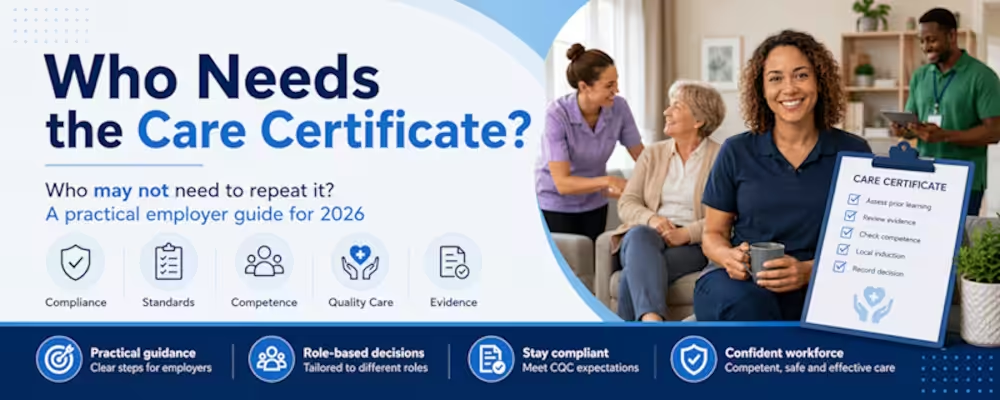
Who Needs the Care Certificate, and Who Is Exempt? A 2026 Guide to navigating exemptions, prior learning, and CQC compliance expectations.
Last updated: 23 July 2026 | Written by: Charlene Realon, Health & Social Care author | Reviewed by: Lynn Brown, Senior nurse for adult social care
The Care Certificate is the recognised set of induction standards for many people who are new to health and adult social care in England. It is not an Ofqual-regulated qualification or a standalone certificate that every employee is legally required to hold. Care providers do, however, have legal and regulatory duties to ensure that staff receive suitable induction, training, supervision and assessment and are competent for the work they perform. New care and support workers with no relevant previous experience will normally complete the Care Certificate standards. People who already hold the certificate, have relevant qualifications or can demonstrate suitable previous learning and competence may not need to repeat the full programme. The employer must assess each person individually, address any gaps and provide induction specific to the organisation, service and role.
Key Takeaways
- The Care Certificate is the recognised induction framework for many new care workers.
- It is not a universal statutory qualification.
- CQC focuses on competence, induction and safe practice.
- Previous learning can reduce unnecessary repetition.
- No occupation is automatically exempt simply because of job title.
- Employers should assess every worker individually.
- Local induction is always important.
- Competency evidence should be documented.
The phrase “Care Certificate exemption” is commonly used, but it can give the wrong impression. There is no official statutory exemption process or definitive list of occupations that are automatically excused from all Care Certificate learning.
The better question is:
What does this employee already know and do competently, what remains to be demonstrated, and what local induction do they need before working safely?
Skills for Care describes the Care Certificate as an agreed set of standards defining the knowledge, skills and behaviours expected of specific health and social care roles. It is intended particularly for people who are new to care and can be used to inform induction. The standards were updated in March 2025 and now comprise 16 standards.
CQC’s Regulation 18 guidance requires providers to have an induction programme that prepares staff for their roles, assess individual learning needs, provide appropriate learning and development, and supervise staff where necessary until they demonstrate an acceptable level of competence.
Avoid unnecessary repetition, but never avoid assessment.
What is the Care Certificate?
The Care Certificate is a workplace induction framework used across health and adult social care in England. It sets out the minimum knowledge, skills and behaviours expected of workers in relevant care and support roles. It was developed jointly by Skills for Care, NHS England and Skills for Health.
It is particularly relevant to people entering roles such as:
- care assistant;
- support worker;
- healthcare assistant;
- healthcare support worker;
- domiciliary care worker;
- residential care worker; and
- other non-regulated roles involving direct care or support.
The Care Certificate is intended to help employers provide a consistent foundation for induction. It does not replace safer recruitment, service-specific induction, statutory or role-specific training, supervised practice, competency assessment, continuing professional development, or ongoing supervision and appraisal.
The Care Certificate is not a regulated qualification
The Care Certificate is employer assessed. It is not itself an Ofqual-regulated qualification and does not confer a professional licence to practise. This distinction matters because the Level 2 Adult Social Care Certificate qualification is a separate, regulated qualification. It is based on the same 16 standards but builds, deepens and consolidates the learner’s knowledge and understanding. Skills for Care describes it as a portable qualification designed to reduce repeat training and provide formal recognition for care workers.
A person holding the Level 2 qualification may therefore have strong evidence of prior learning. The employer must still establish:
- whether relevant practical competence was observed;
- whether the learning remains current;
- whether all duties in the new role are covered;
- whether additional service-specific competencies are required; and
- what local induction remains necessary.
Completion requires knowledge and practice
The Care Certificate is not intended to be completed through online learning alone. Skills for Care states that workers need to be assessed on what they know and what they do to show that they understand and can carry out the standards in their role. Assessors must have a thorough understanding of, and direct experience in, the areas they assess.
Suitable assessment methods may include questioning and professional discussion, written or online knowledge assessments, direct observation, supervised practice, practical demonstration, reflective accounts, simulation where appropriate, and examination of the worker’s records or day-to-day practice.
| Term | What it means |
|---|---|
| Training completion | The worker attended or completed learning |
| Knowledge | The worker understands the subject |
| Competence | The worker can apply the learning safely in practice |
| Ongoing capability | The worker continues to perform safely over time |
A certificate can contribute to the evidence, but it does not prove every practical competency or demonstrate familiarity with a new provider’s procedures. Key point: Online learning can support Care Certificate online training knowledge, but the employer must also assess relevant workplace practice before confirming full achievement.
What are the 16 Care Certificate standards?
The current standards are:
- Understand your role
- Your personal development
- Duty of care
- Equality, diversity, inclusion and human rights
- Work in a person-centred way
- Communication
- Privacy and dignity
- Fluids and nutrition
- Awareness of mental health and dementia
- Safeguarding adults
- Safeguarding children
- Basic life support
- Health and safety
- Handling information
- Infection prevention and control
- Awareness of learning disability and autism
The framework was updated in March 2025. The update aligned the standards with sector developments and the Level 2 Adult Social Care Certificate qualification and added Standard 16. Read more in our guide on the 16 Care Certificate standards explained or compare options in Care Certificate versus Level 2 Adult Social Care Certificate.
Streamline Care Certificate Delivery and Compliance
Manage training pathways, track competencies, and ensure full inspection readiness across your care teams with Caredemy.
Explore Team Training View Care Certificate CoursesIs the Care Certificate a legal requirement?
The Care Certificate is not named in legislation as a universal qualification that every health or social care worker must obtain. However, care providers have enforceable duties concerning staffing, induction, training, skills, supervision, professional development, and competence. It is therefore misleading to say simply that the Care Certificate is “not mandatory” without explaining the provider’s wider obligations.
While the Care Certificate forms an important part of induction, employers must also ensure staff complete any mandatory care training required for their role and service to support safe, effective and compliant practice.
Regulation 18: Staffing
Regulation 18 of the Health and Social Care Act 2008 (Regulated Activities) Regulations 2014 requires providers to deploy sufficient numbers of suitably qualified, competent, skilled and experienced staff. People employed in providing a regulated activity must receive the support, training, professional development, supervision and appraisal necessary to enable them to carry out their duties.
CQC’s guidance states that providers must:
- have an induction programme that prepares staff for their roles;
- assess learning and development needs at the start of employment;
- review those needs at appropriate intervals;
- support workers to complete relevant learning;
- supervise staff where appropriate until competence is demonstrated;
- provide ongoing or periodic supervision;
- monitor completion of required learning; and
- take prompt action when requirements are not met.
Regulation 12: Safe care and treatment
Regulation 12 also requires care and treatment to be provided safely. In practice, providers must ensure that staff have the qualifications, competence, skills and experience necessary for the tasks assigned to them. For example, a medicines course may establish knowledge, but it does not necessarily establish that a worker is competent to administer medicines. The provider may also need policy induction, practical assessment, supervised administration, knowledge of escalation procedures, record-keeping assessment, and periodic reassessment.
Legal duty versus recognised framework
| Question | Correct Position |
|---|---|
| Is the Care Certificate a universal statutory qualification? | No |
| Must providers provide appropriate induction? | Yes |
| Must employees receive training relevant to their duties? | Yes |
| Must providers assess and maintain competence? | Yes |
| Is the Care Certificate recognised and endorsed by CQC? | Yes |
| Does Skills for Care describe it as a CQC expectation for employers? | Yes |
| Must every employee complete the same programme regardless of role or previous learning? | No |
| Can a provider rely on a certificate without checking practical competence? | No |
Skills for Care describes the Care Certificate as a CQC expectation and says employers should offer it. It also describes it as the minimum induction standard for new care workers with no previous experience. This means providers can accurately state: “The Care Certificate is the recognised minimum induction framework for relevant workers who are new to care, and CQC expects employers to address it.” Providers should avoid saying: “Every employee is legally required to hold a Care Certificate.”
Download our Care Certificate Employer induction checklist downloadable PDF to support your onboarding processes.
Why CQC may ask about the standards
CQC’s current registration guidance for relevant new care home, domiciliary care and supported living providers asks applicants for a staff training plan. The plan should explain how the provider will meet the Care Certificate standards alongside statutory, mandatory, role-specific and specialist learning requirements. This demonstrates the standards’ regulatory relevance, but it does not convert them into a standalone statutory qualification.
Meeting CQC training requirements involves much more than ensuring staff complete mandatory courses. Providers must be able to demonstrate that employees have the knowledge, skills and ongoing competence to deliver safe, effective, person-centred care. Our guide on how to meet CQC training requirements in care homes explains the practical steps providers can take to build a compliant training programme and prepare for CQC inspections.
Key point: The enforceable requirement is that staff are properly inducted, trained, supervised and competent. The Care Certificate is a recognised framework for demonstrating these foundations for relevant new workers.
Who normally needs the Care Certificate?
The Care Certificate should principally be considered for workers who are new to health or adult social care, provide direct care or support, have not previously demonstrated the required standards, or cannot provide reliable evidence of equivalent learning and competence. The decision should reflect the person’s duties rather than relying only on their job title.
New care assistants
A new care assistant entering the sector with no previous experience will normally complete the Care Certificate standards. The programme should form part of a broader induction covering the provider’s policies, the needs of the people supported, service-specific risks, safe working practices, safeguarding routes, emergency arrangements, record keeping, supervision, and practical competency assessment.
Healthcare assistants and support workers
New healthcare assistants and support workers delivering direct care will also commonly complete the standards. The employer should consider whether the worker’s role includes personal care, nutrition and hydration support, moving and handling, support with medicines, recording observations, communicating changes in health, supporting people with cognitive or communication needs, or responding to emergencies. Additional role-specific training may be needed beyond the Care Certificate.
Residential care workers
New residential care workers will normally need a structured induction based on the current standards. Their practical assessment may include promoting dignity and choice, communicating effectively, infection prevention, supporting nutrition and hydration, moving and handling, safeguarding, record keeping, and responding to changes in a resident’s condition. They should not be signed off solely because they attended training.
Domiciliary care workers
Domiciliary care workers frequently work alone and in changing environments. Their induction should therefore address matters such as lone working, safe access to people’s homes, missed or delayed visits, escalation routes, medication support, manual handling in domestic settings, safeguarding, electronic or paper care records, emergency procedures, and reporting deterioration or changes in need. New workers may need shadow shifts and supervised visits until their competence is confirmed.
Agency workers
Agency status does not reduce the requirement for competence. A worker supplied by an agency may already hold a Care Certificate and relevant training records. The provider should have clear arrangements for checking evidence supplied by the agency, confirming that learning remains current, matching the worker’s skills to the assignment, providing local orientation, identifying restricted duties, and reporting performance or competency concerns. A receiving provider remains responsible for ensuring that workers deployed in its service can safely carry out the tasks assigned to them.
Apprentices
An apprentice entering adult social care may complete the Care Certificate standards as part of induction and early development. Participation in an apprenticeship does not remove the employer’s immediate responsibility to assess learning needs, provide suitable supervision, determine which tasks may be performed, assess practical competence, and complete local induction.
Volunteers
Whether a volunteer should complete all or part of the Care Certificate depends on their duties and the associated risks. A volunteer helping with supervised social activities may need targeted induction rather than the full standards. A volunteer involved in direct personal care, access to sensitive information or higher-risk support may require a much more extensive programme.
Administrative, domestic and ancillary workers
Not every employee of a care provider will fall within the intended core audience for the full Care Certificate. Administrative, domestic, maintenance, catering or transport staff may instead need induction and training tailored to their duties. This could include safeguarding awareness, confidentiality, infection prevention, health and safety, emergency procedures, equality and dignity, and role boundaries. Where such employees regularly provide direct support, their learning needs should be reassessed accordingly.
Role-based comparison
| Worker or role | Likely approach | Important additional requirements |
|---|---|---|
| New care assistant with no experience | Normally complete the current standards | Local induction and observed practice |
| New domiciliary care worker | Normally complete | Lone working, shadowing and service-specific competence |
| Healthcare assistant without prior evidence | Normally complete or demonstrate every applicable outcome | Clinical or setting-specific induction |
| Experienced support worker | Assess prior learning and competence individually | Gap training and local induction |
| Agency worker with an existing certificate | Verify evidence rather than automatically repeating | Assignment and service orientation |
| Apprentice new to care | Usually include within induction | Structured supervision and assessment |
| Volunteer | Base decision on duties and risks | Targeted safeguarding and local induction |
| Administrator without direct care duties | Role-specific induction may be more appropriate | Confidentiality, safeguarding and local procedures |
Who may not need to repeat the full Care Certificate?
The terms recognition of prior learning, previous achievement and gap assessment are generally more accurate than “exemption”. No current official guidance provides a universal statutory exemption list based solely on occupation or years of experience.
The employer should instead ask:
- What reliable evidence does the person already have?
- Does it cover the current standards?
- Can the person apply that learning competently?
- Is the evidence current and relevant to the new role?
- What gaps remain?
- What local induction is still required?
Workers who already hold a Care Certificate
Skills for Care says that a person who has their Care Certificate should not need to retake it when moving jobs. An employer may ask the worker to demonstrate how previous learning aligns with the new organisation’s requirements and may require refresher learning. This is the clearest official position on portability.
Experienced workers without a certificate
Some experienced workers entered care before the Care Certificate was introduced or completed another induction framework. They may not need to repeat the full programme if the employer can establish that they already meet the current outcomes. Experience alone is not enough; employers must evaluate how recent the experience is, comparable duties, past training, competence assessment, career breaks, changes in legislation, current practical ability, and understanding of new provider procedures.
Workers with relevant qualifications
A qualification may provide strong evidence of prior learning but should not be assumed to cover every practical or local requirement. The Level 2 Adult Social Care Certificate qualification is based on the same 16 standards and is intended to reduce repeat training. Even then, the provider should complete local induction and confirm role-specific competence.
Registered nurses
Registered nurses will usually have substantial professional education, assessed practice and continuing professional development relevant to many Care Certificate outcomes. Requiring an experienced registered nurse to repeat all equivalent basic learning may therefore be unnecessary, though employers must review NMC registration, clinical competencies, local medicines systems, and delegation responsibilities.
Other regulated professionals
The same principle applies to registered social workers, occupational therapists, physiotherapists and other regulated professionals. Professional registration is relevant evidence, but does not remove the need to verify registration, assess suitability, provide local induction, and confirm service-specific skills.
Overseas-trained workers
International qualifications and employment experience may be recognised where they are properly verified and relevant. The employer must assess each worker fairly and individually regarding UK-specific safeguarding, record keeping, consent, and medicines systems.
Workers returning after a career break
A person returning after a prolonged absence may have valid previous evidence but need refresher learning or reassessment depending on the length of the break and changes to standards.
Workers who completed the former 15 standards
The current framework contains 16 standards following the March 2025 update. An employee who previously completed the 15-standard version should not normally be required to repeat everything solely because a new standard was added. A proportionate approach is to verify the earlier certificate, assess currency, address Standard 16, review updates, and provide local induction.
Prior-learning and assessment matrix
| Employee type | Evidence to review | What still needs checking | Likely approach |
|---|---|---|---|
| Existing Care Certificate holder | Certificate, assessment evidence and recent work history | Current competence, new duties and local procedures | Normally avoid full repetition |
| Experienced worker without a certificate | Qualifications, references, training and employment history | Mapping against all applicable current standards | Assess and complete identified gaps |
| Level 2 qualification holder | Qualification certificate, transcript and assessment evidence | Practical and service-specific competence | Recognise relevant achievement and complete local induction |
| Registered nurse | Registration, qualifications, CPD and recent practice | New service and role-specific competencies | Usually avoid unnecessary repetition |
| Other regulated professional | Registration and professional evidence | Duties, local systems and service-specific needs | Individual assessment |
| Overseas-trained worker | Verified qualifications and employment evidence | UK-specific knowledge and current practice | Targeted induction and gap assessment |
| Returning worker | Previous achievement and recent learning | Currency after time away | Refresher learning and reassessment where needed |
| Holder of old 15-standard certificate | Previous certificate and supporting evidence | Standard 16 and any other updates | Update rather than automatically restart |
How should employers make the decision?
A documented process produces more consistent, fair and defensible decisions:
- Step 1: Define the role — Identify what the person will actually do, direct care responsibilities, personal care, medicines, lone working, clinical observations, confidential info, specialist support, decision-making authority, professional registration, and risks.
- Step 2: Gather evidence — Ask for relevant evidence including previous certificates, transcripts, training records, registration, references, and supervision logs.
- Step 3: Map evidence against current requirements — Compare evidence with the current 16 standards, job description, statutory learning requirements, and local procedures.
- Step 4: Assess knowledge and practical competence — Use professional discussion, written assessments, direct observation, supervised shifts, and practical demonstrations.
- Step 5: Identify gaps — Record each outcome as evidenced, partially evidenced, requiring reassessment, not yet achieved, or not applicable.
- Step 6: Complete local induction — Cover organisational values, safeguarding routes, emergency arrangements, reporting, record-keeping systems, and role boundaries.
- Step 7: Record, approve and review the decision — Document the employee role, evidence reviewed, standards mapped, assessments completed, gaps identified, learning assigned, local induction, and approvals.
What evidence should employers retain?
A strong audit trail demonstrates not only what training the employee completed, but how the provider decided that the employee was competent.
| Evidence | What it can demonstrate | What it cannot prove alone |
|---|---|---|
| Previous Care Certificate | Previous achievement of the framework | Current competence or knowledge of local systems |
| Qualification certificate | Formal achievement | Exact units, practical scope or current capability |
| Qualification transcript | Specific knowledge or units covered | Service-specific competence |
| Professional registration | Current regulated professional status | Familiarity with the provider’s policies |
| Training certificate | Attendance or knowledge-course completion | Safe application in practice |
| Knowledge assessment | Understanding of the subject | Practical performance |
| Direct observation | Competence in a practical activity | Performance across unrelated duties |
| Supervised shift record | Ability to work safely in context | Long-term maintenance of competence |
| Local induction checklist | Topics introduced by the provider | Genuine understanding unless checked |
| Supervision record | Reflection, feedback and development | Formal competence unless clearly assessed |
| Competency mapping record | How previous evidence relates to present requirements | Reliability if evidence was not verified |
| Manager sign-off | Organisational decision and accountability | A substitute for supporting evidence |
A stronger record might state:
“The worker’s Care Certificate dated October 2024 and supporting assessment documentation were reviewed. Knowledge checks and supervised observations confirmed current competence in the applicable standards. Standard 16, the provider’s medication procedures, safeguarding escalation route and electronic care-record system were assigned as additional learning. The worker completed three supervised shifts before being approved for lone working.”
A weak record might say:
“Eight years’ experience — exempt.”
Final Thoughts
Navigating who needs the Care Certificate and who may be exempt requires a balanced approach focused on individual assessment, prior learning evaluation, and robust local induction. By avoiding unnecessary repetition while never bypassing practical competency checks, care providers can ensure full CQC compliance and build a highly capable, confident workforce.
Explore Caredemy to discover comprehensive course libraries, Team Training packages, and digital tools designed to support your organisation's training and compliance journey. Visit caredemy.co.uk to find the right training solutions for your care team.
Ready to Simplify Compliance and Staff Onboarding?
Discover how Caredemy’s online learning platform, Care Certificate courses, and Team Training solutions can transform your care organization.
Explore Team Training Browse All Courses