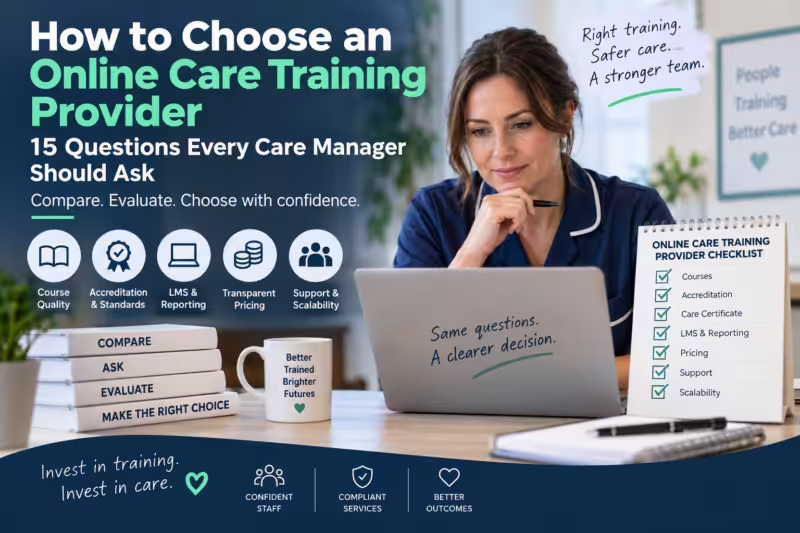
How to Choose an Online Care Training Provider: 15 Questions Every Care Manager Should Ask
What to check before choosing a training provider?
Choosing an online care training provider isn’t simply a question of finding the cheapest courses.
For care homes, domiciliary care agencies, supported living providers and other health and social care organisations, the right training provider should help you deliver relevant learning, keep training records organised, manage refresher training and produce evidence when it is required.
The most important factors to compare are course quality and coverage, accreditation, Care Certificate provision, LMS functionality, reporting, pricing, learner management, support and the true annual cost of training your workforce.
A provider that initially appears cheaper can become more expensive if essential courses cost extra, licences cannot be replaced when employees leave, reporting is limited or managers spend hours maintaining separate spreadsheets.
Before signing a contract, shortlist two or three providers and ask each of them the same 15 questions.
1. How Many Relevant Courses Are Included?
Why it matters
Don’t judge a training library purely by its headline number.
A provider might advertise 100 courses, but only 30 may be relevant to your organisation. Look at the training your actual workforce needs, including mandatory, induction, refresher and role-specific subjects.
This might include safeguarding, infection prevention and control, moving and handling, medication, basic life support, dementia, mental health, food safety, fire safety, equality and diversity, end-of-life care and specialist clinical-awareness subjects.
What a good answer looks like
The provider should offer sufficient breadth to cover both your core training matrix and additional learning requirements.
For example, Caredemy currently advertises 200+ CPD courses across health, social care and related workplace subjects.
Warning signs
Be cautious if a provider advertises an impressive headline package but frequently charges separately for courses outside a small core library.
Ask them to demonstrate
Give the provider your current training matrix and ask them to identify exactly which courses they can supply, and which they cannot.
2. Is the Training CPD Accredited?
Why it matters
CPD accreditation provides independent assurance that training has been assessed against recognised continuing professional development standards.
However, don’t confuse “CPD training”, “CPD points” and independently accredited CPD. Ask who actually accredits the courses.
What a good answer looks like
The provider should clearly identify the accrediting organisation and allow you to verify its accreditation.
Caredemy’s courses are independently accredited by the CPD Standards Office.
Warning signs
Watch for vague phrases such as “CPD suitable”, “CPD compliant” or “meets CPD requirements” without identifying an independent accreditation body.
Ask them to demonstrate
Ask to see the accreditation details for several courses you are likely to use.
3. Is the Provider Skills for Care Endorsed Where Relevant?
Why it matters
For adult social care employers in England, Skills for Care recognition can provide another useful quality indicator when evaluating learning and development providers.
It should not be the only reason you select a provider, but it is worth including in your procurement criteria.
What a good answer looks like
The provider should be transparent about its current status and allow you to verify any endorsement it claims.
Caredemy identifies itself as a Skills for Care Endorsed Provider.
Warning signs
Be careful when providers use phrases such as “aligned to Skills for Care” in a way that could be mistaken for actual provider endorsement.
Ask them to demonstrate
Ask: “Are you currently a Skills for Care Endorsed Provider, and can we verify that independently?”
4. Is the Current Care Certificate Available?
Why it matters
This is particularly important for organisations recruiting employees who are new to care.
The Care Certificate was updated in March 2025 and now contains 16 standards, including the additional standard covering awareness of learning disability and autism.
Online learning can support the knowledge element, but employers must remember that the Care Certificate also requires workers to demonstrate that they understand and can carry out the standards in their role.
What a good answer looks like
The provider should offer training aligned with the current standards and clearly explain the distinction between online learning and workplace assessment of competence.
Warning signs
Watch for outdated references to only 15 standards or claims suggesting that completing an online course alone automatically proves workplace competence.
Ask them to demonstrate
Ask to see the Care Certificate course structure and how it maps to the current 16 standards.
5. How Frequently Are Courses Reviewed and Updated?
Why it matters
Health and social care guidance, legislation, standards and best practice change.
A course that was appropriate several years ago may contain outdated terminology, references or guidance today.
What a good answer looks like
Providers should have a documented review process and update courses when relevant legislation, standards or sector guidance changes.
Warning signs
Look out for courses with no review dates, outdated references or a provider that cannot explain how updates are managed.
Ask them to demonstrate
Choose two important courses—such as safeguarding and infection prevention—and ask when they were last reviewed and what prompted the most recent changes.
6. Does the Platform Provide an LMS?
Why it matters
Buying online courses and managing workforce training are two different things.
Once you have 10, 30, 100 or 500 employees, you need a system for assigning courses, monitoring completion, storing certificates and managing renewals.
That is where a Learning Management System (LMS) becomes important.
What a good answer looks like
Managers should be able to add and manage learners, allocate training individually or in bulk, view progress and access training records without maintaining a separate manual system.
Caredemy Team Training includes a Learner Management System alongside its course library.
Warning signs
Be cautious if the “LMS” is essentially a list of purchased courses with little management or reporting functionality.
Ask them to demonstrate
Ask the provider to show the process from adding a new employee → assigning mandatory training → monitoring progress → downloading evidence.
7. Can Managers Track Training and Compliance?
Why it matters
A manager needs to know more than who has completed a course.
You should quickly be able to identify:
- Training completed
- Training outstanding
- Courses approaching renewal
- Learners who have not started
- Individual learner histories
- Overall training compliance
What a good answer looks like
Look for dashboards, training matrices and clear visual reporting.
Caredemy’s team platform includes a colour-coded reporting matrix, learner management and compliance reporting.
Warning signs
If the provider expects you to export raw data and build your own compliance spreadsheet, ask what administrative benefit the LMS is actually providing.
Ask them to demonstrate
Ask: “Show me how I would identify every employee with overdue mandatory training in under one minute.”
8. Are Automatic Reminders Available?
Why it matters
Training management becomes considerably more difficult when managers must manually check renewal dates.
Automation can reduce administrative work and the risk of refresher training becoming overdue.
What a good answer looks like
The platform should help automate refresher or renewal processes and make upcoming training requirements visible.
Caredemy’s subscription platform includes automated course renewal.
Warning signs
Watch for systems where managers must manually identify every renewal and individually reassign training.
Ask them to demonstrate
Ask the provider to show exactly what happens when an employee’s training reaches its renewal date.
9. Can Reports Be Produced for Inspections?
Why it matters
Good training records help demonstrate how your organisation manages staff learning and development.
An LMS should make evidence easier to retrieve for management reviews, commissioners, audits and inspections.
What a good answer looks like
Look for downloadable compliance reports, training matrices, learner records and certificate management.
Caredemy includes audit and compliance reporting, course-time reporting, a colour-coded matrix and bulk certificate downloads.
Warning signs
A platform that records completions but makes it difficult to produce meaningful management evidence can create unnecessary work.
Ask them to demonstrate
Imagine an inspector has asked for your current staff training position.
Tell the provider:
“Show me what you would give them.”
10. What Happens When an Employee Leaves?
Why it matters
Staff turnover can substantially change the real cost of online training.
Imagine purchasing 50 annual licences and having 10 employees leave during the year.
What happens to those licences?
If every replacement requires another paid account, your actual annual cost may be significantly higher than the original quotation.
What a good answer looks like
The provider should clearly explain whether licences can be disabled, transferred or replaced and whether charges apply.
Warning signs
Beware of attractive per-user prices where a licence effectively becomes unusable as soon as the original employee leaves.
Ask them to demonstrate
Ask them to model the cost if 20% of your workforce changes during the contract year.
11. Are Learner Replacements Charged?
Why it matters
This deserves a separate question because it can materially affect the economics of care training.
A £35 licence isn’t really £35 if you repeatedly have to purchase additional licences for replacement employees.
What a good answer looks like
Look for a clear learner-replacement policy.
Caredemy Team Training subscriptions include free learner replacement, allowing care organisations to replace a learner when an employee leaves rather than automatically losing the value of that training place.
Warning signs
Look for replacement fees, restrictions buried in contract terms or providers that cannot clearly explain what happens to licences when employees leave.
Ask them to demonstrate
Give the provider your annual employee turnover rate and ask them to calculate the resulting annual licence cost.
12. Are There Additional or Hidden Costs?
Why it matters
The advertised price may not be the final price.
Potential additional charges can include:
- LMS access
- Setup
- Manager accounts
- Certificates
- Care Certificate training
- Specialist courses
- Reporting
- Additional learners
- Replacement licences
- Support
What a good answer looks like
You should be able to understand your expected 12-month cost before signing.
Caredemy’s current subscription offering states that there are no hidden fees or setup charges, with manager training and Care Certificate access also included within the subscription proposition.
Warning signs
If a salesperson repeatedly gives you a low “from” price but cannot provide a complete annual cost, investigate further.
Ask them to demonstrate
Request a written quotation based on your real headcount and training requirements.
13. Is Pricing Pay-Per-Course, Credits or Unlimited?
Why it matters
There isn’t one purchasing model that is cheapest for every organisation.
Pay-per-course can suit organisations needing occasional training.
Credits can provide flexibility where training requirements vary.
Unlimited subscriptions can become more economical where employees complete multiple courses each year.
Caredemy currently offers pay-as-you-go, credits and team subscription options.
What a good answer looks like
A provider should recommend the model that suits your usage—not automatically push its most expensive package.
Warning signs
Be cautious of comparing providers using only “price per course” or “price per learner”.
Ask them to demonstrate
Give each provider the same scenario:
“We have 50 employees. Each requires 10 courses per year, and we expect 10 employees to leave and be replaced. What is our total annual cost?”
That figure is far more useful than the headline price.
14. What Customer Support Is Available?
Why it matters
Even a straightforward LMS will occasionally require support.
Employees forget passwords. Managers need help with reporting. New staff need adding. Training may need resetting.
What a good answer looks like
Look for accessible support and clear escalation routes.
For larger accounts, having a named contact can be particularly valuable. Caredemy subscriptions currently include a dedicated account manager alongside priority support.
Warning signs
Check whether support is restricted to tickets, charged separately or only available during limited periods.
Ask them to demonstrate
Ask who you would contact if your manager couldn’t access an important compliance report.
15. Can the System Scale Across Teams, Branches or Locations?
Why it matters
The system you need with 15 employees may be very different from the one you need with 150.
Growing organisations may need local managers, organisational reporting, branch-level visibility and central oversight.
What a good answer looks like
The platform should allow training to be managed efficiently as your organisation grows rather than forcing you to rebuild your processes.
Warning signs
Watch for systems that work well for one manager but become administratively difficult across multiple services or locations.
Ask them to demonstrate
Ask the provider to show how a multi-site organisation would monitor training centrally while still allowing individual managers to manage their own teams.
ONLINE CARE TRAINING PROVIDER CHECKLIST
Use this checklist when speaking to Caredemy, eCert Training or any other provider you are considering.
☐ Relevant mandatory training courses available
☐ Specialist courses required by our organisation available
☐ Independent CPD accreditation verified
☐ Skills for Care provider endorsement checked where relevant
☐ Current 16-standard Care Certificate available
☐ Course review/update process explained
☐ LMS included
☐ Manager dashboard available
☐ Training/compliance matrix available
☐ Bulk course assignment available
☐ Automatic refresher/renewal functionality available
☐ Certificates easy to retrieve
☐ Inspection/audit reports available
☐ Leaver policy explained
☐ Learner replacement cost confirmed
☐ Setup fees confirmed
☐ Manager-account charges confirmed
☐ Care Certificate costs confirmed
☐ PAYG/credit/subscription options compared
☐ Customer support arrangements confirmed
☐ Multi-site/branch functionality demonstrated
☐ Total annual cost supplied in writing
Tip: Don’t simply email this list to providers. Ask them to demonstrate the important features during a live LMS demonstration.
Online Care Training Provider Comparison Scorecard
Score each provider from 0 to 5, where:
0 = Does not provide it
1 = Very poor
2 = Below expectations
3 = Meets requirements
4 = Very good
5 = Excellent
| Criterion | Provider A | Provider B | Provider C |
|---|---|---|---|
| Relevant course coverage | /5 | /5 | /5 |
| CPD accreditation | /5 | /5 | /5 |
| Skills for Care endorsement | /5 | /5 | /5 |
| Current Care Certificate | /5 | /5 | /5 |
| Course updating | /5 | /5 | /5 |
| LMS functionality | /5 | /5 | /5 |
| Compliance tracking | /5 | /5 | /5 |
| Automation/reminders | /5 | /5 | /5 |
| Inspection reporting | /5 | /5 | /5 |
| Leaver management | /5 | /5 | /5 |
| Learner replacement | /5 | /5 | /5 |
| Pricing transparency | /5 | /5 | /5 |
| Purchasing flexibility | /5 | /5 | /5 |
| Customer support | /5 | /5 | /5 |
| Multi-site scalability | /5 | /5 | /5 |
| TOTAL | /75 | /75 | /75 |
You can also weight particularly important categories. For example, an organisation experiencing high staff turnover might give learner replacement twice the weighting of other features.
Red Flags When Choosing a Care Training Provider
Price shouldn’t be the only warning sign.
Be cautious if:
- The provider cannot clearly identify who accredits its training.
- The Care Certificate is still based on outdated standards.
- Course review dates or processes aren’t available.
- The LMS cannot produce a useful training matrix.
- Inspection evidence requires extensive manual spreadsheet work.
- Essential courses aren’t included in the quoted package.
- Care Certificate access costs substantially more.
- Learner licences cannot be transferred or replaced.
- The quotation contains unexplained setup, LMS or management charges.
- The provider won’t demonstrate the platform before you commit.
- The salesperson cannot explain what happens when employees leave.
- The provider implies that completing online training alone proves practical competence.
A good provider should be comfortable with detailed procurement questions.
Price Vs Value: What Should You Actually Compare?
One of the biggest mistakes is comparing:
Provider A = £5 per course
versus
Provider B = £40 per employee
Those numbers measure different things.
Instead calculate:
Training cost + Care Certificate + specialist courses + LMS + setup fees + manager accounts + replacement learners + administration = total annual training cost
Then consider the administrative value of the system.
If one platform saves a manager several hours every month through automated renewals, reporting, bulk allocation and certificate management, that time has a value too.
This is where features such as Caredemy’s 200+ course library, LMS, compliance matrix, bulk certificates, Care Certificate inclusion, automated renewal and free learner replacement should be considered as part of the total package rather than individually.
The cheapest provider is not necessarily the one advertising the lowest course price.
It is the provider that can deliver the training and management functionality your organisation actually requires at the best total cost over the contract period.
The Best Way to Choose Your Provider
Shortlist three providers.
Give all three:
- Your employee headcount
- Your current training matrix
- Your expected annual staff turnover
- Your number of locations
- Your Care Certificate requirements
Ask for a full annual quotation.
Then request a demonstration and score each provider using the scorecard above.
This gives you a far more objective basis for making a decision than comparing websites or advertised prices.
Caredemy provides online training for individual learners and organisations, with 200+ CPD courses, Skills for Care provider endorsement and a team LMS offering compliance reporting, bulk training management, Care Certificate access and free learner replacement on subscription packages.
If you’re currently comparing Caredemy with eCert Training or another online care training provider, request a Caredemy Team Training demonstration and use the checklist in this guide to compare the platforms feature by feature.
Frequently Asked Questions
What should I look for in an online care training provider?
Prioritise relevant course coverage, recognised accreditation, current course content, Care Certificate provision, LMS functionality, compliance reporting, learner management, support and transparent pricing.
Should a care training provider be CPD accredited?
Independent CPD accreditation provides additional external quality assurance. Ask providers which organisation accredits their courses and verify the claim rather than relying solely on a CPD logo.
Does the Care Certificate now have 16 standards?
Yes. The Care Certificate standards were updated in March 2025 and now contain 16 standards. Awareness of learning disability and autism was added as Standard 16.
Is online training enough for the Care Certificate?
Online learning can support the required knowledge, but the Care Certificate also requires workers to be assessed on what they know and what they do. Employers therefore need appropriate workplace assessment and evidence of competence.
Is unlimited care training cheaper than pay-per-course?
It depends on how many courses each employee completes. PAYG can be economical for occasional requirements, while unlimited access can become better value where employees require multiple mandatory, induction, refresher and specialist courses.
Why is free learner replacement important?
Care organisations can experience significant staff turnover. If licences cannot be reassigned or replaced, employers may effectively pay twice when one employee leaves and another joins. Always include replacement costs when comparing annual pricing.
What LMS features should a care provider look for?
Useful features include learner management, bulk course assignment, training matrices, renewal management, certificates, compliance reporting, manager dashboards and multi-site functionality.
How many providers should I compare?
Three is usually a sensible shortlist. Give each provider the same headcount, training requirements and workforce-turnover assumptions so you are comparing like with like.