Unlimited Care Training vs Pay-Per-Course: Which Is Cheaper for Care Providers?
Find the most cost-effective way to train your care team
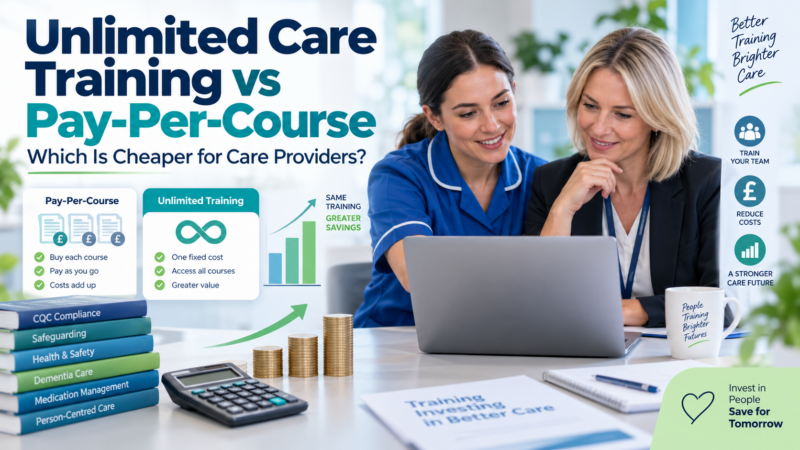
For most care providers, pay-per-course training is cheapest when employees complete only a small number of courses each year, while unlimited training becomes more attractive as each learner requires more mandatory, refresher, induction and specialist training.
But there is an important complication: bulk discounts can dramatically reduce pay-per-course prices.
At Caredemy, for example, standard courses are currently advertised at £15 + VAT individually, but the published bulk price falls progressively to £4.99 at 100+ course enrolments, £2.49 at 500+, £1.99 at 1,000+ and £1.45 at 2,000+.
That means the correct question is not simply:
“How much does unlimited training cost?”
It is:
“What is the lowest genuine annual cost of delivering all the training our workforce will actually need?”
That calculation should include course volume, workforce size, Care Certificate requirements, new starters, staff turnover and whether learner licences can be replaced.
All Caredemy figures below exclude VAT and use published prices checked in September 2026.
The main ways care providers can buy online training
Pay-per-course
Pay-per-course, or PAYG, means purchasing an enrolment whenever an employee needs a particular course.
This provides maximum flexibility and can be extremely economical where training requirements are limited.
Caredemy’s current published bulk pricing is:
| Number of course enrolments | Price per course |
|---|---|
| 1–4 | £15.00* |
| 5–9 | £9.49 |
| 10–29 | £8.49 |
| 30–49 | £7.99 |
| 50–99 | £6.49 |
| 100–249 | £4.99 |
| 250–499 | £3.99 |
| 500–999 | £2.49 |
| 1,000–1,999 | £1.99 |
| 2,000+ | £1.45 |
*Standard individual courses are currently generally advertised at £15. Published volume pricing applies thereafter.
This tiered structure matters enormously when comparing PAYG with subscriptions.
Training credits
Credits allow an employer to buy training capacity in advance and use it as courses are required.
Instead of deciding exactly which employee needs which course when placing the order, the organisation has a bank of training available.
Credits can suit providers with changing requirements because they combine some of the flexibility of PAYG with volume purchasing.
Before buying credits, check:
- whether credits expire;
- whether unused credits carry forward;
- whether every course consumes the same number of credits;
- whether credits can be used for new starters;
- whether the Care Certificate is included;
- what happens when an employee leaves.
Caredemy offers team purchasing and credit options alongside PAYG and subscriptions.
Course bundles
A bundle combines several courses for one price.
Caredemy currently advertises, for example, a 12-course Essential Care Skills package for £25, while other bundles cover particular mandatory or specialist training requirements.
Bundles can be highly cost-effective when employees genuinely need most or all of the included courses.
However, calculate the price against the number of required courses rather than the number advertised.
A £25 bundle containing 12 courses costs £2.08 per course if all 12 are needed.
If an employee actually needs only five of them, the effective cost of the relevant training is £5 per required course.
Per-learner subscriptions
A per-learner subscription charges for each active employee rather than each individual course.
The advantage is predictable expenditure.
If 50 employees cost £40 each annually:
50 × £40 = £2,000 annual training cost
It no longer matters whether an employee completes five courses or fifteen, provided those courses are included in the subscription.
The disadvantage is that you may pay for capacity that employees never use.
Unlimited course subscriptions
Unlimited subscriptions allow learners to access an entire training library during the subscription period.
Caredemy currently advertises an individual unlimited subscription at £60 + VAT for 12 months, with access to its wider course library and the Care Certificate included.
That immediately creates a simple individual break-even calculation.
At £15 per individual course:
£60 ÷ £15 = 4 courses
Four £15 courses cost £60.
A fifth £15 course would take PAYG expenditure to £75, making the £60 subscription cheaper before considering volume discounts.
For employers, however, bulk PAYG discounts change the mathematics significantly.
Team training
Team training combines course access with the tools required to manage a workforce.
Caredemy currently publishes the following team subscription pricing:
| Team size | Monthly cost per learner | Annual cost per learner |
|---|---|---|
| 10–30 | £5 | £60 |
| 31–50 | £4 | £48 |
| 51–100 | £3 | £36 |
| 101+ | Quotation | Quotation |
The package also advertises access to the full course library, compliance tracking, reporting, certificate management and free learner replacements.
That final feature becomes important when we model staff turnover.
Caredemy vs eCert Training: current published pricing
A useful comparison is eCert Training.
eCert currently advertises access to 60+ courses and its homepage states annual training is available “as low as £35 per learner annually.”
There is an inconsistency worth highlighting for buyers: eCert’s dedicated pricing page was displaying £0 per Care Professional seat when checked, while its homepage states “as low as £35 per learner annually”. We have therefore not treated £0 as a normal commercial price and would recommend obtaining a current quotation before purchasing.
eCert’s Care Certificate is separately priced on its pricing page at £15 per credit.
So a provider comparing Caredemy and eCert should not compare only £60 versus £35. It should establish whether the Care Certificate, specialist courses, learner replacement and required course coverage are included.
What does PAYG actually cost?
The following calculations use Caredemy’s current published volume discounts.
The formula is:
Employees × courses required = total course enrolments
Then:
Total course enrolments × applicable bulk rate = annual training cost
5 employees
| Courses each | Enrolments | PAYG annual cost | Cost per learner | Cost/course |
|---|---|---|---|---|
| 2 | 10 | £84.90 | £16.98 | £8.49 |
| 5 | 25 | £212.25 | £42.45 | £8.49 |
| 10 | 50 | £324.50 | £64.90 | £6.49 |
| 15 | 75 | £486.75 | £97.35 | £6.49 |
The £60 individual unlimited subscription would cost £300 for five people.
At five courses each, PAYG costs £212.25 and wins.
At ten courses each, unlimited costs £300 versus £324.50 PAYG.
For a five-person team with substantial training requirements, unlimited access can therefore become attractive relatively quickly.
10 employees
| Courses each | Enrolments | PAYG annual cost | Cost per learner | Cost/course |
|---|---|---|---|---|
| 2 | 20 | £169.80 | £16.98 | £8.49 |
| 5 | 50 | £324.50 | £32.45 | £6.49 |
| 10 | 100 | £499.00 | £49.90 | £4.99 |
| 15 | 150 | £748.50 | £74.85 | £4.99 |
Caredemy team subscription:
10 × £5 × 12 = £600 annually
PAYG remains cheaper at ten courses per employee.
At 15 courses, the subscription becomes cheaper:
PAYG: £748.50
Unlimited: £600
25 employees
| Courses each | Enrolments | PAYG annual cost | Cost per learner | Cost/course |
|---|---|---|---|---|
| 2 | 50 | £324.50 | £12.98 | £6.49 |
| 5 | 125 | £623.75 | £24.95 | £4.99 |
| 10 | 250 | £997.50 | £39.90 | £3.99 |
| 15 | 375 | £1,496.25 | £59.85 | £3.99 |
Unlimited team training:
25 × £5 × 12 = £1,500
At exactly 15 courses per employee, the two models are virtually identical on course cost alone:
PAYG: £1,496.25
Unlimited: £1,500
This is a particularly useful real-world break-even example.
If those employees require additional courses, new-starter training or replacement accounts during the year, unlimited access could move ahead.
50 employees
| Courses each | Enrolments | PAYG annual cost | Cost per learner | Cost/course |
|---|---|---|---|---|
| 2 | 100 | £499.00 | £9.98 | £4.99 |
| 5 | 250 | £997.50 | £19.95 | £3.99 |
| 10 | 500 | £1,245.00 | £24.90 | £2.49 |
| 15 | 750 | £1,867.50 | £37.35 | £2.49 |
The published 31–50 team rate is £4 monthly:
50 × £4 × 12 = £2,400
Here something interesting happens.
Caredemy’s bulk PAYG discounts are so substantial that PAYG remains cheaper even at 15 courses per employee.
This is why employers should calculate their actual requirement rather than assuming “unlimited” automatically means “cheaper”.
100 employees
| Courses each | Enrolments | PAYG annual cost | Cost per learner | Cost/course |
|---|---|---|---|---|
| 2 | 200 | £998.00 | £9.98 | £4.99 |
| 5 | 500 | £1,245.00 | £12.45 | £2.49 |
| 10 | 1,000 | £1,990.00 | £19.90 | £1.99 |
| 15 | 1,500 | £2,985.00 | £29.85 | £1.99 |
Published unlimited team rate:
100 × £3 × 12 = £3,600
Again, bulk PAYG is marginally cheaper at 15 courses per employee.
But course price alone is no longer the entire comparison. If the workforce changes significantly during the year, licence replacement becomes relevant.
250 employees
Caredemy publishes bespoke team pricing for organisations with more than 100 learners, so it would be misleading to invent a 250-user subscription price.
We can, however, calculate PAYG precisely.
| Courses each | Enrolments | PAYG annual cost | Cost per learner | Cost/course |
|---|---|---|---|---|
| 2 | 500 | £1,245.00 | £4.98 | £2.49 |
| 5 | 1,250 | £2,487.50 | £9.95 | £1.99 |
| 10 | 2,500 | £3,625.00 | £14.50 | £1.45 |
| 15 | 3,750 | £5,437.50 | £21.75 | £1.45 |
A 250-person organisation should therefore compare any team quotation against these PAYG benchmarks.
For example, at ten courses per learner, a team package would need to justify a difference against approximately £14.50 per employee annually in pure PAYG course costs.
THE BREAK-EVEN POINT: WHEN DOES UNLIMITED TRAINING BECOME CHEAPER?
The basic calculation is:
Annual unlimited cost per learner ÷ PAYG cost per course = break-even number of courses
For an individual paying £15 per course:
£60 ÷ £15 = 4
So four courses equal £60 and the fifth makes unlimited access cheaper.
But employer volume discounts mean there is no universal Caredemy break-even point.
For 10 employees, once the organisation purchases 100+ course enrolments, PAYG falls to £4.99.
At that price:
£60 annual subscription ÷ £4.99 = 12.02 courses
So the practical break-even is around 12 courses per learner while that price band applies.
For 25 employees buying 250+ enrolments:
£60 ÷ £3.99 = 15.04 courses
That puts the break-even at approximately 15 courses per employee.
At larger volumes the PAYG rate can fall further, meaning bulk purchasing remains highly competitive.
The important lesson is:
The break-even point moves as your workforce and course volume change.
Never calculate it using the £15 headline course price if your organisation qualifies for substantially lower bulk pricing.
Staff turnover can change the answer
Course usage is only one part of the calculation.
Suppose a provider employs 100 people and expects each employee to complete ten courses.
Initial requirement:
100 × 10 = 1,000 enrolments
At £1.99:
1,000 × £1.99 = £1,990
Now assume 20 employees leave and 20 replacements require the same ten-course induction programme.
Total annual requirement becomes:
120 × 10 = 1,200 course enrolments
At the applicable £1.99 tier:
1,200 × £1.99 = £2,388
Staff turnover has therefore added £398 to training expenditure.
With a subscription offering free learner replacement, the departing employee can be replaced without purchasing another learner licence, subject to the package terms.
Caredemy advertises free learner replacements with its team training subscription.
This makes turnover particularly important for domiciliary care agencies, care homes and larger providers with continuous recruitment.
Ask every training provider:
“If someone leaves three months into our annual licence, can we replace them with a new employee without buying another licence?”
The answer can materially change total annual cost.
Care Certificate costs need to be calculated separately
The Care Certificate should not automatically be treated like another £5 mandatory course.
Caredemy’s current Care Certificate covers all 16 standards and has separate published volume pricing:
| Quantity | Price per learner |
|---|---|
| 1–9 | £15.00 |
| 10+ | £13.80 |
| 25+ | £11.95 |
| 50+ | £10.00 |
| 100+ | £9.50 |
Caredemy also states that its Care Certificate is included with its unlimited subscription.
eCert’s pricing page currently lists Care Certificate credits separately at £15 each.
Therefore, if 100 new employees require both an annual eCert seat advertised from £35 and a £15 Care Certificate credit, the illustrative published-price calculation would be:
100 × (£35 + £15) = £5,000
That should not be treated as an eCert quotation — £35 is explicitly a “from” price — but it demonstrates why buyers must check whether induction training is included before comparing subscription prices.
There is also a content issue employers should verify. The Care Certificate has contained 16 standards since 2025, while eCert’s public Care Certificate pages retrieved during this research still describe 15 standards.
Employers should therefore confirm the current specification directly with the provider.
WHICH MODEL SHOULD MY CARE ORGANISATION CHOOSE?
There is no universally cheapest model.
| Organisation / requirement | Model to investigate first |
|---|---|
| Very small team, 1–3 courses each | PAYG |
| 5 employees, 5 courses each | PAYG |
| 5 employees, 10+ courses each | Compare unlimited |
| 10 employees, 2–10 courses each | Bulk PAYG |
| 10 employees, 12–15+ courses | Compare unlimited/team subscription |
| 25 employees, fewer than 10 courses | Bulk PAYG |
| 25 employees, around 15+ courses | Unlimited becomes highly competitive |
| 50–100 employees | Compare high-volume PAYG against team subscription |
| 100+ with low turnover | Bulk PAYG can be exceptionally inexpensive |
| Regular recruitment/high turnover | Give additional weight to free learner replacement |
| Many new-to-care workers | Include Care Certificate cost separately |
| 250+ employees | Obtain bespoke team quote and compare against bulk PAYG |
For larger organisations, do not assume subscription automatically wins.
Caredemy’s £1.45–£2.49 high-volume PAYG pricing can make bulk purchasing extremely economical.
Conversely, do not assume PAYG wins simply because the calculated course expenditure is £300 or £500 lower.
Consider the value of:
- Care Certificate inclusion;
- free learner replacement;
- additional specialist training;
- training matrix and compliance reporting;
- certificate management;
- automated renewals;
- learner administration;
- account management;
- the ability to assign unexpected training without another purchase.
The correct commercial calculation is:
Training purchases + Care Certificate + replacement staff + additional courses + LMS/platform costs + administration = genuine annual training cost
That is the figure care providers should compare.
Frequently asked questions
Is unlimited care training cheaper than paying per course?
Not always. Unlimited training tends to become more attractive as the number of courses completed per learner rises, but high-volume PAYG discounts can substantially move the break-even point.
How many courses make a Caredemy subscription worthwhile?
For an individual paying £15 per course, four courses equal the £60 annual subscription price, so the fifth course makes unlimited access cheaper. Organisations receiving bulk discounts need to calculate their own break-even point.
Is PAYG cheaper for large care providers?
It can be. Caredemy currently publishes bulk pricing down to £1.45 per course at 2,000+ enrolments. At those volumes, PAYG can remain extremely competitive even when employees complete numerous courses.
What is the cheapest model for a small care home?
If staff require only a handful of courses, PAYG or a relevant bundle will often be worth investigating first. If staff require multiple mandatory, refresher and specialist courses, compare unlimited access.
Does staff turnover affect online training costs?
Yes. If every replacement employee requires a new licence or set of course enrolments, turnover increases annual expenditure. Packages allowing free learner replacement can reduce this cost.
Does Caredemy allow free learner replacement?
Caredemy currently advertises free learner replacements with its team training subscriptions.
Is the Care Certificate included in unlimited training?
Caredemy states that its Care Certificate is included with its unlimited subscription. eCert currently lists Care Certificate credits separately on its pricing page.
How should I calculate my organisation’s training budget?
Start with:
Number of employees × expected courses per employee
Then add anticipated replacement/new-starter training and Care Certificate requirements. Compare that annual figure against subscription or team pricing.
Should I choose the provider with the lowest cost per course?
Not necessarily. Compare course coverage, accreditation, reporting, LMS functionality, certificates, Care Certificate provision, staff replacement rules and total annual expenditure.
The bottom line
There is no single answer to whether unlimited care training or pay-per-course training is cheaper.
For a five-person organisation requiring only two courses each, Caredemy’s current bulk PAYG calculation is approximately £84.90 annually.
For 25 staff requiring 15 courses each, PAYG and Caredemy’s published unlimited team rate are virtually identical at approximately £1,496 versus £1,500.
For 100 employees completing 15 courses each, bulk PAYG is approximately £2,985, compared with £3,600 using the published unlimited team rate.
But introduce new starters, Care Certificate requirements, additional training and staff turnover, and the calculation can change.
The best purchasing model is therefore the one that provides all the training and compliance functionality your organisation actually needs for the lowest genuine annual cost — not simply the lowest advertised course price.
For organisations comparing their options, see Caredemy’s current pricing or compare Caredemy unlimited course access.