
What Recruiters Need Before Sending Healthcare Staff to Clients
For healthcare recruitment agencies, filling a vacancy is only part of the job.
Before a healthcare worker is sent to a client, recruiters need confidence that the individual has been properly identified, appropriately vetted, legally able to work and suitably trained for the role.
This is where healthcare agency compliance becomes essential.
A strong compliance process protects patients, service users, healthcare workers, clients and the recruitment agency itself. It also gives clients confidence that the people being supplied have undergone the checks and preparation expected of a professional healthcare staffing provider.
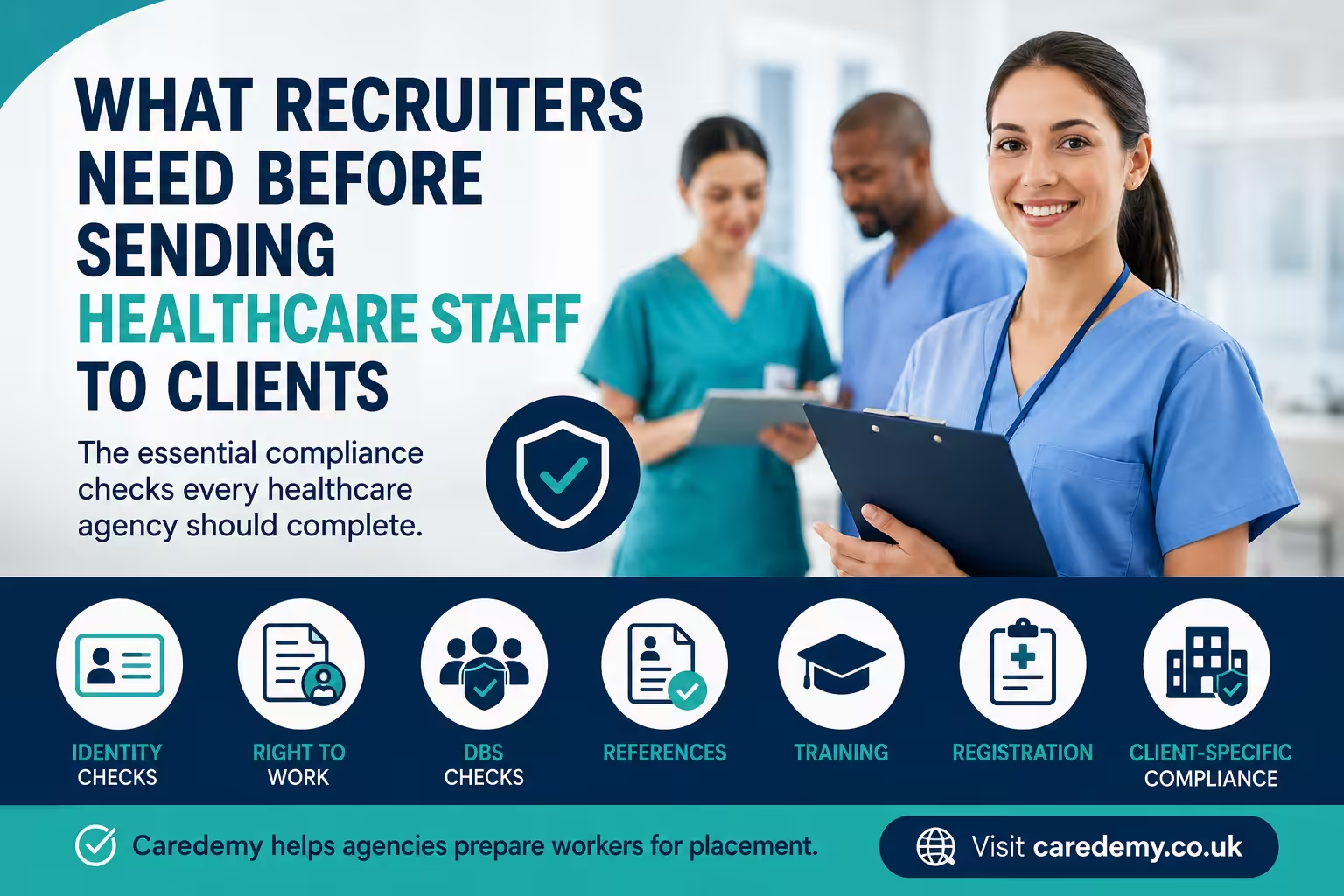
From identity checks and right to work verification to DBS checks, references, training and professional registration, there are several important areas recruiters should consider before placing a worker.
This guide explores the key checks healthcare recruiters should have in place before sending staff to clients.
Important: Compliance requirements can vary depending on the worker’s role, the type of service, the client, the regulator involved and the location of the work. Agencies should always check the specific legal and contractual requirements that apply to each placement. For regulatory standards, consult Care Quality Commission (CQC) guidance.
Why Healthcare Agency Compliance Matters
Healthcare recruitment is different from many other forms of temporary staffing.
A worker may be entering a care home, hospital, supported living service, clinic, nursing home or a person’s own home. They may be working with older people, people with disabilities, children or individuals with complex healthcare needs.
Clients therefore need more than a CV and confirmation that someone is available for a shift. They need assurance that the worker is:
- The person they claim to be
- Legally entitled to work in the UK
- Appropriately checked for the role
- Suitably qualified or registered where required
- Properly referenced
- Trained for the duties they will perform
- Aware of professional and safeguarding responsibilities
- Suitable for the particular client and environment
- Supported by accurate and up-to-date compliance records
A good compliance process should also make it easy for recruiters to demonstrate what checks have been completed and when.
1. Identity Checks
Identity verification should be one of the foundations of the recruitment process.
Before placing a healthcare worker with a client, the agency should establish that the applicant is genuinely who they claim to be and that the identity information held on their recruitment records is accurate.
Depending on the circumstances, this can include checking appropriate identity documents and confirming information such as:
- Full name
- Date of birth
- Current address
- Previous names, where relevant
- Photograph and identifying information
- Supporting documentation required for other checks
Identity checks are particularly important because they underpin several other parts of the compliance process. For example, a DBS application, right to work check and professional registration check all need to relate to the correct individual.
The Nursing and Midwifery Council (NMC) employer guidance recommends checking proof of identity and address as part of background checks for nurses and midwives.
Keep Records Consistently
Recruiters should have a clear process for recording what was checked, when it was checked and who completed the check. A consistent approach makes it much easier to demonstrate compliance during an internal review, client audit or regulatory inspection.
2. Right to Work Checks
A healthcare worker may be highly qualified and experienced, but they still need the appropriate right to work in the UK before they are employed.
The UK Government states that employers must check that a job applicant is allowed to work in the UK before employing them.
Right to work checks can involve:
- Checking original documents where applicable
- Using the Home Office online right to work service
- Checking a worker’s share code where applicable
- Using an approved identity service provider in circumstances where this is permitted
- Carrying out follow-up checks where a worker has a time-limited right to work
The GOV.UK employer’s guide to right to work checks explains the current process and how employers can establish a statutory excuse against a civil penalty.
Don’t Make Assumptions
Recruiters should not assume that someone has the right to work simply because they have worked in the UK previously. Immigration status can change, and some workers may have restrictions on the type of work they can undertake or the amount of work they can do.
Right to work checks should therefore form part of the agency’s formal onboarding and compliance process, applied consistently and without discrimination in line with Home Office standards.
3. DBS Checks
For many healthcare and social care roles, DBS checking is a critical part of safer recruitment. However, the level of DBS check required depends on the role and the activities the worker will carry out.
DBS checks can include:
- Basic checks
- Standard checks
- Enhanced checks
- Enhanced checks with a Children’s Barred List and/or Adults’ Barred List check where eligibility criteria are met
The Disclosure and Barring Service (DBS) eligibility guidance explains that the type of work a person will undertake determines the level of check they may be eligible for. For example, current DBS guidance states that certain healthcare professionals providing healthcare to adults as part of regulated activity may be eligible for an Enhanced DBS check with an Adults’ Barred List check.
Check the Role, Not Just the Job Title
One important point for recruiters is that DBS eligibility is based on the duties and activities involved, rather than simply relying on a job title. A change in responsibilities can affect which level of check is appropriate.
Agencies should maintain clear records of DBS checks and any relevant information required for their compliance process. Where a client has specific requirements around the age or status of a DBS certificate, recruiters should make sure these requirements are understood before a placement is confirmed.
4. References and Employment History
References provide another important layer of assurance. A CV tells you what a candidate says they have done. A reference helps verify their employment history and suitability.
For healthcare workers, references are particularly important because recruiters need confidence that the person has the experience and competence required for the proposed placement.
For nurses and midwives, the NMC advises employers to obtain at least two professional references from the applicant’s last place of work as a nurse or midwife and to follow up references directly. Recruiters should investigate employment gaps and not rely solely on written statements supplied by applicants.
Key Principle: A reference should contribute to the overall recruitment decision. If a previous employer raises concerns about a worker’s conduct, competence or suitability, the agency should have a process for assessing and documenting what happens next when supplying staff to vulnerable people.
5. Training and Competency
Recruitment compliance does not end once a worker has passed their background checks. A healthcare worker also needs the appropriate knowledge and training for their role.
Depending on the worker and placement, training areas may include:
- Safeguarding adults and safeguarding children
- Infection prevention and control
- Moving and handling / Basic life support
- Health and safety, fire safety and food hygiene
- Medication awareness and mental capacity
- Equality, diversity, human rights and person-centred care
- Dementia awareness, communication and confidentiality
The exact training requirements should be based on the worker’s role, responsibilities, previous experience and the requirements of the client. Training completion does not automatically demonstrate practical competence; where a role requires practical assessment or supervised practice, those requirements should be addressed separately.
Streamline Your Agency Training & Compliance
Ensure your healthcare staff are fully prepared for every client placement with Caredemy’s CPD-accredited courses and dedicated learning management system.
Explore Caredemy Team Training Solutions6. Professional Registration
Where a healthcare worker belongs to a regulated profession, recruiters need to verify their professional registration before placing them into a role that requires that registration. This is particularly important for professionals such as nurses, midwives and nursing associates.
Recruiters supplying registered professionals should use official regulatory registers (such as the NMC Register) rather than relying solely on a worker’s own documents or CV.
Registration is an important requirement, but it should not be viewed as the sole evidence of suitability. Recruiters must still evaluate practical experience, references, skills and client alignment.
7. Client-Specific Compliance
One of the areas that can easily be overlooked is client-specific compliance. A healthcare agency may have a robust standard recruitment process, but individual clients can have additional requirements.
A useful approach is to separate your compliance process into two distinct stages:
- Agency Compliance: The baseline checks every worker must meet before being considered for any placements.
- Client Compliance: The additional site-specific training, occupational health clearance, immunisations, or clinical competencies required for a particular client, role or setting.
8. Don’t Forget Ongoing Compliance
Healthcare agency compliance is not a one-time process. Information can change after a worker has been recruited:
- Right to work permissions or visas may expire
- Professional registration status may change
- Mandatory training will require regular renewal
- DBS updates or status monitoring may be necessary
- Contact details, qualifications, or client requirements may evolve
Agencies need an ongoing system for monitoring compliance rather than simply checking documents during initial recruitment.
9. Make Compliance Easy to Evidence
Having completed checks is one thing; being able to demonstrate them quickly during an inspection or client audit is another. A central compliance record makes responding to inquiries seamless.
| Compliance Area | What to Record |
|---|---|
| Identity | Documents checked and verification date |
| Right to Work | Check completed, result and follow-up date where applicable |
| DBS | Level, date and relevant status information |
| References | Referees, dates and outcome |
| Training | Courses completed and renewal dates |
| Registration | Regulatory body and registration status |
| Competency | Relevant assessments or sign-offs |
| Client Requirements | Additional checks completed |
10. A Practical Pre-Placement Approach
Before sending a healthcare worker to a client, recruiters should systematically verify:
- Identity: Has identity been verified and documentation matched with records?
- Right to Work: Has the appropriate right to work check been completed and recorded?
- Vetting: Has the correct DBS check been finalized for the role activities?
- References: Have necessary references been obtained, checked and verified?
- Training: Has the worker completed all training required for their role and the specific placement?
- Registration: Has professional registration been verified through the appropriate regulatory body?
- Client Fit: Have all additional client-specific requirements been fulfilled?
- Audit Trail: Can the agency provide clear, immediate evidence of compliance if requested?
Healthcare Agency Compliance Is About More Than Paperwork
Compliance should not be treated simply as an administrative hurdle between recruitment and placement. It is core to delivering safe, responsible healthcare staffing.
When agencies have effective compliance processes, recruiters can identify problems earlier, reduce delays, respond to client requests more quickly and give clients greater confidence in the workers supplied. It also creates a better, more organized experience for healthcare workers.
How Caredemy Can Support Healthcare Agencies
Training is one of the most important parts of preparing healthcare workers for placement. Caredemy helps agencies prepare workers for safe deployment.
Caredemy provides a comprehensive selection of online CPD-accredited health and social care courses covering safeguarding, first aid, infection prevention, medication, health and safety, and care skills. Agencies can use our training platform to enrol workers, monitor progress and access verifiable certification.
For organizations managing large workforces, Caredemy Team Training provides flexible subscription options and an advanced learner management system to track compliance, reporting, and renewal dates effortlessly.
Ready to Elevate Your Agency Compliance?
Discover professional online courses and flexible training bundles designed specifically for UK health and social care providers.
Explore Caredemy Health & Social Care CoursesFinal Thoughts
Healthcare recruitment agencies carry a profound responsibility to ensure workers are thoroughly prepared before entering client settings. A robust compliance framework brings together identity checks, right to work verification, DBS clearances, references, training, professional registration, and client-specific criteria.
By organizing compliance from day one, recruiters can place staff with absolute confidence, assuring clients that every deployed professional meets the highest standards of safety and care.