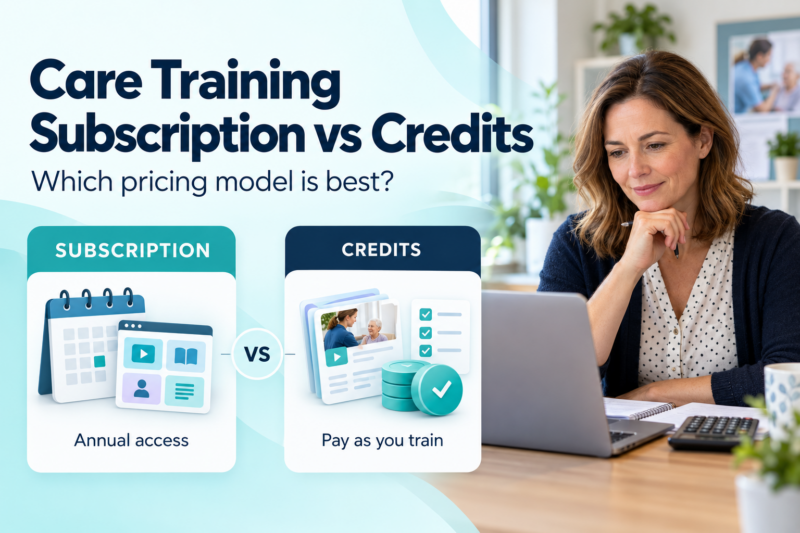
Care Training Subscription vs Credits: Which Pricing Model Is Best?
Choose training that fits your team and budget.
Credits pay for individual course enrolments; subscriptions pay for access over a set period; unlimited training removes per-course charges within an included catalogue. Credits can be economical when staff need a few courses. A subscription can offer better value when employees need substantial induction, refresher and specialist training, particularly where replacement learners are included.
The best option depends on annual course demand, staff turnover, Care Certificate requirements and management features. Compare the complete annual bill for your organisation, rather than the smallest advertised price.
This guide compares published UK provider information checked on 4 October 2026. Calculations are planning examples, not personalised quotations. Training volumes are illustrative: they do not prescribe how many courses every care worker needs.
Understanding care training pricing models
What are training credits?
Training credits are prepaid units you allocate when someone needs training. Typically, one credit buys one course for one employee. Ten employees completing five courses therefore require 50 enrolments, usually 50 standard credits.
Credits offer flexibility: you can purchase a balance before deciding which employees will take which subjects. However, check exactly what consumes a credit. A refresher, repeat enrolment or specialist package may cost extra. The Care Certificate may have separate pricing.
Also distinguish credit expiry from learner access. A credit balance that never expires does not necessarily mean an allocated learner can access a course indefinitely.
What is pay-per-course?
Pay-per-course means purchasing specified courses for specified numbers of learners. You buy the training required now, without purchasing annual library access.
It suits occasional needs, such as updating safeguarding knowledge or adding a subject for a new service. Bulk purchasing can reduce the price substantially. Compare the rate for your actual order quantity, rather than assuming every enrolment costs the single-course price.
What is per-learner pricing?
Per-learner describes the charging unit, rather than the full package. It might mean a course bundle for one person, an annual licence or a monthly subscription.
Ask whether the licence covers a named individual, an active seat or every unique employee trained during the year. These arrangements can produce very different bills when staff leave and replacements join.
What is an unlimited training subscription?
An unlimited subscription provides access to the included course catalogue during the paid term, without charging separately for each standard enrolment.
Unlimited describes course access within the package. It does not automatically include unlimited employees, practical training, regulated qualifications, every specialist course or Care Certificate assessment. Check the catalogue, exclusions, renewal rights and minimum commitment.
What is team training?
Team training combines employee learning with organisational administration. Managers may assign courses, monitor progress, download certificates and maintain a training matrix through a learning management system, or LMS.
It can be purchased through credits, course orders or subscriptions. Team training is therefore a managed service, not a single pricing model. For a growing care organisation, management functionality may matter as much as the course price.
Pricing model comparison
| Model | How it works | Advantages | Disadvantages | Best suited to |
|---|---|---|---|---|
| Training credits | Prepay units and allocate course enrolments later | Flexible allocation; potential bulk savings; unused balance may carry forward | Upfront cash commitment; possible expiry; repeat enrolments and induction packages may consume more credits | Teams with irregular demand or selected subjects |
| Pay-per-course | Buy specific course places | Clear purchase scope; no annual library commitment | More ordering; costs rise with additional learning; quantity discounts vary | Occasional training and small gaps |
| Per-learner package | Pay for each person’s defined bundle or licence | Simple budgeting when coverage is clear | Package may be limited; replacement employees may require another licence | Predictable learning requirements |
| Unlimited subscription | Pay for catalogue access during a term | Predictable course spend; supports broader learning | Unused access still costs money; exclusions and contract terms matter | Regular induction, refreshers and specialist learning |
| Team training | Learning plus central management, under one of the models above | Assignment, tracking and reporting can reduce administration | Compare included features, permissions and support | Organisations managing multiple employees or branches |
Current examples from UK providers
Caredemy
Caredemy offers bulk course purchases, non-expiring credits and subscriptions. Published standard-course order rates include £7.99 for 30–49 enrolments, £6.49 for 50–99, £4.99 for 100–249, £3.99 for 250–499, £2.49 for 500–999 and £1.99 for 1,000–1,999, excluding VAT. Its pricing page lists a separate credit-pack ladder. Source: Caredemy pricing.
The individual all-access product is currently £70 plus VAT per year. Organisational subscription costs should be compared with Team Training pricing rather than multiplying that individual retail price. Source: all-access subscription.
Caredemy’s recently published care-home guide gives Team Training bands of £5 per learner/month for 10–30 learners, £4 for 31–50 and £3 for 51–100, excluding VAT; 101+ requires a quotation. These published bands underpin the calculations below, subject to a current written quote. Source: care-home pricing guide.
eCert Training
eCert advertises annual training as low as £35 per learner. Its pricing page describes Care Professional catalogue access and separately lists Care Certificate credits at £15. The retrieved annual seat-price field displayed £0, so it was not a usable paid tariff. The £35 homepage claim is a starting-price benchmark; confirm eligibility, VAT, turnover rules and the final team quotation. Sources: eCert homepage and pricing.
Care2Learn
Care2Learn publishes £3.99 per standard course and a subscription of £1.99 per learner/month for the first 75 learners, then £1.49 for additional learners up to 300. It states that no VAT is added. The subscription includes its catalogue and Care Certificate; standalone Care Certificate access uses two credits. Discounted credit packs and annual upfront payment are also offered. Source: Care2Learn organisation pricing.
Social Care TV
Social Care TV sells credits, with one credit covering one course for one person once. Its published entry band is £9.49 plus VAT for 1–9 credits, with volume discounts. Credits have no expiry. Its Care Certificate induction pack is separately advertised from £23.80. We do not apply the entry rate to large orders because that would ignore bulk pricing. Source: Social Care TV pricing.
Annual training requirements: 10, 25, 50 and 100 employees
Start with enrolments, not provider prices:
Annual standard enrolments = employees × courses required per employee.
| Employees | 3 courses each | 5 courses each | 10 courses each | 15 courses each |
|---|---|---|---|---|
| 10 | 30 | 50 | 100 | 150 |
| 25 | 75 | 125 | 250 | 375 |
| 50 | 150 | 250 | 500 | 750 |
| 100 | 300 | 500 | 1,000 | 1,500 |
These assume no turnover, growth or additional induction packages. Build the final requirement from your training matrix: care assistants, nurses, kitchen staff and registered managers may have different needs.
For England, CQC Regulation 18 requires training and support appropriate to employees’ duties. It does not establish one identical annual course package for every employee. Other UK nations have their own regulatory arrangements. Source: CQC Regulation 18.
What would those enrolments cost?
Caredemy bulk pay-per-course versus Team Training
The following calculations use the published quantity band for one qualifying standard-course order. They exclude Care Certificate purchases and VAT. Verify eligibility for your selected courses and whether separate purchases qualify for the same discount.
| Employees | 3 courses each | 5 courses each | 10 courses each | 15 courses each | Annual Team Training |
|---|---|---|---|---|---|
| 10 | £239.70 | £324.50 | £499.00 | £748.50 | £600.00 |
| 25 | £486.75 | £623.75 | £997.50 | £1,496.25 | £1,500.00 |
| 50 | £748.50 | £997.50 | £1,245.00 | £1,867.50 | £2,400.00 |
| 100 | £1,197.00 | £1,245.00 | £1,990.00 | £2,985.00 | £3,600.00 |
These are our calculations from the published rates, not provider quotations. For example, 50 employees taking ten courses create 500 enrolments: 500 × £2.49 = £1,245. The subscription calculation is 50 × £4 × 12 = £2,400.
This matters: on standard-course fees alone, the bulk purchase is cheaper in most scenarios here. At ten employees taking 15 courses, the subscription costs less. At 25 employees taking 15 courses, the two options are almost equal before induction and turnover.
A subscription may still justify its cost through included induction, replacement learners, course renewals or additional learning. But those benefits should be calculated, rather than presented as an automatic saving.
Subscription benchmarks across providers
Subscriptions generally produce the same basic licence bill at three, five, ten or 15 included courses per learner. Catalogue coverage still needs checking.
| Employees | Caredemy annual Team Training, before VAT | eCert at advertised £35 starting rate* | Care2Learn standard monthly billing, annualised** |
|---|---|---|---|
| 10 | £600.00 | £350.00 | £238.80 |
| 25 | £1,500.00 | £875.00 | £597.00 |
| 50 | £2,400.00 | £1,750.00 | £1,194.00 |
| 100 | £3,600.00 | £3,500.00 | £2,238.00 |
eCert totals illustrate its headline starting rate; they are not verified quotes at these workforce sizes. VAT treatment must be confirmed.
Care2Learn totals exclude optional discounts. At 100 learners, the calculation uses graduated bands: (75 × £1.99 + 25 × £1.49) × 12. No VAT is added according to its pricing page.
The lowest licence price does not establish the best fit. Compare the exact subjects and levels needed, learner accessibility, reporting and support before selecting a supplier.
Credits: consumption cost versus the cash you must pay
Bulk credit packs introduce a further distinction: the cost of credits used this year can differ from the amount paid upfront.
Caredemy’s 100-credit product costs £494 plus VAT. If your forecast is 75 enrolments and you choose this pack, the cash payment is £494, while 75 credits represent £370.50 at the pack rate. The remaining 25 credits represent £123.50 of prepaid balance, not money saved this year. Source: 100-credit product.
That balance may be useful for future recruits or next year’s training. However, show both figures in a budget: annual cash outlay and value of training consumed. Do not compare a subscription invoice with only the consumed portion of a credit purchase without explaining the difference.
Before buying a larger pack for its lower rate, estimate when you will use the surplus. Check refund terms, eligible courses and whether your organisation expects to remain with the provider.
Include staff turnover in the calculation
Staff turnover means more people can need training than your headline workforce suggests. A 50-person organisation replacing ten employees may train 60 distinct people during the year while maintaining 50 active posts.
For a transparent planning example, assume 20% annual turnover, one replacement per departure, no workforce growth and each replacement needing the same standard-course allocation. This is an illustrative assumption, not a claimed sector average.
| Employees | Replacement starters | Enrolments at 3 courses | At 5 courses | At 10 courses | At 15 courses |
|---|---|---|---|---|---|
| 10 | 2 | 36 | 60 | 120 | 180 |
| 25 | 5 | 90 | 150 | 300 | 450 |
| 50 | 10 | 180 | 300 | 600 | 900 |
| 100 | 20 | 360 | 600 | 1,200 | 1,800 |
This deliberately budgets full allocations for the original workforce and replacements. In practice, some departing employees leave before completing everything; use actual expected enrolments where possible.
At ten courses each, Caredemy’s corresponding one-order standard-course totals become £598.80, £1,197, £1,494 and £3,582 before VAT. These are calculated using the revised quantity bands, not simply adding 20% to every original bill.
Caredemy’s Team Training page lists free learner replacement and Care Certificate inclusion. Under that arrangement, replacing departing employees within an unchanged paid seat count need not increase the basic subscription bill. Confirm how replacements work and how former employees’ records are retained. Source: Team Training.
For comparison, a hypothetical non-transferable £35 annual licence would add £70, £175, £350 or £700 if each replacement required another full licence. This illustrates a contract risk; it is not a claim about eCert’s actual replacement policy.
Care Certificate costs need a separate line
Do not assume one standard credit buys the full Care Certificate package. Providers structure induction differently.
Caredemy’s standalone published prices produce the following totals when buying all places together:
| Care Certificate learners | Price per learner, before VAT | Total before VAT |
|---|---|---|
| 10 | £13.80 | £138.00 |
| 25 | £11.95 | £298.75 |
| 50 | £10.00 | £500.00 |
| 100 | £9.50 | £950.00 |
Source: Caredemy Care Certificate product.
At the 20% turnover assumption, if every replacement needs standalone Caredemy Care Certificate access, additional purchases for two, five, ten and 20 starters cost £30, £75, £138 and £276 respectively before VAT. These use each replacement-order quantity, not the original workforce discount.
eCert lists Care Certificate credits separately at £15. Care2Learn lists standalone access at £7.98, or inclusion within its subscription. Social Care TV advertises its induction pack from £23.80, so obtain the applicable quantity price rather than treating that minimum as universal.
Avoid double-counting overlapping induction topics. If a package already supplies the required knowledge training, do not automatically budget identical courses again.
The Care Certificate now has 16 standards. Employers must assess what workers know and what they do; buying online access does not remove workplace assessment responsibilities. Budget assessor time separately. Source: Skills for Care.
The problem with comparing headline prices
£5 per course, £35 per learner, £10 per credit and an unlimited subscription describe different purchases. Before comparing them, establish:
- Coverage: which subjects, levels and packages are included?
- Charging unit: one enrolment, one individual or one replaceable seat?
- Duration: course access, credit validity and contract length.
- Additional charges: induction, renewals, reporting, support or setup.
- Tax and payment: VAT, annual commitment and upfront cash required.
A subscription billed monthly may still commit you for 12 months. Similarly, an attractive bulk price may require buying more credits than you need.
For the Caredemy examples, £600 before VAT becomes £720 with 20% VAT; £3,600 becomes £4,320. If VAT cannot be recovered, include it in the cost comparison. Confirm your own VAT position and each supplier’s invoice treatment; do not assume every care organisation has identical tax circumstances.
Also compare delivery quality. A cheap catalogue missing a required course creates a second purchase. Poor reporting can leave managers maintaining spreadsheets despite paying for an LMS.
How to calculate your real cost per trained employee
Use this formula:
Real cost per trained employee = total annual training cost ÷ unique employees who completed their required training.
Include course or subscription payments, additional induction, replacement licences, unrecoverable VAT, paid learning time, practical training, assessment and administration. Count people who completed their requirements, not merely accounts created.
For example, suppose an organisation spends £1,200 on online access, £240 on additional induction, £2,400 on paid learning time and £600 on assessment and administration. Total cost is £4,440. If 48 unique employees complete their required training, the real cost is £92.50 each.
Keep this separate from a supplier-only comparison. Both are useful, but mixing them obscures the decision. Track completion rates too: cheaper access offers little value if employees cannot finish the learning they need.
Which pricing model is best for your organisation?
Ten employees
Start with course purchases or credits for three to five subjects each. At 15 courses, the Caredemy example favours Team Training on basic course cost. Turnover and induction can make a subscription relevant sooner.
Twenty-five employees
At low volumes, selective purchases are likely to remain attractive. At 15 courses, Caredemy’s bulk-course and subscription figures are almost identical. Included Care Certificate access and replacements can become decisive.
Fifty or 100 employees
Obtain both a bulk-course quote and a subscription quote. Higher quantities can make selective purchases very competitive. Choose a subscription when its included learning and operational benefits justify the difference, rather than because the workforce is large.
Frequent recruitment or changing needs
Prioritise replacement-seat rules, induction inclusion and course flexibility. For stable teams with predictable, limited requirements, non-expiring credits may provide better control. For mixed roles, ask whether a combination of subscriptions and targeted purchases is available.
Choosing a Caredemy purchasing option
Use pay-per-course for defined immediate requirements; credits when you want prepaid flexibility; and Team Training when catalogue access, induction, replacements and central management suit ongoing needs.
Request a comparison using your staff count, expected courses, replacement starters and Care Certificate learners. Ask for the full annual amount including VAT, the commitment and renewal terms, and the precise included services.
Compare Caredemy pricing or request a Team Training quotation. Call 020 3488 7599 to discuss your requirements.
Frequently asked questions
Are training credits cheaper than subscriptions?
Sometimes. Compare the applicable pack or order rate with the annual subscription, including induction and turnover. Large bulk discounts can change the result.
How many credits do I need?
Multiply employees by their required standard courses, then add replacement-starter enrolments and any separately charged packages. Check the provider’s credit rules.
Do unused credits expire?
Caredemy, Care2Learn and Social Care TV currently advertise non-expiring credits. Allocated learner access and refund terms still need checking.
Does unlimited training include the Care Certificate?
It depends on the package. Caredemy Team Training and Care2Learn advertise inclusion; eCert lists separate Care Certificate credits.
Can I replace an employee who leaves?
Check the contract. Caredemy Team Training advertises free learner replacement. Do not assume every annual learner licence is transferable.
Is monthly billing the same as a monthly contract?
No. Monthly payments can spread an annual commitment. Check cancellation notice, renewal and minimum term before signing.
Does an online training subscription guarantee CQC compliance?
No. Appropriate training supports compliance, but employers also need supervision, assessment, competence and suitable records. Catalogue access alone cannot demonstrate these.