
- Home
- Health & Safety
- Venepuncture and Cannulation Course
Venepuncture and Cannulation Course
£15 + VAT


Written By Allison
- CPD Accredited | Instant Certificate | Mobile Friendly | Bulk Discounts Available
Trusted by care providers, healthcare organisations, businesses and workplace teams
The Venepuncture and Cannulation Course provides healthcare professionals with essential knowledge for performing and supporting safe venous access procedures. It covers venous anatomy, vein and device selection, venepuncture and cannulation procedures, infection prevention, ANTT, haemolysis, needlestick injuries and potential complications. Ideal for clinical staff undertaking induction, refresher training or knowledge development, it supports safer practice, effective risk management and improved patient care.
Venepuncture and Cannulation Course Summary
Course Name: Venepuncture and Cannulation Course
Duration: 1 Hour
Delivery: Online Training Course
Certificate Included: Instant Digital Certificate
Accreditation: CPD Accredited – 1 CPD Point
Suitable For: Nurses, healthcare assistants, phlebotomists, doctors, paramedics and other healthcare professionals involved in venepuncture or peripheral IV cannulation
Assessment: Online Multiple Choice Test
Access: Instant Access
Duration
1 hour
CPD Points
1
Last Updated:
25 Jul 2026
What is Venepuncture and Cannulation training?
Venepuncture and cannulation training develops the knowledge required to safely access a patient’s peripheral veins.
Venepuncture involves puncturing a vein, commonly to obtain a blood sample. Peripheral IV cannulation involves inserting a cannula into a peripheral vein to provide vascular access for appropriate clinical treatment.
This Venepuncture and Cannulation Course covers venous anatomy and physiology, suitable vein and site selection, equipment, skin preparation, order of draw, cannula selection, flushing and aftercare. Learners also explore infection prevention, hand hygiene, Aseptic Non Touch Technique (ANTT), needlestick injuries and complications including infiltration, extravasation and embolism.
Online learning provides the theoretical component of training. Staff performing these procedures should also receive appropriate practical training, supervised practice and competency assessment in accordance with their employer’s procedures and professional scope of practice.
CPD Accredited
User friendly interactive courses
Instant Access
Enrol Now – Start Instantly
Certify Instantly
Certificate Available Immediately
Learn on Any Device
Train on Phone, Tablet or Computer
Money Back Guarantee
14 Day Money Back Guaratnee
How Would You Like to Access This Course?
Flexible options for individuals, staff teams and organisations
1
Instant Online Purchase
From 1 to 100+ learners • Bulk discounts available • Instant online access and certificates included
- Instant Access - No Quote Required
- CPD Accredited Certificates Included
- 100% Online & Mobile Friendly
- Assign Courses to Staff, Friends or Family
- Track Progress and Completions Online
- 14 Day Money Back Guarantee
£15 + VAT
CPD • Certificate included • Start instantly
Quantity
Per Course Price
1+ Courses
£15 + Vat
5+ Courses
£9.40 + Vat
10+ Courses
£8.49 + Vat
30+ Courses
£7.99 + Vat
50+ Courses
£6.49 + Vat
100+ Courses
£4.99 + Vat
2
Need Ongoing Staff Training?
Best value for teams of 8+ learners who need regular mandatory, induction and refresher training.
- Save Money on Staff Training
- Access Our Full 200+ Course Library
- Instant certificates issued
- Track Compliance Across Your Team
- Free Learner Replacements
- Reporting & Certificate Management
- CQC inspection ready
- Lowest price guarantee
- Dedicated Support
Best Price Guarantee • CQC Inspection Ready
When should I choose Caredemy Teams?
Caredemy Teams is ideal for organisations with 8+ learners who need access to multiple courses for mandatory training, induction training, and annual refreshers. Benefit from our best-value pricing, free learner replacements, compliance reporting, and access to our full course library. If you only need a small number of CPD courses, you can buy online instantly.
Access friendly, dedicated expert support whenever you need it, with guidance available throughout your learning journey
All-access individual subscription
Get unlimited access to 200+ CPD-accredited courses. One low monthly price. Learn anytime.
Buy any 5 courses for £47
Mix and max any courses.
CPD accredited - Certificates included.
Who Is This Course For?
The Venepuncture and Cannulation Course is designed for healthcare professionals who perform, assist with or need knowledge of venous access procedures.
It is particularly relevant to nurses, nurse practitioners, healthcare assistants, phlebotomists, junior doctors, medical students, paramedics, emergency medical technicians and other appropriately authorised clinical staff. It may also support professionals moving into phlebotomy or roles where peripheral IV cannulation forms part of their responsibilities.
The course is suitable for staff working in hospitals, GP practices, clinics, community healthcare, urgent and emergency care, outpatient services and other clinical environments.
It can be used for induction, refresher training and continuing professional development. Completion of an online course alone does not establish practical clinical competence; employers should ensure staff are appropriately trained, supervised and assessed before undertaking procedures independently.
Key Benefits
✓ Develop knowledge of safe venepuncture and peripheral IV cannulation
✓ Identify appropriate veins, sites, devices and cannula sizes
✓ Apply infection prevention, hand hygiene and ANTT principles
✓ Recognise complications including infiltration, extravasation and embolism
✓ Understand needlestick injury prevention and appropriate first-aid responses
✓ Support safer, more consistent and patient-centred clinical practice
Course Modules
- Venepuncture and Cannulation – Course Introduction
- What is Venepuncture?
- Influencing Factors During Venepuncture
- Characteristics of a Good Vein
- Veins to Avoid
- Site Selection
- Devices Use in Venepuncture
- Preparing the Skin for Venepuncture
- Hemolysis
- Causes of Hemolysis
- Prevention of Hemolysis
- Before Using an Extinguisher
- Procedure of Venepuncture – Preparation
- Procedure of Venepuncture – Administration
- Tourniquets
- Order of Draw
- Peripheral Cannula and Venepuncture
- Cannula Size,Cannulation Aftercare
- Flushing of Peripheral Venous Cannulae
- Procedure Prior to Cannulation
- During Cannulation
- Needlestick Injuries
- First Aid,Professional Responsibility
- Healthy and Safety at Work Act
- Infection Prevention & Hand Hygiene
- Aseptic Non Touch Technique & Field Management
- Potential Complications
- Extravasation
- Embolism
- Infiltration
- Other Complications
- Key Points
Ready to start?
Learning Outcomes
| Learner Outcome | Covered |
|---|---|
| Explain the purpose of venepuncture and peripheral IV cannulation | ✓ |
| Identify relevant venous anatomy and physiology | ✓ |
| Identify characteristics of suitable veins and veins that should be avoided | ✓ |
| Explain factors influencing venepuncture and site selection | ✓ |
| Identify equipment and devices used during venepuncture | ✓ |
| Explain appropriate skin preparation and infection prevention measures | ✓ |
| Identify common causes of haemolysis and measures that reduce the risk | ✓ |
| Describe the preparation and procedure for venepuncture | ✓ |
| Explain the appropriate use of tourniquets and order of draw | ✓ |
| Identify factors affecting peripheral cannula size and selection | ✓ |
| Explain cannulation preparation, aftercare and flushing principles | ✓ |
| Apply knowledge of hand hygiene and Aseptic Non Touch Technique principles | ✓ |
| Explain how needlestick injuries should be prevented and managed | ✓ |
| Recognise infiltration, extravasation, embolism and other potential complications | ✓ |
| Explain professional responsibilities associated with safe venous access procedures | ✓ |
Training 8+ Staff Across Multiple Courses?
Purchasing multiple licences for this training course? Simply adjust the quantity and buy online today.
If you need ongoing training for 10+ employees across multiple subjects, our Team Training platform provides access to 200+ CPD accredited courses, compliance reporting, learner management and bulk enrolment tools.
- Access 200+ CPD Accredited Courses
- Manage All Learners In One Place
- Compliance & Audit Reporting
- Bulk Enrolment & Certificate Tracking
- Dedicated Account Support
Team Training Solutions
Ideal for care providers, healthcare organisations and workplace teams training multiple employees.
Why Choose Caredemy?
- Instant Certificate
- CPD-accredited courses
- Money Back Guarantee
- Expert-designed training
- 120,000 learners trained
- Flexible online learning
- Compliance-focused
- Dedicated support
What Our Learners Say?
“Clear, practical refresher that covered both venepuncture and cannulation procedures without overcomplicating the subject.”
Sarah M
Staff Nurse
“The sections on vein selection, ANTT and complications were particularly useful for refreshing my clinical knowledge.”
Daniel R
Healthcare Assistant
“Well structured and easy to follow. The needlestick injury and infection prevention sections were very relevant.”
Priya K
Practice Nurse
4.92/5 from 650+ learners
Why Is Venepuncture and Cannulation training important?
Venepuncture and peripheral IV cannulation are invasive clinical procedures that can expose patients and healthcare workers to avoidable risks when performed incorrectly.
Appropriate training helps practitioners select suitable veins and equipment, prepare patients and insertion sites correctly, follow aseptic principles and recognise complications promptly. Safe practice is particularly important for reducing infection risks, needlestick injuries, haemolysis, infiltration and extravasation.
NICE recommends that healthcare workers caring for patients with vascular access devices are trained and assessed as competent in relevant infection prevention practices. Safe insertion and maintenance procedures help minimise vascular-access-related infection.
Training also supports professional accountability and consistent workplace procedures. Online theory should form part of a wider competency process where the learner’s role requires them to perform venepuncture or cannulation.
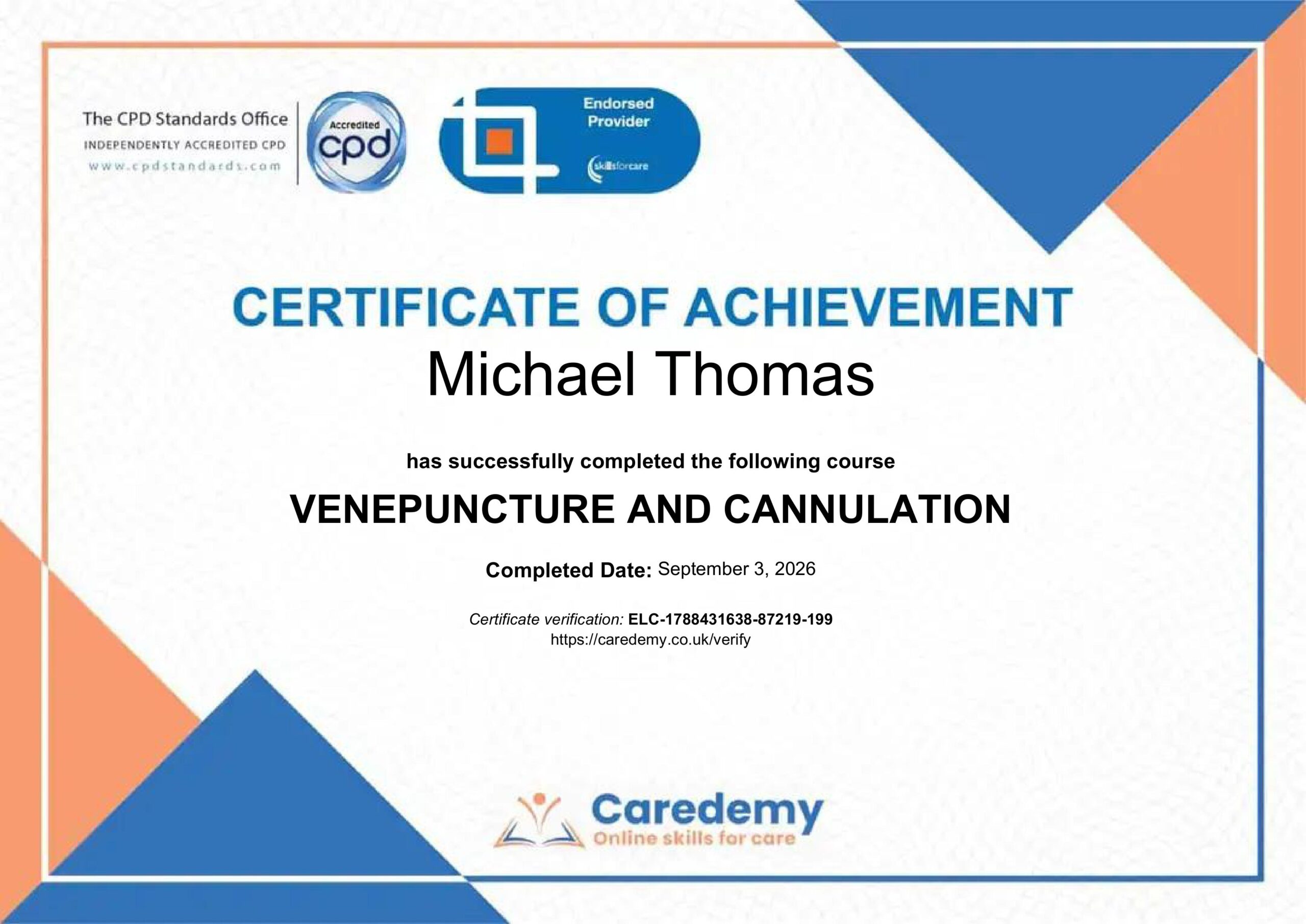
Instant Course Certificate
Is Venepuncture and Cannulation training a legal requirement in the UK?
There is no single UK law stating that every healthcare professional must complete a course specifically titled “Venepuncture and Cannulation Training”. However, employers have legal responsibilities to manage workplace risks and ensure staff can work safely.
The Health and Safety at Work etc. Act 1974 establishes general duties concerning employee and public health and safety. The Health and Safety (Sharp Instruments in Healthcare) Regulations 2013 place specific duties on healthcare employers concerning sharps risks, including safe use and disposal, training and procedures following sharps injuries.
NICE guidance also states that healthcare workers caring for people with vascular access devices should be trained and assessed as competent in relevant infection prevention practices.
In practice, organisations should provide role-appropriate theoretical and practical training, competency assessment, supervision and local procedures before staff perform venepuncture or cannulation independently.
Trusted by 120,000+ learners
Trusted by care providers, healthcare organisations, businesses and workplace teams across the UK for high-quality online training
Office & Commercial
Health & Social Care
Industrial, Warehousing & Facilities
Hospitality, Retail & Public Services
Venepuncture and Cannulation training FAQ?
What is venepuncture and cannulation training?
Venepuncture and cannulation training teaches healthcare professionals the principles of safely accessing peripheral veins. This course covers vein assessment, site and device selection, venepuncture procedures, peripheral IV cannulation, infection prevention, ANTT, haemolysis, needlestick injuries and potential complications. Practical competency should additionally be assessed where learners will perform these procedures clinically.
Who needs venepuncture and cannulation training?
Training is relevant to healthcare professionals whose roles involve venepuncture, blood collection, peripheral IV cannulation or supporting venous access procedures. This may include nurses, healthcare assistants, phlebotomists, doctors, paramedics and other appropriately authorised clinical staff. Employers should determine training requirements according to the employee’s role, responsibilities, local policies and required level of competency.
Is venepuncture and cannulation training a legal requirement?
There is no single UK law requiring everyone undertaking these procedures to hold a qualification with this exact title. However, employers have health and safety responsibilities, including managing risks associated with sharps. Relevant requirements include the Health and Safety at Work etc. Act 1974 and Health and Safety (Sharp Instruments in Healthcare) Regulations 2013.
How long does the Venepuncture and Cannulation Course take?
The Caredemy Venepuncture and Cannulation Course takes approximately one hour to complete and provides one CPD point. It is delivered online, allowing learners to work through the training remotely. Following successful completion of the end-of-course assessment, learners can access their digital CPD-accredited certificate.
Can you learn venepuncture and cannulation completely online?
Online training can provide the underpinning theoretical knowledge needed for venepuncture and cannulation, but completing an online course does not by itself demonstrate practical clinical competence. Where staff will perform these invasive procedures, employers should provide appropriate practical instruction, supervised practice and competency assessment before authorising independent practice.
How often should venepuncture and cannulation training be refreshed?
There is no universal UK statutory renewal period applying to every role and healthcare setting. Refresher training should be determined by employer policy, professional requirements, competency assessment, frequency of performing the procedure and changes to clinical guidance or equipment. Additional training may also be appropriate following an incident, identified competency gap or extended period without performing the procedure.
What complications can occur during venepuncture and cannulation?
Potential complications include bruising, bleeding, infection, infiltration, extravasation and other problems associated with vascular access. Needlestick injuries can also expose healthcare workers to blood-borne infection risks. Training helps staff recognise risk factors, use safer working practices and identify complications so that appropriate action can be taken according to local clinical procedures.
What infection prevention measures are important during cannulation?
Hand hygiene, appropriate skin preparation and aseptic technique are central to reducing infection risk. NICE recommends hand decontamination before accessing or dressing vascular access devices and the use of aseptic technique for site care and accessing the system. Safe insertion, maintenance, dressing and timely removal of vascular access devices also contribute to infection prevention.
Need Training for Multiple Employees?
Train your entire workforce through Caredemy Teams with bulk enrolment, compliance reporting and access to 200+ CPD courses.
- CPD-accredited certificate
- Instant Certificate
- Learn of Any Device
- Money-back Guarantee
Related Courses You May Like
UK Regulations And Guidance
£15 + Vat
Venepuncture and Cannulation Course
- CPD Accredited
- Instant Certificate
- Instant Access
- Bulk Discounts Available