- Home
- Health & Safety
- Mental Wellbeing In Children And Young Adults Course
Mental Wellbeing In Children And Young Adults Course
£15 + VAT


Written By Allison
- CPD Accredited | Instant Certificate | Mobile Friendly | Bulk Discounts Available
Trusted by care providers, healthcare organisations, businesses and workplace teams
The Mental Wellbeing in Children and Young Adults course explores emotional development, mental health difficulties, safeguarding, risk factors and appropriate support pathways. Learners examine how abuse, disability, care experiences and life events can affect wellbeing.
Designed for education, healthcare and social care professionals, this training develops the knowledge needed to recognise concerns, respond appropriately, maintain confidentiality and refer children and young people for additional support.
Mental Wellbeing In Children And Young Adults Course Summary
Course Name: Mental Wellbeing in Children and Young Adults
Duration: 1 Hour
Delivery: Online Training Course
Certificate Included: Instant Digital Certificate
Accreditation: CPD Accredited
Suitable For: Teachers, teaching assistants, safeguarding leads, healthcare professionals, social workers, youth workers, early years practitioners, residential childcare staff, foster carers and anyone supporting children and young people.
Assessment: Online Multiple Choice Test
Access: Instant Access – 12 Months
Duration
1 hour
CPD Points
1
Last Updated:
11 May 2026
What is Mental Wellbeing In Children And Young Adults training?
Mental Wellbeing in Children and Young Adults training provides essential knowledge for recognising and responding to mental health and emotional wellbeing concerns in babies, children, adolescents and young adults.
The course examines common signs of psychological distress, contributing risk factors and the impact of adverse experiences, including abuse, neglect, social isolation and living in care.
Learners explore how mental health needs may differ among disabled children, young carers, care leavers and children from diverse backgrounds.
Training also covers safeguarding responsibilities, confidentiality, consent, Gillick competence, Fraser guidelines and appropriate referral pathways.
For example, a teaching assistant who notices persistent withdrawal or changes in behaviour will learn how to recognise potential concerns, record observations and follow the school’s safeguarding procedures.
This awareness-level course supports professional responsibilities but does not qualify learners to diagnose mental health conditions or provide clinical treatment.
CPD Accredited
User friendly interactive courses
Instant Access
Enrol Now – Start Instantly
Certify Instantly
Certificate Available Immediately
Learn on Any Device
Train on Phone, Tablet or Computer
Money Back Guarantee
14 Day Money Back Guaratnee
How Would You Like to Access This Course?
Flexible options for individuals, staff teams and organisations
1
Instant Online Purchase
From 1 to 100+ learners • Bulk discounts available • Instant online access and certificates included
- Instant Access - No Quote Required
- CPD Accredited Certificates Included
- 100% Online & Mobile Friendly
- Assign Courses to Staff, Friends or Family
- Track Progress and Completions Online
- 14 Day Money Back Guarantee
£15 + VAT
CPD • Certificate included • Start instantly
Quantity
Per Course Price
1+ Courses
£15 + Vat
5+ Courses
£9.40 + Vat
10+ Courses
£8.49 + Vat
30+ Courses
£7.99 + Vat
50+ Courses
£6.49 + Vat
100+ Courses
£4.99 + Vat
2
Need Ongoing Staff Training?
Best value for teams of 8+ learners who need regular mandatory, induction and refresher training.
- Save Money on Staff Training
- Access Our Full 200+ Course Library
- Instant certificates issued
- Track Compliance Across Your Team
- Free Learner Replacements
- Reporting & Certificate Management
- CQC inspection ready
- Lowest price guarantee
- Dedicated Support
Best Price Guarantee • CQC Inspection Ready
When should I choose Caredemy Teams?
Caredemy Teams is ideal for organisations with 8+ learners who need access to multiple courses for mandatory training, induction training, and annual refreshers. Benefit from our best-value pricing, free learner replacements, compliance reporting, and access to our full course library. If you only need a small number of CPD courses, you can buy online instantly.
Access friendly, dedicated expert support whenever you need it, with guidance available throughout your learning journey
All-access individual subscription
Get unlimited access to 200+ CPD-accredited courses. One low monthly price. Learn anytime.
Buy any 5 courses for £47
Mix and max any courses.
CPD accredited - Certificates included.
Who Is This Course For?
This course is suitable for professionals and carers who work with children, adolescents and young adults across education, healthcare, social care and community services.
It is particularly relevant to teachers, teaching assistants, school leaders, designated safeguarding leads, SENCOs, pastoral support staff, school counsellors and early years practitioners.
Healthcare professionals, including school nurses, health visitors, healthcare assistants, GPs, paediatric staff and Child and Adolescent Mental Health Services (CAMHS) workers, can use the training to reinforce their awareness of mental wellbeing and safeguarding.
The course also supports social workers, family support workers, residential childcare staff, foster carers, youth workers, mentors, children’s support workers and professionals supporting care leavers.
Parents, guardians, volunteers and students preparing for careers in childcare, education, nursing or social work may also benefit.
No previous mental health qualification is required. The course is suitable for induction, introductory awareness and refresher training.
Key Benefits
✓ Recognise early warning signs of mental health difficulties in children and young people.
✓ Identify how abuse, neglect, disability and adverse life events affect emotional wellbeing.
✓ Respond appropriately to concerns while maintaining professional safeguarding boundaries.
✓ Apply principles of confidentiality, consent and Gillick competence within professional practice.
✓ Identify appropriate mental health support services, referral pathways and safeguarding procedures.
✓ Support inclusive, child-centred approaches to emotional wellbeing in education, healthcare and social care settings.
Course Modules
- Mental Wellbeing In Children And Young Adults – Course Introduction
- Infant, Child and Adolescent Mental Health
- Supporting Children with Mental Health Difficulties
- Understanding Mental Health
- Abuse and Neglect
- Deaf Children and Children with Disabilities
- Children from Black, Asian and Minoritised Ethnic Communities
- LGBTQ+ Children and Young People
- Children Living in Care
- Types of Care Arrangements
- The Impact of Being in Care
- Returning Home from Care
- Supporting Care Leavers
- Young Carers
- Life Events and Social Isolation
- Recognising Signs of Concern
- Responding to Mental Health ConcernsResponding to Mental Health Concerns
- Safeguarding and Child Protection
- Confidentiality and Information Sharing
- Sources of Support
- Consent and Decision-Making
- Gillick Competence and Fraser Guidelines
- Applying Gillick Competence and the Fraser Guidelines
- Gillick Competence
- Fraser Guidelines
- Key Legislation
- Guidance for Early Years Settings
- Guidance for Schools and Colleges
Ready to start?
Learning Outcomes
Learner Outcome | Covered |
|---|---|
Identify common signs of mental health difficulties in children and adolescents | ✓ |
Explain how mental health concerns may affect emotional, social and behavioural development | ✓ |
Recognise the impact of abuse, neglect and adverse childhood experiences on mental wellbeing | ✓ |
Identify additional considerations when supporting disabled children and children from diverse backgrounds | ✓ |
Explain how living in care, leaving care and caring responsibilities can affect mental wellbeing | ✓ |
Recognise how significant life events and social isolation can contribute to emotional distress | ✓ |
Identify behavioural and emotional changes that may indicate a need for additional support | ✓ |
Describe appropriate professional responses when a child discloses mental health concerns | ✓ |
Explain safeguarding responsibilities when mental health concerns indicate possible abuse or neglect | ✓ |
Apply confidentiality and information-sharing principles to safeguarding situations | ✓ |
Identify appropriate support services and referral pathways for children and young people | ✓ |
Explain how Gillick competence influences consent and decision-making | ✓ |
Distinguish Gillick competence from the specific application of Fraser guidelines | ✓ |
Identify relevant legislation and guidance for children’s mental health and safeguarding | ✓ |
Describe how early years settings, schools and colleges can promote positive mental wellbeing | ✓ |
Training 8+ Staff Across Multiple Courses?
Purchasing multiple licences for this training course? Simply adjust the quantity and buy online today.
If you need ongoing training for 10+ employees across multiple subjects, our Team Training platform provides access to 200+ CPD accredited courses, compliance reporting, learner management and bulk enrolment tools.
- Access 200+ CPD Accredited Courses
- Manage All Learners In One Place
- Compliance & Audit Reporting
- Bulk Enrolment & Certificate Tracking
- Dedicated Account Support
Team Training Solutions
Ideal for care providers, healthcare organisations and workplace teams training multiple employees.
Why Choose Caredemy?
- Instant Certificate
- CPD-accredited courses
- Money Back Guarantee
- Expert-designed training
- 120,000 learners trained
- Flexible online learning
- Compliance-focused
- Dedicated support
What Our Learners Say?
“Helped me recognise behavioural changes and understand when concerns should be referred to our safeguarding lead.”
Sarah Mitchell
Teaching Assistant
“Clear explanations of confidentiality, consent and safeguarding responsibilities. Particularly useful for supporting vulnerable young people.”
Daniel Foster
Residential Childcare Worker
“The sections on care leavers and young carers gave me useful guidance for everyday support.”
Rebecca Turner
Family Support Worker
0/5 from 0+ learners
Why Is Mental Wellbeing In Children And Young Adults training important?
Children and young people experiencing mental health difficulties may show changes in behaviour, attendance, relationships or emotional regulation. Recognising these signs early can help professionals identify when additional support is needed.
Mental health concerns can also overlap with safeguarding risks, including abuse, neglect, exploitation and self-harm.
Mental Wellbeing in Children and Young Adults training helps staff distinguish between their awareness and safeguarding responsibilities and situations requiring specialist mental health assessment.
For example, a residential childcare worker supporting a young person experiencing withdrawal and emotional distress needs to know how to respond sensitively, document concerns and involve appropriate professionals.
The training supports consistent communication, early intervention, appropriate referrals and safer information sharing.
It also helps organisations demonstrate that staff have received relevant awareness training as part of their wider safeguarding and wellbeing arrangements.
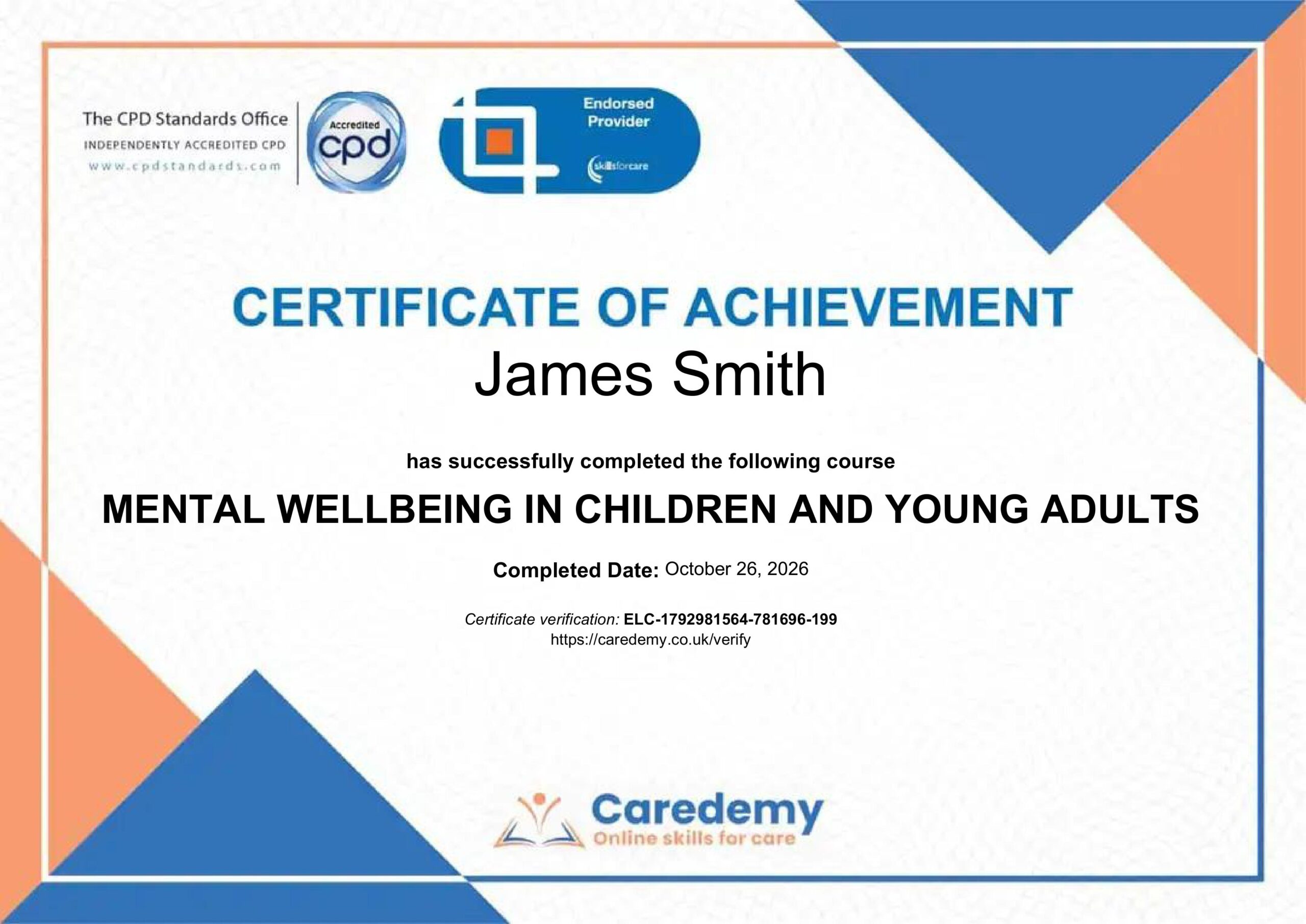
Instant Course Certificate
Is Mental Wellbeing In Children And Young Adults training a legal requirement in the UK?
There is no general UK law requiring every professional working with children to complete a course with this specific title.
However, employers have safeguarding and welfare responsibilities under legislation and applicable statutory guidance.
In England, the Children Act 1989 establishes important duties concerning children’s welfare and protection. The Children Act 2004 provides a framework for cooperation and safeguarding arrangements.
Schools and colleges must follow the relevant statutory safeguarding requirements, including Keeping Children Safe in Education 2026, which addresses mental health concerns and their potential links to safeguarding.
Employers should provide appropriate training for staff responsibilities, ensure clear referral procedures and maintain suitable safeguarding records.
This course can contribute to staff development and safeguarding awareness but does not replace role-specific safeguarding training, professional qualifications or specialist clinical competence. Requirements differ across UK nations.
Trusted by 120,000+ learners
Trusted by care providers, healthcare organisations, businesses and workplace teams across the UK for high-quality online training
Office & Commercial
Health & Social Care
Industrial, Warehousing & Facilities
Hospitality, Retail & Public Services
Mental Wellbeing In Children And Young Adults training FAQ?
What is Mental Wellbeing in Children and Young Adults training?
Mental Wellbeing in Children and Young Adults training is an online awareness course that helps learners recognise emotional and mental health concerns affecting babies, children, adolescents and young adults.
It covers warning signs, risk factors, safeguarding responsibilities, confidentiality, consent and referral pathways. The course is designed for professionals and carers who support children’s wellbeing in education, healthcare, social care and community settings.
Who needs Mental Wellbeing in Children and Young Adults training?
This training is suitable for teachers, teaching assistants, safeguarding leads, early years practitioners, healthcare professionals, social workers, residential childcare staff, youth workers and foster carers.
It is particularly useful for anyone who may notice changes in a child’s behaviour, emotional wellbeing or relationships.
Parents, volunteers and students can also complete the course to develop their knowledge of children’s mental health and appropriate support.
Is Mental Wellbeing in Children and Young Adults training a legal requirement?
There is no specific UK legal requirement for all childcare, healthcare or education professionals to complete a course with this title.
However, employers must meet applicable safeguarding and welfare duties. In England, schools and colleges must follow Keeping Children Safe in Education 2026.
Relevant mental wellbeing training helps employees recognise concerns, follow safeguarding procedures and understand when to seek specialist support.
How long does the Mental Wellbeing in Children and Young Adults course take?
The Caredemy Mental Wellbeing in Children and Young Adults course takes approximately one hour to complete.
Training is delivered entirely online, allowing learners to study using a compatible computer, tablet or smartphone.
Once the course content has been completed, learners take an online multiple-choice assessment. Successful completion provides access to an instant downloadable CPD-accredited digital certificate.
What are the warning signs of mental health difficulties in children and young people?
Possible warning signs include persistent sadness, withdrawal, anxiety, changes in sleep or appetite, difficulties concentrating, unexplained behavioural changes, self-harm or declining school attendance.
Signs vary depending on age, developmental stage and individual circumstances.
Professionals should avoid making assumptions or attempting to diagnose a condition. Concerns should be recorded, discussed through appropriate safeguarding or wellbeing procedures and referred for specialist assessment when necessary.
What should I do if a child tells me they are experiencing mental health difficulties?
Listen calmly, take the child seriously and allow them to explain their concerns without judgement. Avoid promising absolute confidentiality or attempting to diagnose their condition.
Explain what information may need to be shared to keep them safe.
Follow your organisation’s safeguarding and mental health procedures, record relevant information and involve the appropriate professional. Where there is an immediate risk of serious harm, seek urgent assistance.
What is Gillick competence, and why is it important for children's mental health?
Gillick competence concerns whether a child under 16 has sufficient maturity and understanding to make a particular decision about their care or treatment.
It is relevant when professionals consider a child’s ability to consent to healthcare, including mental health support.
Fraser guidelines are a related, more specific framework concerning contraceptive advice and treatment. Neither removes safeguarding responsibilities. Consent decisions must follow applicable law, professional guidance and the child’s circumstances.
How often should Mental Wellbeing in Children and Young Adults training be refreshed?
There is no universal statutory refresher interval for this specific course.
Employers should determine suitable refresher arrangements based on staff responsibilities, safeguarding policies, professional requirements and changes in guidance.
Refresher training may be appropriate when staff take on new responsibilities, procedures change or additional training needs are identified.
Organisations should also ensure employees receive updates on safeguarding concerns and referral procedures between formal training sessions.
Need Training for Multiple Employees?
Train your entire workforce through Caredemy Teams with bulk enrolment, compliance reporting and access to 200+ CPD courses.
- CPD-accredited certificate
- Instant Certificate
- Learn of Any Device
- Money-back Guarantee
Related Courses You May Like


UK Regulations And Guidance
£15 + Vat
Mental Wellbeing In Children And Young Adults Course
- CPD Accredited
- Instant Certificate
- Instant Access
- Bulk Discounts Available