
- Home
- Health & Safety
- Ionising Radiation (Medical Exposure) Regulations Course
Ionising Radiation (Medical Exposure) Regulations Course
£15 + VAT


Written By Allison
- CPD Accredited | Instant Certificate | Mobile Friendly | Bulk Discounts Available
Trusted by care providers, healthcare organisations, businesses and workplace teams
This online Ionising Radiation (Medical Exposure) Regulations Course explains how ionising radiation is used in healthcare and how IR(ME)R supports patient safety. Learners explore radiation risks, medical imaging, safe doses, accidental and unintended exposures, incident investigation, notification requirements and regulatory inspections. It is suitable for healthcare professionals who need practical knowledge of IR(ME)R responsibilities and radiation safety within their role.
Ionising Radiation (Medical Exposure) Regulations Course Summary
Course Name: Ionising Radiation (Medical Exposure) Regulations Course
Duration: 1 Hour
Delivery: Online Training Course
Certificate Included: Instant Digital Certificate
Suitable For: Radiographers, radiologists, oncologists, nurses, medical physicists and healthcare professionals working with medical ionising radiation
Assessment: Online Multiple Choice Test
Access: Instant Access
Duration
1 hour
CPD Points
1
Last Updated:
30 Sep 2025
What is Ionising Radiation (Medical Exposure) Regulations training?
Ionising Radiation (Medical Exposure) Regulations training introduces the legal and practical framework governing medical exposures to ionising radiation.
The course explains how radiation is used in X-rays, nuclear medicine, interventional procedures and radiotherapy, alongside the potential benefits and risks of exposure. Learners examine the Ionising Radiation (Medical Exposure) Regulations 2017 (IR(ME)R), including safe dosage, accidental and unintended exposures, investigation, record keeping, notification and regulatory enforcement.
IR(ME)R establishes responsibilities for employers and defined duty holders, including referrers, practitioners and operators. Its central principles include justification of individual medical exposures and optimisation so that doses are kept as low as reasonably practicable for their intended purpose.
This training helps learners recognise how these requirements influence everyday clinical practice and patient safety.
CPD Accredited
User friendly interactive courses
Instant Access
Enrol Now – Start Instantly
Certify Instantly
Certificate Available Immediately
Learn on Any Device
Train on Phone, Tablet or Computer
Money Back Guarantee
14 Day Money Back Guaratnee
How Would You Like to Access This Course?
Flexible options for individuals, staff teams and organisations
1
Instant Online Purchase
From 1 to 100+ learners • Bulk discounts available • Instant online access and certificates included
- Instant Access - No Quote Required
- CPD Accredited Certificates Included
- 100% Online & Mobile Friendly
- Assign Courses to Staff, Friends or Family
- Track Progress and Completions Online
- 14 Day Money Back Guarantee
£15 + VAT
CPD • Certificate included • Start instantly
Quantity
Per Course Price
1+ Courses
£15 + Vat
5+ Courses
£9.40 + Vat
10+ Courses
£8.49 + Vat
30+ Courses
£7.99 + Vat
50+ Courses
£6.49 + Vat
100+ Courses
£4.99 + Vat
2
Need Ongoing Staff Training?
Best value for teams of 8+ learners who need regular mandatory, induction and refresher training.
- Save Money on Staff Training
- Access Our Full 200+ Course Library
- Instant certificates issued
- Track Compliance Across Your Team
- Free Learner Replacements
- Reporting & Certificate Management
- CQC inspection ready
- Lowest price guarantee
- Dedicated Support
Best Price Guarantee • CQC Inspection Ready
When should I choose Caredemy Teams?
Caredemy Teams is ideal for organisations with 8+ learners who need access to multiple courses for mandatory training, induction training, and annual refreshers. Benefit from our best-value pricing, free learner replacements, compliance reporting, and access to our full course library. If you only need a small number of CPD courses, you can buy online instantly.
Access friendly, dedicated expert support whenever you need it, with guidance available throughout your learning journey
All-access individual subscription
Get unlimited access to 200+ CPD-accredited courses. One low monthly price. Learn anytime.
Buy any 5 courses for £47
Mix and max any courses.
CPD accredited - Certificates included.
Who Is This Course For?
The Ionising Radiation (Medical Exposure) Regulations Course is designed for people working in healthcare environments where ionising radiation is used for diagnosis, treatment or research.
It is particularly relevant to radiographers, radiologists, oncologists, medical physicists, nurses working in radiology or oncology, and other clinical professionals involved in medical exposures. It may also provide useful knowledge for managers, governance teams and healthcare staff whose responsibilities involve radiation safety, incident management or regulatory compliance.
The course can support induction, refresher training, awareness and knowledge development. Where an individual acts as an IR(ME)R practitioner or operator, employers must ensure that they meet the specific training requirements applicable to the functions they undertake. Completion of an introductory online course alone does not establish clinical competence.
Key Benefits
✓ Recognise common medical uses and risks of ionising radiation
✓ Understand how IR(ME)R protects patients undergoing medical exposures
✓ Identify significant accidental or unintended exposure reporting requirements
✓ Understand investigation, notification and record-keeping processes
✓ Recognise the importance of justification, optimisation and safe radiation doses
✓ Support safer clinical practice and stronger regulatory compliance
Course Modules
- Course Introduction – Ionising Radiation (Medical Exposure) Regulations
- Ionising Radiation in Healthcare
- Medical Imaging
- Benefits and Risk Assessment
- X-rays
- Nuclear Medicine
- Radiation Risks
- Safe Dosage
- Exposure to Ionising Radiation
- Ionising Radiation (Medical Exposure) Regulations (IR(ME)R)
- Reporting an Exposure
- Significant Accidental or Unintended Exposures (SAUE)
- Clinically Significant Accidental or Unintended Exposures (CSAUE)
- Incidents Not Requiring SAUE Notification
- IR(ME)R Licensing Breaches
- Making an IR(ME)R Notification
- How the CQC Processes Statutory Notifications
- When to Investigate and Notify the Enforcing Authority
- Local Investigation of Non-SAUE Incidents
- Maintaining Investigation Records
- Assessing the Dose
- Complementary Notification Codes
- Interventional Radiology and Cardiology
- Radiotherapy Treatment Verification Imaging
- Notifiable Incidents
- Foetal Exposure
- Other Errors and Exposures
- Public or Occupational Exposures
- IR(ME)R Inspections
- Themed Inspection Programmes
- Inspection Outcomes
- Enforcing IR(ME)R
- IR(ME)R Reports and Information
Ready to start?
Learning Outcomes
| Learner Outcome | Covered |
|---|---|
| Identify medical imaging procedures that use ionising radiation | ✓ |
| Explain the principal risks associated with exposure to ionising radiation | ✓ |
| Recognise the purpose and scope of IR(ME)R | ✓ |
| Explain the importance of benefit-risk assessment for medical exposures | ✓ |
| Recognise principles relating to safe and optimised radiation doses | ✓ |
| Distinguish significant accidental or unintended exposures from other incidents | ✓ |
| Identify circumstances in which an IR(ME)R notification may be required | ✓ |
| Explain how accidental or unintended exposures should be investigated | ✓ |
| Recognise requirements for maintaining investigation records | ✓ |
| Explain the purpose of assessing intended and unintended patient dose following an incident | ✓ |
| Recognise radiation risks associated with foetal exposure | ✓ |
| Identify relevant considerations for interventional radiology, cardiology and radiotherapy imaging | ✓ |
| Explain the purpose of IR(ME)R inspections and regulatory enforcement | ✓ |
| Recognise the importance of learning from IR(ME)R incidents and inspection findings | ✓ |
Training 8+ Staff Across Multiple Courses?
Purchasing multiple licences for this training course? Simply adjust the quantity and buy online today.
If you need ongoing training for 10+ employees across multiple subjects, our Team Training platform provides access to 200+ CPD accredited courses, compliance reporting, learner management and bulk enrolment tools.
- Access 200+ CPD Accredited Courses
- Manage All Learners In One Place
- Compliance & Audit Reporting
- Bulk Enrolment & Certificate Tracking
- Dedicated Account Support
Team Training Solutions
Ideal for care providers, healthcare organisations and workplace teams training multiple employees.
Why Choose Caredemy?
- Instant Certificate
- CPD-accredited courses
- Money Back Guarantee
- Expert-designed training
- 120,000 learners trained
- Flexible online learning
- Compliance-focused
- Dedicated support
What Our Learners Say?
“Clear explanation of IR(ME)R and reporting requirements. Very useful as a refresher alongside departmental training.”
Sarah Mitchell
Diagnostic Radiographer
“The sections on accidental exposures and investigation made the regulations much easier to understand in practice.”
James Patel
Radiology Nurse
“Concise, relevant and particularly useful for understanding notification, dose assessment and regulatory responsibilities.”
Helen Morris
Imaging Services Manager
5.00/5 from 1+ learners
Why Is Ionising Radiation (Medical Exposure) Regulations training important?
Medical ionising radiation provides significant diagnostic and therapeutic benefits, but unnecessary, incorrect or excessive exposure can cause avoidable harm. IR(ME)R provides a legal framework designed specifically to protect people undergoing medical exposures.
Effective training helps healthcare professionals understand why exposures must be appropriately justified and optimised and why robust procedures are required to prevent accidental or unintended exposures.
It also supports staff in recognising incidents, escalating concerns and understanding when investigation, documentation or statutory notification may be required.
For healthcare organisations, appropriate IR(ME)R training contributes to patient safety, professional competence, effective clinical governance and regulatory compliance. It also supports learning from incidents and inspection findings, helping organisations identify weaknesses and reduce the likelihood of similar events occurring again.
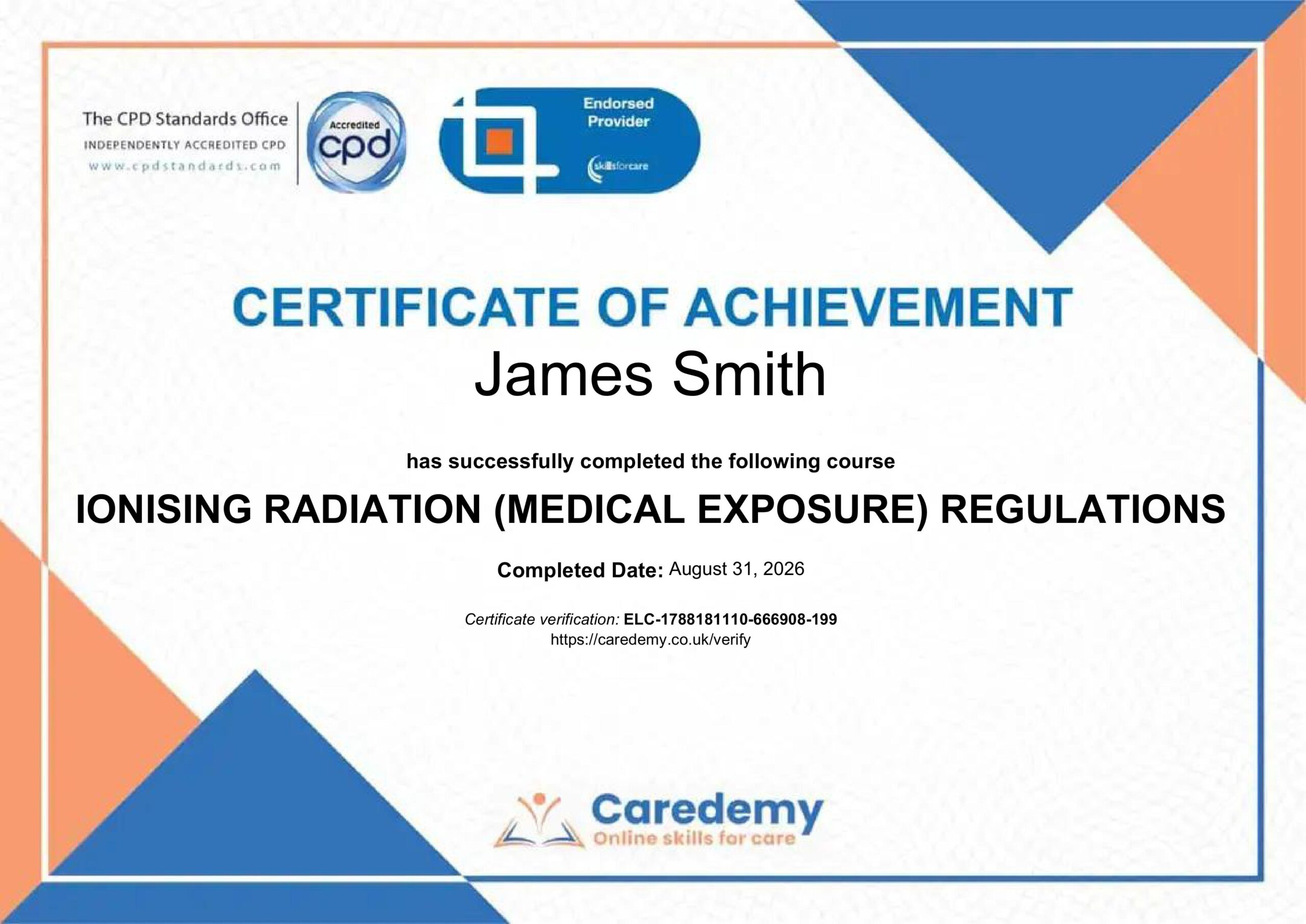
Instant Course Certificate
Is Ionising Radiation (Medical Exposure) Regulations training a legal requirement in the UK?
IR(ME)R places specific legal responsibilities on employers and duty holders involved in medical exposures. Under the Ionising Radiation (Medical Exposure) Regulations 2017, practitioners and operators must be adequately trained before undertaking the functions assigned to them, with Schedule 3 setting out matters relevant to adequate training.
This does not mean that every healthcare employee is legally required to complete this particular online course. Employers must determine the training and competence required according to each person’s role and IR(ME)R responsibilities.
In practice, organisations should ensure staff performing relevant functions receive suitable theoretical and practical training and maintain appropriate training records.
IR(ME)R 2017 applies in England, Scotland and Wales. Northern Ireland has separate Ionising Radiation (Medical Exposure) Regulations (Northern Ireland) 2018.
Trusted by 120,000+ learners
Trusted by care providers, healthcare organisations, businesses and workplace teams across the UK for high-quality online training
Office & Commercial
Health & Social Care
Industrial, Warehousing & Facilities
Hospitality, Retail & Public Services
Ionising Radiation (Medical Exposure) Regulations training FAQ?
What are the Ionising Radiation (Medical Exposure) Regulations?
The Ionising Radiation (Medical Exposure) Regulations 2017, commonly called IR(ME)R, provide a legal framework for protecting people from hazards associated with ionising radiation used for medical purposes. They cover areas including justification, optimisation, responsibilities of duty holders, training, equipment, clinical audit and the investigation and notification of certain accidental or unintended exposures.
Who needs IR(ME)R training?
Training requirements depend on a person’s responsibilities. IR(ME)R specifically requires practitioners and operators to be adequately trained for the functions they undertake. Relevant staff can include radiographers, radiologists, oncologists and other professionals involved in medical exposures. Nurses, managers and governance staff may also require appropriate knowledge depending on their responsibilities and workplace risk assessment.
Is IR(ME)R training a legal requirement?
IR(ME)R 2017 requires practitioners and operators to be adequately trained before carrying out functions assigned to them. However, the legislation does not state that every healthcare worker must complete the same online IR(ME)R course. Employers must ensure training is appropriate to the person’s role, responsibilities, competence and the procedures they perform.
What is a significant accidental or unintended exposure under IR(ME)R?
A significant accidental or unintended exposure, often abbreviated to SAUE, is an accidental or unintended medical exposure that meets relevant notification criteria. Where an employer knows or has reason to believe such an exposure has occurred, IR(ME)R establishes investigation and notification responsibilities. Current enforcing-authority guidance should be used when deciding whether an incident meets notification criteria.
When should an IR(ME)R incident be reported?
Under Regulation 8, employers have responsibilities for investigating accidental or unintended exposures. Where an exposure meets the criteria for a significant accidental or unintended exposure, the appropriate enforcing authority must be notified as soon as possible. Organisations should use current guidance from their relevant UK enforcing authority because notification criteria vary according to the type and circumstances of the exposure.
How long does the Ionising Radiation (Medical Exposure) Regulations Course take?
The Caredemy Ionising Radiation (Medical Exposure) Regulations Course takes approximately one hour to complete and provides one CPD point. It is delivered entirely online, allowing learners to work through the training remotely and complete the assessment before receiving their digital certificate.
How often should IR(ME)R training be refreshed?
IR(ME)R does not prescribe one universal annual refresher interval for every worker. Employers should determine appropriate refresher training according to the learner’s role, competence, local procedures, equipment, regulatory requirements and changes in practice. Additional training may be necessary following regulatory updates, incidents, changes to procedures or equipment, or where competence needs to be reinforced.
What is the difference between IR(ME)R and the Ionising Radiations Regulations 2017?
IR(ME)R primarily protects people undergoing medical exposures and regulates how those exposures are justified, optimised and managed. The Ionising Radiations Regulations 2017 (IRR17) primarily address occupational and public exposure arising from work with ionising radiation. Healthcare organisations using radiation may therefore have responsibilities under both regulatory frameworks.
Need Training for Multiple Employees?
Train your entire workforce through Caredemy Teams with bulk enrolment, compliance reporting and access to 200+ CPD courses.
- CPD-accredited certificate
- Instant Certificate
- Learn of Any Device
- Money-back Guarantee
Related Courses You May Like


UK Regulations And Guidance
£15 + Vat
Ionising Radiation (Medical Exposure) Regulations Course
- CPD Accredited
- Instant Certificate
- Instant Access
- Bulk Discounts Available