- Home
- Health & Safety
- Children and Young People Health and Safety Training Course
Children and Young People Health and Safety Training Course
£15 + VAT


Written By Allison
- CPD Accredited | Instant Certificate | Mobile Friendly | Bulk Discounts Available
Trusted by care providers, healthcare organisations, businesses and workplace teams
Children and Young People Health and Safety Training introduces the responsibilities and everyday precautions involved in supporting children safely. Topics include risk assessment, moving and handling, infection control, food preparation, allergies, medicines and behaviour support. Designed for staff and carers in childcare, education, healthcare and social care, it helps learners recognise hazards, follow agreed procedures and balance protection with children’s independence.
Children and Young People Health and Safety Training Course Summary
Course Name: Children and Young People Health and Safety Training
Duration: 1 hour
Delivery: Online Training Course
Certificate Included: Instant Digital Certificate upon successful completion
Accreditation: CPD Accredited -1 CPD point
Suitable For: Early years practitioners, school staff, children’s support workers, healthcare staff, youth workers, volunteers and carers
Assessment: Online Multiple Choice Test with unlimited retakes
Access: Instant Access with 12 months’ course access.
Duration
1 hour
CPD Points
1
Last Updated:
30 Sep 2025
What is Children and Young People Health and Safety Training?
Children and Young People Health and Safety Training is introductory learning about preventing avoidable harm when caring for or supporting children. It connects duty of care with practical decisions, such as preparing a safe activity space, helping a child move, encouraging handwashing or following a medicines support plan.
Learners explore how children’s needs, abilities and environments affect risk. The course also considers emotional support, positive behaviour and opportunities for children to develop confidence through appropriately managed activities.
It provides underpinning knowledge for safer working and workplace induction. Staff must apply this knowledge alongside their organisation’s policies, individual care plans and role-specific training. Completing an online course does not, by itself, demonstrate practical competence in moving children or using specialist medication equipment.
CPD Accredited
User friendly interactive courses
Instant Access
Enrol Now – Start Instantly
Certify Instantly
Certificate Available Immediately
Learn on Any Device
Train on Phone, Tablet or Computer
Money Back Guarantee
14 Day Money Back Guaratnee
How Would You Like to Access This Course?
Flexible options for individuals, staff teams and organisations
1
Instant Online Purchase
From 1 to 100+ learners • Bulk discounts available • Instant online access and certificates included
- Instant Access - No Quote Required
- CPD Accredited Certificates Included
- 100% Online & Mobile Friendly
- Assign Courses to Staff, Friends or Family
- Track Progress and Completions Online
- 14 Day Money Back Guarantee
£15 + VAT
CPD • Certificate included • Start instantly
Quantity
Per Course Price
1+ Courses
£15 + Vat
5+ Courses
£9.40 + Vat
10+ Courses
£8.49 + Vat
30+ Courses
£7.99 + Vat
50+ Courses
£6.49 + Vat
100+ Courses
£4.99 + Vat
2
Need Ongoing Staff Training?
Best value for teams of 8+ learners who need regular mandatory, induction and refresher training.
- Save Money on Staff Training
- Access Our Full 200+ Course Library
- Instant certificates issued
- Track Compliance Across Your Team
- Free Learner Replacements
- Reporting & Certificate Management
- CQC inspection ready
- Lowest price guarantee
- Dedicated Support
Best Price Guarantee • CQC Inspection Ready
When should I choose Caredemy Teams?
Caredemy Teams is ideal for organisations with 8+ learners who need access to multiple courses for mandatory training, induction training, and annual refreshers. Benefit from our best-value pricing, free learner replacements, compliance reporting, and access to our full course library. If you only need a small number of CPD courses, you can buy online instantly.
Access friendly, dedicated expert support whenever you need it, with guidance available throughout your learning journey
All-access individual subscription
Get unlimited access to 200+ CPD-accredited courses. One low monthly price. Learn anytime.
Buy any 5 courses for £47
Mix and max any courses.
CPD accredited - Certificates included.
Who Is This Course For?
This course is suitable for nursery practitioners, childminders, preschool staff, teachers, teaching assistants, lunchtime supervisors and staff supporting children with special educational needs or disabilities.
It is also relevant to children’s residential care workers, social workers, family support workers, school nurses, healthcare assistants and community healthcare staff whose roles involve children and young people.
Youth workers, sports coaches, playworkers and volunteers can use the training to strengthen everyday safety awareness. Parents, guardians and carers may also find it useful when supporting children at home.
The introductory level makes it suitable for induction, refresher learning or updating underpinning knowledge. Managers should consider any additional training required for each learner’s duties and setting.
Key Benefits
✓ Recognise hazards in children’s care, learning and play environments.
✓ Balance children’s independence with proportionate risk management.
✓ Identify safer moving and handling principles that protect children and staff.
✓ Support infection prevention, food hygiene and allergy awareness.
✓ Recognise responsibilities and role boundaries when supporting medicines.
✓ Use positive behaviour principles to support calmer, safer interactions.
Course Modules
- Children and Young People Health and Safety Training – Course Introduction
- Supporting the Health and Safety of Children and Young People
- Duty of Care
- Key Responsibilities
- Every Child Matters
- Every Disabled Child Matters
- Moving and Handling Children
- Lifting Children Manually
- Lifting Strategies and Weight Monitoring
- Manual Handling Key Principles
- Protecting Yourself From Injury
- Home Safety
- Building Confidence in Risk-Taking
- Risk Assessments
- Positive Risk Management
- Hazard Awareness and Education
- Healthy Child Record
- Healthy Environments
- Healthy Care
- The Impact of Emotional Support
- Infection Control
- Encouraging Good Hygiene Habits
- Teaching Hygiene Awareness
- Food Preparation
- Allergy Awareness
- Administering Medicines
- Administering Medication via Specialist Equipment
- Medication Refusal
- Helpful Approaches to Administering Medicines
- Behaviours That Challenge
- Behaviour Support Plans
- Promoting Positive Behaviour
- Responding to Behaviour
- Being a Positive Role Model
- Principles of Positive Behaviour Support
- Techniques for Diffusing Situations
Ready to start?
Learning Outcomes
| Learner Outcome | Covered |
|---|---|
| Explain duty of care when supporting children and young people. | ✓ |
| Identify staff responsibilities for maintaining safe care and learning environments. | ✓ |
| Describe key principles for moving and handling children safely. | ✓ |
| Identify factors to consider before manually lifting a child. | ✓ |
| Recognise working practices that reduce handling-related injury risks. | ✓ |
| Identify hazards in home and childcare environments. | ✓ |
| Explain how risk assessment supports proportionate safety precautions. | ✓ |
| Describe how positive risk management supports children’s confidence and independence. | ✓ |
| Explain how emotional support contributes to children’s wellbeing. | ✓ |
| Identify infection control measures relevant to working with children. | ✓ |
| Describe ways to encourage age-appropriate hygiene habits. | ✓ |
| Identify food preparation precautions and allergy-related risks. | ✓ |
| Explain role boundaries when administering medicines, including through specialist equipment. | ✓ |
| Describe appropriate responses to a child refusing medication. | ✓ |
| Explain how behaviour support plans, positive role modelling and de-escalation approaches support safer interactions. | ✓ |
Training 8+ Staff Across Multiple Courses?
Purchasing multiple licences for this training course? Simply adjust the quantity and buy online today.
If you need ongoing training for 10+ employees across multiple subjects, our Team Training platform provides access to 200+ CPD accredited courses, compliance reporting, learner management and bulk enrolment tools.
- Access 200+ CPD Accredited Courses
- Manage All Learners In One Place
- Compliance & Audit Reporting
- Bulk Enrolment & Certificate Tracking
- Dedicated Account Support
Team Training Solutions
Ideal for care providers, healthcare organisations and workplace teams training multiple employees.
Why Choose Caredemy?
- Instant Certificate
- CPD-accredited courses
- Money Back Guarantee
- Expert-designed training
- 120,000 learners trained
- Flexible online learning
- Compliance-focused
- Dedicated support
What Our Learners Say?
“A useful introduction to everyday nursery risks, especially hygiene routines and helping children explore safely.”
Hannah Reed
Early Years Practitioner
“The handling and medicines sections helped me identify where I needed further workplace guidance.”
Daniel Brooks
Children’s Support Worker
“Clear explanations of positive behaviour support and practical considerations for keeping our learning environment safe.”
Aisha Patel
Teaching Assistant
4.87/5 from 47+ learners
Why Is Children and Young People Health and Safety Training important?
Children’s safety needs change as they grow, develop new skills and encounter different environments. Staff need to recognise preventable hazards without unnecessarily restricting play, learning or independence.
Children and Young People Health and Safety Training connects everyday tasks with their potential consequences. Unsafe lifting can injure both a child and a worker; poor hygiene can spread infection; overlooked allergies or unclear medicines responsibilities can expose children to harm.
The course also addresses emotional wellbeing and behaviour support, helping learners consider how their responses affect safety and trust.
For employers, this learning can support more consistent working practices and identify areas requiring further instruction or supervision. Its value comes from applying the learning through appropriate risk assessments, individual support arrangements and workplace procedures.
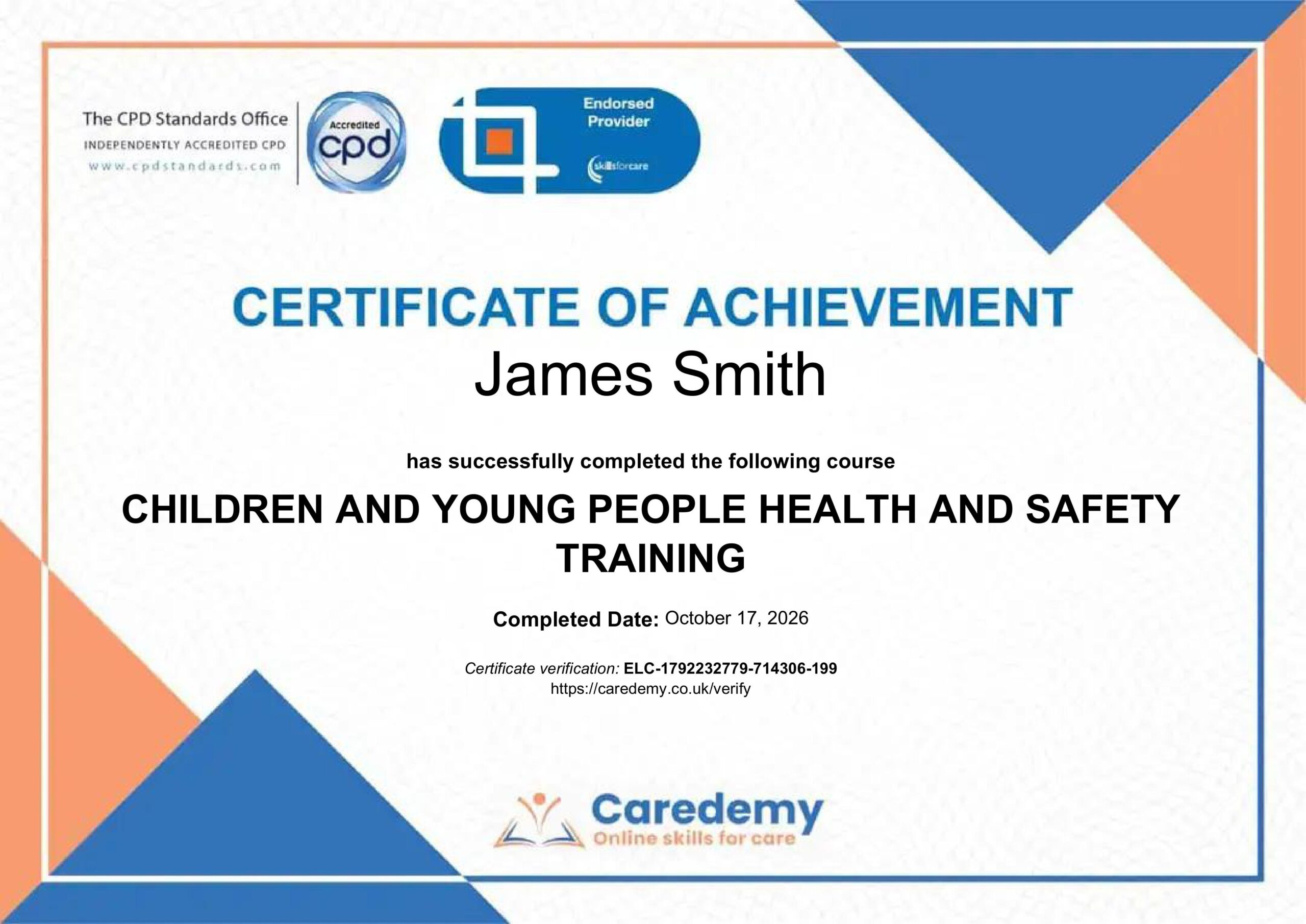
Instant Course Certificate
Is Children and Young People Health and Safety Training a legal requirement in the UK?
There is no universal legal requirement to complete this particular named course. Employers must, however, meet applicable health and safety duties and provide training appropriate to employees’ work.
In Great Britain, the Health and Safety at Work etc. Act 1974 establishes duties towards employees and others affected by work. The Management of Health and Safety at Work Regulations 1999 require employers to assess and manage risks. In practice, this means identifying hazards to children and staff and putting suitable controls in place. Northern Ireland has separate legislation. HSE
Early years providers in England must also follow the current EYFS statutory framework for their provider type. Other nations and settings have their own requirements. This course can contribute to staff development, but does not establish compliance on its own.
Trusted by 120,000+ learners
Trusted by care providers, healthcare organisations, businesses and workplace teams across the UK for high-quality online training
Office & Commercial
Health & Social Care
Industrial, Warehousing & Facilities
Hospitality, Retail & Public Services
Children and Young People Health and Safety Training FAQ?
What is children and young people health and safety training?
It is training about reducing avoidable harm when supporting children in care, education and community environments. This course introduces duty of care, risk management, moving and handling, hygiene, food safety, medicines support and positive behaviour. It helps learners connect these topics with everyday responsibilities, such as preparing activities or supporting personal care.
Who needs health and safety training when working with children?
Staff need learning appropriate to their responsibilities and the risks they encounter. This introductory course is relevant to nursery workers, school staff, children’s care workers, healthcare staff and youth activity leaders. Managers should assess whether learners also need specialist instruction, such as practical moving and handling training or training for an individual child’s healthcare needs.
How long does the course take, and how is it assessed?
The course takes approximately one hour and is delivered online. Learners complete a multiple choice test, with unlimited retakes included. Access is available immediately after purchase and continues for 12 months, allowing time to revisit the material. Successful learners receive a digital certificate that they can download or print.
How often should children’s health and safety training be refreshed?
Refresher learning should reflect the employer’s training policy, workplace risks and the learner’s responsibilities. Review training needs when a child’s support requirements change, new equipment is introduced, procedures are revised or an incident highlights a knowledge gap. The course’s 12-month access period should not be treated as a statutory refresher interval.
Is this course a legal requirement for nursery and school staff?
This specific course is not universally required by law. Employers must manage relevant risks and ensure staff have appropriate information, instruction and training. Nurseries and schools must also meet the requirements applicable to their setting. For early years provision in England, the current EYFS framework forms part of those responsibilities.
Does this course qualify me to lift children or administer medicines?
No. It provides introductory knowledge rather than practical authorisation or a competency assessment. Before undertaking these tasks, staff need to follow their employer’s procedures, the child’s individual plan and any required practical training. Using specialist medication equipment or moving and handling equipment requires instruction and assessment appropriate to the task.
What does positive risk management mean when supporting children?
Positive risk management means considering the benefits of an activity alongside possible harm and choosing proportionate precautions. For example, staff might support a child to try an unfamiliar play activity with suitable supervision and an appropriate environment. The aim is to enable development and independence while addressing foreseeable dangers.
Does this course replace safeguarding or paediatric first aid training?
No. Its focus is everyday health and safety, including handling, hygiene, food preparation, medicines awareness and behaviour support. Staff should complete separate safeguarding and paediatric first aid training where required for their role or setting. Employers should assess the full training requirements rather than relying on one introductory certificate.
Need Training for Multiple Employees?
Train your entire workforce through Caredemy Teams with bulk enrolment, compliance reporting and access to 200+ CPD courses.
- CPD-accredited certificate
- Instant Certificate
- Learn of Any Device
- Money-back Guarantee
Related Courses You May Like


UK Regulations And Guidance
£15 + Vat
Children and Young People Health and Safety Training Course
- CPD Accredited
- Instant Certificate
- Instant Access
- Bulk Discounts Available