
- Home
- Health & Safety
- Manual Handling at Work Course
Manual Handling at Work Course
£15 + VAT


Written By Allison
- CPD Accredited | Instant Certificate | Mobile Friendly | Bulk Discounts Available
Trusted by care providers, healthcare organisations, businesses and workplace teams
This Manual Handling at Work Course explains how to avoid hazardous manual handling, assess tasks that cannot be avoided and reduce the risk of injury. Learners explore risk assessment, mechanical aids, good handling techniques, legal duties and workers who may be at greater risk. It is suitable for employees, supervisors and managers who undertake or oversee lifting, lowering, carrying, pushing or pulling activities at work.
Manual Handling at Work Course Summary
Course Name: Manual Handling at Work Course
Duration: 1 Hour
Delivery: Online Training Course
Certificate Included: Instant Digital Certificate
Accreditation: CPD Accredited – 1 CPD Point
Suitable For: Employees, managers, supervisors and workers who undertake or oversee manual handling activities
Assessment: Online Multiple Choice Test
Access: Instant Access
Duration
1 hour
CPD Points
1
Last Updated:
30 Sep 2025
What is Manual Handling at Work training?
Manual Handling at Work training teaches workers how to recognise and control risks associated with transporting or supporting loads by hand or bodily force. Manual handling can include lifting, lowering, carrying, pushing, pulling and moving loads.
The course follows the principles of the Manual Handling Operations Regulations 1992, which require employers to avoid hazardous manual handling where reasonably practicable, assess unavoidable hazardous handling and reduce the risk of injury.
Learners examine how to identify hazardous tasks, choose an appropriate level of assessment, use risk filters, consider automation or mechanisation and apply good handling techniques.
The Manual Handling at Work Course also explains employer and employee responsibilities and considers workers who may face increased risk, helping learners apply safer working practices to everyday manual handling activities.
CPD Accredited
User friendly interactive courses
Instant Access
Enrol Now – Start Instantly
Certify Instantly
Certificate Available Immediately
Learn on Any Device
Train on Phone, Tablet or Computer
Money Back Guarantee
14 Day Money Back Guaratnee
How Would You Like to Access This Course?
Flexible options for individuals, staff teams and organisations
1
Instant Online Purchase
From 1 to 100+ learners • Bulk discounts available • Instant online access and certificates included
- Instant Access - No Quote Required
- CPD Accredited Certificates Included
- 100% Online & Mobile Friendly
- Assign Courses to Staff, Friends or Family
- Track Progress and Completions Online
- 14 Day Money Back Guarantee
£15 + VAT
CPD • Certificate included • Start instantly
Quantity
Per Course Price
1+ Courses
£15 + Vat
5+ Courses
£9.40 + Vat
10+ Courses
£8.49 + Vat
30+ Courses
£7.99 + Vat
50+ Courses
£6.49 + Vat
100+ Courses
£4.99 + Vat
2
Need Ongoing Staff Training?
Best value for teams of 8+ learners who need regular mandatory, induction and refresher training.
- Save Money on Staff Training
- Access Our Full 200+ Course Library
- Instant certificates issued
- Track Compliance Across Your Team
- Free Learner Replacements
- Reporting & Certificate Management
- CQC inspection ready
- Lowest price guarantee
- Dedicated Support
Best Price Guarantee • CQC Inspection Ready
When should I choose Caredemy Teams?
Caredemy Teams is ideal for organisations with 8+ learners who need access to multiple courses for mandatory training, induction training, and annual refreshers. Benefit from our best-value pricing, free learner replacements, compliance reporting, and access to our full course library. If you only need a small number of CPD courses, you can buy online instantly.
Access friendly, dedicated expert support whenever you need it, with guidance available throughout your learning journey
All-access individual subscription
Get unlimited access to 200+ CPD-accredited courses. One low monthly price. Learn anytime.
Buy any 5 courses for £47
Mix and max any courses.
CPD accredited - Certificates included.
Who Is This Course For?
The Manual Handling at Work Course is suitable for employees who undertake manual handling and for managers or supervisors responsible for managing these activities.
It is relevant across healthcare, social care, warehousing, retail, hospitality, cleaning, manufacturing, construction, logistics, offices and other workplaces where people may need to lift, lower, carry, push, pull or otherwise move loads.
Relevant learners can include care workers, healthcare support workers, warehouse operatives, delivery workers, cleaners, maintenance staff, retail employees, hospitality workers, facilities teams, administrators handling supplies, supervisors, team leaders and managers.
The course can be used for induction, refresher training, general manual handling awareness and knowledge development. Employers should ensure that training reflects the actual risks, equipment and handling activities within each employee’s role.
Key Benefits
✓ Identify hazardous manual handling tasks before injuries occur
✓ Apply practical techniques for safer lifting, carrying, pushing and pulling
✓ Understand how manual handling risks should be assessed and controlled
✓ Recognise when mechanical aids or task redesign could reduce risk
✓ Understand employer and worker responsibilities under UK health and safety law
✓ Recognise workers who may require additional consideration during risk assessment
Course Modules
- Manual Handling at Work – Course Introduction
- Introduction to Manual Handling at Work
- Avoiding Hazardous Manual Handling
- Assessing Manual Handling That Cannot Be Avoided
- Choosing the Right Level of Assessment
- Automation and Mechanisation
- Recording and Reviewing
- Reducing the Risk of Injury
- Training
- Good Handling Technique
- The Law
- Legal Requirements
- Duties of Workers
- Employees at Greater Risk
- Levels of Assessment
- Using Filters
Ready to start?
Learning Outcomes
| Learner Outcome | Covered |
|---|---|
| Explain what constitutes manual handling in the workplace | ✓ |
| Identify manual handling activities that may create a risk of injury | ✓ |
| Explain when hazardous manual handling should be avoided | ✓ |
| Identify when a manual handling risk assessment is required | ✓ |
| Select an appropriate level of assessment for a manual handling task | ✓ |
| Explain how automation and mechanisation can reduce manual handling risks | ✓ |
| Identify practical measures for reducing the risk of manual handling injuries | ✓ |
| Apply the principles of good handling technique | ✓ |
| Explain why manual handling assessments should be recorded and reviewed where appropriate | ✓ |
| Explain employers’ responsibilities for managing manual handling risks | ✓ |
| Describe workers’ responsibilities when undertaking manual handling | ✓ |
| Recognise employees who may be at greater risk from manual handling activities | ✓ |
| Explain how manual handling risk filters can support assessment decisions | ✓ |
| Recognise when mechanical or handling aids may reduce physical demands | ✓ |
Training 8+ Staff Across Multiple Courses?
Purchasing multiple licences for this Fire Extinguisher Training course? Simply adjust the quantity and buy online today.
If you need ongoing training for 10+ employees across multiple subjects, our Team Training platform provides access to 200+ CPD accredited courses, compliance reporting, learner management and bulk enrolment tools.
- Access 200+ CPD Accredited Courses
- Manage All Learners In One Place
- Compliance & Audit Reporting
- Bulk Enrolment & Certificate Tracking
- Dedicated Account Support
Team Training Solutions
Ideal for care providers, healthcare organisations and workplace teams training multiple employees.
Why Choose Caredemy?
- Instant Certificate
- CPD-accredited courses
- Money Back Guarantee
- Expert-designed training
- 120,000 learners trained
- Flexible online learning
- Compliance-focused
- Dedicated support
What Our Learners Say?
“Clear explanation of risk assessment and lifting techniques that I could relate directly to my daily work.”
Sarah Mitchell
Care Assistant
“Straightforward and practical. The sections on avoiding lifts and using equipment were particularly useful.”
Daniel Roberts
Warehouse Operative
“Useful refresher covering both staff responsibilities and what managers should consider when assessing handling tasks.”
Emma Collins
Team Leader
4.74/5 from 102+ learners
Why Is Manual Handling at Work training important?
Manual handling can expose workers to musculoskeletal injury when loads are heavy, bulky, difficult to grip or moved in awkward conditions. Risk can also increase through repetitive handling, poor posture, unsuitable environments or individual factors.
Manual Handling at Work training helps workers recognise these hazards and understand that safe manual handling involves more than simply learning how to lift correctly. Risks should first be avoided where reasonably practicable and, where handling cannot be avoided, assessed and reduced.
Effective training supports safer decisions about task design, mechanical aids, handling techniques and when assistance may be required. This can help protect employees, colleagues, patients, service users and others affected by handling activities.
It also supports employers in demonstrating a structured approach to managing manual handling risks and maintaining appropriate workplace health and safety standards.
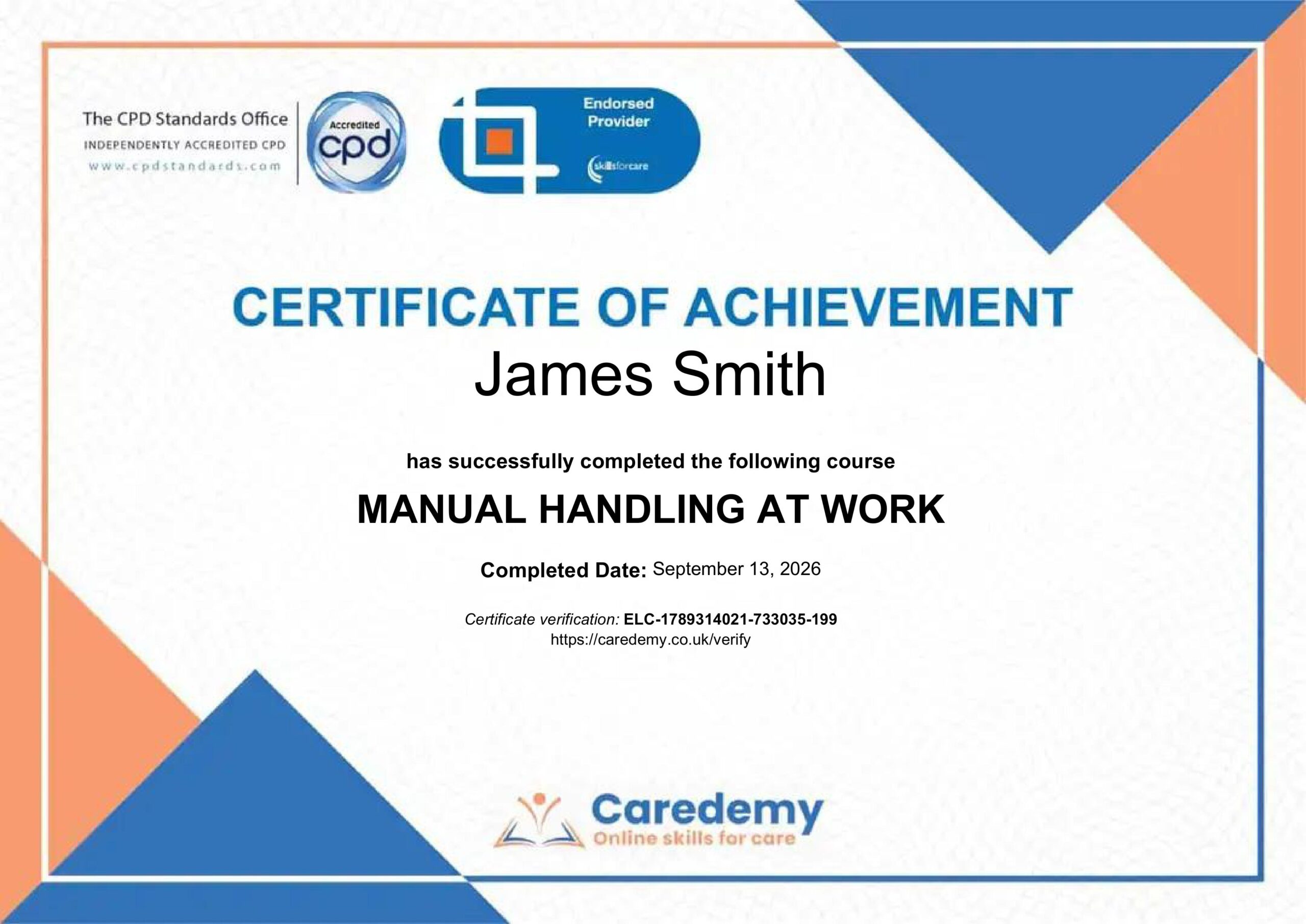
Instant Course Certificate
Is Manual Handling at Work training a legal requirement in the UK?
UK law does not state that every employee must complete a particular named or accredited “manual handling course”. However, employers have legal duties to manage manual handling risks and provide appropriate health and safety information and training.
The Manual Handling Operations Regulations 1992 require employers to avoid hazardous manual handling so far as reasonably practicable. Where it cannot be avoided, employers must make a suitable and sufficient assessment and reduce the risk of injury so far as reasonably practicable.
The Health and Safety at Work etc. Act 1974 and wider health and safety regulations also establish duties concerning employee safety, risk management, information and training.
Therefore, manual handling training should be provided where it is necessary to help employees work safely. Training should be relevant to the actual tasks, risks, loads, environment and equipment encountered in the workplace.
Trusted by 120,000+ learners
Trusted by care providers, healthcare organisations, businesses and workplace teams across the UK for high-quality online training
Office & Commercial
Health & Social Care
Industrial, Warehousing & Facilities
Hospitality, Retail & Public Services
Manual Handling at Work training FAQ?
What is manual handling at work?
Manual handling means transporting or supporting a load using bodily force. It can include lifting, lowering, pushing, pulling, carrying or moving a load. A load can be an object, person or animal. Manual handling risks can occur across many workplaces, including healthcare, social care, warehouses, retail, construction, hospitality and offices.
Who needs manual handling training?
Manual handling training is relevant to employees whose work exposes them to manual handling risks and to managers or supervisors responsible for those activities. This can include care workers, warehouse operatives, delivery drivers, cleaners, retail staff, maintenance teams and healthcare workers. The training required should reflect the person’s actual work activities and associated risks.
Is manual handling training a legal requirement in the UK?
There is no general legal requirement for every employee to hold a specific manual handling certificate. However, employers have legal duties to assess and control manual handling risks and provide appropriate information and training. Training may therefore form an important part of an employer’s arrangements for complying with UK health and safety law.
How often should manual handling training be refreshed?
UK manual handling legislation does not prescribe a universal expiry period or fixed refresher interval. Employers should determine refresher training according to workplace risks. Refresher training may be appropriate when working practices or equipment change, new risks are identified, an employee’s competence needs reinforcing or an incident indicates that existing controls or knowledge are insufficient.
How long does the Manual Handling at Work Course take?
The Caredemy Manual Handling at Work Course takes approximately 1 hour to complete and provides 1 CPD point. Because it is delivered online, learners can access the training remotely and work through the course without needing to attend a classroom-based session.
What are the main principles of safe manual handling?
The priority is to avoid hazardous manual handling where reasonably practicable. Where handling cannot be avoided, the task should be appropriately assessed and the risk reduced. Controls may include changing the task or workplace layout, reducing loads, using mechanical aids and applying appropriate handling techniques. Workers should also follow their employer’s risk assessments and safe systems of work.
What should a manual handling risk assessment consider?
A manual handling assessment should consider factors associated with the task, load, working environment and individual capability, together with other relevant factors. Employers should consider issues such as awkward postures, load characteristics, repetitive movements, carrying distances, workplace constraints and whether mechanical assistance could eliminate or reduce the physical demands of the task.
Does online manual handling training replace practical training?
Not always. Online training can provide essential knowledge about manual handling risks, legal responsibilities, assessment and good handling principles. However, employers must consider the employee’s actual role and risks. Where workers need to demonstrate task-specific practical techniques or safely use handling equipment, additional workplace instruction, supervision, competency assessment or practical training may be necessary.
Need Training for Multiple Employees?
Train your entire workforce through Caredemy Teams with bulk enrolment, compliance reporting and access to 200+ CPD courses.
- CPD-accredited certificate
- Instant Certificate
- Learn of Any Device
- Money-back Guarantee
Related Courses You May Like

UK Regulations And Guidance
£15 + Vat
Manual Handling at Work Course
- CPD Accredited
- Instant Certificate
- Instant Access
- Bulk Discounts Available