

- Home
- Health & Safety
- Medicines Optimisation: An Introduction Level 2 Course
Medicines Optimisation: An Introduction Level 2 Course
£15 + VAT


Written By Allison
- CPD Accredited | Instant Certificate | Mobile Friendly | Bulk Discounts Available
Trusted by care providers, healthcare organisations, businesses and workplace teams
Medicines Optimisation: An Introduction Level 2 explores how medicines can be used safely and effectively to achieve better outcomes for people. Learners examine polypharmacy, shared decision-making, medicine safety, adverse events and medicines-related patient safety incidents. The course is suitable for health and social care professionals who need practical knowledge to recognise medicines-related risks, respond appropriately to incidents and support safer, person-centred medicines use.
Medicines Optimisation: An Introduction Level 2 Course Summary
Course Name: Medicines Optimisation: An Introduction Level 2 Course
Duration: 1 Hour
Delivery: Online Training Course
Certificate Included: Instant Digital Certificate
Accreditation: CPD Accredited – 1 CPD Point
Suitable For: Healthcare professionals, social care practitioners, pharmacists, nurses, GPs, clinical pharmacists, healthcare assistants and staff involved in medicines use or support
Assessment: Online Multiple Choice Test
Access: Instant Access
Duration
1 hour
CPD Points
1
Last Updated:
25 Jul 2026
What is Medicines Optimisation: An Introduction Level 2 training?
Medicines Optimisation: An Introduction Level 2 Training introduces the principles that support safe, effective and person-centred use of medicines in health and social care.
Medicines optimisation is concerned with helping people achieve the best possible outcomes from their medicines while reducing avoidable harm. NICE describes it as a person-centred approach to safe and effective medicines use.
The course introduces medicines and polypharmacy before examining how medicines can be optimised through shared decision-making and safer practice. Learners also explore adverse events and the systems used to identify, report and learn from medicines-related patient safety incidents.
This knowledge helps staff recognise potential medication risks, follow workplace reporting procedures and understand their contribution to safer medicines use within the boundaries of their role.
CPD Accredited
User friendly interactive courses
Instant Access
Enrol Now – Start Instantly
Certify Instantly
Certificate Available Immediately
Learn on Any Device
Train on Phone, Tablet or Computer
Money Back Guarantee
14 Day Money Back Guaratnee
How Would You Like to Access This Course?
Flexible options for individuals, staff teams and organisations
1
Instant Online Purchase
From 1 to 100+ learners • Bulk discounts available • Instant online access and certificates included
- Instant Access - No Quote Required
- CPD Accredited Certificates Included
- 100% Online & Mobile Friendly
- Assign Courses to Staff, Friends or Family
- Track Progress and Completions Online
- 14 Day Money Back Guarantee
£15 + VAT
CPD • Certificate included • Start instantly
Quantity
Per Course Price
1+ Courses
£15 + Vat
5+ Courses
£9.40 + Vat
10+ Courses
£8.49 + Vat
30+ Courses
£7.99 + Vat
50+ Courses
£6.49 + Vat
100+ Courses
£4.99 + Vat
2
Need Ongoing Staff Training?
Best value for teams of 8+ learners who need regular mandatory, induction and refresher training.
- Save Money on Staff Training
- Access Our Full 200+ Course Library
- Instant certificates issued
- Track Compliance Across Your Team
- Free Learner Replacements
- Reporting & Certificate Management
- CQC inspection ready
- Lowest price guarantee
- Dedicated Support
Best Price Guarantee • CQC Inspection Ready
When should I choose Caredemy Teams?
Caredemy Teams is ideal for organisations with 8+ learners who need access to multiple courses for mandatory training, induction training, and annual refreshers. Benefit from our best-value pricing, free learner replacements, compliance reporting, and access to our full course library. If you only need a small number of CPD courses, you can buy online instantly.
Access friendly, dedicated expert support whenever you need it, with guidance available throughout your learning journey
All-access individual subscription
Get unlimited access to 200+ CPD-accredited courses. One low monthly price. Learn anytime.
Buy any 5 courses for £47
Mix and max any courses.
CPD accredited - Certificates included.
Who Is This Course For?
The Medicines Optimisation: An Introduction Level 2 Course is suitable for health and social care professionals whose work involves medicines, medication support or the care of people taking one or more medicines.
Relevant learners include pharmacists, pharmacy staff, registered nurses, GPs, clinical pharmacists, healthcare assistants, care workers and other health and social care practitioners. It can also support staff completing induction, refresher training or role-specific knowledge development.
The course is particularly relevant where staff encounter people taking multiple medicines, support individuals experiencing possible adverse effects, contribute to medication safety processes or need to recognise and report medicines-related incidents.
The training provides underpinning knowledge rather than authorising learners to prescribe, administer, review or make clinical decisions about medicines beyond their professional competence and workplace responsibilities.
Key Benefits
✓ Understand the principles of safe and effective medicines optimisation
✓ Recognise risks associated with polypharmacy and medicines use
✓ Support person-centred conversations and shared decision-making
✓ Identify adverse events and medicines-related safety incidents
✓ Follow appropriate processes for reporting medicines-related incidents
✓ Apply learning from incidents to support safer workplace practice
Course Modules
- Medicines Optimisation: An Introduction Level 2 – Course Introduction
- Introduction to Medicines
- Polypharmacy
- Optimising Medicines
- Shared Decision-Making
- Medicine Safety
- Adverse Events
- Systems for Identifying, Reporting, and Learning
- Identifying Medicines-Related Safety Incidents
- Reporting Medicines-Related Safety Incidents
- Learning from Medicines-Related Safety Incidents
Ready to start?
Learning Outcomes
| Learner Outcome | Covered |
|---|---|
| Explain the purpose of medicines optimisation in health and social care | ✓ |
| Describe key principles relating to the safe and effective use of medicines | ✓ |
| Explain what polypharmacy means and recognise associated medicines-related risks | ✓ |
| Identify how medicines optimisation can contribute to improved outcomes | ✓ |
| Explain the importance of involving people in decisions about their medicines | ✓ |
| Recognise the role of shared decision-making in person-centred medicines use | ✓ |
| Identify key principles of medicine safety | ✓ |
| Recognise medicines-related adverse events | ✓ |
| Distinguish medicines-related safety incidents that require appropriate action or escalation | ✓ |
| Explain how medicines-related patient safety incidents should be identified | ✓ |
| Describe the importance of reporting medicines-related patient safety incidents | ✓ |
| Explain how organisations can learn from medicines-related incidents | ✓ |
| Recognise how incident learning can contribute to safer medicines practice | ✓ |
Training 8+ Staff Across Multiple Courses?
Purchasing multiple licences for this Fire Extinguisher Training course? Simply adjust the quantity and buy online today.
If you need ongoing training for 10+ employees across multiple subjects, our Team Training platform provides access to 200+ CPD accredited courses, compliance reporting, learner management and bulk enrolment tools.
- Access 200+ CPD Accredited Courses
- Manage All Learners In One Place
- Compliance & Audit Reporting
- Bulk Enrolment & Certificate Tracking
- Dedicated Account Support
Team Training Solutions
Ideal for care providers, healthcare organisations and workplace teams training multiple employees.
Why Choose Caredemy?
- Instant Certificate
- CPD-accredited courses
- Money Back Guarantee
- Expert-designed training
- 120,000 learners trained
- Flexible online learning
- Compliance-focused
- Dedicated support
What Our Learners Say?
“Clear explanation of medicines safety and reporting. Very useful for refreshing knowledge used in everyday clinical practice.”
Sarah M
Registered Nurse
“The sections on polypharmacy and adverse events were particularly useful and easy to apply to my role.”
Daniel P
Healthcare Assistant
“A concise and practical introduction to medicines optimisation, with useful guidance around recognising and reporting incidents.”
Priya K
Clinical Pharmacist
4.93/5 from 222+ learners
Why Is Medicines Optimisation: An Introduction Level 2 training important?
Medicines can improve health and manage long-term conditions, but their use can also create risks. Medication errors, adverse events, inappropriate medicines use and problems associated with polypharmacy can cause avoidable harm.
Medicines optimisation places the individual at the centre of decisions about medicines and considers safety, effectiveness, preferences and outcomes. NICE recommends robust processes for identifying, reporting, investigating and learning from medicines-related patient safety incidents.
This training helps learners recognise medicines-related risks, understand the importance of shared decision-making and respond appropriately when an incident or adverse event is identified.
For employers, appropriate medicines training supports staff competence, safer practice, effective incident reporting and a workplace culture where medicines-related problems are identified and used as opportunities to improve care.
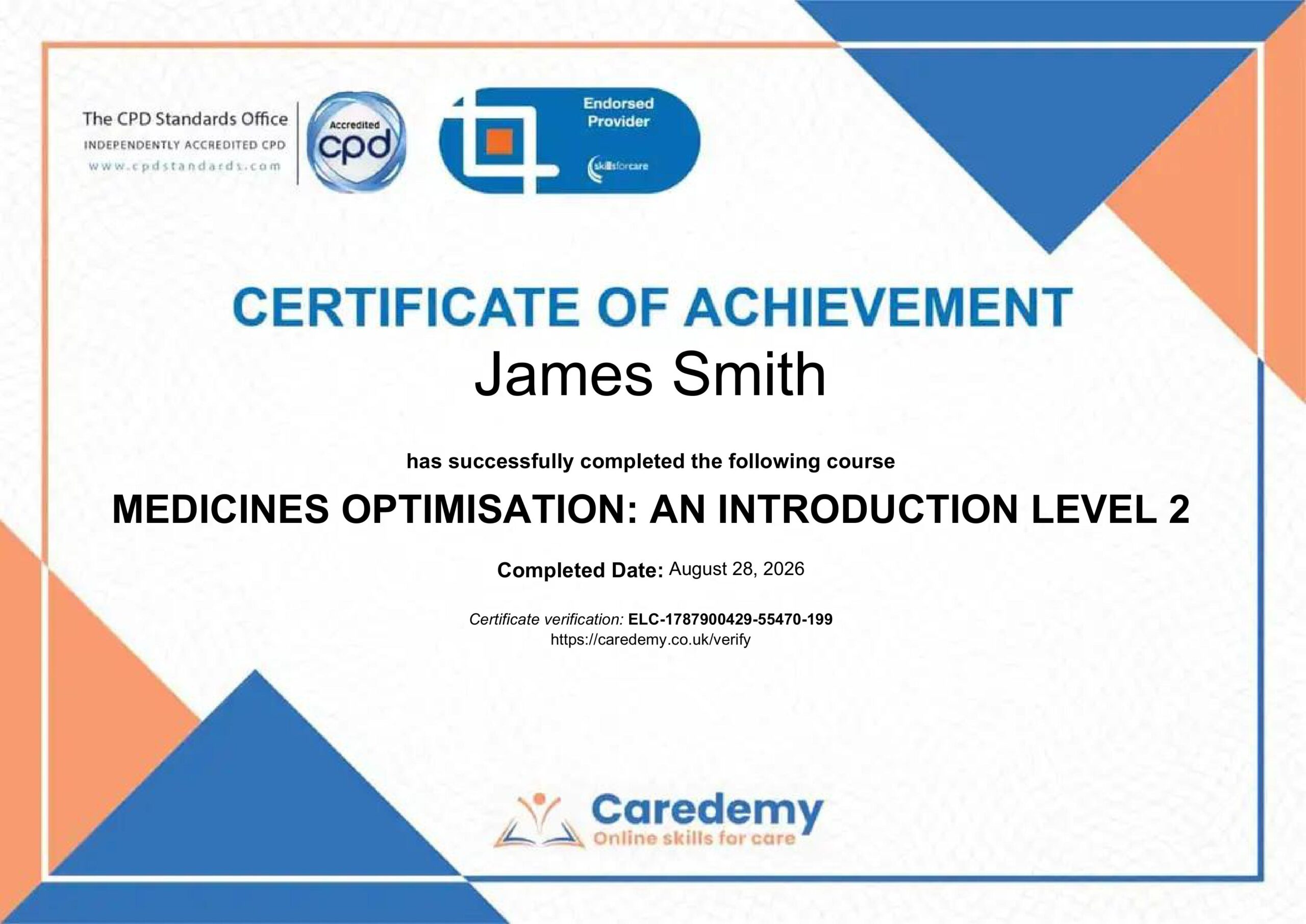
Instant Course Certificate
Is Medicines Optimisation: An Introduction Level 2 training a legal requirement in the UK?
There is no single UK law stating that every health or social care worker must complete a course specifically titled Medicines Optimisation: An Introduction Level 2.
However, employers and regulated providers must ensure that workers carrying out medicines-related responsibilities are appropriately trained and competent for their roles. In England, Regulation 12 of the Health and Social Care Act 2008 (Regulated Activities) Regulations 2014 requires regulated providers to deliver care and treatment safely and ensure those providing care have the necessary competence, skills and experience.
The Human Medicines Regulations 2012 provide an important legal framework governing medicinal products in the UK.
NICE NG5 also provides recognised best-practice recommendations on medicines optimisation, including medicines safety, incident reporting, shared decision-making, reconciliation and medication review.
Employers should therefore determine training requirements according to each worker’s responsibilities, competence and medicines-related risks.
Trusted by 120,000+ learners
Trusted by care providers, healthcare organisations, businesses and workplace teams across the UK for high-quality online training
Office & Commercial
Health & Social Care
Industrial, Warehousing & Facilities
Hospitality, Retail & Public Services
Medicines Optimisation: An Introduction Level 2 training FAQ?
What is medicines optimisation?
Medicines optimisation is a person-centred approach to ensuring medicines are used safely and effectively so people achieve the best possible outcomes. It considers whether medicines are appropriate and effective, how safely they are being used and the person’s needs, preferences and experience. Shared decision-making between individuals and healthcare professionals is an important part of the approach.
Who needs Medicines Optimisation: An Introduction Level 2 training?
The course is suitable for healthcare and social care professionals whose roles involve medicines or supporting people who take medicines. This may include nurses, pharmacists, clinical pharmacists, GPs, healthcare assistants, care workers and other practitioners. Employers should determine the appropriate training and competency requirements according to each worker’s role and responsibilities.
What does the Medicines Optimisation: An Introduction Level 2 Course cover?
The course covers an introduction to medicines, polypharmacy, optimising medicines, shared decision-making, medicine safety and adverse events. It also examines systems for identifying, reporting and learning from medicines-related patient safety incidents, helping learners understand how effective incident management contributes to safer medicines use.
Is medicines optimisation training a legal requirement?
There is no general legal requirement requiring all UK workers to complete a course with this specific title. However, organisations must ensure employees are appropriately trained and competent for their responsibilities. For CQC-regulated services in England, Regulation 12 requires providers to ensure people delivering care or treatment have the necessary qualifications, competence, skills and experience to do so safely.
How long does the Medicines Optimisation: An Introduction Level 2 Course take?
The Medicines Optimisation: An Introduction Level 2 Course takes approximately one hour to complete. It is delivered online, allowing learners to work through the training flexibly. After completing the course and successfully passing the online multiple choice assessment, learners receive an instant digital CPD-accredited certificate.
What is polypharmacy and why is it important in medicines optimisation?
Polypharmacy generally refers to a person taking multiple medicines. It can be appropriate where medicines have been optimised for complex or multiple conditions, but it can become problematic where medicines are inappropriate or their intended benefits are not being achieved. Medicines optimisation helps professionals consider safety, effectiveness and individual needs when supporting people taking multiple medicines.
What is a medicines-related patient safety incident?
A medicines-related patient safety incident is an unintended or unexpected incident involving medicines use that could have caused, or did cause, harm. NICE examples include medication errors, near misses, potentially avoidable adverse events and potentially avoidable medicines-related hospital admissions or readmissions. Appropriate reporting helps organisations investigate incidents and learn how to reduce future risks.
How often should medicines optimisation training be refreshed?
There is no universal statutory refresher interval for a course specifically called medicines optimisation training. Employers should determine refresher requirements through role requirements, risk assessment, organisational policy, regulatory expectations and individual competency. Additional or refresher training may be appropriate following incidents, changes in responsibilities, updated procedures or where competency assessments identify a learning need.
Need Training for Multiple Employees?
Train your entire workforce through Caredemy Teams with bulk enrolment, compliance reporting and access to 200+ CPD courses.
- CPD-accredited certificate
- Instant Certificate
- Learn of Any Device
- Money-back Guarantee
Related Courses You May Like


UK Regulations And Guidance
£15 + Vat
Medicines Optimisation: An Introduction Level 2 Course
- CPD Accredited
- Instant Certificate
- Instant Access
- Bulk Discounts Available