

A missing certificate is not necessarily proof that a care worker has not been trained. But it is a gap that needs investigating.
For care home managers, homecare managers and training leads, the important question is not simply whether a spreadsheet shows a green tick. It is whether the provider can verify the worker’s learning, demonstrate appropriate competence and respond to any risk.
When training evidence is incomplete, the right response is to investigate, assess the implications for people’s safety, take proportionate action and keep a clear record of the outcome. This guide explains a practical process for CQC-regulated adult social care services in England.
Watch: How to Resolve Missing Staff Training Evidence
Watch our short guide to identifying training evidence gaps, assessing risks and taking corrective action.
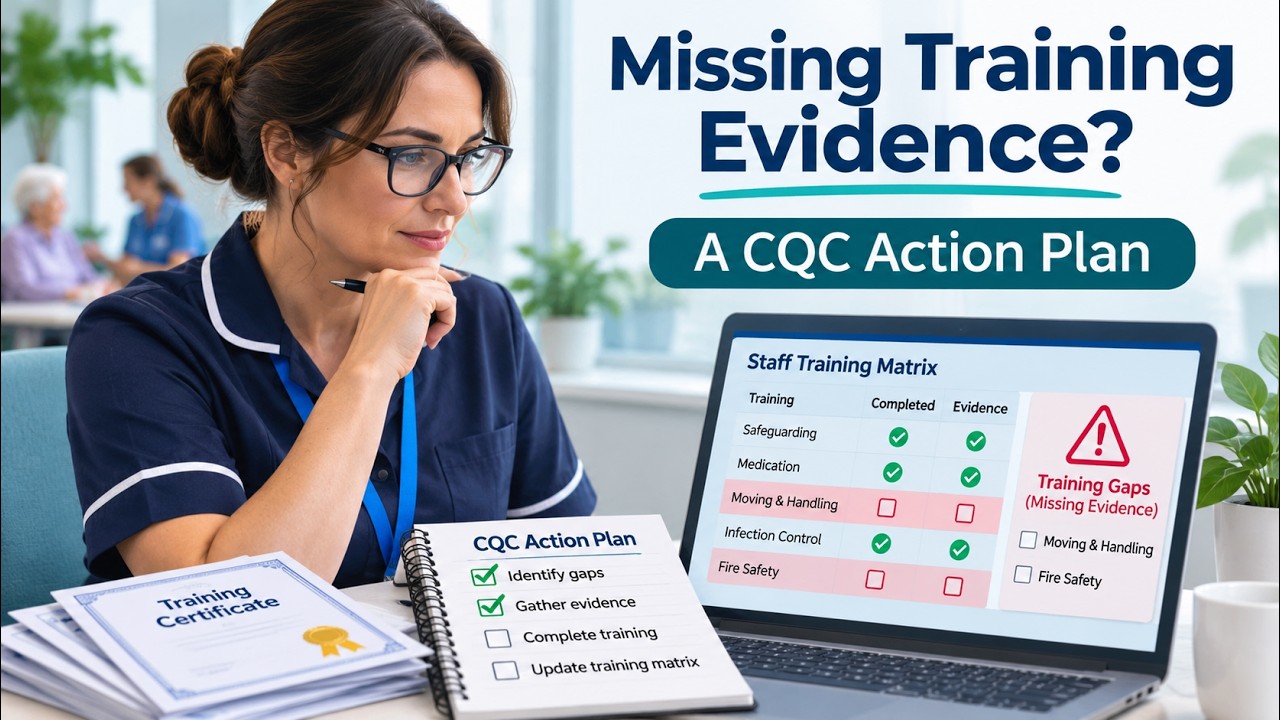
Why Missing Training Evidence Matters to CQC
Under CQC Regulation 18 (Staffing) of the Health and Social Care Act 2008 (Regulated Activities) Regulations 2014, staff must receive the support, training, supervision and appraisal needed to carry out their roles effectively. CQC guidance emphasises that completed learning and required training should be monitored continuously, with appropriate action taken quickly when standards or requirements are not met.
Furthermore, Regulation 17 (Good governance) requires providers to operate effective systems for monitoring quality and risk, while maintaining secure, accurate records for both staff management and service operation.
Key Regulatory Insight: CQC regulations do not prescribe one particular training spreadsheet or insist that every missing certificate automatically forces a worker to repeat a course. Managers must establish what happened and verify whether the worker possesses the knowledge and practical competence needed for their current duties.
Five Steps to Resolve a Training Evidence Gap
1
Identify Precisely What is Missing
Start with the individual requirement, not just a headline compliance percentage. Is the completion date absent? Has a certificate been misplaced? Is refresher training overdue under the service’s internal policy? Was workplace competency assessment never recorded? These are distinct issues requiring tailored responses.
Record the employee or staff reference, role, training requirement, date identified and current evidence available. Ensure the training requirement still aligns with the staff member's actual responsibilities.
2
Verify Evidence Before Assuming Training Was Not Completed
Check the learning management platform, archived reports, training provider portals and authorised personnel files. Consult both the employee and relevant manager regarding past training. If evidence is located, link or securely store it within the current system and record how it was verified.
Crucial Rule: Never retrospectively invent a completion date, backdate a record or mark an unverified course as complete. If evidence cannot be established, retain the gap as open while deciding what learning or assessment is required.
3
Assess Any Immediate Risk to People Receiving Care
Consider the worker’s actual duties and potential consequences of the gap. A missing awareness-course certificate presents a vastly different risk profile compared to absent evidence of competence for administering medicines or operating moving-and-handling equipment.
Where competence cannot be confirmed for safety-critical tasks, responsible managers must implement suitable interim controls before those tasks continue (e.g., closer supervision, reallocating duties, or an immediate competency check). Urgent safety concerns must align with the service's NHS and CQC safeguarding and escalation procedures.
4
Assign an Owner, Deadline and Corrective Action
For each outstanding gap, decide exactly what will resolve it—whether obtaining an original certificate, correcting a data entry error, arranging training, completing an observed competency assessment, or reviewing role-specific requirements. Assign a named responsible person and set a deadline proportionate to risk.
Do not treat simply booking a course as equivalent to completing it. The action item remains open until sufficient evidence is reviewed and formally accepted.
5
Verify Closure and Look for the Underlying Cause
A manager must check the supporting evidence, record the review date and mark the action closed only when genuinely resolved. If systemic gaps appear across a team or branch, audit the root cause—such as manual spreadsheet errors, inconsistent induction handovers or siloed systems.
Improvements may include clearer record ownership, routine exception reports, defined evidence rules and regular management audits. The objective is preventing recurrence rather than tidying records just before inspection.
Worked Example: Medicines Training Recorded, Competency Missing
Illustrative Scenario: A care home training matrix marks a senior care worker’s medicines learning as complete. During a management audit, the manager finds an online course certificate but cannot locate the workplace assessment required by the service’s medicines policy.
| Action Stage | Manager Response & Action Taken |
|---|---|
| 1. Gap Recorded | Knowledge-course completion is verified; practical competency evidence is missing. |
| 2. Risk Assessed | Manager reviews worker’s medicines responsibilities and assesses whether safe performance has been demonstrated. |
| 3. Interim Action | Supervision or restriction of medicines duties applied in line with provider risk assessment until competence is verified. |
| 4. Owner & Deadline | A competent assessor is assigned to execute the required workplace assessment and document results by a set target date. |
| 5. Closure | Manager verifies assessment documentation, updates central records and audits whether other staff have identical missing evidence. |
Key Distinction: A course certificate demonstrates completion of theoretical learning; it does not automatically demonstrate safe performance of practical workplace tasks.
What to Include in a Training Evidence Corrective-Action Record
A structured action record ensures an easily auditable decision trail for inspectors and internal governance. Key fields include:
- Staff reference, role and specific service or branch location
- Training or competency requirement and reason it applies
- Evidence missing or inconsistent, including the date identified
- Risk assessment findings and immediate safeguarding controls
- Corrective action plan, named owner and target completion date
- Evidence obtained, verification outcome and formal closure date
- Follow-up review details to prevent recurring systemic issues
Data Protection Note: Always protect personal information. Store employee-level details in approved internal systems with access restricted to authorised personnel in compliance with UK GDPR guidelines. Generic downloadable templates or public reports must never contain real employee or service-user details.
Use the Right Resource for the Right Job
Optimise your compliance workflow using the appropriate Caredemy tools and guidance:
- To audit total compliance readiness, use the Care Training Compliance Checklist 2026/27.
- To track ongoing learning and renewal cycles, use the Staff Training Matrix Template.
- To structure documentation for audits, refer to the CQC Inspection Training Evidence Checklist.
- For routine compliance advice, read How to Keep Staff Training Records CQC Inspection Ready.
How Caredemy Team Training Supports Better Oversight
While corrective actions depend on managerial judgement and workplace competency assessment, centralized learning management transforms record keeping. Caredemy Team Training provides centralized course tracking, real-time learner progress, instant certification access and automated reporting—helping managers catch evidence gaps early.
Explore Caredemy Team TrainingFrequently Asked Questions
Does a missing training certificate automatically mean a CQC breach?
No. A missing certificate alone does not establish a regulatory breach. The circumstances matter, including whether training and competence can be verified through other records, the risk level involved, and what action the provider takes once the gap is identified.
Can an online course certificate prove practical competence?
Not by itself where workplace practical competence is required (such as moving and handling or medication administration). The provider must retain suitable evidence of practical assessment conducted by an appropriately competent assessor.
Should a manager wait until the next inspection to correct records?
No. Training requirements and evidence must be monitored routinely, with action taken promptly when gaps arise. Management response should be proportionate to risk and clearly documented.
Is there a single CQC-required training evidence action-plan template?
CQC does not prescribe one universal action-plan template. Providers can use any secure, suitable system that effectively identifies gaps, records decisions, tracks accountability and demonstrates full follow-through.
Scope: This guidance applies to CQC-regulated adult social care services in England. Always apply your organisation’s internal policies, professional regulatory requirements and risk assessments. Seek specialist legal or compliance advice where appropriate.