
- Home
- Health & Safety
- Venous Thromboembolism Course
Venous Thromboembolism Course
£15 + VAT


Written By Allison
- CPD Accredited | Instant Certificate | Mobile Friendly | Bulk Discounts Available
Trusted by care providers, healthcare organisations, businesses and workplace teams
Venous Thromboembolism training introduces blood clots in adults, including deep vein thrombosis (DVT) and pulmonary embolism (PE). Explore risk factors, symptoms, investigations, treatment and prevention. For staff supporting adults after surgery, during reduced mobility or following hospital discharge, the course provides knowledge to recognise concerns and contribute to care within their responsibilities.
Venous Thromboembolism Course Summary
Course Name: Venous Thromboembolism (VTE)
Duration:1 hour
Delivery: Online Training Course
Certificate Included: Instant Digital Certificate following successful assessment
Accreditation: CPD Accredited
Suitable For: Healthcare professionals and adult social care staff whose roles involve supporting people at risk of blood clots
Assessment: Online Multiple Choice Test
Access: Instant Access with 12 months’ course access.
Duration
1 hour
CPD Points
1
Last Updated:
25 Jul 2026
What is Venous Thromboembolism training?
Venous Thromboembolism training explains how clots develop in veins and why they can cause serious complications. DVT usually affects a deep vein in the leg; PE occurs when a clot blocks a blood vessel in the lungs. NHS
Learners explore who is at risk, how DVT and PE are investigated, and the principles of treatment and prevention. Topics also include unprovoked VTE, inferior vena cava filters and post-thrombotic syndrome.
In practice, this knowledge helps staff understand the significance of changes such as a newly swollen leg in someone with reduced mobility. It supports informed communication with clinical colleagues and use of local procedures.
This introductory course develops underpinning knowledge. Clinical assessment, prescribing and treatment decisions require appropriate professional competence and authorisation.
CPD Accredited
User friendly interactive courses
Instant Access
Enrol Now – Start Instantly
Certify Instantly
Certificate Available Immediately
Learn on Any Device
Train on Phone, Tablet or Computer
Money Back Guarantee
14 Day Money Back Guaratnee
How Would You Like to Access This Course?
Flexible options for individuals, staff teams and organisations
1
Instant Online Purchase
From 1 to 100+ learners • Bulk discounts available • Instant online access and certificates included
- Instant Access - No Quote Required
- CPD Accredited Certificates Included
- 100% Online & Mobile Friendly
- Assign Courses to Staff, Friends or Family
- Track Progress and Completions Online
- 14 Day Money Back Guarantee
£15 + VAT
CPD • Certificate included • Start instantly
Quantity
Per Course Price
1+ Courses
£15 + Vat
5+ Courses
£9.40 + Vat
10+ Courses
£8.49 + Vat
30+ Courses
£7.99 + Vat
50+ Courses
£6.49 + Vat
100+ Courses
£4.99 + Vat
2
Need Ongoing Staff Training?
Best value for teams of 8+ learners who need regular mandatory, induction and refresher training.
- Save Money on Staff Training
- Access Our Full 200+ Course Library
- Instant certificates issued
- Track Compliance Across Your Team
- Free Learner Replacements
- Reporting & Certificate Management
- CQC inspection ready
- Lowest price guarantee
- Dedicated Support
Best Price Guarantee • CQC Inspection Ready
When should I choose Caredemy Teams?
Caredemy Teams is ideal for organisations with 8+ learners who need access to multiple courses for mandatory training, induction training, and annual refreshers. Benefit from our best-value pricing, free learner replacements, compliance reporting, and access to our full course library. If you only need a small number of CPD courses, you can buy online instantly.
Access friendly, dedicated expert support whenever you need it, with guidance available throughout your learning journey
All-access individual subscription
Get unlimited access to 200+ CPD-accredited courses. One low monthly price. Learn anytime.
Buy any 5 courses for £47
Mix and max any courses.
CPD accredited - Certificates included.
Who Is This Course For?
This course is suitable for registered nurses, healthcare assistants, support workers and adult social care staff working in hospitals, care homes, rehabilitation services and community settings.
It is particularly relevant to people supporting adults with restricted mobility, recovering from surgery or returning home after a hospital stay. Junior doctors, healthcare students, pharmacists and pharmacy technicians may also use it as an introductory refresher.
Clinical educators and care managers can include the training in role-appropriate induction or continuing professional development. The course focuses on adult VTE and should be selected according to the learner’s responsibilities and existing knowledge.
Key Benefits
✓ Recognise signs that may indicate DVT or pulmonary embolism.
✓ Identify risk factors affecting adults in your care.
✓ Understand the purpose of VTE investigations.
✓ Explain the principles of DVT treatment.
✓ Support prescribed prevention measures within your role.
✓ Recognise complications that may affect recovery.
Course Modules
- Venous Thromboembolism – Course Introduction
- What is Venous Thromboembolism
- Who is at Risk for VTE
- Deep Vein Thrombosis
- Pulmonary Embolism
- Diagnosing a DVT
- PE Diagnosis
- DVT Treatment
- Unprovoked VTE
- Inferior Vena Cava Filters
- Post-Thrombotic Syndrome
- Risk Assessments
- DVT Prevention
- Lifestyle Changes
Ready to start?
Learning Outcomes
| Learner Outcome | Covered |
|---|---|
| Define venous thromboembolism and its main forms | ✓ |
| Identify factors that increase an adult’s risk of VTE | ✓ |
| Recognise common signs and symptoms of DVT | ✓ |
| Recognise common signs and symptoms of pulmonary embolism | ✓ |
| Explain how DVT and pulmonary embolism differ | ✓ |
| Describe the purpose of investigations used to diagnose DVT | ✓ |
| Describe the purpose of investigations used to diagnose PE | ✓ |
| Explain the main principles of DVT treatment | ✓ |
| Distinguish unprovoked VTE from VTE associated with an identifiable trigger | ✓ |
| Describe the purpose of inferior vena cava filters | ✓ |
| Identify post-thrombotic syndrome as a possible complication of DVT | ✓ |
| Explain the purpose of VTE risk assessment | ✓ |
| Describe measures used to help prevent DVT | ✓ |
| Identify lifestyle changes that can help reduce blood clot risk | ✓ |
Training 8+ Staff Across Multiple Courses?
Purchasing multiple licences for this training course? Simply adjust the quantity and buy online today.
If you need ongoing training for 10+ employees across multiple subjects, our Team Training platform provides access to 200+ CPD accredited courses, compliance reporting, learner management and bulk enrolment tools.
- Access 200+ CPD Accredited Courses
- Manage All Learners In One Place
- Compliance & Audit Reporting
- Bulk Enrolment & Certificate Tracking
- Dedicated Account Support
Team Training Solutions
Ideal for care providers, healthcare organisations and workplace teams training multiple employees.
Why Choose Caredemy?
- Instant Certificate
- CPD-accredited courses
- Money Back Guarantee
- Expert-designed training
- 120,000 learners trained
- Flexible online learning
- Compliance-focused
- Dedicated support
What Our Learners Say?
“Clear explanations of DVT and PE helped me recognise why new symptoms need prompt reporting.”
Helen Morris
Healthcare Assistant
“A useful refresher on clot risks, particularly when supporting adults with reduced mobility after hospital discharge.”
Daniel Clarke
Community Support Worker
“The overview of investigations and treatment helped me explain the care pathway more clearly to patients.”
Aisha Benett
Registered Nurse
4.89/5 from 68+ learners
Why Is Venous Thromboembolism training important?
A blood clot can have serious consequences, especially if it travels to the lungs. Adults may face increased risk during hospital admission, after surgery or when they cannot move around normally. Recognising concerning symptoms supports prompt medical attention. NHS
Venous Thromboembolism training helps staff connect these risks with everyday observations. For example, new calf pain and one-sided swelling in someone recovering from surgery should be reported promptly rather than dismissed as routine discomfort.
Knowledge of prevention, investigations and treatment also helps staff understand care plans and communicate concerns accurately. Employers can use relevant training alongside local protocols, supervision and competency assessment to support safer care.
Instant Course Certificate
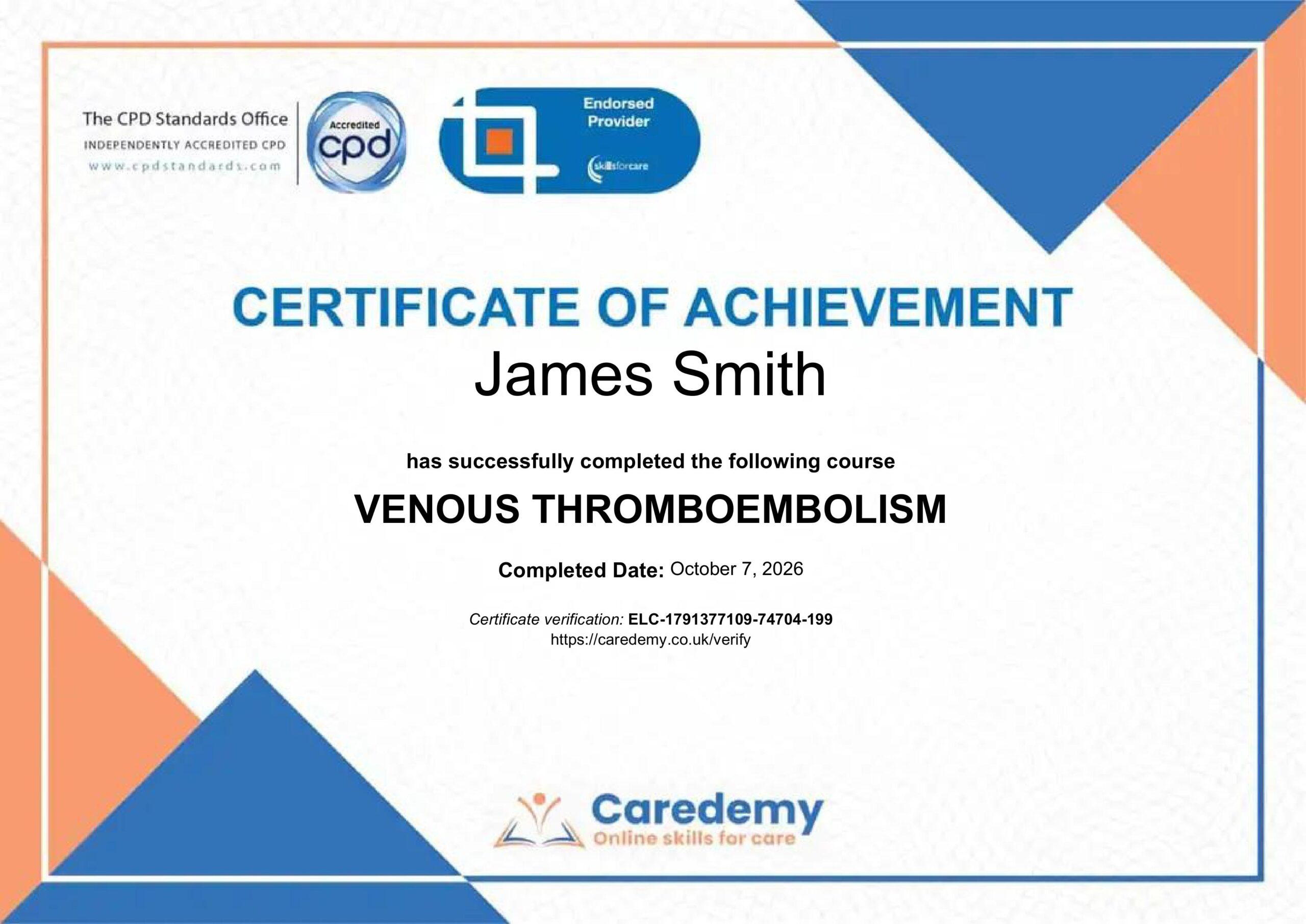
Is Venous Thromboembolism training a legal requirement in the UK?
There is no blanket UK legal requirement for every healthcare or care worker to complete this specific VTE course. Employers should determine training needs according to duties, patient risks and service requirements.
In England, Regulation 12 of the Health and Social Care Act 2008 (Regulated Activities) Regulations 2014 requires regulated providers to assess and mitigate risks and ensure staff have the competence to deliver care safely. Relevant VTE training can contribute to meeting these responsibilities. Care Quality Commission
NICE guidance provides recommendations on VTE prevention, diagnosis and management; it does not mandate purchase of a particular course. Services elsewhere in the UK should follow their applicable regulatory requirements and local clinical guidance. Course completion alone does not establish practical clinical competence.
Trusted by 120,000+ learners
Trusted by care providers, healthcare organisations, businesses and workplace teams across the UK for high-quality online training
Office & Commercial
Health & Social Care
Industrial, Warehousing & Facilities
Hospitality, Retail & Public Services
Venous Thromboembolism training FAQ?
What is venous thromboembolism?
Venous thromboembolism, or VTE, refers to blood clots in the venous circulation. Its main forms are deep vein thrombosis and pulmonary embolism. DVT usually develops in a deep leg vein. If a clot travels to the lungs, it can cause a life-threatening pulmonary embolism requiring immediate treatment.
Who needs venous thromboembolism training?
VTE training is relevant to staff whose work involves adults at risk of blood clots. This may include nurses, healthcare assistants, rehabilitation staff and care workers supporting people with reduced mobility or recent surgery. Employers should match training to each role, including whether staff observe and report symptoms, contribute to prevention or undertake clinical assessment.
What symptoms of DVT and pulmonary embolism should staff recognise?
DVT can cause pain, swelling and skin colour changes, usually in one leg. DVT symptoms accompanied by breathlessness or chest pain require emergency help because a clot may have reached the lungs. Staff should obtain urgent medical advice for suspected DVT and follow emergency procedures, including calling 999 when appropriate.
What does a VTE risk assessment consider?
VTE risk assessment considers factors that make blood clots more likely, alongside bleeding risk when planning preventive treatment. NICE NG89 recommends assessment for relevant hospital patients using an appropriate tool. Staff should understand their contribution to the process, use local procedures and ensure clinical decisions are made by appropriately competent professionals.
How often should venous thromboembolism training be refreshed?
There is no single refresher interval suitable for every role or setting. Employers should set a schedule based on staff responsibilities, local policy and identified learning needs. Earlier updating may be appropriate after changes to clinical guidance, a move into a different role, a period away from practice or an incident highlighting gaps in knowledge.
Is VTE training mandatory for healthcare assistants and care workers?
This specific course is not universally mandatory for healthcare assistants or care workers. An employer may require VTE training where it is relevant to the people supported. In England, regulated providers must ensure staff can deliver care safely, so role-appropriate learning should support risk management and competence alongside supervision and workplace procedures.
How long does the VTE course take, and is a certificate included?
The course takes approximately one hour, although individual study time varies. Learners complete an online multiple choice assessment and receive an instant digital certificate after passing. The certificate records successful completion of the knowledge-based training; employers should also consider any practical assessment or supervision required for the learner’s duties.
Does this course qualify me to diagnose or treat DVT or pulmonary embolism?
No. This introductory course explains VTE and the principles behind investigations, treatment and prevention. It does not confer prescribing authority or independently qualify someone to diagnose blood clots. Diagnostic and treatment decisions must follow clinical pathways and be undertaken by appropriately qualified professionals. Learners should apply the knowledge within their existing responsibilities.
Need Training for Multiple Employees?
Train your entire workforce through Caredemy Teams with bulk enrolment, compliance reporting and access to 200+ CPD courses.
- CPD-accredited certificate
- Instant Certificate
- Learn of Any Device
- Money-back Guarantee
Related Courses You May Like

UK Regulations And Guidance
Useful References:
- NICE NG158 – Venous thromboembolic diseases: diagnosis, management and thrombophilia testing
- NICE NG89 – Venous thromboembolism in over 16s: reducing the risk of hospital-acquired deep vein thrombosis or pulmonary embolism
- The Health and Social Care Act 2008 (Regulated Activities) Regulations 2014 – Regulation 12: Safe care and treatment (England)
£15 + Vat
Venous Thromboembolism Course
- CPD Accredited
- Instant Certificate
- Instant Access
- Bulk Discounts Available