
- Home
- Health & Safety
- Principles of Consent Course
Principles of Consent Course
£15 + VAT


Written By Allison
- CPD Accredited | Instant Certificate | Mobile Friendly | Bulk Discounts Available
Trusted by care providers, healthcare organisations, businesses and workplace teams
Principles of Consent training introduces the responsibilities involved in obtaining permission for care and treatment. It addresses consent, capacity, refusal and decision-making when someone cannot consent. Designed for staff supporting patients and service users, it provides a foundation for respectful care conversations and recognising when further advice is needed.
Principles of Consent Course Summary
Course Name: Principles of Consent
Duration: 1 hour
Delivery: Online Training Course
Certificate Included: Instant Digital Certificate on successful completion
Accreditation: CPD Accredited
Suitable For: Healthcare professionals, care workers, support workers and staff involved in care decisions
Assessment: Online Multiple Choice Test with unlimited retakes
Access: Instant Access with 12 months to complete the course.
Duration
1 hour
CPD Points
1
Last Updated:
25 Jul 2026
What is Principles of Consent training?
Principles of Consent training explains how permission for care or treatment should be sought and respected. Valid consent must be voluntary, informed and given by someone with capacity to make the particular decision. A signed form alone does not establish that these conditions have been met. nhs.uk
In practice, consent matters when helping someone wash, administering treatment or explaining an examination. Staff need to communicate clearly, check the person’s wishes and recognise when a decision requires additional support.
This introductory course connects consent with individual rights and professional responsibilities. Workplace competence also requires staff to follow local procedures, work within their role and seek appropriate supervision.
CPD Accredited
User friendly interactive courses
Instant Access
Enrol Now – Start Instantly
Certify Instantly
Certificate Available Immediately
Learn on Any Device
Train on Phone, Tablet or Computer
Money Back Guarantee
14 Day Money Back Guaratnee
How Would You Like to Access This Course?
Flexible options for individuals, staff teams and organisations
1
Instant Online Purchase
From 1 to 100+ learners • Bulk discounts available • Instant online access and certificates included
- Instant Access - No Quote Required
- CPD Accredited Certificates Included
- 100% Online & Mobile Friendly
- Assign Courses to Staff, Friends or Family
- Track Progress and Completions Online
- 14 Day Money Back Guarantee
£15 + VAT
CPD • Certificate included • Start instantly
Quantity
Per Course Price
1+ Courses
£15 + Vat
5+ Courses
£9.40 + Vat
10+ Courses
£8.49 + Vat
30+ Courses
£7.99 + Vat
50+ Courses
£6.49 + Vat
100+ Courses
£4.99 + Vat
2
Need Ongoing Staff Training?
Best value for teams of 8+ learners who need regular mandatory, induction and refresher training.
- Save Money on Staff Training
- Access Our Full 200+ Course Library
- Instant certificates issued
- Track Compliance Across Your Team
- Free Learner Replacements
- Reporting & Certificate Management
- CQC inspection ready
- Lowest price guarantee
- Dedicated Support
Best Price Guarantee • CQC Inspection Ready
When should I choose Caredemy Teams?
Caredemy Teams is ideal for organisations with 8+ learners who need access to multiple courses for mandatory training, induction training, and annual refreshers. Benefit from our best-value pricing, free learner replacements, compliance reporting, and access to our full course library. If you only need a small number of CPD courses, you can buy online instantly.
Access friendly, dedicated expert support whenever you need it, with guidance available throughout your learning journey
All-access individual subscription
Get unlimited access to 200+ CPD-accredited courses. One low monthly price. Learn anytime.
Buy any 5 courses for £47
Mix and max any courses.
CPD accredited - Certificates included.
Who Is This Course For?
This course is relevant to care assistants, domiciliary care workers, support workers, healthcare assistants, nurses, doctors, allied health professionals, social workers and mental health staff.
It also suits registered managers, team leaders and staff responsible for overseeing care practices in care homes, supported living, community services, hospitals and primary care.
Staff supporting children and young people may find the consent principles relevant where their role involves healthcare decisions. The training can support induction or refresher learning, with employers deciding how it fits each worker’s responsibilities.
Key Benefits
✓ Recognise the conditions needed for valid consent
✓ Support informed choices before care or treatment
✓ Distinguish agreement from pressure or assumption
✓ Respond appropriately when permission is withdrawn
✓ Recognise when capacity concerns need further assessment
✓ Connect everyday care decisions with individual rights
Course Modules
- Principles of Consent – Course Introduction
- What is Consent
- Capacity
- How is Consent Given?
- Seeking Consent
- Refusing Consent
- Knowledge Check – Valid Consent
- Advance Decision
- Gillick Competence
- Knowledge Check – Consent from Children
- Lasting Power of Attorney
- The Mental Capacity Act
Ready to start?
Learning Outcomes
| Learner Outcome | Covered |
|---|---|
| Define consent to care and treatment | ✓ |
| Identify the conditions for valid consent | ✓ |
| Explain capacity in relation to consent | ✓ |
| Identify different ways consent can be communicated | ✓ |
| Explain when staff should seek consent | ✓ |
| Recognise refusal or withdrawal of consent | ✓ |
| Explain the purpose of an advance decision | ✓ |
| Define Gillick competence | ✓ |
| Explain the role of a lasting power of attorney | ✓ |
| Describe the purpose of the Mental Capacity Act 2005 | ✓ |
| Explain when best interests decisions are necessary | ✓ |
Training 8+ Staff Across Multiple Courses?
Purchasing multiple licences for this training course? Simply adjust the quantity and buy online today.
If you need ongoing training for 10+ employees across multiple subjects, our Team Training platform provides access to 200+ CPD accredited courses, compliance reporting, learner management and bulk enrolment tools.
- Access 200+ CPD Accredited Courses
- Manage All Learners In One Place
- Compliance & Audit Reporting
- Bulk Enrolment & Certificate Tracking
- Dedicated Account Support
Team Training Solutions
Ideal for care providers, healthcare organisations and workplace teams training multiple employees.
Why Choose Caredemy?
- Instant Certificate
- CPD-accredited courses
- Money Back Guarantee
- Expert-designed training
- 120,000 learners trained
- Flexible online learning
- Compliance-focused
- Dedicated support
What Our Learners Say?
“Clear explanations of consent and refusal, with useful reminders for everyday personal care.”
Sarah Bennett
Care Assistant
“Helped me distinguish consent from capacity and recognise when a decision needs further advice.”
Daniel Clarke
Support Worker
“A useful introduction to best interests and the importance of involving people in their care decisions.”
Aisha Patel
Registered Nurse
4.90/5 from 368+ learners
Why Is Principles of Consent training important?
Consent protects dignity, autonomy and trust. Proceeding without appropriate permission can cause distress, undermine relationships and expose people to care they have not agreed to.
Staff must recognise that consent is an ongoing conversation. Someone who agreed earlier may change their mind during personal care or treatment. Communication support may also be necessary before the person can make an informed choice. Care Quality Commission
Principles of Consent training supports professional judgement by helping staff recognise the boundaries of their authority. For example, difficulty speaking must not automatically be treated as an inability to decide. Exploring suitable communication methods can prevent people being excluded from decisions about their own care.
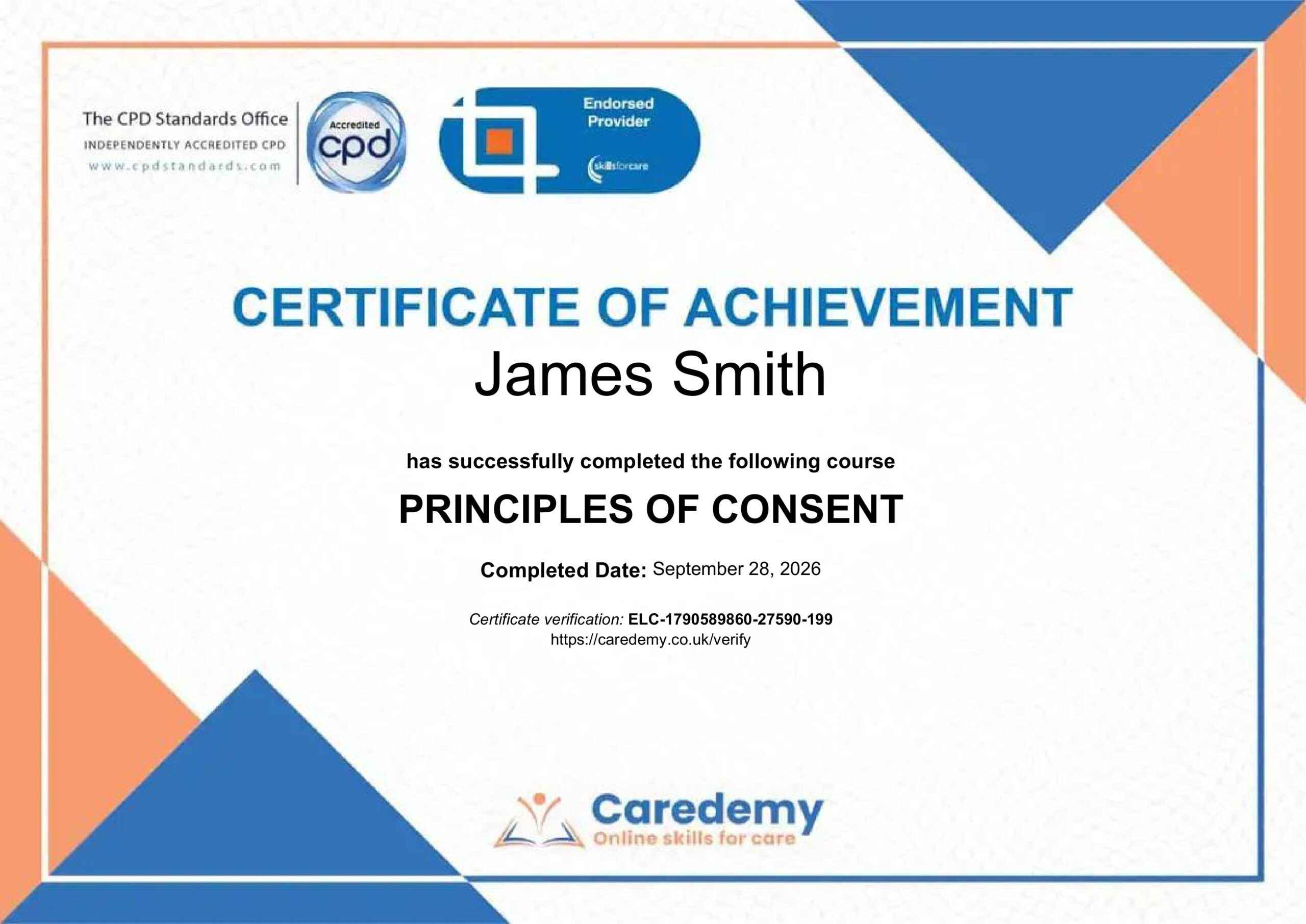
Instant Course Certificate
Is Principles of Consent training a legal requirement in the UK?
There is no general UK-wide legal requirement to complete this specific named course. However, staff and employers must meet the consent obligations relevant to their work.
In England, Regulation 11 of the Health and Social Care Act 2008 (Regulated Activities) Regulations 2014 requires registered providers to obtain consent lawfully. Staff seeking consent must have appropriate knowledge and understanding. Care Quality Commission
The Mental Capacity Act 2005 and its Code of Practice provide the framework in England and Wales for decisions involving people who lack capacity. Relevant paid carers and professionals must have regard to the Code. Scotland and Northern Ireland have different legal frameworks. GOV.UK
Employers should identify suitable training, maintain consent procedures and check staff can apply them. A course certificate alone does not demonstrate workplace competence.
Trusted by 120,000+ learners
Trusted by care providers, healthcare organisations, businesses and workplace teams across the UK for high-quality online training
Office & Commercial
Health & Social Care
Industrial, Warehousing & Facilities
Hospitality, Retail & Public Services
Principles of Consent training FAQ?
What is valid consent in health and social care?
Valid consent is permission given voluntarily by someone who has enough information and capacity to make the particular decision. The person should understand the proposed care or treatment, relevant benefits and risks, alternatives and consequences of declining. Consent must be free from pressure; simply obtaining a signature is insufficient.
Who needs Principles of Consent training?
Staff involved in providing, arranging or discussing care and treatment need knowledge appropriate to their responsibilities. This includes care workers, healthcare assistants, nurses, clinicians and relevant supervisors. Employers should consider whether introductory training is sufficient for the role or whether the worker needs further learning, supervision or specialist guidance.
Is consent training a legal requirement for CQC compliance?
CQC does not require providers to purchase a particular consent course. In England, Regulation 11 requires lawful consent and staff who understand the relevant principles. Training can support these duties, but providers must also demonstrate appropriate practice through their procedures, supervision and the way staff involve people in care decisions.
How long does the course take, and will I receive a certificate?
Allow approximately one hour for this CPD-accredited course. After successfully completing the online multiple choice assessment, you can download your digital certificate. Instant access lets you begin after purchase, and the course includes 12 months’ access. You can revisit the material and retake the assessment if needed.
How often should consent training be refreshed?
Set refresher intervals according to the worker’s role, organisational policy and identified learning needs. Review knowledge when responsibilities change, guidance is updated or supervision identifies uncertainty. Incidents involving consent or capacity should also prompt a review of practice and training. Do not assume an annual interval is a universal statutory requirement.
What should staff do if someone refuses care or treatment?
For an adult with capacity, a voluntary and informed refusal must be respected, even when staff disagree. Check whether the person needs clearer information or communication support, and follow local recording and escalation procedures. Refusal alone does not establish a lack of capacity; concerns about decision-making require appropriate assessment.
What happens when someone lacks capacity to consent?
In England and Wales, decisions must follow the Mental Capacity Act framework. Help the person participate as far as possible, consider their wishes and consult relevant people. Check for an applicable advance decision or authorised decision-maker. Family members can provide valuable information, but being a relative does not automatically give authority to consent.
Can children and young people consent to treatment?
Young people aged 16 or 17 are generally presumed able to consent to their own treatment. A child under 16 may consent when they have sufficient understanding and intelligence to appreciate what is proposed: this is called Gillick competence. Otherwise, someone with parental responsibility may consent. Disputes or serious refusals require specialist advice.
Need Training for Multiple Employees?
Train your entire workforce through Caredemy Teams with bulk enrolment, compliance reporting and access to 200+ CPD courses.
- CPD-accredited certificate
- Instant Certificate
- Learn of Any Device
- Money-back Guarantee
Related Courses You May Like


UK Regulations And Guidance

£15 + Vat
Principles of Consent Course
- CPD Accredited
- Instant Certificate
- Instant Access
- Bulk Discounts Available