
- Home
- Health & Safety
- Positive Behavioural Support Course
Positive Behavioural Support Course
£15 + VAT


Written By Allison
- CPD Accredited | Instant Certificate | Mobile Friendly | Bulk Discounts Available
Trusted by care providers, healthcare organisations, businesses and workplace teams
This Positive Behavioural Support (PBS) course introduces the principles, assessment methods and competence framework used to support individuals whose behaviour may challenge. Learners explore how to identify behavioural triggers, recognise unmet needs and contribute to person-centred support planning. Suitable for health, social care and education professionals, the training promotes safer responses, improved communication and consistent support that respects individual rights and dignity.
Positive Behavioural Support Course Summary
Course Name: Positive Behavioural Support (PBS) Online Training Course
Duration: 1 hour
Delivery: Online Training Course, Self-Paced
Certificate Included: Instant Digital CPD Certificate
Accreditation: CPD Accredited – 1 CPD Point
Suitable For: Care Assistants, Support Workers, Healthcare Professionals, Registered Managers, Teaching Assistants, SENCOs, Personal Assistants and Family Carers
Assessment: Online Multiple Choice Test, Unlimited Free Resits
Access: Instant Access for 12 Months
Duration
1 hour
CPD Points
1
Last Updated:
25 Jul 2026
What is Positive Behavioural Support training?
Positive Behavioural Support (PBS) training introduces an evidence-based approach to understanding behaviour and improving the quality of life of people with additional support needs.
PBS recognises that behaviour may communicate distress, discomfort, frustration or an unmet need. Rather than simply responding to challenging situations, it focuses on identifying underlying causes and developing supportive environments that reduce the likelihood of distress.
This course explores the values, theory and evidence behind PBS, including functional behaviour assessment, teamwork, assessment measures and the PBS Competence Framework.
Learners examine how behavioural support strategies can promote independence, improve communication and reduce reliance on restrictive interventions.
The training supports person-centred practice and helps staff understand their responsibilities under relevant legislation, including the Mental Capacity Act 2005 and the CQC fundamental standards in England.
CPD Accredited
User friendly interactive courses
Instant Access
Enrol Now – Start Instantly
Certify Instantly
Certificate Available Immediately
Learn on Any Device
Train on Phone, Tablet or Computer
Money Back Guarantee
14 Day Money Back Guaratnee
How Would You Like to Access This Course?
Flexible options for individuals, staff teams and organisations
1
Instant Online Purchase
From 1 to 100+ learners • Bulk discounts available • Instant online access and certificates included
- Instant Access - No Quote Required
- CPD Accredited Certificates Included
- 100% Online & Mobile Friendly
- Assign Courses to Staff, Friends or Family
- Track Progress and Completions Online
- 14 Day Money Back Guarantee
£15 + VAT
CPD • Certificate included • Start instantly
Quantity
Per Course Price
1+ Courses
£15 + Vat
5+ Courses
£9.40 + Vat
10+ Courses
£8.49 + Vat
30+ Courses
£7.99 + Vat
50+ Courses
£6.49 + Vat
100+ Courses
£4.99 + Vat
2
Need Ongoing Staff Training?
Best value for teams of 8+ learners who need regular mandatory, induction and refresher training.
- Save Money on Staff Training
- Access Our Full 200+ Course Library
- Instant certificates issued
- Track Compliance Across Your Team
- Free Learner Replacements
- Reporting & Certificate Management
- CQC inspection ready
- Lowest price guarantee
- Dedicated Support
Best Price Guarantee • CQC Inspection Ready
When should I choose Caredemy Teams?
Caredemy Teams is ideal for organisations with 8+ learners who need access to multiple courses for mandatory training, induction training, and annual refreshers. Benefit from our best-value pricing, free learner replacements, compliance reporting, and access to our full course library. If you only need a small number of CPD courses, you can buy online instantly.
Access friendly, dedicated expert support whenever you need it, with guidance available throughout your learning journey
All-access individual subscription
Get unlimited access to 200+ CPD-accredited courses. One low monthly price. Learn anytime.
Buy any 5 courses for £47
Mix and max any courses.
CPD accredited - Certificates included.
Who Is This Course For?
This Positive Behavioural Support course is suitable for professionals and carers supporting children, young people or adults whose behaviour may challenge services or those supporting them.
It is particularly relevant to care assistants, support workers, healthcare assistants, learning disability nurses, registered nurses, residential care workers, domiciliary care staff, supported living teams and registered managers.
The training also benefits SENCOs, teaching assistants, specialist education staff, youth workers, personal assistants, family members and unpaid carers.
It is especially useful for professionals supporting individuals with learning disabilities, autism, dementia, communication difficulties or complex behavioural support needs.
The course provides introductory PBS knowledge for staff involved in implementing existing behaviour support plans or contributing to multidisciplinary assessments. Specialist assessment and the independent development of complex plans require additional training, supervision and competence.
Key Benefits
✓ Recognise behavioural triggers and potential unmet needs.
✓ Support individuals using person-centred, evidence-based approaches.
✓ Understand functional assessment and behaviour support planning.
✓ Reduce reliance on restrictive responses through proactive support.
✓ Promote dignity, independence, communication and quality of life.
✓ Strengthen team consistency and knowledge of PBS competencies.
Course Modules
- Course Introduction – Positive Behavioural Support
- What is Positive Behavioural Support?
- Key Components of PBS
- Values, Theory & Evidence-Base, and Process
- Primary Process Outcomes
- Why Use PBS?
- When are PBS Plans Needed?
- Team Approach to Assessment
- Assessment Measures
- Implementation of PBS
- The PBS Competence Framework
- The PBS Competence Framework in Practice
- PBS Framework Competencies
- Levels of Competency by Function
- Competence Area 1
- Competence Area 2
- Competence Area 3
Ready to start?
Learning Outcomes
Learner Outcome | Covered |
|---|---|
Define Positive Behavioural Support and its core principles | ✓ |
Identify the values, theory and evidence underpinning PBS | ✓ |
Explain how PBS promotes individual rights and quality of life | ✓ |
Recognise circumstances where a PBS plan may be required | ✓ |
Identify factors that may trigger or maintain behaviour that challenges | ✓ |
Describe the role of functional behaviour assessment | ✓ |
Identify assessment measures used to understand behaviour | ✓ |
Explain the importance of multidisciplinary assessment and teamwork | ✓ |
Distinguish between proactive and reactive support strategies | ✓ |
Describe the key stages involved in implementing PBS | ✓ |
Explain the purpose of the PBS Competence Framework | ✓ |
Identify the three competence areas within the PBS framework | ✓ |
Recognise different competency levels and professional responsibilities | ✓ |
Explain how PBS can reduce reliance on restrictive interventions | ✓ |
Training 8+ Staff Across Multiple Courses?
Purchasing multiple licences for this training course? Simply adjust the quantity and buy online today.
If you need ongoing training for 10+ employees across multiple subjects, our Team Training platform provides access to 200+ CPD accredited courses, compliance reporting, learner management and bulk enrolment tools.
- Access 200+ CPD Accredited Courses
- Manage All Learners In One Place
- Compliance & Audit Reporting
- Bulk Enrolment & Certificate Tracking
- Dedicated Account Support
Team Training Solutions
Ideal for care providers, healthcare organisations and workplace teams training multiple employees.
Why Choose Caredemy?
- Instant Certificate
- CPD-accredited courses
- Money Back Guarantee
- Expert-designed training
- 120,000 learners trained
- Flexible online learning
- Compliance-focused
- Dedicated support
What Our Learners Say?
“Clear explanations of behavioural triggers and how to support residents without escalating distress.”
Sarah Mitchell
Senior Support Worker
“Helped me understand PBS assessments and why consistent approaches across the care team are important.”
Daniel Roberts
Registered Care Manager
“Useful introduction to recognising unmet needs and supporting individuals with learning disabilities more effectively.”
Rebecca Collins
Learning Disability Support Worker
4.88/5 from 1,003+ learners
Why Is Positive Behavioural Support training important?
Positive Behavioural Support training helps care and education professionals recognise that behaviour often communicates an underlying need.
Without appropriate assessment and support, distress may escalate, potentially resulting in injury, restrictive interventions, reduced independence or poorer quality of life.
PBS encourages staff to understand contributing factors such as communication difficulties, sensory environments, changes in routine, pain and emotional distress.
For example, recognising that a resident becomes distressed in a noisy dining room may lead to environmental adjustments rather than unnecessary confrontation.
Consistent PBS approaches also help teams follow individual support plans, identify early warning signs and communicate effectively across shifts.
For organisations, the training supports safer, person-centred practice and aligns with recognised guidance on reducing restrictive interventions, protecting individual rights and maintaining appropriate standards of care.
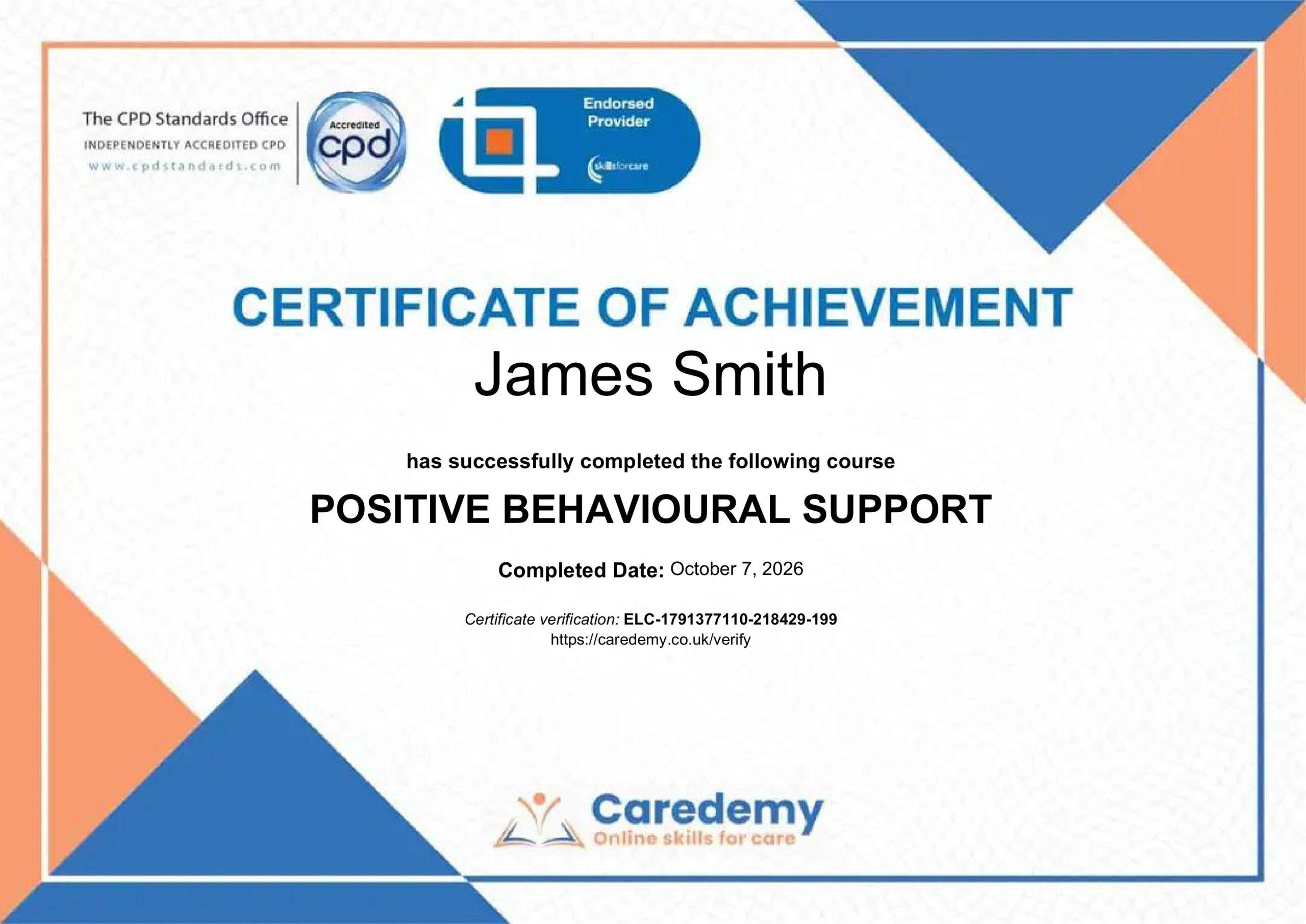
Instant Course Certificate
Is Positive Behavioural Support training a legal requirement in the UK?
There is no general UK law requiring every health or social care worker to complete a course specifically titled Positive Behavioural Support.
However, employers must ensure staff have the knowledge, skills and competence needed for their responsibilities.
In England, the Health and Social Care Act 2008 (Regulated Activities) Regulations 2014 establishes requirements covering person-centred care, safe care, protection from improper treatment and staff competence.
The Mental Capacity Act 2005 also provides important safeguards for decision-making involving adults who may lack capacity, including consideration of less restrictive options.
NICE guideline NG11 recommends appropriate staff training, supervision and proactive strategies when supporting people with learning disabilities whose behaviour challenges.
PBS training can therefore contribute to demonstrating suitable workforce development, but a short online course does not replace supervised practical training or specialist competence assessment.
Trusted by 120,000+ learners
Trusted by care providers, healthcare organisations, businesses and workplace teams across the UK for high-quality online training
Office & Commercial
Health & Social Care
Industrial, Warehousing & Facilities
Hospitality, Retail & Public Services
Positive Behavioural Support training FAQ?
What is Positive Behavioural Support (PBS)?
Positive Behavioural Support (PBS) is a person-centred, evidence-based approach that aims to improve quality of life while reducing behaviour that challenges.
It focuses on understanding why behaviour occurs, identifying unmet needs and making appropriate changes to support, communication and the environment. PBS combines assessment, proactive strategies and consistent support planning to promote independence, dignity and wellbeing.
Who needs Positive Behavioural Support training?
Positive Behavioural Support training is particularly relevant to care assistants, support workers, learning disability nurses, healthcare professionals, registered managers, teaching assistants and personal assistants.
It is beneficial for anyone supporting people with learning disabilities, autism or complex behavioural needs. Employers should determine the appropriate level of PBS training according to staff responsibilities, individual support requirements and workplace risks.
Is Positive Behavioural Support training mandatory in the UK?
Positive Behavioural Support training is not universally mandatory under UK law.
However, employers providing regulated care must ensure workers have appropriate training and competence to support individuals safely. In England, CQC regulations and NICE guidance are relevant to organisations supporting people whose behaviour challenges.
Employers may require PBS training as part of induction, specialist development or ongoing competency assessments.
How long does the Positive Behavioural Support course take?
The Positive Behavioural Support online course takes approximately one hour to complete.
Training is delivered online and can be completed at your own pace, with 12 months of course access.
After studying the learning materials, you complete a multiple-choice assessment requiring a 70% pass mark. Unlimited free resits are available, and a digital CPD certificate is provided following successful completion.
What is a Positive Behaviour Support Plan?
A Positive Behaviour Support Plan is an individualised document explaining how to improve a person’s quality of life, address unmet needs and respond safely to behaviour that challenges.
Plans may include identified triggers, communication preferences, environmental adjustments, proactive strategies and agreed responses to escalating distress.
Plans should be informed by assessment, developed with appropriate professional involvement and reviewed regularly to ensure they remain effective and suitable.
What is the difference between Positive Behavioural Support and behaviour management?
Traditional behaviour management may focus primarily on responding to or reducing particular behaviours.
Positive Behavioural Support takes a broader approach by examining why behaviour occurs and what changes may improve the person’s experience.
For example, rather than repeatedly responding to distress during personal care, PBS encourages staff to investigate possible causes, including discomfort, communication barriers or environmental factors, and adapt support accordingly.
How often should Positive Behavioural Support training be refreshed?
There is no universal statutory renewal period for Positive Behavioural Support training.
Employers should determine refresher intervals through risk assessment, staff responsibilities, supervision and individual support needs.
Additional training may be appropriate when a person’s behaviour changes, support plans are revised, incidents identify knowledge gaps or staff assume new responsibilities. Workers delivering specialist interventions may require regular observed competency assessments alongside theoretical refresher training.
Can I complete Positive Behavioural Support training online and receive a certificate?
Yes. This CPD-accredited Positive Behavioural Support course is completed entirely online, with instant access after enrolment.
Learners study the PBS framework, assessment approaches and relevant competencies before completing a multiple-choice assessment.
Successful learners receive an instant digital certificate worth one CPD point. The certificate demonstrates completion of introductory training but does not independently qualify someone to undertake specialist functional assessments or deliver restrictive interventions.
Need Training for Multiple Employees?
Train your entire workforce through Caredemy Teams with bulk enrolment, compliance reporting and access to 200+ CPD courses.
- CPD-accredited certificate
- Instant Certificate
- Learn of Any Device
- Money-back Guarantee
Related Courses You May Like


UK Regulations And Guidance

£15 + Vat
Positive Behavioural Support Course
- CPD Accredited
- Instant Certificate
- Instant Access
- Bulk Discounts Available