
- Home
- Health & Safety
- Disability Discrimination Course
Disability Discrimination Course
£15 + VAT


Written By Allison
- CPD Accredited | Instant Certificate | Mobile Friendly | Bulk Discounts Available
Trusted by care providers, healthcare organisations, businesses and workplace teams
This online Disability Discrimination Course explains how disability is defined, different models of disability, disability discrimination, inclusive communication, common barriers and disability-friendly workplaces. Learners develop practical knowledge for supporting disabled colleagues, patients, service users and customers while promoting equality and accessibility. The course is suitable for staff, managers and professionals across healthcare, social care and other workplace settings.
Disability Discrimination Course Summary
Course Name: Disability Discrimination Course
Duration: 1 Hour
Delivery: Online Training Course
Certificate Included: Instant Digital Certificate
Accreditation: CPD Accredited – 1 CPD Point
Suitable For: Healthcare, social care, HR, management, education, public services, customer-facing roles and wider workplace teams
Assessment: Online Multiple Choice Test
Access: Instant Access – 12 Months
Duration
1 hour
CPD Points
1
Last Updated:
25 Jul 2026
What is Disability Discrimination training?
Disability discrimination training helps learners recognise situations where disabled people may experience unfair treatment, disadvantage or barriers at work or when accessing services.
The Disability Discrimination Course examines how disability is defined, what may not fall within the legal definition of disability, different models used when discussing disability, discriminatory behaviour and the importance of appropriate communication and language.
Learners also explore practical ways to identify and overcome physical, organisational, communication and attitudinal barriers and contribute to a disability-friendly workplace.
The course supports awareness of the Equality Act 2010, which protects disabled people from discrimination in Great Britain and creates duties to make reasonable adjustments in relevant circumstances. It helps staff translate equality principles into everyday workplace decisions, communication and service delivery.
CPD Accredited
User friendly interactive courses
Instant Access
Enrol Now – Start Instantly
Certify Instantly
Certificate Available Immediately
Learn on Any Device
Train on Phone, Tablet or Computer
Money Back Guarantee
14 Day Money Back Guaratnee
How Would You Like to Access This Course?
Flexible options for individuals, staff teams and organisations
1
Instant Online Purchase
From 1 to 100+ learners • Bulk discounts available • Instant online access and certificates included
- Instant Access - No Quote Required
- CPD Accredited Certificates Included
- 100% Online & Mobile Friendly
- Assign Courses to Staff, Friends or Family
- Track Progress and Completions Online
- 14 Day Money Back Guarantee
£15 + VAT
CPD • Certificate included • Start instantly
Quantity
Per Course Price
1+ Courses
£15 + Vat
5+ Courses
£9.40 + Vat
10+ Courses
£8.49 + Vat
30+ Courses
£7.99 + Vat
50+ Courses
£6.49 + Vat
100+ Courses
£4.99 + Vat
2
Need Ongoing Staff Training?
Best value for teams of 8+ learners who need regular mandatory, induction and refresher training.
- Save Money on Staff Training
- Access Our Full 200+ Course Library
- Instant certificates issued
- Track Compliance Across Your Team
- Free Learner Replacements
- Reporting & Certificate Management
- CQC inspection ready
- Lowest price guarantee
- Dedicated Support
Best Price Guarantee • CQC Inspection Ready
When should I choose Caredemy Teams?
Caredemy Teams is ideal for organisations with 8+ learners who need access to multiple courses for mandatory training, induction training, and annual refreshers. Benefit from our best-value pricing, free learner replacements, compliance reporting, and access to our full course library. If you only need a small number of CPD courses, you can buy online instantly.
Access friendly, dedicated expert support whenever you need it, with guidance available throughout your learning journey
All-access individual subscription
Get unlimited access to 200+ CPD-accredited courses. One low monthly price. Learn anytime.
Buy any 5 courses for £47
Mix and max any courses.
CPD accredited - Certificates included.
Who Is This Course For?
The Disability Discrimination Course is suitable for employees and professionals who need to understand disability equality and inclusive working practices.
This includes healthcare assistants, care workers, nurses, support workers, social care staff, reception and administrative teams, HR professionals, managers, supervisors, EDI leads, compliance teams, health and safety professionals, educators, trainers, public service staff and customer-facing employees.
It is particularly relevant to people who recruit, manage or supervise staff, make workplace decisions, communicate with patients or service users, provide services to the public, or have responsibility for accessibility and inclusion.
The course can also be used for induction, refresher training and continuing professional development where disability discrimination awareness is relevant to the learner’s role.
Key Benefits
✓ Recognise disability discrimination and potentially discriminatory workplace practices
✓ Understand how disability is defined and the importance of individual circumstances
✓ Use respectful and inclusive disability-related language and communication
✓ Identify physical, communication, organisational and attitudinal barriers
✓ Apply practical approaches to creating a more disability-friendly workplace
✓ Support equality, accessibility and compliance with workplace responsibilities
Course Modules
- Promoting Understanding of Equality, Diversity, & Human Rights – Disability Discrimination – Course Introduction
- Defining Disability
- What is Not a Disability?
- Models for Referring to Disability
- Disability Discrimination
- Communication and Language
- Overcoming Barriers
- Disability Friendly Workplace
Ready to start?
Learning Outcomes
| Learner Outcome | Covered |
|---|---|
| Explain how disability can be defined | ✓ |
| Identify factors relevant to determining whether an impairment may meet the legal definition of disability | ✓ |
| Recognise circumstances that may fall outside the Equality Act definition of disability | ✓ |
| Describe different models used when referring to disability | ✓ |
| Identify examples of disability discrimination | ✓ |
| Recognise inappropriate or potentially discriminatory language | ✓ |
| Apply respectful approaches when communicating about disability | ✓ |
| Identify barriers that may disadvantage disabled people | ✓ |
| Explain practical approaches to overcoming workplace and service barriers | ✓ |
| Recognise how working practices can affect disabled employees and service users | ✓ |
| Identify ways to make workplaces more inclusive and accessible | ✓ |
| Apply disability-inclusive principles to everyday workplace situations | ✓ |
Training 8+ Staff Across Multiple Courses?
Purchasing multiple licences for this training course? Simply adjust the quantity and buy online today.
If you need ongoing training for 10+ employees across multiple subjects, our Team Training platform provides access to 200+ CPD accredited courses, compliance reporting, learner management and bulk enrolment tools.
- Access 200+ CPD Accredited Courses
- Manage All Learners In One Place
- Compliance & Audit Reporting
- Bulk Enrolment & Certificate Tracking
- Dedicated Account Support
Team Training Solutions
Ideal for care providers, healthcare organisations and workplace teams training multiple employees.
Why Choose Caredemy?
- Instant Certificate
- CPD-accredited courses
- Money Back Guarantee
- Expert-designed training
- 120,000 learners trained
- Flexible online learning
- Compliance-focused
- Dedicated support
What Our Learners Say?
“Clear explanations of disability discrimination and useful examples I could relate directly to my work.”
Rachel Foster
Care Coordinator
“Helped me think differently about barriers and how small workplace changes can improve inclusion.”
Mark Ellison
Team Leader
“Concise, practical training that clearly explained inclusive communication and disability-friendly working practices.”
Natalie Hughes
HR Administrator
4.81/5 from 66+ learners
Why Is Disability Discrimination training important?
Disability discrimination can affect recruitment, employment, communication, access to services and people’s ability to participate fully in everyday workplace activities.
Effective training helps staff recognise barriers and behaviours that could disadvantage disabled colleagues, patients, service users or customers. This includes considering physical accessibility, communication methods, workplace practices, assumptions and the language used when discussing disability.
For managers and employers, disability awareness also supports better decision-making around workplace adjustments, recruitment, training and staff management. Under the Equality Act 2010, employers must make reasonable adjustments where the relevant legal requirements are met to prevent disabled workers being placed at a substantial disadvantage. Legislation.gov.uk
The Disability Discrimination Course therefore supports professional competence, inclusive workplace standards, accessible services and more consistent application of equality principles.
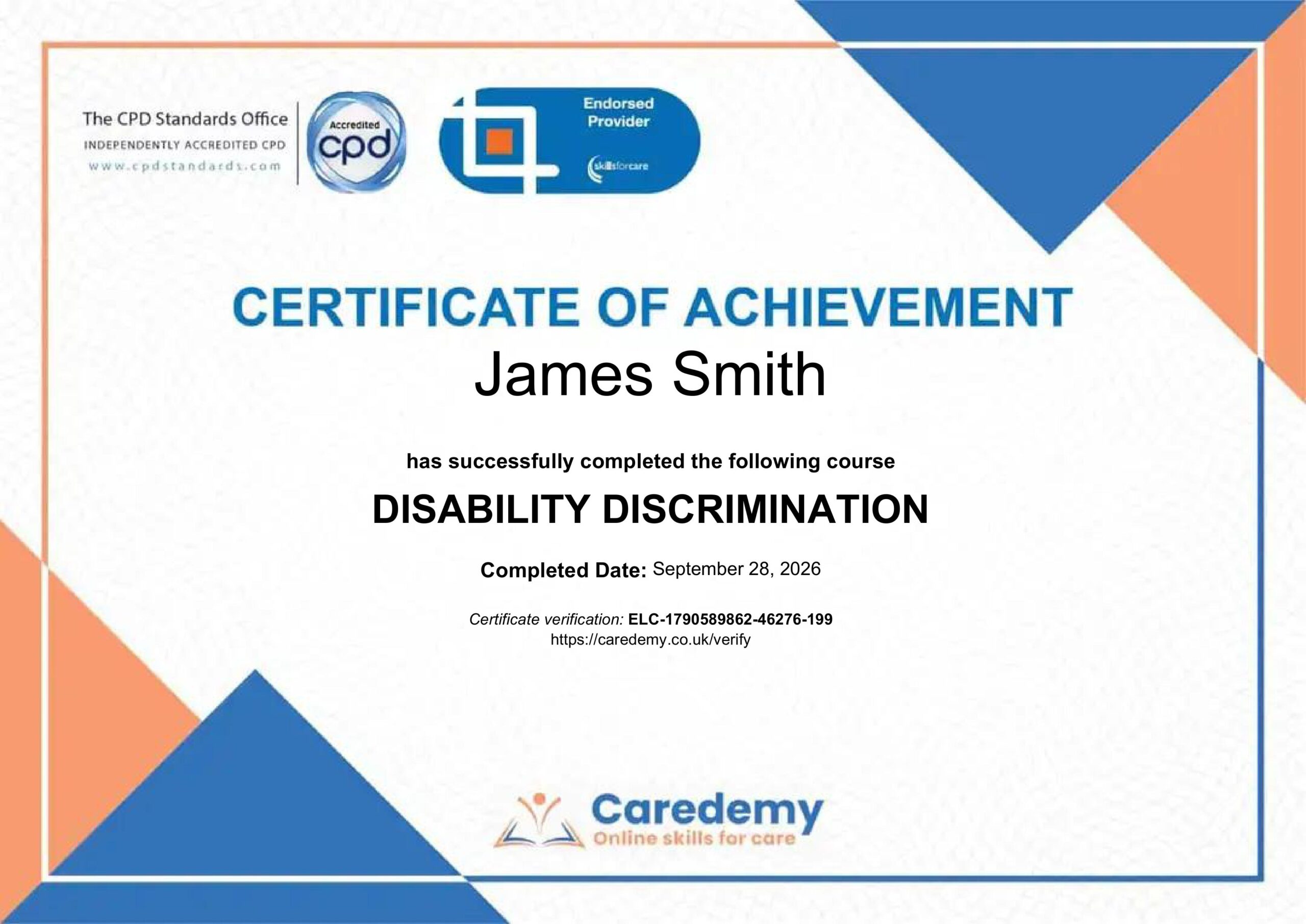
Instant Course Certificate
Is Disability Discrimination training a legal requirement in the UK?
There is no general legal requirement stating that every UK worker must complete a specific disability discrimination training course.
However, organisations have legal responsibilities relating to disability discrimination. In Great Britain, the Equality Act 2010 protects disabled people against unlawful discrimination in areas including employment and services. Employers also have a duty to make reasonable adjustments in circumstances covered by the Act. Legislation.gov.uk
Training can therefore form part of an organisation’s approach to helping staff understand and meet these responsibilities, reduce discriminatory practices and create accessible workplaces and services.
The Equality Act 2010 applies in England, Scotland and Wales, but not Northern Ireland. Northern Ireland has separate disability discrimination legislation.
Trusted by 120,000+ learners
Trusted by care providers, healthcare organisations, businesses and workplace teams across the UK for high-quality online training
Office & Commercial
Health & Social Care
Industrial, Warehousing & Facilities
Hospitality, Retail & Public Services
Disability Discrimination training FAQ?
What is disability discrimination?
Disability discrimination occurs when someone is treated unlawfully because of disability or experiences disadvantage in circumstances protected by equality law. The Equality Act 2010 includes different forms of prohibited conduct and also establishes duties concerning reasonable adjustments. Disability discrimination can arise in employment, recruitment and the provision of services, among other areas.
Who needs disability discrimination training?
Disability discrimination training is relevant to employees, managers and professionals who work with colleagues, patients, service users, customers or members of the public. It is particularly useful for HR teams, managers, healthcare and social care workers, educators, public service employees, customer-facing teams and anyone responsible for equality, accessibility or workplace practices.
Is disability discrimination training a legal requirement?
There is no blanket UK law requiring every employee to complete a named disability discrimination training course. However, employers and service providers have important legal duties concerning disability discrimination. In Great Britain, these primarily arise under the Equality Act 2010. Appropriate staff training can help organisations demonstrate practical steps towards meeting their equality responsibilities.
How does the Equality Act 2010 define disability?
Under the Equality Act 2010, a person is generally disabled if they have a physical or mental impairment that has a substantial and long-term negative effect on their ability to carry out normal day-to-day activities. Specific provisions apply to certain progressive, recurring and fluctuating conditions.
What are reasonable adjustments for disabled employees?
Reasonable adjustments are changes intended to prevent a disabled person being placed at a substantial disadvantage. Depending on the circumstances, workplace examples can include altering working hours, adapting equipment, changing aspects of working arrangements or providing additional support. What is considered reasonable depends on the individual circumstances.
How long does the Disability Discrimination Course take?
The Caredemy Disability Discrimination Course takes approximately 1 hour to complete. It contains eight course modules covering the definition and models of disability, disability discrimination, communication and language, overcoming barriers and creating a disability-friendly workplace. Learners can complete the online training at their own pace.
How often should disability discrimination training be refreshed?
There is no universal statutory refresher interval for disability discrimination training. Employers should determine refresher frequency according to staff roles, organisational policies, identified training needs and changes in legislation or workplace practices. Refresher training may also be appropriate following incidents, complaints or identified gaps in staff knowledge.
What does a disability-friendly workplace look like?
A disability-friendly workplace considers accessibility, communication, workplace practices and individual needs rather than assuming everyone works or accesses services in the same way. Practical measures can include removing unnecessary barriers, considering reasonable adjustments, using inclusive communication, providing accessible information and ensuring recruitment, training and progression practices do not unlawfully disadvantage disabled people.
Need Training for Multiple Employees?
Train your entire workforce through Caredemy Teams with bulk enrolment, compliance reporting and access to 200+ CPD courses.
- CPD-accredited certificate
- Instant Certificate
- Learn of Any Device
- Money-back Guarantee
Related Courses You May Like


UK Regulations And Guidance
£15 + Vat
Disability Discrimination Course
- CPD Accredited
- Instant Certificate
- Instant Access
- Bulk Discounts Available