
- Home
- Health & Safety
- Fire Safety in Domiciliary Care – Level 2 Course
Fire Safety in Domiciliary Care – Level 2
£15 + VAT


Written By Allison
- CPD Accredited | Instant Certificate | Mobile Friendly | Bulk Discounts Available
Trusted by care providers, healthcare organisations, businesses and workplace teams
Fire Safety in Domiciliary Care – Level 2 teaches care workers how to recognise and respond to fire risks in people’s homes. Learners explore ignition sources, smoke, oxygen therapy, emollients, hoarding, mobility and cognitive risks, smoke alarms, escape routes and emergency action. The course supports safer, person-centred care by helping staff identify changing risks, take appropriate action and report concerns before they result in harm.
Fire Safety in Domiciliary Care – Level 2 Online Training Course Summary
Course Name: Fire Safety in Domiciliary Care – Level 2
Duration: 2 Hours
Delivery: Online Training Course
Certificate Included: Instant Digital Certificate
Accreditation: CPD Accredited
Suitable For: Domiciliary care workers, home care staff, support workers, senior carers, care coordinators, supervisors and managers
Assessment: Online Multiple Choice Test
Access: Instant Access
Duration
2 hours
CPD Points
2
Last Updated:
18 Sep 2026
What is Fire Safety in Domiciliary Care – Level 2 training?
Fire Safety in Domiciliary Care – Level 2 is specialist fire safety training for staff who provide care and support in people’s own homes.
Unlike general workplace fire safety training, it addresses risks commonly encountered during home visits, including smoking, cooking, portable heaters, overloaded electrical equipment, oxygen therapy, emollient products, hoarding and obstructed escape routes.
Learners explore how fire develops and spreads, why smoke and toxic gases are dangerous, and how mobility difficulties, dementia and sensory impairments can affect a person’s ability to recognise or escape a fire.
The course also develops practical knowledge of person-centred fire risk, smoke alarms, escape routes, home fire safety visits, emergency action and appropriate escalation.
It helps care workers identify risks while respecting that they are working in another person’s home and remaining within their professional role.
CPD Accredited
User friendly interactive courses
Instant Access
Enrol Now – Start Instantly
Certify Instantly
Certificate Available Immediately
Learn on Any Device
Train on Phone, Tablet or Computer
Money Back Guarantee
14 Day Money Back Guaratnee
How Would You Like to Access This Course?
Flexible options for individuals, staff teams and organisations
1
Instant Online Purchase
From 1 to 100+ learners • Bulk discounts available • Instant online access and certificates included
- Instant Access - No Quote Required
- CPD Accredited Certificates Included
- 100% Online & Mobile Friendly
- Assign Courses to Staff, Friends or Family
- Track Progress and Completions Online
- 14 Day Money Back Guarantee
£15 + VAT
CPD • Certificate included • Start instantly
Quantity
Per Course Price
1+ Courses
£15 + Vat
5+ Courses
£9.40 + Vat
10+ Courses
£8.49 + Vat
30+ Courses
£7.99 + Vat
50+ Courses
£6.49 + Vat
100+ Courses
£4.99 + Vat
2
Need Ongoing Staff Training?
Best value for teams of 8+ learners who need regular mandatory, induction and refresher training.
- Save Money on Staff Training
- Access Our Full 200+ Course Library
- Instant certificates issued
- Track Compliance Across Your Team
- Free Learner Replacements
- Reporting & Certificate Management
- CQC inspection ready
- Lowest price guarantee
- Dedicated Support
Best Price Guarantee • CQC Inspection Ready
When should I choose Caredemy Teams?
Caredemy Teams is ideal for organisations with 8+ learners who need access to multiple courses for mandatory training, induction training, and annual refreshers. Benefit from our best-value pricing, free learner replacements, compliance reporting, and access to our full course library. If you only need a small number of CPD courses, you can buy online instantly.
Access friendly, dedicated expert support whenever you need it, with guidance available throughout your learning journey
All-access individual subscription
Get unlimited access to 200+ CPD-accredited courses. One low monthly price. Learn anytime.
Buy any 5 courses for £47
Mix and max any courses.
CPD accredited - Certificates included.
Who Is This Course For?
Fire Safety in Domiciliary Care – Level 2 is designed for employees who provide care, treatment or support in people’s own homes and need practical knowledge of home fire risks.
It is suitable for domiciliary care workers, home care assistants, healthcare assistants, support workers, personal assistants, community care staff, senior carers, care coordinators, field care supervisors, team leaders and registered managers.
The course is particularly relevant to workers supporting people who smoke, use home oxygen or emollient products, have limited mobility, live with dementia or sensory impairment, or have hoarding behaviours that may increase fire risk.
It is also appropriate for employees expected to recognise environmental hazards during home visits, report changes in risk and contribute information to care planning or fire risk management.
Key Benefits
✓ Recognise fire hazards specific to domiciliary and home care environments
✓ Identify people whose health, behaviour or circumstances may increase fire risk
✓ Understand additional risks associated with smoking, oxygen and emollient products
✓ Recognise problems with smoke alarms, electrical equipment and escape routes
✓ Respond safely if a fire occurs without putting yourself at unnecessary risk
✓ Report and escalate fire safety concerns to support effective risk management
Course Modules
- Welcome
- Learning Outcomes
- Why Fire Safety Matters
- Fire Safety in Domiciliary Care
- Responsibilities
- Legislation and Regulation
- The Fire Triangle
- How Fire Spreads
- Smoke and Toxic Gases
- Recognising Fire Hazards
- Electrical Safety and White Goods
- Cooking, Heaters and Naked Flames
- Smoking
- Oxygen Therapy
- Emollient Products
- Hoarding and Clutter
- People at Increased Risk
- Mobility, Dementia and Sensory Impairment
- Fire Risk Assessment
- Changes in Risk
- Smoke Alarms and Escape Routes
- Home Fire Safety Visits
- If You Discover a Fire
- Personal Safety and Calling 999
- Evacuation
- Fire Extinguishers
- Fire Blankets and Practical Competence
- Reporting and Escalating Concerns
- Scenario: Smoking and Oxygen
- Scenario: Escape Route and Kitchen Fire
- Key Points and Course Completion
Ready to start?
Learning Outcomes
| Learner Outcome | Covered |
|---|---|
| Explain why fire safety presents particular challenges in domiciliary care | ✓ |
| Describe how the fire triangle contributes to starting and sustaining a fire | ✓ |
| Explain how fire, smoke and toxic gases can spread through a home | ✓ |
| Identify common electrical, cooking, heating and naked-flame fire hazards | ✓ |
| Recognise increased fire risks associated with smoking | ✓ |
| Explain why oxygen therapy can significantly increase the consequences of a fire | ✓ |
| Identify the fire risks associated with emollient-contaminated clothing, bedding and dressings | ✓ |
| Recognise how hoarding and clutter can increase fire and escape risks | ✓ |
| Identify how mobility, dementia and sensory impairment may affect a person’s fire safety | ✓ |
| Contribute relevant observations to person-centred fire risk assessment and review | ✓ |
| Recognise changes in circumstances that may require fire risks to be reassessed | ✓ |
| Identify concerns involving smoke alarms and escape routes | ✓ |
| Explain when a home fire safety visit or specialist advice may be appropriate | ✓ |
| Apply appropriate actions when discovering a fire in a person’s home | ✓ |
| Explain the importance of personal safety, raising the alarm and calling 999 | ✓ |
| Recognise the limitations of their role when considering evacuation and firefighting equipment | ✓ |
| Report and escalate fire safety concerns appropriately | ✓ |
| Apply fire safety principles to realistic domiciliary care scenarios | ✓ |
Training 8+ Staff Across Multiple Courses?
Purchasing multiple licences for this Fire Extinguisher Training course? Simply adjust the quantity and buy online today.
If you need ongoing training for 10+ employees across multiple subjects, our Team Training platform provides access to 200+ CPD accredited courses, compliance reporting, learner management and bulk enrolment tools.
- Access 200+ CPD Accredited Courses
- Manage All Learners In One Place
- Compliance & Audit Reporting
- Bulk Enrolment & Certificate Tracking
- Dedicated Account Support
Team Training Solutions
Ideal for care providers, healthcare organisations and workplace teams training multiple employees.
Why Choose Caredemy?
- Instant Certificate
- CPD-accredited courses
- Money Back Guarantee
- Expert-designed training
- 120,000 learners trained
- Flexible online learning
- Compliance-focused
- Dedicated support
What Our Learners Say?
“The smoking, oxygen and emollient sections highlighted risks I now specifically look for during home visits.”
Karen Walsh
Domiciliary Care Worker
“Very relevant to home care. The scenarios made it clear when a fire risk needs escalating rather than simply recording.”
Nathan Brooks
Field Care Supervisor
“The section on dementia, mobility and escape planning helped me think about fire safety from the service user’s perspective.”
Aisha Rahman
Senior Care Assistant
0/5 from 0+ learners
Why Is Fire Safety in Domiciliary Care – Level 2 training important?
Fire risks can be particularly serious for people receiving care at home because illness, reduced mobility, dementia, sensory impairment or medication may affect their ability to recognise danger or escape independently.
Domiciliary care workers are often well placed to notice hazards such as damaged electrical equipment, unsafe smoking, obstructed escape routes, unsuitable heaters or changes in a person’s ability to respond to an emergency.
Some care-related factors create additional risks. Oxygen can accelerate combustion, while emollient residue that builds up on clothing, bedding or dressings can make fabrics ignite more easily and burn rapidly.
Effective Level 2 training helps workers recognise these combined risks, respond appropriately and escalate concerns so suitable control measures can be considered.
It also reinforces an essential principle: personal safety comes first. Care workers should know what to do during a fire without placing themselves in danger by attempting actions beyond their training or competence.
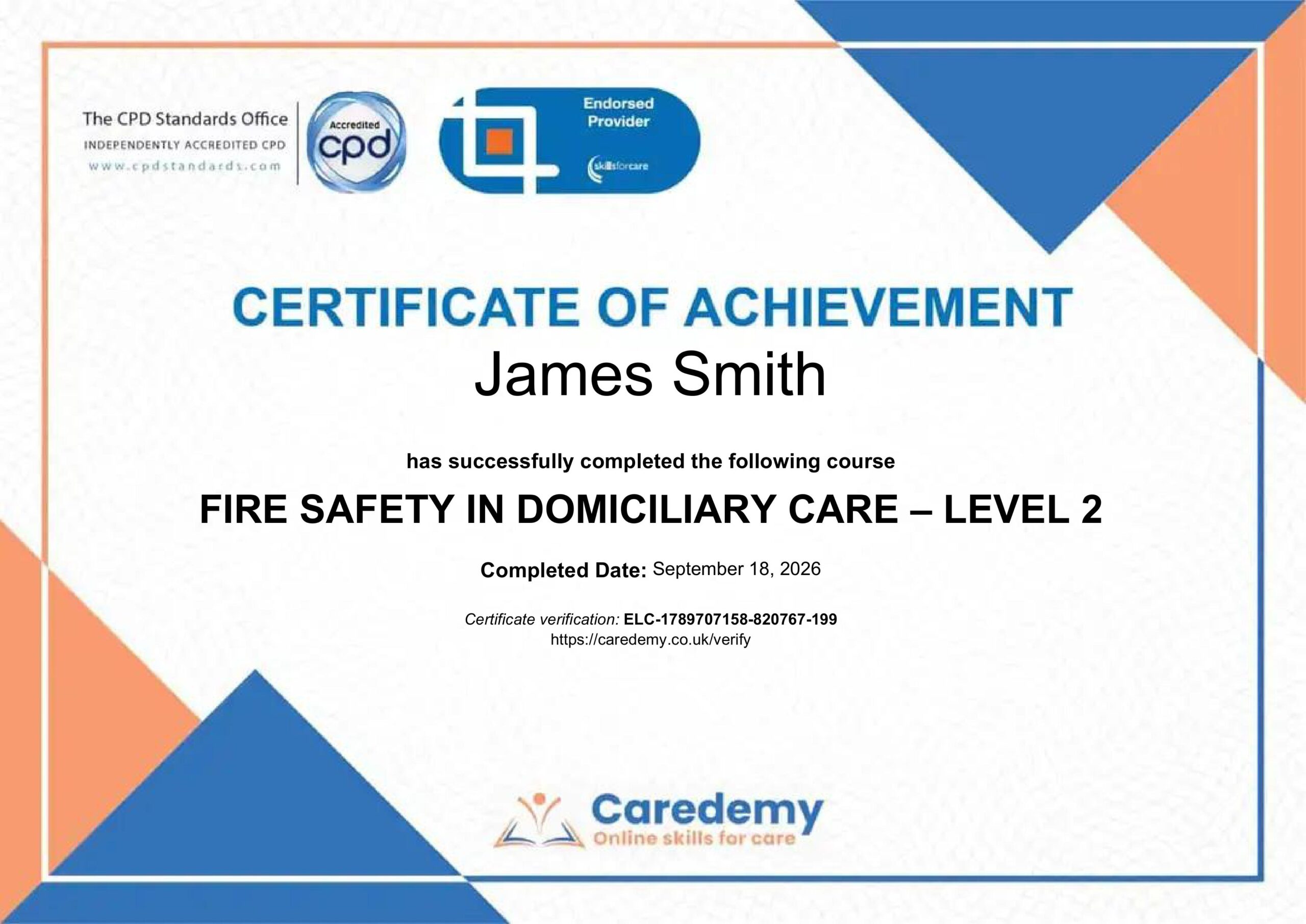
Instant Course Certificate
Is Fire Safety in Domiciliary Care – Level 2 training a legal requirement in the UK?
There is no UK law requiring domiciliary care workers to hold a certificate specifically called Fire Safety in Domiciliary Care Level 2.
In England, however, regulated care providers must deliver care safely. Regulation 12 of the Health and Social Care Act 2008 (Regulated Activities) Regulations 2014 requires providers to assess risks to service users’ health and safety and do what is reasonably practicable to mitigate them.
The Regulatory Reform (Fire Safety) Order 2005 is also central to workplace fire safety in England and Wales, although its application to domestic premises differs from its application to workplaces and communal areas.
Employers should therefore assess their fire safety training needs according to employees’ roles and the risks they encounter.
For domiciliary care workers, appropriate training can help demonstrate that staff have the knowledge and competence required to identify hazards, respond safely and report concerns affecting people receiving care.
Trusted by 120,000+ learners
Trusted by care providers, healthcare organisations, businesses and workplace teams across the UK for high-quality online training
Office & Commercial
Health & Social Care
Industrial, Warehousing & Facilities
Hospitality, Retail & Public Services
Fire Safety in Domiciliary Care – Level 2 training FAQ?
What is Fire Safety in Domiciliary Care Level 2 training?
Fire Safety in Domiciliary Care Level 2 is specialist training for staff providing care in people’s homes. It covers how fires start and spread, common domestic hazards, vulnerable individuals, smoking, oxygen, emollients, hoarding, fire risk assessment, smoke alarms, escape routes, emergency action and reporting fire safety concerns.
Who needs fire safety training in domiciliary care?
Domiciliary care workers should receive fire safety training appropriate to their responsibilities and the risks they may encounter. This can include care assistants, support workers, senior carers, personal assistants, care coordinators and supervisors. Level 2 training is particularly useful where staff need to identify and escalate individual fire risks during home visits.
Is Fire Safety in Domiciliary Care Level 2 a legal requirement?
There is no universal legal requirement to hold a certificate specifically called Fire Safety in Domiciliary Care Level 2. However, care providers have responsibilities to assess and manage risks to people receiving care and ensure staff have suitable competence, skills and knowledge. Fire safety training can form an important part of meeting these responsibilities.
Why is home oxygen a fire risk?
Oxygen itself does not burn, but an oxygen-enriched environment can make other materials ignite more readily and cause fires to burn more intensely. Smoking, naked flames and other ignition sources are therefore particularly dangerous around oxygen equipment. Care workers should follow the person’s care arrangements and organisational procedures and report unsafe practices or new risks promptly.
Why are emollient creams a fire safety concern?
Emollients can build up on clothing, bedding, dressings and other fabrics. These residues can increase the risk of severe or fatal burns if the material comes into contact with cigarettes, naked flames or another ignition source. The risk is associated with both paraffin-containing and some paraffin-free products, so appropriate fire safety precautions are essential.
What should a domiciliary care worker do if they identify a fire hazard?
Take action that is safe, appropriate and within your role. Immediate dangers may require urgent action, while other concerns should be recorded and reported according to organisational procedures. Significant changes in a person’s fire risk may require review of their care arrangements, risk assessment or referral for specialist fire safety advice.
What should a care worker do if they discover a fire in someone's home?
Raise the alarm, call 999 and follow the person’s emergency and evacuation arrangements where these are known and it is safe to do so. Do not put yourself at unnecessary risk or attempt firefighting beyond your training and competence. Getting yourself and others to safety takes priority over protecting property or tackling the fire.
Can domiciliary care workers use fire extinguishers or fire blankets?
Workers should only use firefighting equipment where organisational procedures permit it, they have received appropriate practical training and it is safe to do so. Fire extinguishers and blankets are not substitutes for raising the alarm and escaping. Online training provides underpinning knowledge but should not be treated as evidence of practical competence in using firefighting equipment.
Need Training for Multiple Employees?
Train your entire workforce through Caredemy Teams with bulk enrolment, compliance reporting and access to 200+ CPD courses.
- CPD-accredited certificate
- Instant Certificate
- Learn of Any Device
- Money-back Guarantee
Related Courses You May Like
UK Regulations And Guidance
£15 + Vat
Fire Safety in Domiciliary Care – Level 2 Course
- CPD Accredited
- Instant Certificate
- Instant Access
- Bulk Discounts Available
- CPD-accredited certificate
- Instant Certificate
- Learn of Any Device
- Money-back Guarantee